
Estimated reading time: 12 minutes
The Lipsey’s S&W 632 puts six rounds of .32 H&R Magnum into a 13-ounce J-frame that nearly disappears in a pocket. It shoots accurately, carries easily, and delivers more authority than its small caliber reputation suggests.

Table of contents
The S&W 632 Gives the Little .32 More Bite
The .32 has never really been considered a serious defense round. For most shooters, it has occupied get-off-of-me territory. The .32 H&R Magnum is a bit more. It brings more velocity and more energy. It’s like the .32 S&W finally grew into its own.
Chambering the caliber in S&W’s Model 632 J-frame adds something especially useful: more capacity paired with controllable power. The result is a lightweight, six-shot concealed carry revolver that offers a practical middle ground between mild pocket-pistol cartridges and the fast, sharp punishment of a lightweight .357 Magnum.
How the .32 H&R Magnum Grew Out of an Anemic Pocket Round
The .32 S&W, also known as the .32 S&W Short, was popular back in the late 19th century as a pocket-pistol caliber. Introduced in 1878, the caliber is still in production today. With an 85-grain bullet pushed at 680 fps at the muzzle, saying the caliber is anemic is being nice.
In 1896, S&W introduced the .32 S&W Long. That same 85-grain round-nose lead bullet increased muzzle velocity to about 732 fps. Back then, it was a big deal, and I can tell you are thoroughly impressed.
To put it into perspective, the Nagant M1895 revolver was chambered in 7.62x39mm, which is very similar to the .32 S&W Long. The Nagant revolver and caliber were used well into the mid 20th century. So, to say the .32 is puny and weak is one thing, but you have to admit the caliber has stamina.

Just when you thought the .32 caliber was fading away to its final resting place, a listing in an obsolete chapter of Cartridges Of The World, H&R and Federal brought it back to life. H&R, a now defunct US firearm manufacturer, teamed up with the ammunition maker to release the .32 H&R Magnum.
That same 85-grain bullet is now clocking about 1,263 fps. Now that’s an increase in speed. The .32 H&R Magnum offers high velocity with lightweight bullets and relatively low recoil. Federal upped the ante again in 2007 by introducing the .327 Federal Magnum, but that’s a different story.
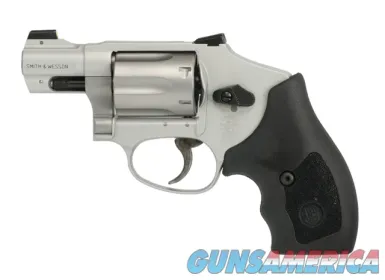
Lipsey’s S&W 632 Packs Six Shots Into a Featherweight J-Frame
Lipsey’s teamed up with Smith & Wesson to produce the Model 632, touted as “the ultimate carry revolver.” It is lightweight and has no lock. Not having a lock must keep the A2 xenophobes up at night. I like to think gun owners have common sense, and if you don’t want someone to have access to your gun, you will make sure they don’t have access to your gun.

Unloaded, the S&W 632 H&R Mag weighs about 13 ounces. Loaded, it weighs about one pound. In my opinion, the J-frame is one of the most practical defense revolvers ever produced because of its size-to-power ratio and its ability to conceal easily.
The Model 632 has all those attributes, plus it adds an additional round. Most centerfire J-frames have a five-round capacity. The 632 gives you six.
In hand, the 632 is a featherweight because the frame is aluminum, the cylinder is titanium, and the steel barrel is slipped into an aluminum sleeve. I think some cell phones are heavier and larger than the 632.
The S&W Model 632 also features a Hamre Forge AFR UnderCover G10 grip that fills the palm of your hand. It gives this tiny revolver more gripping surface without turning it into something that feels bulky or difficult to conceal.

Hammerless Design and Serious Sights Make the 632 Carry-Ready
The S&W 632 uses a hammerless design, meaning the hammer is encased in the frame. There is no exposed hammer spur to snag if you carry the revolver in your pocket. This also means it is double action only.
The sights are nearly perfect for defense work. The front sight is an XS Sights green ring with a Tritium dot. It is big and large and puts you in charge because that bright front sight is a snap to find.
The rear sight is dovetailed into the frame and fixed in place. It uses a deep U-notch that makes the visual equation simple: drop the dot into the notch and press the trigger. I also like that the user-facing edge of the rear sight is serrated to cut glare. These are nice sights for close work.

Hamre Forge G10 Grips Put More Revolver in Your Hand
The Hamre Forge grip allows for a high hold, fills your palm with a palm swell, and lets the revolver point naturally. Its texture is relatively smooth, so there is less chance of snagging when carrying the S&W 632 in a pocket.
The high grip also helps control recoil. I used the Hamre Forge AFR UnderCover grip for testing. There is no give in the grip because it is made of G10, but it fills the hand and spreads felt recoil across more of your palm. That is preferable to concentrating recoil in a smaller area, as some compact grips do.
A set of S&W rubber grips is also included. Those grips are slightly smaller, giving owners another option if maximum concealability matters more than filling the hand.
S&W and Lipsey’s chose to equip the 632 with the XS Sights green-ring Tritium front sight, which is large and made for close-up work. The 632 is also upgraded from the typical J-frame with what S&W calls an “Endurance Package” that improves performance and durability.
I’m not sure exactly what that means, but the trigger pull averages about 11 pounds and feels much lighter. The trigger stroke is smooth and quick, with no stacking.

S&W 632 Range Test: Tamer Than a Lightweight .357 Magnum
As much as I like lightweight J-frames, I hate the recoil from those chambered in 357 Magnum. That whole inertia thing involving equal and opposite reactions comes into play. You know what I mean if you have touched off an aluminum J-frame stoked with hot 357 Magnum. The recoil impulse is fast and sharp.
With the .32 H&R Mag, recoil is much tamer. You can still feel it, but the impulse is less sharp. The Hamre Forge grips help mitigate and spread out the recoil. Don’t get me wrong, you will notice the recoil, but you won’t be wringing your hands after a few shots.

Fiocchi .32 Special Accuracy: Mild, Precise, and Decaffeinated
I stoked up the 632 with .32 Special ammunition first, namely Fiocchi loaded with a 97-grain FMJ bullet. I used my range bag as a rest and fired for accuracy at 10 yards.
The Fiocchi produced a best 5-shot group of 1.0 inches and averaged 1.08 inches. In my experience, .32 calibers can be accurate. The Fiocchi ammunition, however, generated only 738 fps muzzle velocity and 117 ft-lb. of energy. I think of this round as decaffeinated.
Hornady Critical Defense Adds Speed Without Getting Nasty
Hornady’s Critical Defense .32 H&R Mag uses an 80-grain FTX bullet. Muzzle velocity averaged 979 fps, which translates to 170 ft-lb. of energy.
My best group measured 1.4 inches and averaged 1.7 inches. That is not bad for a DAO revolver with a 1.8-inch barrel, especially one designed to ride in a pocket rather than dominate a bullseye match.
Buffalo Bore +P Turns the S&W 632 Fully Caffeinated
Next up in the juice department was Buffalo Bore .32 H&R Mag +P loaded with a 100-grain JHP. Muzzle velocity averaged 1090 fps, and energy was 264 ft-lb. Now we are talking about a defense load.
The best group measured 1.1 inches, and the average was 1.5 inches. Recoil with the Buffalo Bore ammunition was noticeably stronger. I wouldn’t advise letting a newbie use it unless you want them to grow a distinct flinch with DAO revolvers.
Let new shooters start with .32 Special ammunition, which is much milder. The Fiocchi is decaffeinated. The Buffalo Bore load is definitely caffeinated.
Remember, the 632 weighs only 13 ounces, and the energy from the bullet goes straight back into your hand. The grip helps, but physics is still physics.

Fast Defensive Drills Expose One S&W 632 Weakness
Shooting for speed on USPSA targets at 7 yards, I ripped through a box of .32 Specials to get acclimated to the 632. The Hamre grip allows for a high hold, and the large sights are fast on target.
I squeezed off shots as fast as I could, unloading cylinderfuls at a time. Moving to the Hornady and Buffalo Bore loads required more effort to control recoil, but the revolver remained manageable.
I also performed the Failure Drill with two quick shots to center of mass and one to the head. Staging the DAO trigger for the more surgical head shot was very doable with the 632. There were no functional issues while firing.
Extraction was less perfect. A few of the Buffalo Bore cases stuck in the chambers, and I needed to push the ejector rod against the wood bench top to eject the empties. The short ejector rod also needs some gravity assistance if you want to shuck cases quickly.
S&W Model 632 .32 H&R Magnum Specifications
[ga_price_button id=”[ItemID]” text=”Check Price on GunsAmerica”]
| Model | Smith & Wesson Model 632 |
|---|---|
| Caliber | .32 H&R Magnum |
| Action | Double action only |
| Barrel Length | 1.8 inches |
| Unloaded Weight | About 13 ounces |
| Loaded Weight | About one pound |
| Capacity | Six rounds |
| Frame | Aluminum |
| Cylinder | Titanium |
| Barrel Construction | Steel barrel slipped into an aluminum sleeve |
| Front Sight | XS Sights green ring with Tritium dot |
| Rear Sight | Fixed, dovetailed deep U-notch |
| Test Grip | Hamre Forge AFR UnderCover G10 |
| Trigger Pull | About 11 pounds |
| MSRP | Not provided in the source article |
Is the S&W 632 Worth Carrying for Personal Defense?

It is summer in NC, and that means cargo shorts and T-shirts. I carried the 632 in a Galco StukOn-U pocket holster along with a Tuff Quick Strip that holds eight cartridges. I like Tuff Quick Strips because they lay flat in your pocket.
The 632 weighs about a pound loaded, and I don’t notice it. That is exactly what a pocket revolver should do. It should be present when needed without constantly reminding you that it is there.
Do I feel undergunned? Not in the least. Is it an odd caliber? Sure, but the extra round capacity provides peace of mind. The .32 H&R Magnum also gives the shooter a useful range of ammunition, from mild .32 Special loads for practice to noticeably hotter defensive loads.
The S&W 632 is not a miniature service pistol, and it does not pretend to be one. It is a lightweight, snag-free, six-shot J-frame with excellent close-range sights, a smooth DAO trigger, and recoil that remains more manageable than a lightweight 357 Magnum.
Its short ejector rod and occasional sticky Buffalo Bore cases deserve attention, but they do not erase what the revolver does well. For discreet summer carry, pocket carry, or shooters who want more capacity without moving to a semiautomatic, the Lipsey’s S&W 632 makes a strong case for the little .32.
S&W 632 Pros and Cons: Tiny Carry Gun, Real Tradeoffs
- Pros: Six-round capacity, about 13-ounce unloaded weight, manageable .32 H&R Magnum recoil, smooth DAO trigger, highly visible XS Sights front sight, deep U-notch rear sight, snag-free enclosed hammer, accurate performance at 10 yards, and excellent pocket-carry dimensions.
- Cons: Short ejector rod does not fully eject cases, hotter Buffalo Bore ammunition produces noticeably more recoil, some Buffalo Bore cases stuck in the chambers, G10 grips provide no cushioning, and .32 H&R Magnum remains an uncommon caliber.
Related Reads from GunsAmerica Digest
- Lipsey’s Ultimate Snub and the Return of .32 H&R Magnum
- Ruger LCR .32 H&R Magnum Review
- S&W 940 Review: A 9mm J-Frame That Runs Hard
- Charter Arms Professional 7-Shot .32 H&R Magnum Review
Available on GunsAmerica Now

Robert A. Sadowski is an American writer and journalist.
He has written about firearms and 2A issues for decades, and has trained with some of the country’s finest firearm instructors in handguns, rifles/carbines, shotguns and long-range shooting. He has also had the opportunity to interview numerous individuals deeply involved in protecting our 2nd Amendment.
He a is a frequent contributor to numerous gun-enthusiast publications, a few of which include:
- TheArmorylife.com
- TheTruthAboutGuns.com
- GunsAmerica.com
- GunBroker.com
- Gun-Tests.com
- Shooting Illustrated
- SHOT Business
- Gun Digest
Sadowski is also the author of numerous gun books, including: “9MM — Guide to America’s Most Popular Caliber” and “Book Of Glock,” both of which were #1 new releases on Amazon. He also wrote the popular DIY gun book series: Shooter’s Bible Guide to Firearms Assembly, Disassembly, and Cleaning Volume 1 and Volume 2. Other gun books authored by Sadowski include “50 Guns That Changed the World,” and edited “The M16A1 Rifle: Operation and Preventive Maintenance”originally published by the U.S. Department of the Army. He also edits the annual “Gun Trader’s Guide” to firearm values.
Sadowski is also the Treasurer/Secretary of the GLOCK Collectors Association, a non-profit organization with the mission to educate and preserve: Educate the public on the models, variations, and commemoratives built by GLOCK, as well as provide members with information on GLOCK serial numbers, importation, and other facts unique to GLOCK pistols.
7.62×39 is a rifle cartridge. Nagant M1895 revolver uses 7.62x38mmR.
Being a died in the wool S&W fanboy, I always loved the little J frame guns and wish I had the Chief Special that my father carried to work every day on the railroad to stave off the criminals that were breaking into the boxcars and assaulting employees, as he’s actually had to use it several times to keep the ghetto trash at bay!
Very accurate little gun that you could draw and fire from the pocket in an instant, perfect for short range defense when loaded with Hornaday meat mashers!
There is no .32 Special handgun cartridge.
There IS a .32 Special rifle cartridge, but it is similar in overall size to the .30-30.
I like my Undercoverette.
Hello,
What, precisely, is the “.32 Special” ammunition referred to repeatedly in the article? If the author was referring to the .32 Smith and Wesson Long, I have never, ever heard the .32 Smith and Wesson Long referred to as “.32 Special.”