
Estimated reading time: 13 minutes
The 22 Creedmoor launches heavy .224 bullets fast, shoots brutally flat, bucks wind, and delivers almost no recoil. This former wildcat has become a serious option for predators, PRS competition, long-range steel, and even deer-sized game.
Table of contents
- How the 22 Creedmoor Escaped Wildcat Status
- 22 Creedmoor Development: From Necked-Down Brass to SAAMI
- 22 Creedmoor Brass, Dies, and Factory Ammunition
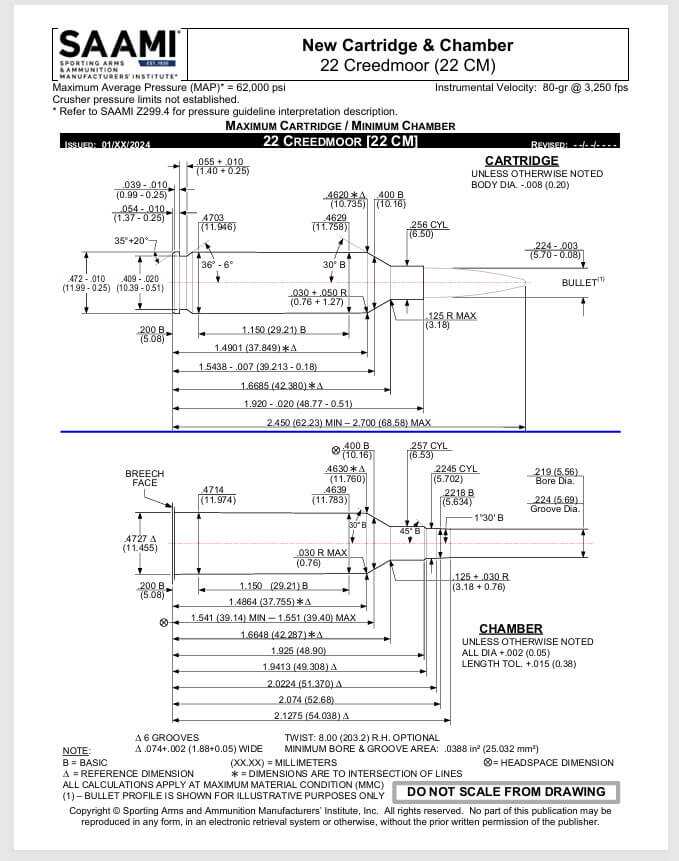
- 22 Creedmoor Cartridge Specifications
- 22 Creedmoor Ballistics: Flat, Fast, and Wind Defying
- Almost No Recoil Makes the 22 CM Addictive
- One 22 Creedmoor Rifle Built for Three Jobs
- 22 Creedmoor PRS Performance at 1,000 Yards
- Can the 22 Creedmoor Cleanly Take Deer?
- 22 Creedmoor Ballistics Compared at 1,000 Yards
- Why Energy Numbers Never Tell the Whole Story
- 22 Creedmoor Barrel Life Is the Lingering Question
- Pros and Cons of the 22 Creedmoor
- The Verdict: Was the 22 Creedmoor Build Worth It?
- Related Reads From GunsAmerica Digest
How the 22 Creedmoor Escaped Wildcat Status
As soon as any new cartridge hits the mainstream market, handloaders start tinkering with it and making wildcat variations. The now super popular Hornady 6.5 Creedmoor case is no exception to that rule. The first of those wildcats to make it to the big league was the 6mm CM, but there is another one that quickly gained widespread popularity: the 22 Creedmoor, aka 22 Creed.
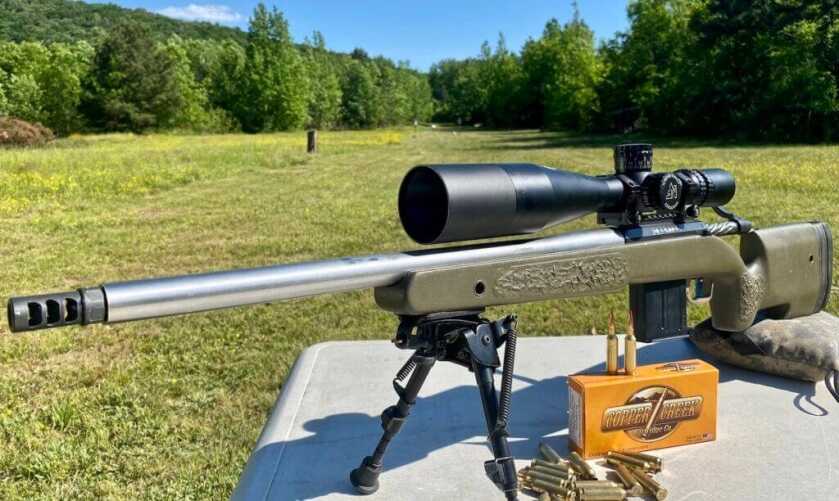
Revisiting the 22 CM: No longer a wildcat! This article originally ran during the summer of 2020, before SAAMI recognized the 22 Creed. If you have had any opinion-making experiences since then, especially now that it is SAAMI recognized and far more common, let us know in the comments below!
I have rifles chambered in both 6.5 and 6mm Creedmoor, or CM, but the 22 CM captured my attention. I first heard of it from a friend who said the 22 CM came in the top 3 in a first-round hit capability study he had read.
Well, I am always a bit skeptical of studies and statistics since they can easily be swayed depending on what is included or excluded in the study, or how the study process is conducted. However, after running basic ballistic numbers on the 22 Creed, my interest was piqued.

The 22 CM has been making waves in predator and varmint hunting circles since before 2014, and its popularity has continued to climb. A rapid increase in interest led to widespread industry support, with brass, dies, and ammunition reaching the market.
22 Creedmoor Development: From Necked-Down Brass to SAAMI
The following is from the original report. Remember, this was written when the 22 Creed was still a wildcat cartridge.
Check out what SAAMI has to say about the 22 Creedmoor.
Based on the 6.5 CM cartridge case, the 22 CM runs in short-action rifles and feeds smoothly from SA magazines produced by many manufacturers. The only thing needed is a fast-twist barrel to stabilize the long, high BC bullets: 1 x 7 – 7.5 twist.
I had a rifle built by Meredith Rifles using a Defiance action, Bartlein barrel, Manners stock, and Nightforce scope. The first rounds I loaded were made by necking down readily available 6mm CM cases before 22 Creedmoor head-stamped brass was available.
22 Creedmoor Brass, Dies, and Factory Ammunition
The process for making that brass was easy enough, but still somewhat time-consuming. The good news is that Hornady, Peterson, Gunwerks, Atlas Development Group, or ADG, and Alpha Munitions are all selling factory brass now, so there is no more necking down the 6 CM for me.
Similarly, there were no big-name ammunition companies loading for the 22 CM as of this writing, but several smaller companies offered ammunition, so you did not have to reload at all. Cooper Creek, Gunwerks, and Spark Munitions had a variety of offerings depending on what purpose you had for the gun.
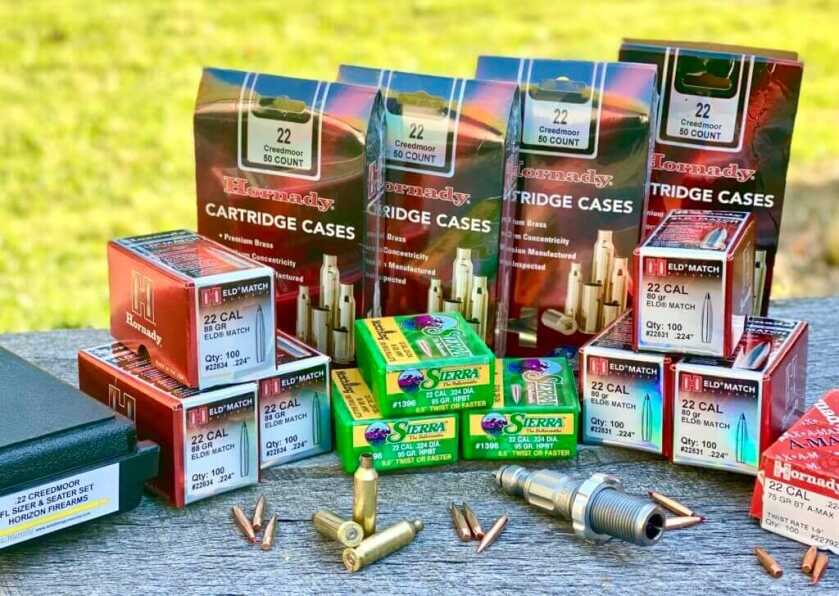
The available ammunition was priced in line with high-quality hunting and match ammunition. That pushed the 22 CM beyond the realm of a wildcat requiring handloading and brought it closer to being a true factory product.
22 Creedmoor Cartridge Specifications
| Specification | 22 Creedmoor |
|---|---|
| Bullet diameter | .224 |
| Shoulder angle | 30 degrees |
| Shoulder diameter | .462 |
| Rim diameter | .468 |
| Case length | 1.92 inches |
| Primer type | Large and small |
22 Creedmoor Ballistics: Flat, Fast, and Wind Defying
The performance of the 22 CM with 75 to 80 grain bullets makes it an outstanding varmint cartridge. I have seen claims of 80 grain Bergers at 3500 fps out of 26” barrels, which would be devastating on any varmint. Loaded ammunition is available with bullets in the 70-75 range leaving 24” barrels at velocities around 3400+ fps. That is a bit more conservative than personal handloading, but it still makes the 22 Creedmoor a very flat-shooting, low-recoiling round capable of delivering impressive results.
Part of the beauty of the 22 CM is that it shoots standard .224 caliber bullets, which are available almost everywhere for handloaders and cost less than larger caliber bullets. The heavier bullets used in the 22 CM range from 75 to 95 grains.
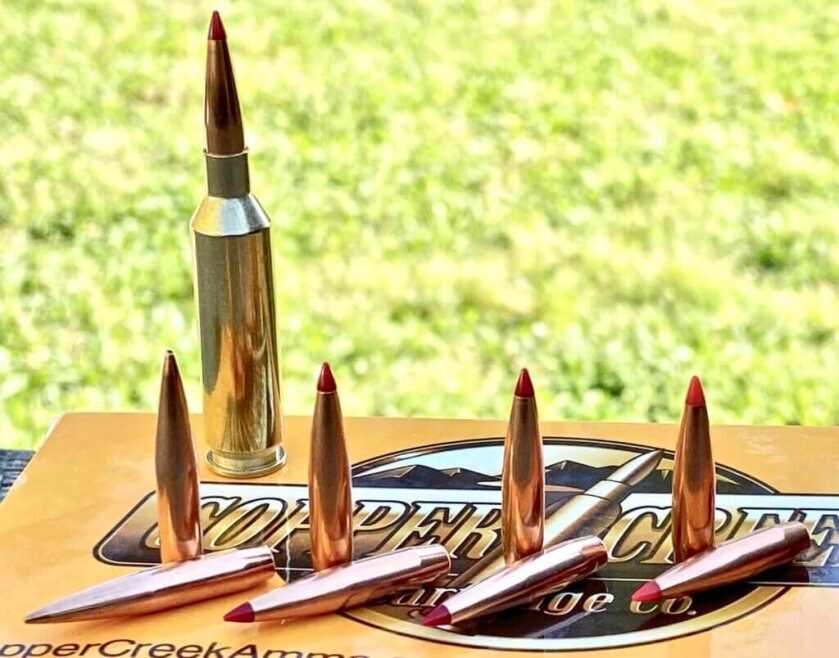
With a wide selection of bullets and factory brass available, all that is needed is a set of reloading dies to put everything together. With dies available from major sources such as RCBS, Hornady, Redding, and Whidden, the 22 CM’s future seems to be on the rise.
The cartridge stood out in the first-round hit study because its heavy-for-caliber bullets have relatively high ballistic coefficients. Those bullets can be launched at fast speeds, resulting in fewer wind and elevation corrections.
Almost No Recoil Makes the 22 CM Addictive
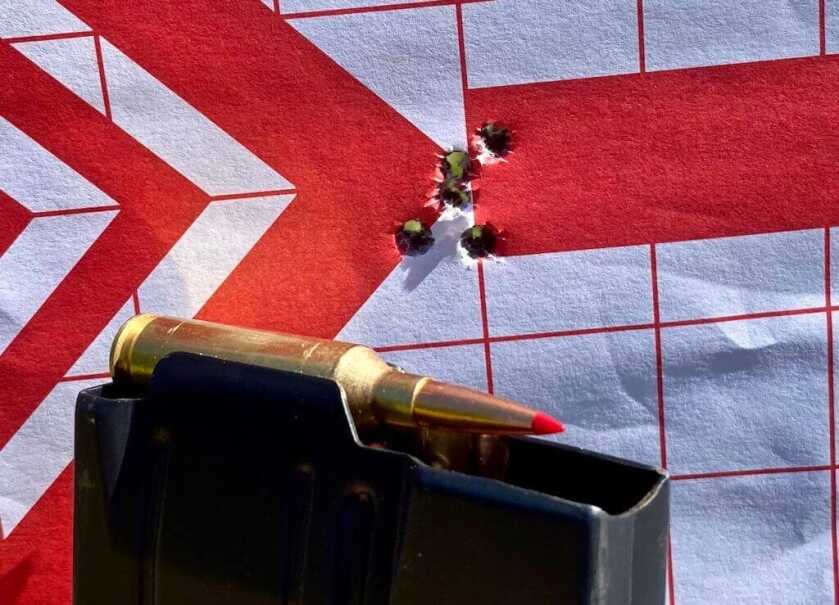
I have to say, the best part about shooting the Meredith 22 CM is that it is just fun to shoot. The gun has NO recoil and is downright easy to hit targets with thanks to its flat trajectory and outstanding wind-defeating bullets.
The lack of recoil resulting from the relatively light bullets makes it possible to watch your own impacts or misses if the terrain allows. This permits fast and accurate second-round corrections, which is a big advantage while hunting or competing.
One 22 Creedmoor Rifle Built for Three Jobs
I built the 22 CM to be a dual-purpose gun, or actually a 3-purpose gun. The first purpose was predator hunting and the varmints previously mentioned. The second was shooting PRS, or Precision Rifle Series, style matches on occasion. The third was hunting deer-sized game. As with any multi-purpose tool, there tend to be compromises.
For this project, my sacrifice was in the barrel length. It is a great-quality barrel, but the only profile available at the time was far heavier than I would have liked. To keep the overall weight of the gun down, I had the gunsmith make it a shorter barrel, giving up some velocity to gain mobility afield.
22 Creedmoor PRS Performance at 1,000 Yards
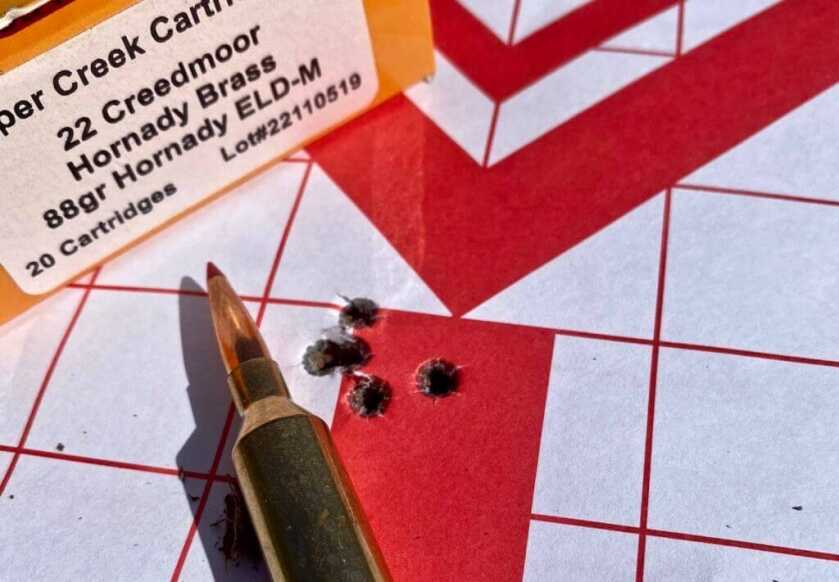
PRS matches typically limit bullet speeds to 3200 fps, which coincidentally works well since Copper Creek offers the 22 CM with a 95-grain SMK at 3160 fps based on a 24” barrel. This makes an outstanding round with only 7.1 mils of drop at 1000 yards and 1.7 mils of wind drift for a 10-mph wind at that distance. For PRS, you do not actually need all the speed the 22 CM can offer from longer barrels.

A quick ballistic comparison with several respected long-range cartridges shines a bright light on the 22 CM’s potential. Using 1000 yards as a distance benchmark, the 6mm CM drops 8.1 mils, and the 6.5 CM with the Hornady 147 ELD-M drops 8.7 mils. Both rounds are considered fantastic for long-range shooting.
Compared with the 7.1 mils of the 22 CM, it is easy to see why the 22 Creedmoor has a high hit probability. On unknown-distance targets, that flatter trajectory would result in more hits.
All of these Creedmoor cartridges are truly great long-range rounds when compared with the old military and police standard, the 308.
22 Creedmoor vs 308: A Brutal Long-Range Comparison
The industry-standard 308 load of a 168-grain Sierra MatchKing bullet at 2650 fps is no match for the more modern high BC cartridges. The old standard would have dropped in a rainbow-like curve of 12.6 mils at the 1000-yard mark.
Can the 22 Creedmoor Cleanly Take Deer?
For the third purpose, hunting deer-sized game, the 22 CM will certainly shoot far enough and flat enough to produce accurate hits. The long, slender bullets have good sectional density, so they will easily get the penetration needed to reach the vitals of thin-skinned medium game. However, the big hunting question is whether the small-diameter bullets have the energy needed to make clean kills.
So how much bullet energy is needed for medium-sized game? Well, opinions are mixed, and you know what they say about opinions. Research shows that recommendations range from 800 ft-lbs to 1300 ft-lbs. Some think energy is not the all-important factor and cite archery and sub-sonic hog hunting as examples. I really cannot argue with that either.
The good news is that the 22 CM seems to have all the energy needed for the task. The old deer-hunting go-to, a 30-30 caliber 150 grn bullet, drops below the 800 ft-lb mark at about 225 yards. The 22 CM drops below that 800 ft-lb threshold at between 600 to 775 yards, depending on the bullet and muzzle velocity of Copper Creek’s different offerings.
Leaning toward the more conservative number of 1300 ft-lbs, the same 22 CM bullet combinations are good out to 300- 400 yards. In reality, I think that number is way over what is needed with good shot placement.
22 Creedmoor Ballistics Compared at 1,000 Yards
| Caliber/ Bullet | Drop @ 1000 (mils) | 10 mph Drift @ 1000 | Energy @ 500 yds (ft-lbs) |
|---|---|---|---|
| 22 CM 75 ELD | 6.2 | 2.0 | 975 |
| 22CM 88 ELD | 6.2 | 1.9 | 1141 |
| 22 CM 95 SMK | 7.1 | 1.7 | 1028 |
| 6 CM 108 ELD | 8.1 | 2.2 | 1082 |
| 6.5 CM 147 ELD | 8.7 | 1.8 | 1409 |
| 308 168 SMK | 12.6 | 3.5 | 410 |
Why Energy Numbers Never Tell the Whole Story
I ran the numbers on the 45-70 I carried to Africa last year. The Hornady 250 grn FTX worked well on a large Black Wildebeest at 296 yards. The first shot took it down, and the second ensured it never got back to its feet.
The energy of the 250-grain 45-caliber bullet at that distance was only 630 ft-lbs. I have used the same round on whitetail deer, and inside 100 yards it takes them off their feet. They never know what hit them. It is definitely more than just the energy numbers that matter.
With all that being said, I do not think the 22 CM will have any problems making clean kills on deer-sized game out to 400-450 yards with solid shot placement. A highly accurate, easy-to-shoot rifle with a flat trajectory will make for confident hunting.
22 Creedmoor Barrel Life Is the Lingering Question
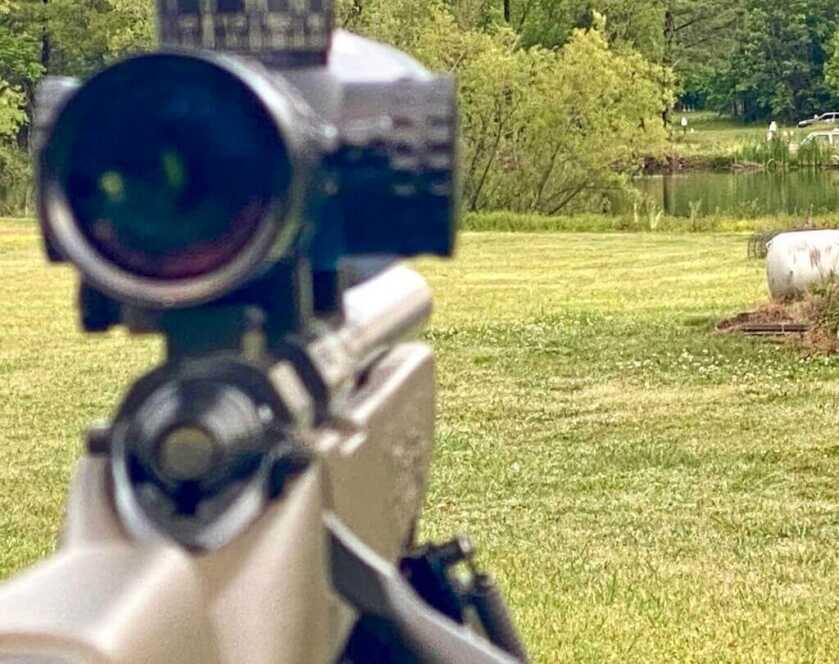
The only real issue that remains with the 22 CM rifle is just how long the barrel is going to last. I am running the heavier bullets, typically 88 or 95 grains. These bullets have higher energy levels, perform better in the wind, and should provide longer barrel life than the faster, lighter bullets.
Compounding the problem, though, is the fact that it is so fun to shoot. Its 22 caliber bullets also make it much cheaper to shoot than my larger calibers. I think the barrel will give me good life based on round count, but maybe not based on time because I really enjoy shooting it and letting others try it.
Pros and Cons of the 22 Creedmoor
- Pros: Flat trajectory, outstanding wind performance, almost no recoil, standard .224 bullets, strong long-range hit potential, easy impact spotting, and support for predator hunting, PRS competition, and deer-sized game.
- Cons: Barrel life remains a concern, fast-twist barrels are required for the longest bullets, and a multi-purpose rifle build can force compromises in barrel length and overall weight.
The Verdict: Was the 22 Creedmoor Build Worth It?
So, was the 22 CM worth the time and money it took to build? I think so. The 22 Creedmoor is a great-shooting cartridge, and the Meredith rifle shoots amazingly well. The cartridge and rifle perform with my handloads or the available factory ammunition. The fact that several vendors are manufacturing 22 CM brass certainly makes handloading simpler.
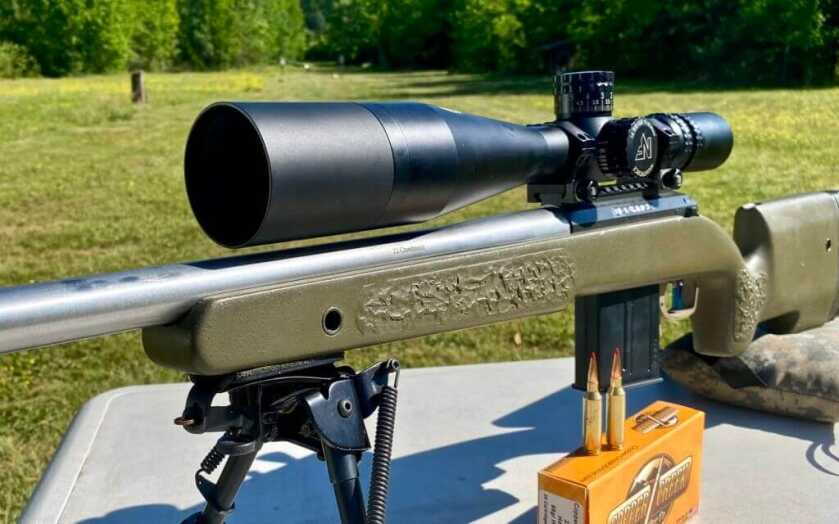
If I were to do it over again, I would build a lighter hunting-weight rifle. In reality, that would mean using a slimmer barrel and dropping down to a Nightforce NX8 2.5- 20x scope. Then the 22 CM would be right at home in the field where it belongs.

Check out the details, run the numbers yourself, and consider the 22 Creedmoor for your next rifle build.
Related Reads From GunsAmerica Digest
- Hornady Unveils the 22 ARC: Everything You Need to Know
- Ruger Precision Rifle in 6mm Creedmoor Breaks the 1,000-Yard Barrier
- Christensen Arms Ridgeline: A Precision Long-Range Hunting Rifle

is a world-class competitive shooter having won medals at both the 2012 IPSC World Shotgun Championship in Hungary and more recently the 2017 IPSC World Rifle Championship in Russia. He is passionate about shooting sports and the outdoors. He has followed that passion for over 30 years, hunting and competing in practical pistol, 3gun, precision rifle and sporting clays matches. Jeff is intimately familiar with the shooting industry – competitor, instructor, RO, range master, match director. Among his training credits include NRA Instructor, AR-15 armorer, FBI Rifle Instructor, and Officer Low Light Survival Instructor. As a sponsored shooter, Jeff has represented notable industry names such as: Benelli, 5.11 Tactical, Bushnell, Blackhawk, DoubleStar, and Hornady. He has been featured on several of Outdoor Channel’s Shooting Gallery episodes and on a Downrange TV series. Jeff’s current endeavors cover a broad spectrum and he can be found anywhere from local matches helping and encouraging new shooters as they develop their own love of the sport, to the dove field with his friends, a charity sporting clays shoot, backpack hunting public land in Montana, or the winners podium of a major championship.
I agree that “it is definitely more than just the energy numbers that matter”. I think the issue is, the formula for kinetic energy focuses too much on velocity and gives unreliable results. A 10% increase in velocity gives a 21% increase in KE, but a 10% increase in bullet weight only gives a 10% increase in KE. (100gr/2500fps=1388ft-lbs, 110gr/2500fps=1527ft-lbs, 100gr/2750fps= 1680 ft-lbs). You said your 250gr .45-70 had 630 ft-lbs of energy when you took a wildebeest, I can’t be the only one who thinks a .22CM with 630 ft-lbs of energy would have had a vastly different outcome in that scenario.
What powder is being used to generate 410 fpe at 500 yards with a 168 grain .308 I wonder? I want to be sure to never buy it.
Notwithstanding the error concerning the 168 SMK retained energy at 500 yards, I thought the following comment in order—
Complaining or belittling the “next new cartridge development” is short-sighted. Keep in mind there are millions of new firearms sold each year, many of which are rifles if one kind or another. So it’s not a case of gun/ammo producers trying to market products to existing gun owners. If a new cartridge (best example is 6.5 Creedmoor) is received well in the marketplace, it survives. Doesn’t mean it replaces older standards but rather adds to the variety of good choices available. Does the 22 CM replace the 22-250 or 22 Valkyrie? No, it just adds to the choices we have available. You don’t have to personally own a rifle for every great cartridge available. Thankfully, however, we have choices thanks to our great country’s gun makers, experimenters, and innovators.
Well, contrary to some of the chat here, when I read a review like this, even though comparing various cartridges is common, I think of the new stuff as “in addition to my current collection versus instead of.” Kinda like my wife does with shoes. When I add to my collection very little leaves on the other side. Who do you know who has enough guns?
While on numerous TADS (Temp Assigned Duty) over a three and a half year period on San Clemente Island…… (next island out in the Pacific from Catalina Island off of Calif.)……..we “Airedales” had fun experimenting with combat weapons of various types and calibers. The gamut ran from .22 to 20 MM. We had unlimited access, unlimited use, unlimited quantity of ammunition, fired rounds at night, morning, afternoon, black sky, full moon, rain, fog, cold, hot>>> yada yada yada…..we had an awful lot of fun just chewing up ammunition and “testing” all that we could. We were all enlisted…our CO/Officer – in – charge was an Ensign straight out of the Naval Academy……and he was in agreement with “all of his men” (“us”)……that this was cake duty and that God is the benevolent supreme being by stationing us there temporarily on TAD. This went on …off and on….for three years…we were the Naval Aviation version of M.A.S.H. Our hair was “long”, we’d wear cut off Navy dungaree’s, (jeans), Navy chambray shirts with the sleeves removed……we would shoot enormous amounts of ammunition, we basically looked like 180 degree out of “phase” squids>>>(sailors). It was great fun and freedom……and lasted until my enlistment was up. They wouldn’t allow me to stay on shore duty if I re-enlisted – – – – I didn’t really want to end up o the “U.S.S. Never Dock” after all of this three and a half years of what was basically “partying at the governments expense”……..so I left the Navy. Sad. Many who knew of my easy duty wondered how I did it. I’d tell them that my Dad was a Senator on a military senate sub-committee………they’d believe me. My memories of my military time make me smile………..
168 SMKs don’t have only 410 ft-lbs of muzzle energy at 500 yards. They are about 1180 ft-lbs. Like most things “Creedmoor” the performance of the CM is exaggerated by pitting the highest BC bullets against “standard” 308 bullets and even getting that data completely wrong. A 308 Hornady ELD 168 grain has about 1360 ft-lbs of energy at 500 yards. It would be nice if you could just stick to the facts instead of trying to inflate performance by straight up lying about 308.
a 168gr 308 at 500yards, is over 1100ft/lbs, did you get your data from Wikipedia?
I built one after reading this and other articles. It really doesn’t out do my 22-250AI, its probably going to be used for something else. Both are 26″
It shouldnt outdo the 22-250 ai since capacity is nearly identical. Getting quality headstamped brass with no fire forming is what sets the 22 creedmoor apart from the 250ai.
I have personally taken a large Zebra male with a clean headshot with my 22CM shooting a 75gr Hornady ELD-M at 3650 fps, it dropped right on the spot. I also shot an impala with a headshot, it took almost half the head off. This is starting to become my go to gun for general purpose hunting and gong competitions.
Back in the day, my first ever rifle was a Remington 700 in 6mm. I took many deer with that rifle with an 87gr. hornady spire point. Almost all fell in their tracks. As a matter of fact, I don’t remember but one large buck that ran about 100 yds. but part of the reason is because I could only get a head on shot to the chest.
Gotta love the experts who denounce new cartridges as useless just because they own something similar. 22 creedmoor is SUPERIOR to 22-250 AND 220 swift.
I don’t really care for comparisons based on different “caliber” rounds.
Compare it to Factory ammo available to everyone for the last 50-75 years to see if it’s even worth the bother to wildcat it. Such as the 22-250 as mentioned before, (that I have loved for over 45 years now!) Or even better, compare it to the 220 swift! I HAVE shot the bbls out a a few older models, which is WHY I went to the 22-250. I have killed a couple with that round as well..but it took a lot longer to do so. Plus I hand load HOT for that round as well.
It sounds to me like your pissing on the .308, something MANY snipers would disagree with as well.
It seems like a futile venture to me personally. The 22-250 AI would make more sense to me.
Thanks for the half baked artical. I truly don’t believe a senseable person would use ANY .22 caliber rifle for deer hunting. But again, that just my opinion.
The point of this wildcat is to use heavy for caliber bullets, which most if not all of the “old” 22s cannot do. If they can, velocities are so low they aren’t practical. You are quite wrong about using 22s for medium sized game. With good bullets, medium sized game can be taken quite easily with some 22 calibers. I’m up to 3 pronghorn and a pig with my 223 shooting 70 grain tsx, at reasonable ranges. Farthest was about 140yds, bullet still passed completely through, exiting through the far shoulder on a quartering away shot. All harvests have been one shot kills. The TSXs in my experience have been overperformers, big time. Happy hunting.
Maybe not the article to raise this point. I tried to find an email for Mr. Cramblit – with no luck. Here’s my issue – or more correctly, just a question. I’ve been shooting the 6mm Rem our of my old 788 for well over 40 years. I have also been shooting a .260 Rem out of a M700 for almost as long. I never thought I needed another 6mm or 6.5mm cartridge. Then along comes the new Creedmore offerings and the shooting world makes me feel like time has passed me by. I know that huge advances in rifles has taken place since the 1970s. But ballistics seem to show that the old 6mm Rem and .260 Rem more than hold their own against the ‘new’ Creedmore offerings. Why would I switch. More importantly, why all the fuss? Not trying to start a war on the very interesting .22 thread. But I am interested in this apparent incongruity.
Great question!!
My opinion of the matter is as it has been for many years. Gun “writers” simply ran out of stuff to write about..and manufacturers ran out of “new and improved” items to sell. (Even if they are NOT improvements worth mentioning!)
I moved a couple of years ago..I sorted through hundreds of gun magazines, it’s all the same. Everyone is in the .45 ACP vs the “tiny” 9mm for a couple of years..then they ALL switch to the side of the “deeper hitting” 9mm! Laugh!!
The same with rifles. Nothing changes..heavy vs super light! Big bore vs small bore, back and forth FOREVER. I stopped buying them after a while..it’s just repeating over and over.
In MY worthless opinion, if you have 5 or 6 REALLY accurate rifles for varmint hunting, and at least a couple for EACH larger animal you hunt..then the same for various target sports..then you really have all the calibers and guns that you will have any USE for. You will certainly NEED many more, if just to point out to others the importance of diff bore sizes, stock styles, etc..even if you NEVER shoot them! Laugh! I have plenty like that..including my original model ’73 Winchester in .38-40! I love that gun..I have NEVER shot it..but I love it anyway! 😁✌
I agree. If the ammo is not common and it has not been manufactured for around 10 years, I want nothing to do with it. The most common rifle calibers you won’t spend ridiculous sums on are: .308 Winchester, 7.62 x 39, .300 AAC Blackout, 5.56 x 45, .22 Long Rifle, 30-06, .270 Winchester, 6.5 Creedmoor, .300 Winchester Magnum, .44 Magnum, and .357 Magnum. (Maybe also 6.5 x 39 Grendel for an AR-15.)
Marketing
Nobody routinely uses a 45-70 or a 30-30 where they anticipate regular shots at over 100-150 yards; stupid comparison. With all the more appropriate cartridges out there, why anyone would use a barely capable 22 caliber class round on medium sized game is beyond me. Ethical hunters don’t do that because we all know that the opportunity for perfect shot placement is the exception not the rule; particularly in brushy cover. SMFH.
Mark I shoot a 22-6mm rem which is a touch faster but very similar in performance. I can tell you for an absolute fact that the 90 gr berger vld at 3400 fps is a death ray for white tails. It
gets about 15″ of penetration which is plenty unless you’re the one to try to reach the vitals via the butthole. In fact, I compared wound tracks in ballistics gel and it was virtually indistinguishable from a 168 gr ballistic tip from a 30-06. The last deer I shot I tucked right inside the shoulder blade as he was quartering towards me and it completely destroyed the opposite lung. Not a trace of it. It flipped him over backwards and he never so much as twitched his tail.
BAck in the 70’s we used to shoot 85gr Sierra hollow point boat tail bullets in our 6mm Rems. From the loaders manual, the stated velocity was 3300 FPS. When you hit a deer you could hear a loud Thwapp! I had a stand at the top of a rocky hill, surrounded by field. But the stand was in the middle of a little woods. In front of me was a dry wash – I could see deer enter it on one end and pop out about 100 yards in front of me. One morning I shot three bucks without getting a chance to reload my rifle. It was great for about 3 years. Then one opening day, when it got daylight, I could see I was surrounded by other hunters. Rather than gripe, i got out of my tree and left it to the ‘combat’ hunters. Fun while it lasted. If you get open shots at deer, those little hollow points really ground them.
I totally agree! When did the 30-30 change from a “brush gun” to a 200 plus yard tack driver?? Everyone I know that uses one considers it to be a 50-150 yard gun, at best!
Thank you!!
Why was it not compared to any of the mainstream big boomer .22 calibers, e.g. .22-250. Seriously doubt any significant difference. As a 450 yard deer cartridge. Not so likely. Most states would not allow it as lacking sufficient energy. Yes deer are half the size of a man and do not have body armor but even the mostly ignorant DOD civilians are letting the military look at larger calibers than .22 because of lack of long range effectiveness.
This one has my attention. What is the MSP.
Please double check the 500 yd energy of the 308 168 SMK….
How does 22CM compare to a 22-250 with a 1-7.5 twist ?
This is my question exactly!
Velocity in a 12” and 16” Ar?
Thanks for the informative story! Good news — Peterson’s 22 Creedmoor brass is very good so you don’t even have to neck down brass. I presume the Alpha brass is good too. However, my take on this (as one who has owned and shot a 22-250, and 22-250 AI), is skip the Creedmoor if you handload. Do a 22 BR or 22 BRA. Considerably less powder, longer barrel life, slightly less recoil, and I bet it will be easier to tune. With a 22 BRA (22 BR with 40deg shoulder) you’ll have plenty of velocity. For a varmint cartridge, 95% of your shots will be inside 500 yards, and probably 80% inside 300.