

Estimated reading time: 9 minutes
The 7 Creedmoor went straight into an NRL Hunter Open Light match and came out with 2nd place in the division and 4th overall. It brought more recoil than my usual 6.5cm, but the extra impact signature, wind performance, accuracy, and 433,674 power factor made a strong argument for the 7cm.
Table of contents
- 7 Creedmoor Goes to Work in NRL Hunter Open Light
- NRL Hunter Power Factor: Where the 7 Creedmoor Hits Hard
- 433,674 Power Factor Gives the 7 Creedmoor an Edge
- NRL Hunter Terrain Made Every 7 Creedmoor Shot Count
- 7 Creedmoor Results: 2nd in Open Light, 4th Overall
- Final Verdict: The 7 Creedmoor Earned Another Match
7 Creedmoor Goes From Wildcat Experiment to Match Rifle
I hope readers enjoyed my introductory article to a 7mm wildcat cartridge I have been experimenting with: the 7 Creedmoor, which is a 6.5 Creedmoor case that has been expanded, or ‘necked up’, to a 7mm diameter.
In my first article, I mentioned using the rifle for hunting anything from coyotes up to elk-sized game. In this article, I focus more on the competitive aspect of shooting, namely, NRL Hunter competitions. I’m drawing on experience from shooting both the 6.5cm and the 7cm in NRL Hunter matches.
7 Creedmoor Goes to Work in NRL Hunter Open Light
I tested the 7cm on my first NRL Hunter match in over 2 years. This was a slightly risky decision as I was using a heavier recoil caliber on a lighter chassis for my first match in a while. I generally would have used the same rifle and action, but with a different barrel chambered in 6.5cm. But I loved how well this barrel was shooting, so I decided to take the risk.
The NRL Hunter division I competed in was the ‘Open Light’ division, which requires that a shooter must have a complete rifle with an optic and any accessories weighing 12 lbs 10 ounces or less. If the shooter is not using a suppressor, the weight limit is reduced to 12 lbs. Here are the components of my rifle build, weighing 12lbs 10 ounces:
- XLR Element 4.0 Mg Chassis with folding carbon buttstock
- Terminus Apollo Lite, Short Action
- 26in Patriot Valley Arms Osprey Carbon Barrel chambered in 7 Creedmoor
- KGM R30 Suppressor
- TriggerTech Special Flat-Bow trigger
- Kahles 5-25 LSW with SKMR3 Reticle
- Cole-Tac Data Card Holder
- Accuracy First Scope Mounted Bubble Level
- Nightforce Ultralite Rings
- MDT Ckye-Pod Double Pull Light version
7 Creedmoor NRL Hunter Rifle Build Specifications
| Cartridge | 7 Creedmoor |
|---|---|
| Chassis | XLR Element 4.0 Mg Chassis with folding carbon buttstock |
| Action | Terminus Apollo Lite, Short Action |
| Barrel | 26in Patriot Valley Arms Osprey Carbon Barrel chambered in 7 Creedmoor |
| Suppressor | KGM R30 Suppressor |
| Trigger | TriggerTech Special Flat-Bow trigger |
| Optic | Kahles 5-25 LSW with SKMR3 Reticle |
| Data Card Holder | Cole-Tac Data Card Holder |
| Level | Accuracy First Scope Mounted Bubble Level |
| Rings | Nightforce Ultralite Rings |
| Bipod | MDT Ckye-Pod Double Pull Light version |
| Complete Rifle Weight | 12lbs 10 ounces |
NRL Hunter Power Factor: Where the 7 Creedmoor Hits Hard
The rifles are weighed before the competition starts. The velocity is also captured, as well as bullet weight, to give you a ‘power factor’. The minimum allowed power factor to compete for NRL Hunter points in Light and Heavy divisions is 380,000. This ensures that the 6mm or other small caliber rifles can’t compete because they do not have sufficient power factor to be a true hunting rifle. Power factor is calculated by multiplying the bullet weight by the velocity. In my situation, it was a 162 ELDM at 2677 fps, which would be:
162 x 2677 = 433,674.
Generally speaking, most shooters are using a 6.5 Creedmoor, with numbers like this:
140 x 2750 = 385,000.
The purpose of the power factor is to eliminate calibers that are low recoil and not typically hunting rifles, like a 6 Creedmoor. For example, a 6 Creedmoor shooting a 115-grain bullet at 3000 will only be 345,000. The other purpose of the power factor is to act as a tiebreaker. If two shooters are tied, they use the power factor to determine who won. A balance is still necessary, though; someone competing with a 300 Win Mag will have a crazy power factor, but the recoil of the rifle will make it very difficult to see your shots through the scope.
433,674 Power Factor Gives the 7 Creedmoor an Edge
The 7 cm carries some energy! I did like having a heavier power factor than most other shooters, ensuring that I do not have to worry about a tie-breaker. You can see that no one in Open Light in the top 15 places was even close to the power factor produced by the 7 cm. See the column on the right side of the image for the power factor of each competitor. The 7cm is in the second row, where I finished the match.

NRL Hunter Terrain Made Every 7 Creedmoor Shot Count
The match was set in a beautiful pine tree-laden landscape. We were seeking targets and shooting into another pine tree-covered hill over top of fields and meadows below.
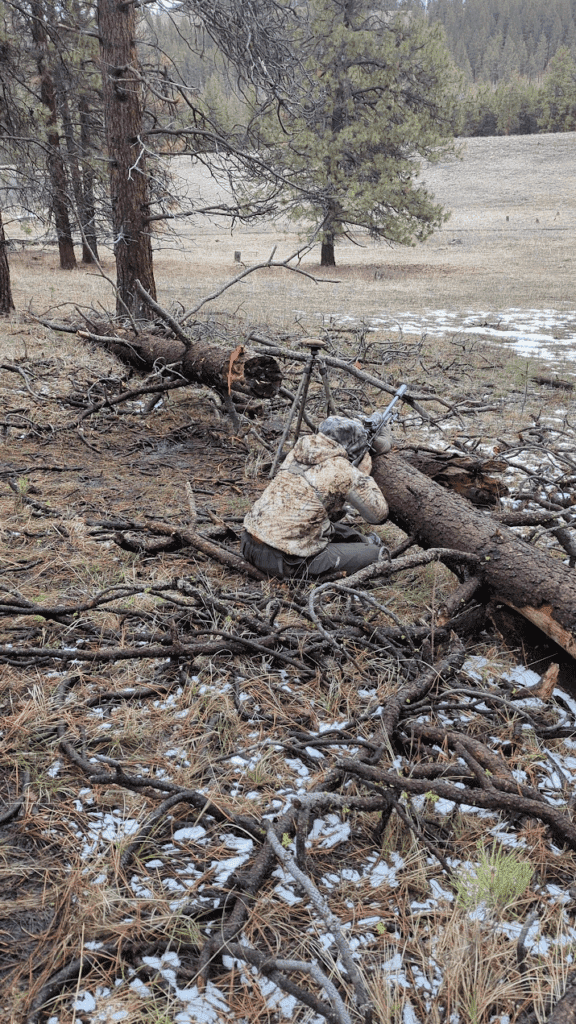
The match had targets placed from 150 yards to just shy of 1000 yards. The targets were hidden in shadows, rocks, and brush-covered areas. Finding targets was difficult as it was an overcast weekend, with intermittent snow and rain. Grey steel doesn’t show up well under dreary conditions.
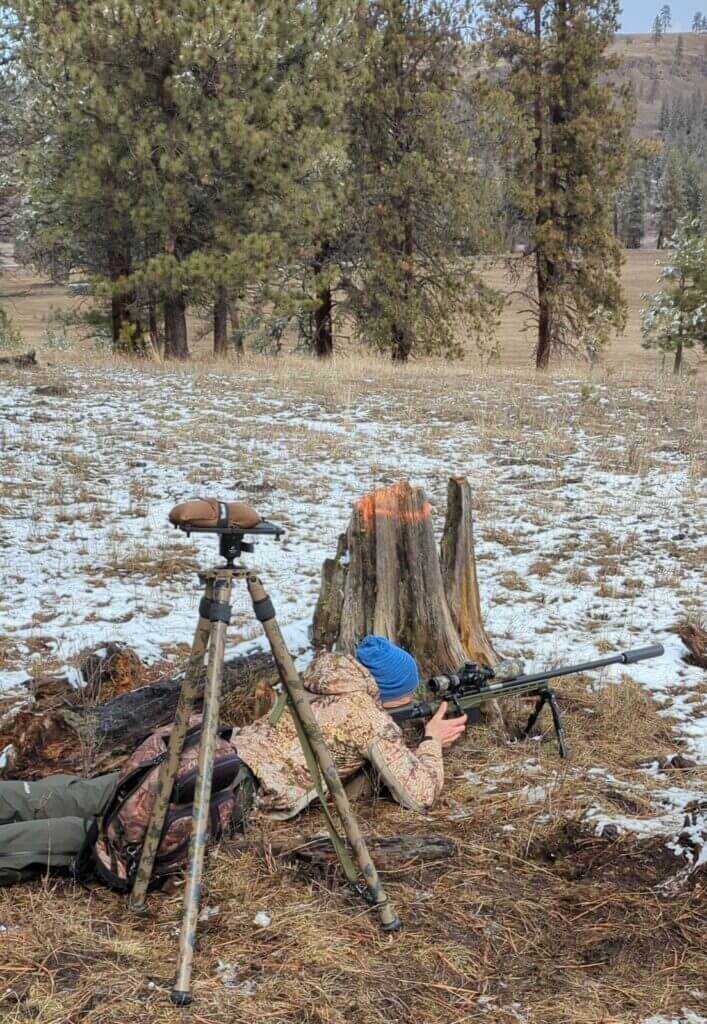
The targets were placed in a way that a shooter had to build positions that were not always prone. Prone is always preferred for these matches, as we are using lightweight rifles and need good vision through the scope to see what the wind is doing as shots are taken. As you can see in the picture, there were stages that required a shooter to engage off a random, natural object. Objects included rocks, spongy pine-covered earth, logs, and branches. One reason why I love NRL Hunter matches is that we are shooting in much more realistic scenarios than when a shooter goes to the rifle range and practices off of manmade barricades.
7 Creedmoor Results: 2nd in Open Light, 4th Overall
After shooting the entire match with the 7cm, I was able to take 2nd place in Open Light Division, and 4th place overall for all divisions. Here are some key observations I noted while shooting with the 7cm. I will compare this to a typical 6.5cm that I have used at previous matches.
- The 7cm cut wind as well as or better in some situations than a 6.5cm. The 162 ELDM bullet I use carries a .338 G7 BC after truing up. There are 6.5cm bullets that are higher in G7 BC, but do not carry the same weight and signature as the 7mm.
- The ability to spot my shots both on target and when I missed was drastically improved. The 162-grain bullet carried a ton of energy compared to a 6.5cm. The target impact location was clearly visible through the scope so long as I built a solid position before engaging the target. The splash in the dirt, mud, or brush when I missed a target was notable as well. I never questioned where my bullet landed due to the larger diameter and bullet weight.
- The recoil was manageable, but noticeably more than 6.5cm. This certainly was a disadvantage. However, as with all shooting disciplines, as long as I focused on building solid positions and having good rifle control, I was able to stay on target through the scope and watch my bullet impact.
- The accuracy was wonderful. I would say that all Creed-based cartridges are inherently accurate due to the case design. 22cm, 6cm, 6.5cm, and the 7cm all have easy-to-load characteristics. The 7cm has been easier to tune and has consistent group sizes than some of my other 6.5cm barrels. I wouldn’t say this was a huge difference comparatively.
- In connection with accuracy, I felt there was a noticeable advantage of the Osprey Carbon barrel compared to my other carbon barrels. The Osprey Carbon barrel held up under 8-shot strings arguably better. It is worth noting that most carbon barrels I have owned have a first- or second-round impact shift. I don’t have science to support this, but I do have experience in load development on more than a few carbon barrels. The first round from carbon barrels is generally slightly different than the following 5 shots, especially when it is a cold barrel. With the Osprey Carbon, I have noticed that the first-round impact shift is minimized, if not eliminated entirely with the Osprey Carbon technology from Patriot Valley Arms. I will monitor this over the life of the barrel.
- As mentioned previously, my 7cm did not have to compete with any other rifle in a tie-breaker; the power factor was higher than anyone in the Open Light division finishing in the top 15. This is a clear advantage.
7 Creedmoor Pros and Cons After a Full NRL Hunter Match
- Pros: Strong wind performance, obvious target and miss signature, 433,674 power factor, wonderful accuracy, easy tuning, and enough energy to remove much of the concern about a tie-breaker.
- Cons: Recoil was manageable but noticeably more than 6.5cm, making a solid position and good rifle control more important for staying in the scope.
Final Verdict: The 7 Creedmoor Earned Another Match
The 7cm has exceeded my expectations in both hunting and rifle competitions. I will take it to another NRL Hunter Match with confidence. The advantage of a higher power factor, larger signature from impacts on targets or the area around targets, and the inherent accuracy has made this cartridge a new favorite of mine.
For me, that is where the 7 Creedmoor separated itself during this match. The additional recoil was real, but so were the benefits. I could see impacts, read misses, trust the accuracy, and carry a power factor that stood well above the other top Open Light finishers. For a cartridge I originally approached as an experiment, the 7cm is making a convincing case for staying in the rifle.
Learn More About the 7 Creedmoor NRL Hunter Build
To learn more about the 7 Creedmoor and Osprey carbon barrels, please visit: patriotvalleyarms.com.
To learn more about NRL Hunter Matches, please visit: NRL Hunter.
To learn more about Terminus Actions, please visit: terminusactions.com.
To learn more about XLR Chassis systems, please visit: xlrindustries.com.
To learn more about KGM suppressors, please visit: kgm-tech.com.
To learn more about Kahles optics, please visit: www.kahles.at/us
Related Reads from GunsAmerica Digest
- A Deep Dive into the Hunter NRL: Lessons Learned and Essential Gear
- More Bolt-Action Rifle Reviews
- More GunsAmerica Ammunition Reviews

Steel is an avid shooter, athlete, father, rancher and farmer. He currently works for a small software company in the morning, and jumps on the farm and ranch jobs in the afternoon. He came across competitive shooting while living on the East coast of the United States. He quickly became competitive and shot in the Precision Rifle Series across the entire United States placing within the top 80 shooters in the professional series. As shooting progressed, Steel became interested in the NRL Hunter Series, in which he competes as often as life, and family, permit.
Steel is married with children, and reserves time for family before any hobbies of shooting, team roping, and other outdoor activities.
Experience:
– Semi-Professional Shooter. Top 15 finisher in multiple NRL Hunter and Precisions Rifle Series Pro competitions.
– Night Hunter. Over 9 years experience with night hunting and thermal optics.
– Senior Manager in Professional Services, specializing in distribution digital strategy and strategic account growth.
– Long time reloader for standard and wildcat cartridges.
– Rancher / Farmer