
The Walther P1 is the postwar, aluminum-framed version of the WWII Walther P38, and it is one of the most affordable ways to own a piece of that history. It is a 9mm, double-action/single-action service pistol with an 8-round single-stack magazine, a slide-mounted safety and decocker, and a heel magazine release. West Germany’s Bundeswehr and police carried it for decades before replacing it with the P8 in the 1990s and early 2000s, and surplus P1s are now common on the civilian market. It shoots like a classic service pistol, has a surprisingly good trigger, and costs far less than a wartime P38. For modern Walthers, see our best Walther pistols guide.
Table of contents
Walther P1 at a Glance
- What it is: the postwar P38 with a lightweight aluminum-alloy frame
- Caliber: 9x19mm Parabellum
- Action: short recoil, double action/single action
- Capacity: 8-round single-stack magazine
- Controls: slide-mounted safety/decocker, frame-mounted takedown lever, heel magazine release
- Service: Bundeswehr and West German police, replaced by the P8 starting in the 1990s and retired around 2004
- Dating: a month/year stamp on the frame, such as 04/79 for April 1979
- Buying: common as surplus, and much cheaper than wartime P38s
From Luger to P38
Many people picture German soldiers carrying the Luger P08. Some did, but the P38 was the main German sidearm of WWII. The Luger, designed around Georg Luger’s 9x19mm cartridge, was adopted by the German army in 1908 and served through WWI. It was accurate and innovative, but its toggle action was complicated and expensive to build and did not tolerate dirt well.
Walther’s answer was the Pistole 38, or P38. It was one of the first military pistols that could be carried safely with a round chambered and the hammer down, ready to fire with a long double-action pull and no manual safety to manipulate. Its locking wedge under the barrel will look familiar to anyone who has taken apart a Beretta 92 or M9. Military production began with Walther in 1939, and demand was so high that Mauser and Spreewerk also built P38s. More than a million were produced during the war.
How the P38 Became the P1
After WWII, the new West German army wanted the pistol it already knew. Walther updated the design, most notably replacing the steel frame with an aluminum alloy one. Walther retooled at its new factory in Ulm, and the first new pistols were delivered to the Bundeswehr in June 1957. The Bundeswehr called the gun the Pistole 1, or P1, from the start, but early guns were still marked P38 on the slide. Walther began stamping military guns P1 in October 1963, while commercial guns kept the P38 name.
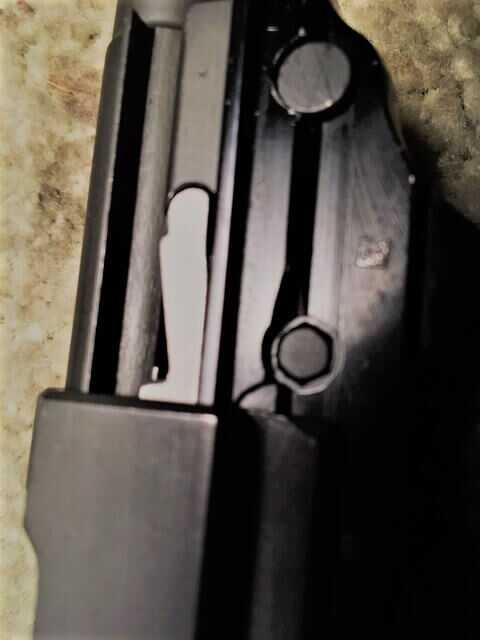
Walther built the P1 for West German military and police use for more than 25 years. Around 1975, the frame was reinforced with a hex bolt above the trigger guard, and a thicker, stronger slide was introduced. In the 1990s, the Bundeswehr began fielding the P8, a military version of the H&K; USP, and the P1 was retired around 2004. P1s also saw service outside Germany.
Walther P1 vs P38: What Is Different?
The design is almost the same, but they are not the same gun. The P38 has a steel frame and the P1 has an aluminum alloy frame. Later P1s also have the hex bolt frame reinforcement and the thicker slide. In the hand and on the range, both guns feel and shoot nearly the same. Collectors pay a large premium for wartime P38s. The P1 gives you the same design and much of the same history for a lot less money.
Walther P1 Specifications
- Operation: short recoil, locking wedge
- Caliber: 9x19mm Parabellum
- Action: double action/single action
- Safeties: decocker, manual safety and firing pin block
- Trigger pull, author’s gun: 5.5 pounds single action and 9.5 pounds double action
- Sights: fixed front post with white dot and U-notch rear with white stripe
- Overall length: 8.5 inches
- Overall width: 1.5 inches. Slide and grips are about 1.25 inches thick.
- Weight: 27 ounces unloaded
- Barrel: 4.9 inches, 6 grooves, 1 in 10 inch right-hand twist
- Magazine: 8-round single stack
- Other features: loaded chamber indicator, last round hold open, lanyard ring
Features That Inspired Later Pistols
The P1 is a contemporary of the SIG P226 and the Beretta 92, and you can see its influence in both. For a primer on how these actions work, see our guide to striker fired vs hammer fired pistols.
- Double action/single action: carried loaded with the hammer down, ready for a double-action first shot. The DA pull on our author’s gun was as good as a SIG and better than a Beretta.
- Slide-mounted safety and decocker: it sits high and out of the way in the fire position, and it is harder to engage by accident during slide manipulation than the Beretta’s.
- Locking wedge: Beretta used a very similar locking block in the 92.
- Loaded chamber indicator: a pin above the hammer sticks out when a round is chambered, so you can see or feel the pistol’s condition.
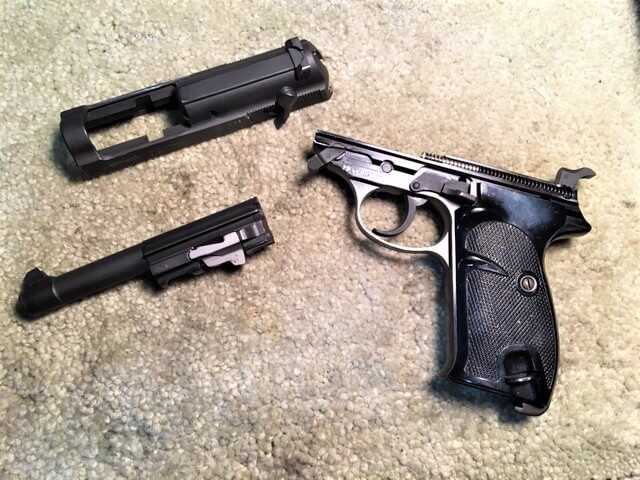
- Toolless takedown: rotate the takedown lever and the slide and barrel come off the front.
The one feature that feels dated is the heel magazine release at the bottom rear of the grip. It was common on older European pistols. It is slower than a button release, but it works fine with a little practice.
Shooting the Walther P1
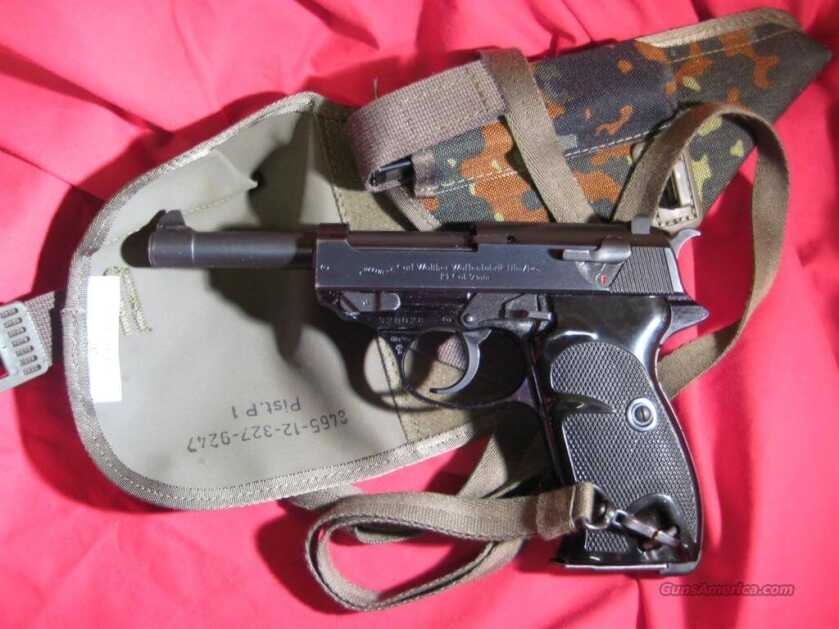
Our author shot his P1 over a couple of months, drawing from a surplus Bundeswehr flecktarn flap holster. He used loads from 115 to 147 grains, including +P, and the gun fed everything with no malfunctions. The P1 was designed around full-power military 9mm, so it will handle +P, but expect faster wear on an older aluminum frame. The dual recoil springs on his gun were old but still had plenty of life.
The sights are as good as most service pistol sights, recoil is very manageable with little muzzle flip, and the single-action trigger is light and smooth with a short reset. The author found it shot well for speed and accuracy from 7 to 50 yards. Brass ejects in varied directions, but it always ejects.
A few drawbacks: the 8+1 capacity is low by modern standards, the decocker and slide stop have sharp angles that can snag, and the controls and lanyard ring are set up for right-handed shooters. Left-handed shooters can still run the gun with their support hand. The P1 is not an everyday carry gun, but in an open carry setting the author preferred it over the Beretta M9 he was issued.
Buying a Walther P1
Surplus P1s are common in gun shops and online, and most are in good condition because they served in peacetime. When this article was first published in 2022, P38s were running around $1,000 in 2022 dollars, and a P1 cost less than half that in 2022. Both pistols are long out of production, so there is no current MSRP. Check current listings on GunsAmerica for today’s prices, or see what your gun is worth if you already own one.
Things to check before you buy:
- The frame date stamp, so you know when the gun was made
- Whether it has the later hex bolt frame reinforcement
- Recoil spring condition, since many are decades old
- Matching serial numbers and original magazines if collector value matters to you
- Any frame cracks near the slide rails on early, unreinforced guns
Walther P1 FAQ
Is the Walther P1 the same as the P38?
No. The P1 is the postwar version of the P38 with an aluminum alloy frame instead of steel. Later P1s also have a hex bolt frame reinforcement and a thicker slide. Otherwise the design is nearly identical.
How do I tell what year my P1 was made?
Look for the month and year stamp on the frame. For example, 04/79 means April 1979.
Can a Walther P1 shoot +P ammo?
Our author’s P1 ran +P without problems, and the pistol was built around full-power military 9mm. Expect faster wear on the aluminum frame, so keep +P to a minimum on an older gun.
What replaced the Walther P1?
The Bundeswehr began fielding the P8, a military version of the H&K; USP, in the 1990s. The P1 was retired around 2004.
How many rounds does the Walther P1 hold?
The P1 uses an 8-round single-stack magazine, for 8+1 with a round chambered.
Is the Walther P1 a good carry gun?
Not really. It is reliable and accurate, but it is thick for a single stack, has snag-prone controls and holds only 8+1. It is best as a range gun and a piece of history.

Mark Miller is a former U.S. Customs Agent and Green Beret with operational experience in Afghanistan and other live-fire zones around the world. A lifelong student of firearms and tactics, Mark combines battlefield-tested wisdom with technical knowledge gained as both an FFL and a Special Occupational Taxpayer (SOT).
His approach is rooted in hard-earned experience: terrain and situation dictate tactics—and the enemy always gets a vote. Whether he’s writing about firearms, evaluating gear, or analyzing real-world applications of force, Mark brings strategic insight and no-nonsense clarity to the GunsAmerica team.
Experience:
– Green Beret Veteran – Served in Afghanistan and multiple high-threat environments with U.S. Special Forces.
– Former Customs Agent – Federal law enforcement background with real-world interdiction and enforcement experience.
– FFL & SOT Holder – Licensed dealer and manufacturer with a deep understanding of firearms law and NFA weapons.
– Tactical Thinker – Believer in adaptive tactics shaped by terrain, mission, and threat.
– Combat-Proven Insight – Offers a rare blend of firsthand combat knowledge and technical firearms expertise.
– Firearms Educator – Dedicated to improving skills, understanding, and mindset for both professionals and civilians.
cool fire arm gun.
Hey Walther! How about bring back the P38!
What’s the price.
Cost
Judging from the comments, the more alarming characteristic of the P1/P38 design is the mental impairment that ownership can cause, particularly the need to randomly capitalize words in your response. Even merely reading the article about this pistol has a noticeable impact on reading comprehension among GunsAmerica users. This probably warrants future study, specifically on the outcome of hostilities in WW2 and the pistol selection by the Bundeswehr in post war West Germany.
I am interested in purchasing a Walter P1 or P38
Nice review of an iconic piece of history! As a fan of WWII weapons and equipment, it is nice to see it get some “screen time” since it served such a prominent role in history, rather than the Luger.
I wanted to know the price on the Walther P38 and where to buy it.
I have two P38’s, one is a AC43 with a hard shell holster with P38 in large letters on the inside of the back panel, and the other is a BYF I got with two German Police WW2 holsters and both have Wa359 and Wa135 markings respectively. Both are good shooters and are a part of my collection of WWII weapons,P08,PP,C-96,and a S.A.C.M.odd ball all with markings excepting the C-96. I got these many years ago as all who I knew back then are gone now, and as my email will show, I’m trying to save history as much as I can!! Joe L.
How can I obtain information on purchasing this item?
Check GunsAmerica and your local gun store. They turn up all the time.
How much is this Walther 9 MM pistol???
Please send all pertinent information.
Cheer’s,
Mel Whitford☀️☀️☀️🌵🇺🇸🇺🇸🇺🇸🇺🇸
I am not interested in selling my Walther but if you check GunsAmerica, one is sure to pop up eventually. They are pretty common in the used market. I found mine at my local gun store.
I own a COMMERCIAL P38 (MARKED P38 BUT NO DATE) that I bought mail order in April 1968 for $89.95. It has a gloss black aluminum frame, gloss black plastic grips and a Parkerized slide and barrel. There is NO REINFORCING BOLT.
In August 2008 I Found a P1 (MARKED P1 AND 7/79) in a gun store and bought it for $200. It Has a gloss black aluminum frame, gloss black slide and barrel, gloss black plastic stocks AND it came with A PAIR OF WOOD STOCKS!!! It has better sights than the P-38. There IS a REINFORCING BOLT. I shot the P1 in a PPC match and scored 408 out of 600 possible DESPITE the fact that the trigger pull is REALLY BAD compared to a revolver set up for shooting PPC!
Neither gun has trigger pulls NEARLY AS GOOD as my Wilson Combat Beretta 92 G Brigadier!!!
I have only used FMJ ammo except for the P38 that WILL NOT FEED Winchester Silver Tip HPs!
Great article, loved the history with and about the gun