
Here is the dirty secret of the Hellcat vs Hellcat Pro decision: it is mostly a question about your pants. The two Springfields share the same width, the same sights, the same controls, and the same basic guts. One is a true micro 9mm. The other is that micro stretched into something you could wear on duty.
We have shot plenty of both. Ivan Loomis got one of the first Hellcat OSPs in 2019, put more than 300 rounds of mixed ammo through it with zero malfunctions, and pushed it out to 50 yards just to see what a 3 inch barrel would do. Clay Martin and crew then ran a single production Hellcat through 10,000 rounds in one day. Justin Opinion reviewed the Hellcat Pro in 2022 and called it a Goldilocks gun, and Mitchell Graf ran a threaded FDE Hellcat Pro OSP in 2024 with a light, a dot, and a can.
So which one? If you carry in the summer, appendix, under a T-shirt, and want the smallest gun that still holds a real load, buy the Hellcat. If you have bigger hands, carry in a jacket or on a belt, or want one pistol that can do carry and home defense, buy the Pro. That is the short version. The rest of this page is the why, with specs and range results from our own reviewers.
Shopping the whole micro class? Our best micro-compact 9mm guide puts the Hellcat against its rivals.
Table of contents
Buyer’s Guide: Springfield Hellcat vs Hellcat Pro
Size and Concealment
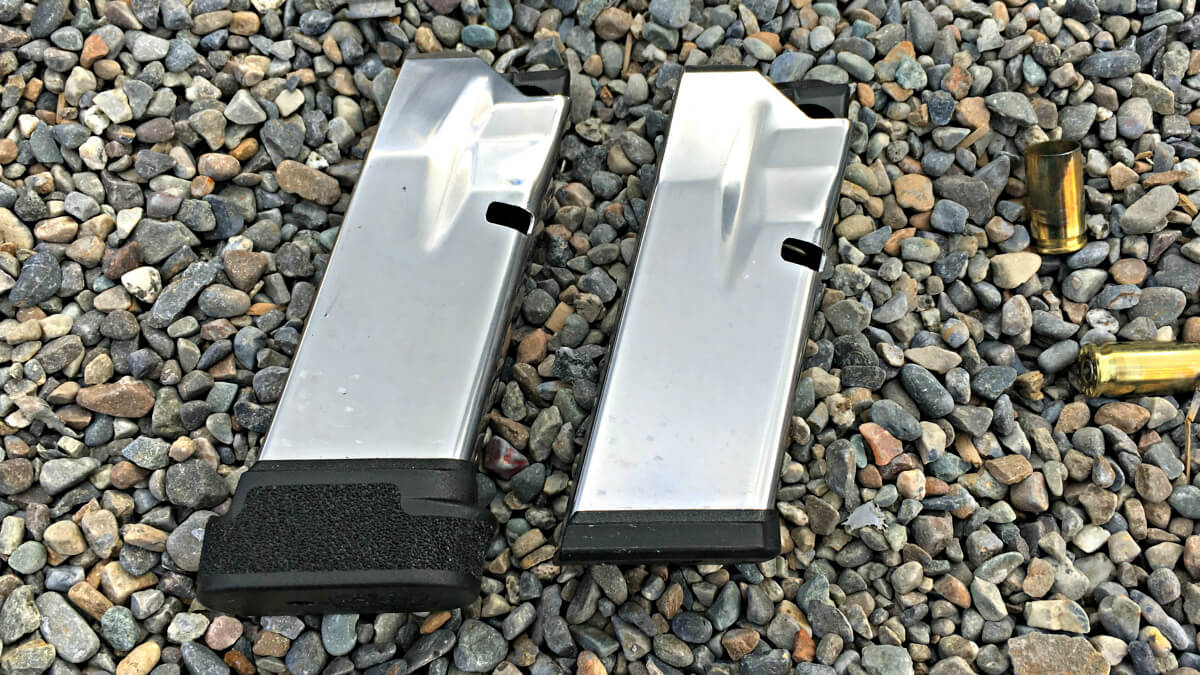
Per Justin Opinion’s review, the Hellcat Pro is 0.6 inch longer and 0.8 inch taller than the standard Hellcat, and it is the same pistol in every other way. Width does not change, which is the clever part. The original Hellcat measured 6 inches long, 4 inches tall with the flush magazine, and 1 inch wide in Loomis’s spec sheet. Grip height is what prints, so that extra 0.8 inch is the number that matters for concealment.
Capacity
The Hellcat ships with an 11-round flush magazine and a 13-round extended, so 12 or 14 with one in the chamber. The Hellcat Pro ships with 15-round flush magazines for 16 on board, and the threaded FDE OSP Graf tested came with one 15 and one 17-rounder.
Shootability
Opinion found that the longer grip gave him more leverage and reduced muzzle lift, and that every pinkie in the building fits on a Pro. Graf called his threaded Pro a bit snappier than a Glock 19 or M&P M2.0, which makes sense for a gun that is still thin and light. The standard Hellcat is fine to shoot. Loomis kept rounds on steel at 25 yards with an RMSc. But it is a 3 inch micro, and you will feel it.
Sights and Optics
Both use the U-Dot setup: a tritium dot in a bright luminescent ring up front and the Tactical Rack U-notch rear. OSP models are milled for the Shield RMSc footprint, and both reviewers co-witnessed irons through the dot. Graf notes the irons are not suppressor height.
Triggers
Loomis measured his 2019 Hellcat at about 5 to 5.5 pounds and called it exactly what he expected from a striker gun. Opinion’s Pro had the Gen 3 trigger and averaged 5 pounds 11 ounces on his gauge after a few hundred rounds. Graf measured his threaded Pro at 5.0 to 5.5 pounds with some creep past the wall.
Durability
The standard Hellcat has the stronger paper trail here. In the 20,000 round milestone test, the crew cleaned the gun every 500 rounds and swapped the recoil spring every 2,500, which is a useful maintenance baseline for any small 9mm you shoot a lot. The Hellcat Pro has not had a public torture test in our coverage, but it shares the same basic design, and neither Opinion nor Graf saw a malfunction. Treat the Pro as likely just as durable, not proven to the same round count.
Price
MSRPs from our reviews: $569 for the Hellcat and $599 for the Hellcat OSP in 2019, $634 for the Hellcat Pro in 2022, and $710 for the threaded FDE Hellcat Pro OSP in January 2024. Pricing has moved since, so check current listings.
Springfield Hellcat: Best for Deep Concealment (2026)
When the Hellcat launched, Springfield billed it as the world’s highest capacity micro-compact, and Loomis said it checked nearly every box people were asking for. Then Clay’s crew ran one production gun through 10,000 rounds of Federal American Eagle in a single day, and a second crew put another 10,000 through the same pistol with only user-induced malfunctions. Around the 15,000 round mark it slowed down from grime in the grip frame. No parts failed. That is more abuse than most carry guns see in a lifetime.
Read our full Springfield Hellcat OSP review here, plus the 10,000 round torture test and the 20,000 round milestone.
Key Specs
- Caliber: 9mm
- Capacity: 11+1 flush, 13+1 extended
- Weight: 18.3 ounces with flush magazine
- Barrel / Length: 3 inch hammer-forged / 6 inches
- Action: Striker fired, about 5 to 5.5 pound trigger as tested
- Sights / Optic Cut: U-Dot tritium front, Tactical Rack U-notch rear; OSP milled for Shield RMSc
- Price: $569, or $599 for OSP (2019 MSRP)
Pros
- Zero malfunctions in Loomis’s 300-plus round test
- Survived 20,000 rounds with only user-induced stoppages
- Up to 14 rounds in a 1 inch wide pistol
- Optic co-witnesses with the factory irons
Cons
- Short grip leaves bigger hands hanging off the flush magazine
- 3 inch barrel and light weight mean more snap
- Small rail and short sight radius
🛒 Check Current Price for Springfield Hellcat on GunsAmerica
Springfield Hellcat Pro: Best for Carry and Home Defense (2026)
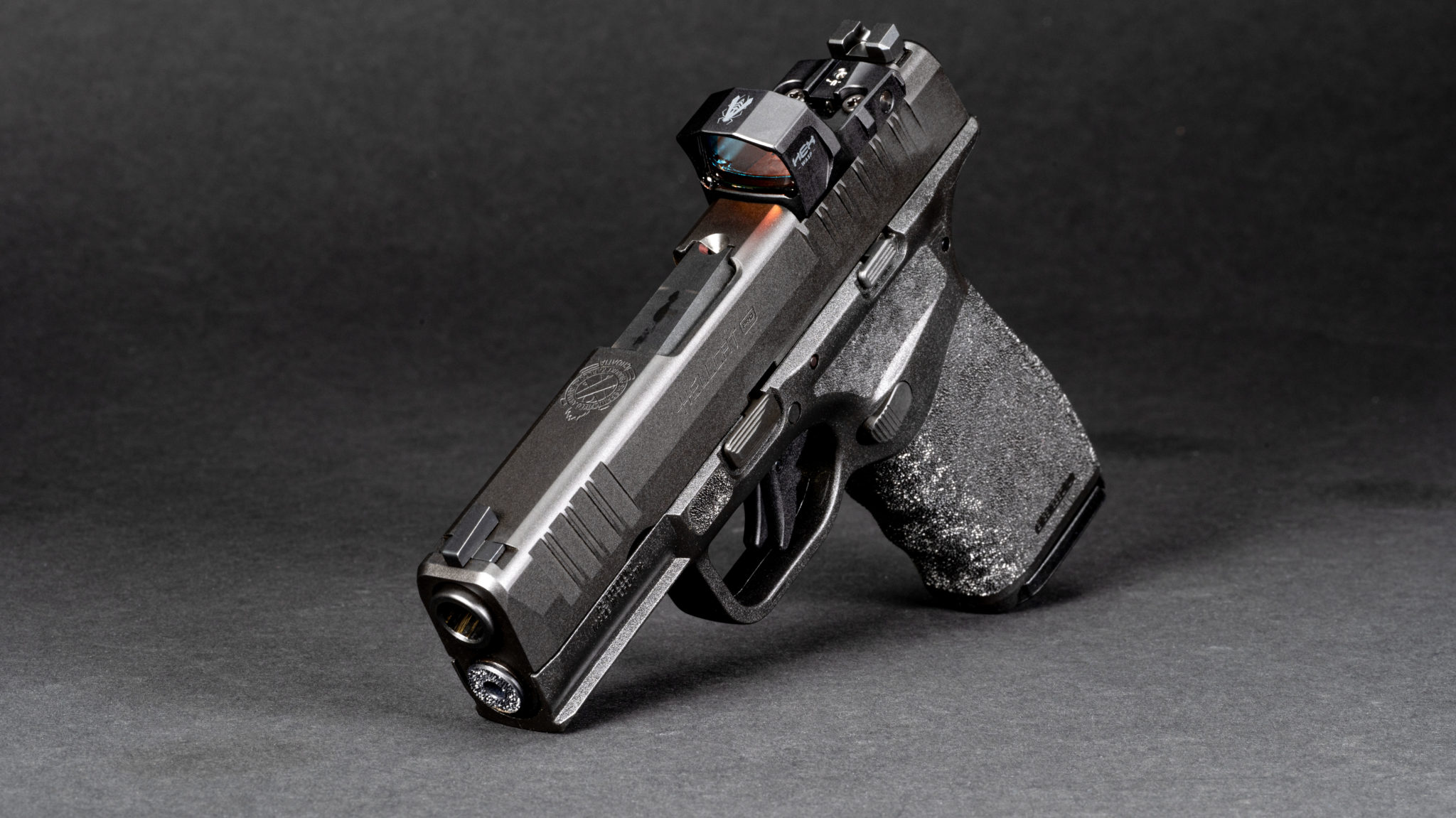
Opinion’s first impression was that the Pro feels exactly like a Hellcat, only with a full grip, and he meant that as praise. From a rest at 15 yards, every best-three-shot group was inside an inch, and his best five-shot group was just under 1.4 inches with Fiocchi 124 grain ball. The longer dust cover takes a full-size Streamlight TLR-2. Graf’s threaded FDE OSP shot five-round groups around an inch at 10 yards across five carry loads and never malfunctioned through a couple hundred rounds, suppressed and unsuppressed. His one gripe: a lot of unburned powder in the face when shooting it suppressed.
Read our full Springfield Hellcat Pro review here, and our threaded FDE Hellcat Pro OSP review.
Key Specs
- Caliber: 9mm
- Capacity: 15+1 flush; 17-round magazine available
- Weight: 22 ounces with flush magazine (threaded FDE OSP)
- Barrel / Length: 4.4 inch threaded barrel, 7.2 inches long (threaded FDE OSP); standard Pro is 0.6 inch longer than a Hellcat
- Action: Striker fired, Gen 3 trigger, 5 pounds 11 ounces average as tested
- Sights / Optic Cut: U-Dot front, U-notch rear; OSP milled for Shield RMSc
- Price: $634 (2022 MSRP); $710 for threaded FDE OSP (January 2024 MSRP)
Pros
- Sub-inch best-three groups at 15 yards in Opinion’s test
- 16 rounds on board with flush magazines
- Full-length rail fits duty-size lights
- Same 1 inch width as the micro Hellcat
Cons
- Taller grip is harder to hide under light clothing
- Graf found it snappier than a Glock 19 or M&P M2.0
- Some trigger creep past the wall in Graf’s test gun
🛒 Check Current Price for Springfield Hellcat Pro on GunsAmerica
Hellcat vs Hellcat Pro: Head to Head
- Concealment: Hellcat. Shorter grip, shorter slide, same width.
- Capacity: Hellcat Pro, 15+1 flush against 11+1.
- Shooting comfort: Hellcat Pro. Full grip and a longer sight radius.
- Proven durability: Hellcat, thanks to the 20,000 round test.
- Accessories: Hellcat Pro, with room for a full-size light.
- Price at launch MSRPs: Hellcat, by about $65.
Which Hellcat Should You Buy?
Buy the Hellcat if the gun has to disappear. Pocket-adjacent carry, gym shorts, a dress, a tucked shirt. It holds more than most micro 9mms of its era, it has a torture test behind it, and the OSP version lets you run a dot without losing your irons.
Buy the Hellcat Pro if you can hide a slightly taller grip. You get 16 rounds, a better grip for bigger hands, a rail that takes real lights, and a pistol that can pull double duty on the nightstand. Opinion’s groups say it shoots like a bigger gun, and Graf’s say it runs like one.
Either way, carry the one you will actually wear every day, and train with it. Our best concealed carry handguns guide has more options, and you can find new and used Hellcats on GunsAmerica.com.

As the Chief Operating Officer of GunsAmerica.com, Chris blends his passion for firearms with years of experience in marketing, communications, and technology. A dedicated 3-Gun competitor, firearm collector, and staunch Second Amendment supporter, he is deeply involved in the shooting community.
Beyond the firearms world, he’s an avid overlander, nature lover, and sailor.
Experience
Tech Founder:Specializing in accelerated growth and digital transformation.
Competitive Shooter: Active 3-Gun competitor with a strong foundation in practical shooting disciplines.
Advanced Training: Completed high-level courses in pistol, carbine, concealed carry, shotgun, and precision rifle.
2A Advocate: Committed to promoting responsible gun ownership, education, and 2A rights advocacy.
Outdoor Enthusiast: Avid overlander, sailor, and adventurer, with a background in self-reliance and off-grid exploration.