
Estimated reading time: 22 minutes
With the KP50, KelTec completely reworked its original P50 concept, replacing the awkward top-loading design with a drop-free magazine, machined receiver and far more practical controls. We put the new KP50 through a high-volume range session, with and without a suppressor, to find out whether the unusual 5.7x28mm pistol is more than a novelty.

This 2026 review covers the KP50 Braced Pistol we tested, current KelTec pricing for all four models, the $0 federal tax on the KP50 SBR, how the KP50 compares with the original P50 and other 5.7x28mm guns, and what to expect from its 50-round magazines. For background on the launch, see our KP50 and MP50 announcement coverage.
Table of contents
- KelTec KP50 Review: This Is Not Just Another Weird KelTec
- Watch the KelTec KP50 Review and Range Test
- KelTec KP50 Specifications: 50 Rounds of 5.7x28mm
- KelTec P50 vs. KP50: The Redesign That Changes Everything
- The KelTec KP50 50-Round Magazine Is Its Wildest Trick
- KelTec KP50 Controls and Ergonomics: Simple, but Not AR-Pattern
- KP50 Folding Brace: 18.6 Inches of Compact Weirdness
- Shooting the KelTec KP50: Mild Recoil, Serious Velocity
- KelTec KP50 Suppressed: The 5.7x28mm Gets Even More Fun
- KelTec KP50 Trigger: Service Grade and Good Enough to Run Fast
- KelTec KP50 Accuracy: Sub-Inch Potential at 50 Yards?
- KelTec KP50 Reliability: Hundreds of Hard Rounds and One Weird Failure
- KelTec KP50 Price and Models (2026): From $899 to $1,349
- Where to Buy a KelTec KP50
- KelTec KP50 SBR: Form 4 and the $0 Tax Stamp
- KelTec KP50 vs Other 5.7x28mm Carbines and PDWs
- KelTec KP50 Pros and Cons: Brilliant Redesign, Familiar Tradeoffs
- KelTec KP50 Review Verdict: Weird, Wild and Surprisingly Well Executed
- KelTec KP50 FAQ
- Related Reads from GunsAmerica Digest
KelTec KP50 Review: This Is Not Just Another Weird KelTec
KelTec has never shown much interest in making ordinary firearms.
While much of the industry competes to produce slightly different versions of familiar designs, KelTec routinely begins with a clean sheet of paper. Sometimes the result is unconventional. Sometimes it is downright strange. Almost invariably, it is interesting.
The new KelTec KP50 belongs squarely in that tradition.
It is a large-format, semi-automatic pistol chambered in 5.7x28mm, built around a horizontally oriented 50-round magazine. With KelTec’s Jungle Clip connecting two magazines back-to-back, the KP50 carries 100 rounds in a package that remains relatively flat and compact.
That description makes the gun sound like a mildly updated version of the original KelTec P50. It is not. The KP50 retains the original concept, but KelTec substantially redesigned the firearm around a more conventional and usable operating system.
The result is one of the most unusual firearms I have tested in years, but also one of the most entertaining and unexpectedly practical.
Watch the KelTec KP50 Review and Range Test
Watch our video of the KelTec KP50 range test on YouTube.
KelTec KP50 Specifications: 50 Rounds of 5.7x28mm
The gun tested was the KP50 Braced Pistol, which includes the folding pistol brace, two 50-round magazines and KelTec’s Jungle Clip magazine coupler.
| Specification | KP50 Braced Pistol |
|---|---|
| Caliber | 5.7x28mm |
| Operating system | Straight blowback |
| Barrel length | 9.6 inches |
| Barrel twist | 1:7 |
| Muzzle threads | 1/2×28 |
| Magazine capacity | 50 rounds, or 100 with Jungle Clip |
| Overall length, folded | 18.6 inches |
| Overall length, unfolded | 28.3 inches |
| Height | 6.5 inches |
| Width | 2.5 inches |
| Unloaded weight | 4 pounds |
| Published trigger pull | 6.5 pounds |
| MSRP | $1,099 |
KelTec also offers an unbraced pistol, a stock-equipped short-barreled rifle and a Defender package that adds a Vortex Crossfire red dot, Magpul MBUS backup sights and a hard case to the braced model. The Defender is sold only through KelTec Direct.
🛒 Check Current Price for KelTec KP50 on GunsAmerica
KelTec P50 vs. KP50: The Redesign That Changes Everything
The original P50 used the same basic 50-round magazine found in the FN P90 and PS90, but loading the firearm required opening its hinged upper assembly and placing the magazine between the upper and lower halves of the gun.
It worked, but it was not an especially fast or intuitive system.
The KP50 turns the magazine over and inserts it from underneath. Press the ambidextrous magazine release forward, and the magazine drops out of the bottom of the receiver. Insert another magazine, press it upward until it locks, run the charging handle, and continue shooting.
This single change transforms the character of the firearm.

KelTec retained the horizontal magazine orientation, which keeps the gun flat and prevents a long box magazine from projecting below the receiver. That matters when storing the KP50 inside a backpack, briefcase or similarly compact case. Aside from the pistol grip, there is relatively little hanging beneath the gun to catch on straps or other equipment.
KelTec also replaced much of the original gun’s polymer-heavy construction with a more substantial, metal-centric assembly. The company describes the KP50 as having a fully machined lower receiver and identifies the fire-control mechanism as its proven SU16 trigger group. It is not an AR-15 trigger system, although the replaceable B5 Systems pistol grip is familiar to anyone accustomed to an AR. KP50 feels considerably more solid than its futuristic appearance suggests. Nothing about the test gun felt flimsy or temporary.
Should P50 Owners Upgrade to the KP50?
If the P50’s top-hinged reload was your biggest complaint, the KP50 fixes it, and that alone makes it worth a hard look. You also get the machined lower receiver, the SU16-based trigger group and a drop-free magazine that can be swapped without opening the gun. If you mostly shoot your P50 slowly from a bench and don’t mind the reload, the case for upgrading is weaker.
As of October 2026, KelTec Direct still listed the P50 Defender at $879.99 but showed it as out of stock. If you plan to sell your P50 to fund a KP50, find out what your P50 is worth before you list it.
The KelTec KP50 50-Round Magazine Is Its Wildest Trick
Each KP50 magazine holds 50 cartridges arranged perpendicular to the bore. As the magazine feeds, its internal mechanism rotates each cartridge into alignment with the chamber.

KelTec’s optional Jungle Clip connects two magazines back-to-back. After firing the first 50 rounds, the shooter releases the magazine, rotates the coupled assembly 180 degrees and inserts the second magazine.

It is not a conventional reload, but it is easy to understand and surprisingly quick after a few repetitions.
The system also avoids the bulk of a vertically mounted 50 or 100-round drum. Even with two loaded magazines connected together, the assembly remains within the basic width and length of the firearm.

There is a significant drawback: loading the magazines by hand.
The first several cartridges are easy enough. Resistance increases progressively, and the final portion of the 50-round load becomes genuinely unpleasant. After loading the magazines repeatedly during a long range session, my thumb felt like it had been through a minor industrial accident.

This is not a minor consideration for anyone who plans to shoot the KP50 regularly. KelTec has developed a dedicated KP50/MP50 speedloader, and its launch announcement listed the loader with the Defender package. However, KelTec’s current KP50 page (checked October 2026) describes the Defender as the braced model plus a Vortex Crossfire, Magpul MBUS sights and a hard case, with no loader mentioned, so confirm what is in the box before ordering. Either way, the loader is likely to be one of the most useful accessories available for the platform.
KelTec KP50 Controls and Ergonomics: Simple, but Not AR-Pattern
The safety is ambidextrous and positioned beneath a protective ledge formed by the upper receiver. It remains easy to reach with the firing-hand thumb, but the receiver helps prevent it from being inadvertently moved while the gun is carried in a bag.

The non-reciprocating charging handle resembles an AR charging handle in placement and basic operation. It can be pulled from one side, but it is noticeably easier to operate by gripping both sides evenly.

A continuous Picatinny rail runs along the top of the receiver. There is enough space for a red-dot sight, magnifier, backup sights, light mount or other accessories. Because the rail is part of the receiver rather than a removable handguard, optics and aiming devices have a stable mounting surface.
The bottom of the gun does not provide an accessory rail or M-LOK slots. A light can still be offset from the top rail.

The factory B5 pistol grip is comfortable and familiar. Shooters with large hands may notice the upper portion of the folding brace contacting the firing hand. After a substantial number of rounds, I developed a small hot spot on top of my thumb where it rubbed against the brace. It was not serious, but grip position and hand size will determine whether another shooter experiences the same thing.
KP50 Folding Brace: 18.6 Inches of Compact Weirdness
The side-folding brace is one of the KP50’s most useful features.
Pressing downward on the hinge allows the brace to fold alongside the receiver. Opening it does not require pressing a release button. The shooter simply pulls it into position until it locks.

More importantly, the KP50 remains mechanically operable with the brace folded. The brace does not interfere with the ejection port, charging handle, safety, magazine or trigger. It can therefore be fired from its folded condition before the brace is deployed.
Folded, the KP50 measures 18.6 inches long. It is not a conventional holster pistol, but it is short and flat enough for many backpacks and discreet equipment cases.
An integrated QD sling cup near the rear adapter provides another carry option.
Shooting the KelTec KP50: Mild Recoil, Serious Velocity
The KP50 is exceptionally easy to shoot.
The 5.7x28mm cartridge already produces relatively mild recoil, and the KP50 combines it with a 9.6-inch barrel, four-pound unloaded weight, and a straight-blowback operating system. The result is a recoil only slightly greater than a rimfire firearm.
The gun barely moves between shots. Keeping a red dot on target during rapid fire requires little effort, and shooters who struggle with heavier recoil should find the KP50 unusually manageable.
Its longer barrel also allows the 5.7x28mm cartridge to perform closer to its potential.
During chronograph testing, our standard supersonic ammunition produced velocities slightly above 2,000 feet per second. That was a substantial improvement over the performance I have seen from several conventional 5.7mm handguns.

The difference was also apparent on steel. Some lightweight 5.7mm loads fired from shorter pistols have struggled to knock over plate-rack targets. The KP50 hit those same plates with noticeably more authority and knocked them down consistently.
We also tested reduced-velocity ammunition marketed for suppressed use. It functioned without difficulty, but chronographed at approximately 1,250 feet per second. That higher velocity is likely due to the longer barrel. Under our environmental conditions, that was still supersonic. The suppressor reduced muzzle blast substantially, but the ammunition continued to produce an audible supersonic crack.
KelTec KP50 Suppressed: The 5.7x28mm Gets Even More Fun

The KP50 comes with a standard A2-style flash hider installed on its 1/2×28 threaded muzzle.
For testing, we removed the factory muzzle device and installed a SIG flow-through suppressor. The gun ran well with the suppressor and did not exhibit an obvious increase in operating problems until very late in the high-volume session.

The combination was especially pleasant and hearing safe with all the ammo but was noticeably quieter with the lower-velocity ammunition. Even though the projectiles remained supersonic during our test, reducing the muzzle blast made the gun considerably more comfortable to shoot.
Suppressors can increase fouling and operating stress in some straight-blowback firearms. A low-backpressure or flow-through design is a sensible choice for the KP50, particularly during sustained strings of fire.
KelTec KP50 Trigger: Service Grade and Good Enough to Run Fast

KelTec publishes the trigger pull at 6.5 pounds.
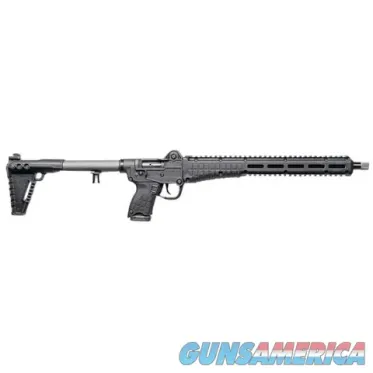
Available on GunsAmerica Now
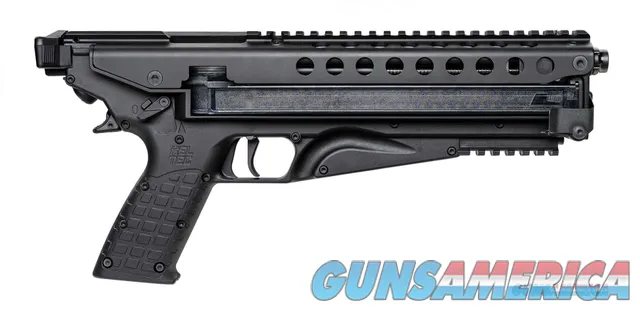
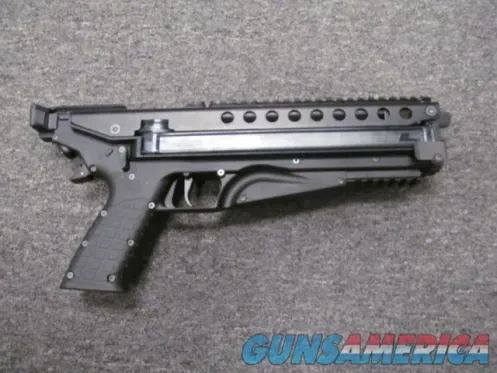
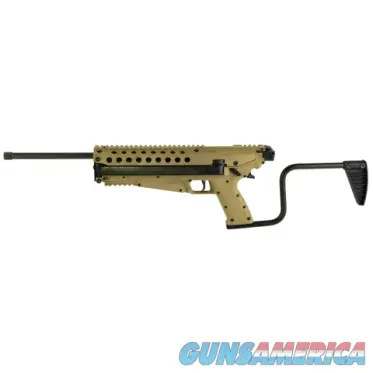

The trigger on our test gun was best described as a service-grade trigger. It had some perceptible movement and creep, but it was neither excessively heavy nor difficult to manage. It also improved as the gun was fired.
This is not a match trigger, and the KP50 is not presented as a precision competition pistol. The trigger is entirely adequate for rapid shooting and practical accuracy.

We experienced no light primer strikes, failures to fire or other ignition problems during testing.
KelTec KP50 Accuracy: Sub-Inch Potential at 50 Yards?
The KP50 appears to be capable of better accuracy than its appearance might suggest.
At 50 yards, horizontal dispersion was extremely small. Most of my group enlargement occurred vertically, which I attribute primarily to my astigmatism and difficulty resolving the red-dot aiming point.
Based on the target, I believe the firearm has sub-inch potential at 50 yards with suitable ammunition, magnification, and a shooter who can see the aiming point clearly. That is an informed estimate, not a formal accuracy claim. I would want to repeat the test from a stable rest with a magnifier before publishing a definitive group average.
Even without magnification, the KP50 was more accurate than necessary for steel targets and rapid practical shooting at typical pistol distances.
KelTec KP50 Reliability: Hundreds of Hard Rounds and One Weird Failure
The KP50 ran reliably through most of an unusually demanding range session.
We fired it rapidly, conducted repeated magazine dumps, used inexpensive ammunition, and ran it suppressed. We did not stop to clean or lubricate the gun during the session.
Near the end of testing, we encountered one strange malfunction. A fired case became lodged around an opening in the bolt assembly. While clearing it, I removed the case before dropping the magazine. A live cartridge subsequently disappeared into the receiver and became trapped beneath the bolt and recoil-spring assembly.

The bolt eventually stopped closing, forcing us to field strip the gun and retrieve the loose cartridge.
I cannot assign that malfunction conclusively to the firearm. It could have begun with an ammunition problem, excessive fouling, insufficient lubrication or the suppressed firing schedule. My clearing procedure then contributed to the second portion of the problem by allowing a live round to enter an area where it did not belong.
The useful lesson is that unconventional firearms require familiarization. The KP50’s internal layout and magazine system differ from those of common rifles and pistols. Owners should learn the correct unloading, malfunction-clearing, and disassembly procedures before relying on instinct developed with an AR-15 or conventional handgun.

Field stripping itself is relatively simple. Removing the lower receiver exposes the bolt and dual recoil springs, giving the user good access for inspection and cleaning.

The KP50 does not lock its bolt open after the final round, and it has no separate bolt-release control. After inserting a loaded magazine, the shooter must manually cycle the charging handle.
That is slightly slower than a conventional bolt-lock reload, although running through 50 rounds before each reload makes the difference less significant than it would be on a lower-capacity firearm.
KelTec KP50 Price and Models (2026): From $899 to $1,349
KelTec currently lists four commercial KP50 configurations. The MSRPs below come from KelTec’s KP50 page and were checked in October 2026. KelTec Direct, the company’s own online store, listed the standard KP50 at $899.99 to $1,099.99 depending on configuration and the Defender at $1,349.99. The select-fire MP50 is built for military and law enforcement use, and KelTec lists its pricing as available on request.
KP50 Pistol, $899: The base pistol includes one 50-round magazine and a rear Picatinny rail for mounting a brace or other accessory. KelTec lists it at 3.2 pounds unloaded, compared with 4 pounds for the braced model.
KP50 Braced Pistol, $1,099: This is the model tested. It includes the side-folding brace, two 50-round magazines and Jungle Clip.
KP50 SBR, $1,099: The SBR replaces the brace with a folding stock and includes two magazines with the Jungle Clip. It is sold as an NFA-regulated short-barreled rifle, which means an approved ATF Form 4, but no longer a $200 tax stamp (details below).
KP50 Defender, $1,349: The Defender includes the braced configuration, a Vortex Crossfire optic, Magpul MBUS sights and a hard case. It is available exclusively through KelTec Direct. KelTec’s launch announcement also lists the KP50/MP50 speedloader, although the current product page does not identify the loader in its brief package description. Buyers should verify current included equipment when ordering.
Where to Buy a KelTec KP50
The KP50 Pistol, Braced Pistol and SBR are sold through dealers, while the Defender is a KelTec Direct exclusive. Like any handgun bought online, a KP50 has to ship to a licensed dealer, where you complete the background check and transfer paperwork before taking it home. The SBR adds an approved ATF Form 4 to that process.
You can check current KelTec KP50 listings on GunsAmerica. If you are selling another gun to help pay for one, list it on GunsAmerica.
KelTec KP50 SBR: Form 4 and the $0 Tax Stamp
The KP50 SBR pairs the 9.6-inch barrel with a side-folding stock, which makes it a short-barreled rifle under the National Firearms Act. For decades, that meant a $200 tax stamp. The One Big Beautiful Bill Act, which became law on July 4, 2025, cut the federal NFA making and transfer tax to $0 for short-barreled rifles, short-barreled shotguns, suppressors and AOWs, effective January 1, 2026. ATF published its conforming final rule in the Federal Register on May 8, 2026 (document 2026-09155). Machine guns and destructive devices still carry the $200 tax.
What did not change is the process. Buying a KP50 SBR still requires an approved ATF Form 4 before the dealer can hand it over, along with fingerprints, a photograph, a background check and a copy of the form sent to your chief law enforcement officer. Some states prohibit or restrict short-barreled rifles, so confirm your state and local laws before you order one.
If you would rather skip the NFA process, the Braced Pistol we tested is sold as a pistol and carries the same $1,099 MSRP.
KelTec KP50 vs Other 5.7x28mm Carbines and PDWs
The KP50 lands in a small but growing field of 5.7x28mm long guns and large-format pistols. Here is how it compares on paper with the most common alternatives, using manufacturer specs and prices checked in October 2026. We have not tested these head to head with the KP50, so this is a spec and price comparison, not a range verdict.
| Firearm | Type | Barrel | Magazine Capacity | Price |
|---|---|---|---|---|
| KelTec KP50 Braced Pistol | Braced pistol | 9.6 inches | 50, or 100 with Jungle Clip | $1,099 MSRP |
| KelTec R50 | Carbine | 16 inches | 50 | $653.99 at KelTec Direct |
| FN PS90 | Carbine | 16 inches | 10 or 30 | $2,330 MSRP |
| Ruger LC Carbine 5.7x28mm (model 19300) | Carbine | 16.25 inches | 20+1 | $1,039 MSRP |
| Ruger-57 | Pistol | 4.94 inches | 20+1 | $549 MSRP |
KelTec’s own R50 is the obvious sibling. It is a 50-round carbine with a 16-inch threaded barrel, and at $653.99 on KelTec Direct it costs less than any KP50. With that 16-inch barrel, though, it is a full-length rifle rather than an 18.6-inch folded package. Read our full KelTec R50 review here.
The FN PS90 is the civilian carbine version of FN’s P90, and its $2,330 MSRP is more than double the price of a braced KP50. FN lists it with 10 or 30-round magazines.
Ruger’s LC Carbine in 5.7x28mm lists for $1,039 in its standard 20-round configuration, with a 16.25-inch threaded barrel and a folding, adjustable stock. Read our launch coverage of the 5.7x28mm LC Carbine.
If you mainly want a 5.7x28mm handgun, the Ruger-57 is far smaller and lists for $549. As our chronograph numbers showed, though, shorter pistol barrels give up velocity compared with the KP50’s 9.6-inch tube. Read our full Ruger-57 review here, and see our best 5.7×28 pistols guide for more options.
KelTec KP50 Pros and Cons: Brilliant Redesign, Familiar Tradeoffs
- Pros: Exceptionally mild recoil, 50-round capacity, 100 rounds with the Jungle Clip, practical bottom-loading magazine system, compact folded profile, solid machined construction, strong practical accuracy, stable top rail, threaded muzzle and entertaining range performance.
- Cons: Hand-loading 50-round magazines becomes unpleasant, no last-round bolt hold-open, no separate bolt release, unconventional manual of arms, possible brace contact for larger hands, and 5.7x28mm ammunition costs more than 22 LR.
KelTec KP50 Review Verdict: Weird, Wild and Surprisingly Well Executed
The KP50 is not for everyone, and KelTec clearly did not design it to be.
It is heavier and larger than a conventional handgun. It lacks a last-round bolt hold-open, and its unusual internal arrangement requires the shooter to learn a different manual of arms.
Ammunition cost will also discourage casual shooters from treating it like a rimfire plinker, no matter how mild the recoil feels. A 50-round box cost us $29 at the time of testing, so it’s not ridiculously expensive but also not cheap like 22 LR.
Within those limitations, however, the KP50 is a remarkably successful redesign.
The new bottom-loading magazine corrects the original P50’s most awkward feature. The machined construction feels substantial. The folding brace, flat magazine orientation and uninterrupted top rail produce a compact package that is easy to configure and transport. Recoil is almost nonexistent, practical accuracy is excellent and the 9.6-inch barrel produces a meaningful increase in velocity compared with shorter 5.7mm pistols.

Most importantly, the KP50 is enjoyable to shoot.
That may sound like faint praise, but it is not. Firearms do not always need to imitate existing service weapons or satisfy a narrowly defined tactical requirement. There is still room in the market for a well-built, mechanically interesting gun that is accurate, reliable under reasonable conditions, and genuinely fun on the range.
The KP50 is strange, but it is not strange merely for the sake of attracting attention. Its unusual shape follows an unusual mechanical solution: fitting 50 or 100 rounds of 5.7x28mm into a compact firearm without hanging a large magazine underneath it.
KelTec took an intriguing but awkward concept and turned it into a much more mature platform. The KP50 remains unmistakably KelTec, but this time the unconventional engineering is paired with unexpectedly good execution.
KelTec KP50 FAQ
How much does the KelTec KP50 cost?
KelTec lists the KP50 Pistol at $899, the Braced Pistol at $1,099, the SBR at $1,099 and the Defender at $1,349 (KelTec MSRPs, October 2026). Dealer prices vary.
How many rounds does the KP50 hold?
Each magazine holds 50 rounds of 5.7x28mm. The Braced Pistol, SBR and Defender include two magazines and the Jungle Clip for 100 rounds on board. The base Pistol includes one magazine.
Is the KelTec KP50 an SBR?
Only the KP50 SBR model. It requires an approved ATF Form 4, but the federal tax on SBRs has been $0 since January 1, 2026. The Pistol, Braced Pistol and Defender are sold as pistols.
What is the difference between the KelTec P50 and KP50?
The P50 loads from the top through a hinged upper. The KP50 takes its magazine from underneath, drops it free, and adds a fully machined lower receiver and an SU16-based trigger group.
Is there a KelTec KP50 speedloader?
Yes. KelTec developed a dedicated KP50/MP50 speedloader. Its current KP50 page does not list the loader with the Defender, so confirm the package contents when you order.
How fast is 5.7x28mm from the KP50?
Our standard supersonic ammunition ran slightly above 2,000 feet per second from the 9.6-inch barrel, and reduced-velocity suppressor ammo ran about 1,250 feet per second.
Related Reads from GunsAmerica Digest
- KelTec P50 Full Review: King of the 5.7
- Finally! A Pistol with a CLIP! KelTec PR57
- The PX-5.7 Pistol from SDS Arms

As the Editor-in-Chief of GunsAmerica, Hunt365, Decoding Darkness, and Suppressor Academy, True Pearce brings a rare blend of legal expertise, competitive shooting credentials, and deep hunting knowledge to the forefront of the firearms world. A former professional sponsored 3-Gun and Multigun competitor with multiple championships and titles, True’s shooting career began in long-range and tactical sniper matches—and he still burns powder in precision competitions, now branching into Hunter NRL.
A certified firearms instructor who has trained over 10,000 students face-to-face, True has also served on both sides of the courtroom as an attorney and currently as an elected Prosecuting Attorney. He has prosecuted and defended high-profile self-defense and firearms cases, giving him a unique, real-world perspective on the Second Amendment.
Outside the courtroom and off the range, True is a true western outdoorsman. A lifelong hunter and rancher, he rides and hunts off his own string of horses and pack animals, chasing elk, mule deer, wolves, coyotes, and anything else in season. He’s a longtime reloader, producing both precision rifle ammo and, back in the day, handloading over 40,000 rounds of 9mm and 5.56 annually for competition.
He’s also a thermal and night vision expert, known for his obsession with high-end optics, and is rarely found without a camera or a guitar nearby. Whether he’s glassing a distant ridge, reviewing cutting-edge gear, or deep in legal research, True brings passion, precision, and grit to everything he does.
Experience:
– Professional Shooter – Sponsored 3-Gun & Multigun competitor with multiple titles and a foundation in long-range and sniper/tactical matches.– Firearms Instructor – Certified instructor with over 10,000 students trained face-to-face.– Elected Prosecuting Attorney – Attorney with real-world experience defending and prosecuting self-defense and gun-related cases.– Hunter & Rancher – Horseback hunter with a working ranch, passionate about elk, deer, predator, and backcountry hunting.– Reloading & Ballistics Expert – Precision reloader and former high-volume competition handloader.– Optics Authority – Known for his deep knowledge and unrelenting standards in optics, thermal, and night vision gear.– Outdoor Creative – Avid photographer, guitar player, and outdoorsman with a sharp eye for gear and storytelling.– 2A Advocate – Committed to protecting the Second Amendment and educating Americans about their rights and responsibilities.
I can’t wait to see what the ‘hood-rats’ name these as they trickle out on to the streets. “Chopper Junior” maybe?
From that disastrously clumsy POS to the best ever GOAT? Kel Tec should offer a full refund AT THE STUPID HIGH PRICE to any customer or dealer who was saddled with that unusable/unsellable original.