

Estimated reading time: 14 minutes
Three classic Winchester rifles step back into the field, and none of them are museum pieces. From a .308 Winchester Model 88 to a 1952 Model 70 in .270 Win. and a 1904 Winchester 1894 takedown in 30wcf, this is Old School Cool with dirt, blood, and hunting stories still attached.

Old School Cool – Part 1
Old School Cool – Part 2
Old School Cool – Part 3
Old School Cool – Part 4
Old School Cool – Part 5
Old School Cool – Part 6
Table of contents
- Three Classic Winchester Rifles With Real Field Miles
- Old School Cool Table of Contents
- Winchester 88 in .308 Win: A Leveraction That Still Works for a Living
- The Ubiquitous 308win. Still Does Almost Everything
- Winchester Model 70: A 1952 Rifleman’s Rifle in the Antelope Fields
- The Classic 270win. With Modern Bullet Muscle
- Blooding a Borrowed Pre-64 Model 70
- Good Friends, Good Times, and One Classic Winchester
- Winchester 1894 Takedown: A 1904 Leveraction With Work Left To Do
- 30wcf, 30-30win., and the Cartridge That Built a Legend
- Sight Corrections for a 100+ Year Old Hunting Rifle
- A Hunting Sight You Can Actually See When It Counts
- Got Lucky With a 1904 Winchester 1894 and a Muddy Pond Pig
- Pre-64 Winchester Rifle Specs and Field Notes
- Pros and Cons: Three Winchester Classics That Still Earn Their Keep
- Related Reads from GunsAmerica Digest
Three Classic Winchester Rifles With Real Field Miles
Three Winchesters this time, for many, the absolute epitome of Old School Cool. All pre-64 models are lever actions, and one is a Model 70. The youngster of the group is a Model 88 in 308win. from 1956. The Model 70 is not only pre-64, but also in the iconic 270win. caliber and of 1952 vintage. The old man of the trio is over 110 years old, a 1894 takedown in 30wcf. (30-30), from 1904.
Old School Cool Table of Contents
- Winchester 88 in .308 Win: A Leveraction That Still Works for a Living
- The Ubiquitous 308win. Still Does Almost Everything
- Winchester Model 70: A 1952 Rifleman’s Rifle in the Antelope Fields
- The Classic 270win. With Modern Bullet Muscle
- Blooding a Borrowed Pre-64 Model 70
- Good Friends, Good Times, and One Classic Winchester
- Winchester 1894 Takedown: A 1904 Lever Action With Work Left To Do
- 30wcf, 30-30win., and the Cartridge That Built a Legend
- Sight Corrections for a 100+ Year Old Hunting Rifle
- A Hunting Sight You Can Actually See When It Counts
- Got Lucky With a 1904 Winchester 1894 and a Muddy Pond Pig
Winchester 88 in .308 Win: A Leveraction That Still Works for a Living
The 88 had been purchased ten years previously; it came to me as a barreled action. At which point I bedded the action into a Boyd’s laminated stock. The completed rifle was almost immediately placed into action, accounting for a large feral pig and a nice South Texas buck. I initially used standard 150gr. projectiles, but when terminal performance was less than expected, I attempted to move to a 165gr. projectile. Poor accuracy ensued, and I discovered two issues. The first being the rifle had a 1 in 12” rifling twist, the other being my mount had loosened up. Obviously, the loose mount would affect accuracy, but I’d already decided I would revert to 150gr. bullets as well.

I would make up for the terminal performance deficit by using a premium bullet. The move to a 150gr. The Nosler partition was a “no-brainer”; I’d had great success with the partition bullet, and its performance is consistent. Since the rifle was most likely not seen in use outside of medium game, a 150gr. The projectile would not hinder or lessen its potential use. If I decided to go with an all-copper bullet of 150gr. I should be able to handle a game as large as elk or the big Carolina black bears.
The Ubiquitous 308win. Still Does Almost Everything
The 308win. in the 88 produces good velocity with its 22” barrel, and the 3 lug rotary bolt lock up provides plenty of strength. The caliber is suitable for most anything in the World except only the biggest and baddest. Using proper bullets, it is at home being used on moose or varmints. Accuracy has been enhanced and consistent by permanently bedding the rear attachment point to the stock with bedding compound. Bedding the action and forend attachment bushing to the stock helps keep shifting and pressure consistent. Playing with the tension used for the forend screw allowed me to find the optimum amount, then locktite it in place.

The rifle weighs just over 8.5 pounds, wearing a Burris RT6, which puts it right in that comfortable carry zone for sneaking around thickets or brush. The caliber makes it a great all-purpose gun, and the accuracy provided makes it effective out to 250 yards and beyond. My load with the 150gr. Partitions get 2740fps, sighted 2” high at 100, provides a 200-yard zero. The lever action allows for rapid follow-up shots or the ability to engage multiple targets. Given that I spend much of my time doing abatement work on pigs, the multiple target opportunities are plentiful.

Winchester Model 70: A 1952 Rifleman’s Rifle in the Antelope Fields
The Model 70 is a 1952 vintage gun. It belongs to a good friend, Ryan Muckenhirn, who works for Vortex Optics. I had traveled to Wyoming for our annual antelope camp and locked my rifles in my Truck Vault. Then somewhere along the trip, I lost the key I had to the vault. While I had my handguns available, I was not able to close the distance enough to bring them into play. Ryan offered me his new-to-him Winchester to use for my doe tag.
The Classic 270win. With Modern Bullet Muscle
It was a privilege to use this pre-64 gun for my goat. The rifle is topped with a period-correct Redfield 3-9x and vintage Redfield mounts and rings. The caliber gained fame and infamy from early gunwriters, Jack O’Connor and Elmer Keith. However, neither had the benefit we have today of modern monometal projectiles. This M70 uses a 130gr. Barnes TTSX, and velocity is chrono’d at 3200fps. The modern bullet elevates the performance of all calibers using it. Ryan says accuracy is sub-MOA. The load was quickly sighted at the Vortex indoor range with an impromptu 50-yard zero, just prior to leaving.

Blooding a Borrowed Pre-64 Model 70
When we spotted the small herd with my doe in it, they were about 700 yards away. Ryan and I decided to sneak over to a cliffside and get above them and then drop down. While we moved towards the cliff side, the antelope moved into a low spot. That allowed us to slip from their view and gain 200-300 yards by following a drainage. As we moved forward, they moved towards us to avoid a small hill with vertical sides. This placed the entire herd inside 250 yards. I picked out my doe and settled in. I was focused on my animal, and when the shot broke, I realized I’d missed completely. However, the doe lingered long enough for me to reacquire and deliver a shot as she quartered towards me. The shot landed on her shoulder, and on impact, she ran a few yards and disappeared.
Good Friends, Good Times, and One Classic Winchester
When we walked forward, my doe was dead after having moved 20-30 yards. I realized that my miss was due to being in an awkward prone position and the rifle not securely in my shoulder. The rifle is a classic from a bygone era. Luckily, it has found a home with someone who can appreciate it for what it is. Ryan appreciates the classic utility of the rifle, and the fact that its previous owner is also a good lifelong friend makes it that much more special. It will continue to make memories as well as recall memories while carried afield. I was grateful for the opportunity to use it and be allowed to blood it prior Ryan’s doing so. Good friends and Good times.
Winchester 1894 Takedown: A 1904 Leveraction With Work Left To Do
The last of our little Winchester herd is a rifle that belonged to a long lost relative of mine. It came to me in a round about way, a pair of twin uncles had received it through an inheritance. They were not gun guys, and so forwarded it to my father, who they knew owned guns. It was in working condition, but overall it needed help. The rifle was a 94 Takedown, from 1904, an old gun from a time when train travel was normal. Airplane flight was a year old and traveling with a gun as luggage was as common as socks and underwear.

It was loose and the magazine tube was dented, only allowing 3 rounds to be placed in the tube. The barrel is octagon and 26 inches long, the rifle wears a Lyman tang sight. The mag tube was an easy fix, by using a steel rod of proper diameter. Pushing it in and lightly tapping the tube with a small hammer allowed the magazine follower to smoothly slide. Once that was fixed, I focused on tightening up the two receivers for a safe and secure lock up. Adjusting the Winchester plates that abut each other when joined together was simple enough. I now had a tight, and fully functioning 100+ year old leveraction.
30wcf, 30-30win., and the Cartridge That Built a Legend
The 30wcf (Winchester centerfire) is better known as the 30-30. It was developed as a modern smokeless powder caliber. The -30, being the amount of standard smokeless powder used in its loading. Both the caliber and the Winchester 1894 are often imagined synonymously. Because of the age of my 1894, I decided to use cast bullets and mild load. Using 150gr. cast bullets and a starting load for Reloder 7 powder, still velocity was 2275fps. Accuracy was good enough for use out to 150 for deer and pigs. However the load printed 12” high at 50 yards with the tang sight on its lowest setting. A taller front sight would need to be ordered or a lighter bullet used, to lower the impact. After measuring the necessary details I used my math skills to arrive at needing .256 inch of correction on a new front sight for a desired impact.

Sight Corrections for a 100+ Year Old Hunting Rifle
I went with a bit more correction than needed so I could raise the rear tang sight a bit as well. A .450 front was obtained and installed, then the gun was properly zeroed. The rifle produced 3-4” groups at 100 yards, with the group landing just over the front sight. The flat nose and hollow point cast bullets were chosen, both with powder coating and gas check applied. A period correct Beech’s front sight has been acquired and will be placed on the rifle after I hunt with it.

A Hunting Sight You Can Actually See When It Counts
My favorite front sight for hunting is a fiber optic type. Many will claim that the best sights for iron sight shooting are plain black. I have discovered that the best sights, are ones you can see, and a fiber optic front is no doubt going to be seen even in low light. So I placed a green fiber optic front sight on the rifle for my hunting purposes. It paired well with the Lyman tang sight and proved easy to center the glowing green dot in the middle of the tang sight opening. The rifle would require as precise non rushed aiming as I could manage, for accurate shooting out to 150 yards.
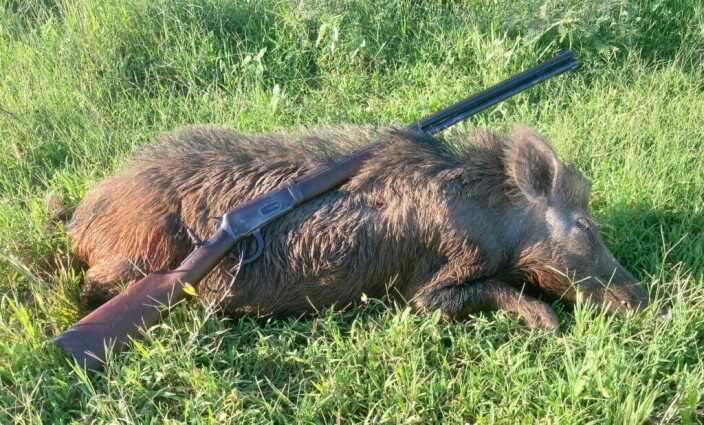
Got Lucky With a 1904 Winchester 1894 and a Muddy Pond Pig
I lucked out one hot and humid afternoon while sitting on a small pond. I was situated 99 yards from the far end of the pond. When a sow pig came in and plopped herself down in the muddy water to cool off. She only had about 5 inches of her body and head visible as she lay in the water. Knowing she would stay there for awhile I took my time getting a good rest and acquired her in the sights. When she stopped rolling around I prepared for her to stand. When she did I had her whole body in the sights and placed the green dot halfway into the water and squeezed the trigger. At the shot I heard the bullet hit her, she took off on a short run and piled up about 50 yards away from where she stood.

The cast hollow point had completely penetrated and left a decent sized exit hole. Impact was just behind the shoulder and midway up the body, both lungs had been hit. The rifle still worked as designed and would now be retired from my use. As far as I was concerned it had earned a well respected place in my personal inventory. All three Winchesters are classic Americana, and with our 250th year it seemed appropriate to finish off this article with the oldest. Stay tuned for a few more Old School Cool articles, I hope you’ve enjoyed them.
Pre-64 Winchester Rifle Specs and Field Notes
| Model | Winchester 88 | Winchester Model 70 | Winchester 1894 Takedown |
|---|---|---|---|
| Vintage | 1956 | 1952 | 1904 |
| Caliber | 308win. | 270win. | 30wcf. (30-30) |
| Barrel Length | 22” | Not stated | 26 inches |
| Rifling Twist | 1 in 12” | Not stated | Not stated |
| Optic or Sight | Burris RT6 | Redfield 3-9x with vintage Redfield mounts and rings | Lyman tang sight with .450 front sight and green fiber optic front sight |
| Bullet or Load | 150gr. Nosler partition | 130gr. Barnes TTSX | 150gr. cast bullets and a starting load for Reloder 7 powder |
| Velocity | 2740fps | 3200fps | 2275fps |
| Zero or Impact Notes | Sighted 2” high at 100, provides a 200 yard zero | Impromptu 50 yard zero | Printed 12” high at 50 yards before sight correction |
| Accuracy or Range | Effective out to 250 yards and beyond | Sub-MOA | 3-4” groups at 100 yards, accurate shooting out to 150 yards |
| Weight | Just over 8.5 pounds wearing a Burris RT6 | Not stated | Not stated |
| Capacity | Not stated | Not stated | Magazine tube was dented, only allowing 3 rounds to be placed in the tube |
Pros and Cons: Three Winchester Classics That Still Earn Their Keep
- Pros: The Winchester 88 gives fast leveraction follow ups, strong 3 lug rotary bolt lock up, useful 308win. performance, and enough accuracy for 250 yards and beyond.
- Pros: The 1952 Winchester Model 70 brings classic pre-64 handling, 270win. authority, period correct glass, and modern 130gr. Barnes TTSX performance at 3200fps.
- Pros: The 1904 Winchester 1894 Takedown still functions, still groups well enough for hunting, still carries family history, and still puts cast bullets through pigs.
- Cons: The Winchester 88 needed bedding work, proper forend screw tension, and a return to 150gr. bullets after 165gr. accuracy proved poor.
- Cons: The Model 70 missed once when the rifle was not securely in the shoulder from an awkward prone position, which was shooter more than rifle.
- Cons: The 1894TD needed magazine tube repair, takedown lock up tightening, sight correction, and careful non rushed aiming for accurate shooting out to 150 yards.
Related Reads from GunsAmerica Digest
- Winchester Model 70 Featherweight Review: Still King?
- Winchester 94 Review: The .30-30 Legend
- Lever Actions Still Rule Deer Season

Trapr Swonson,…hunter, trainer, competitor, owner operator Trapr Ltd., retired firefighter/first responder, and Hunt365 writer.
I’d be called a traditionalist. I like and appreciate the latest tech, but really enjoy doing things the old ways.
Experience/Qualifications