
Estimated reading time: 14 minutes
High-pressure hybrid brass could change what shooters expect from short-barrel rifles. After more than two years experimenting with the 375 Raptor, I’ve seen results that make the future of compact rifle performance look very interesting.
Table of contents
- 375 Raptor Hybrid Brass: Big Velocity From a Short Barrel?
- 80,000 PSI Ammunition: Why Hybrid Brass Is Changing the Game
- High-Pressure Magnum Cartridges: What’s Holding Them Back?
- 375 Raptor Hybrid Brass: Inside My Two-Year Experiment
- SIG Fury Hybrid Cases: Availability, Headstamps, and Consistency
- What the 375 Raptor Case Experiment Revealed
- Annealing, Material Properties, and Hybrid Case Research
- 375 Raptor Case Geometry: Comparing the Finished Results
- Case Trimming Equipment and the Importance of Consistency
- High-Pressure 375 Raptor: Performance Versus Safety
- 11-Inch 375 Raptor Performance: The Result That Got My Attention
- 375 Raptor Hybrid Brass: Key Specifications and Reported Observations
- 375 Raptor Hybrid Brass: The Promise and the Tradeoffs
- Final Verdict: Is Hybrid Brass the Future of the 375 Raptor?
375 Raptor Hybrid Brass: Big Velocity From a Short Barrel?
How do we keep the velocities that we have come to expect from our modern rifle systems, while also chopping 6-8″ off of the barrel length so we can comfortably add a suppressor onto the muzzle end? High-pressure ammunition. I’ve been experimenting for over two years with high-pressure hybrid brass formation and load development using the 375 Raptor. I’m here to explain why this technology interests me, discuss the advantages, and share my personal results.
The goal is pretty simple. I want the velocity performance that makes a rifle effective, but I don’t necessarily want the barrel length that traditionally comes with it. Add a suppressor to a full-length barrel and suddenly that handy hunting rifle starts feeling like a fishing pole.
That’s why high-pressure ammunition technology caught my attention. If modern cartridge cases can support a new class of ammunition designs, there’s a lot of potential for people who want compact rifles without giving up the performance they’re accustomed to.
80,000 PSI Ammunition: Why Hybrid Brass Is Changing the Game
Your uncle Mike has been reloading 300 Win. Mag to bolt-shearing peak pressures for decades, so what’s so interesting about the new “technology” that we’ve seen in the past few years that advertises peak pressures in the 80,000 PSI range?
SIG released the 277 SIG Fury (6.8x51mm) with its hybrid steel/brass design. Then we see Federal release their fancy necked-down 30-06 with a steel case (7mm Backcountry). Soon after, the 6.5 Creedmoor received a facelift from Federal with the pairing of their + Peak Alloy Case technology to operate at the increased 80,000 PSI pressure range. To compare, 6.5 Creedmoor is specified by SAAMI to have a maximum average pressure of 62,000 PSI.

All of this innovation is aimed at squeezing higher velocities out of smaller cartridges, often using shorter barrels to do so. Another potential advantage is magnum-like performance from non-magnum powder quantities. This matters during a time where RL26 is being re-sold for $200 a pound, for example.
The timing for this shift in the gun market seems to align perfectly with the increase in suppressor use by hunters and recreational shooters alike. More shooters want shorter, handier rifles that remain practical once a suppressor is added to the muzzle.
Oh, and the answer to my question above is this: Uncle Mike is gambling with his life, but you don’t have to follow his example. Modern hybrid and alloy case technology is designed for demanding applications, but a stronger case doesn’t automatically make an overpressure load safe. The cartridge, chamber, rifle action, and entire ammunition system still have to be engineered and validated together.
High-Pressure Magnum Cartridges: What’s Holding Them Back?
If higher operating pressures can improve the performance of some modern cartridges, shouldn’t similar technology have even more potential in magnum cartridges? The logic is appealing, but there’s an important mechanical hurdle.
The larger case head of a magnum cartridge can produce substantial bolt thrust. That force becomes an especially important consideration as operating pressure increases. Bolt strength, action geometry, chamber support, and the entire rifle design matter. A cartridge case by itself cannot eliminate those engineering constraints.

I’m entering speculative territory here, but I imagine we’ll eventually see a rifle action designed specifically for this purpose, released alongside a new magnum cartridge marketed toward hunters. I suspect the manufacturer will develop a new and unique magnum cartridge to avoid the liability of someone chambering it in a rifle that wasn’t designed to withstand its high operating pressures.
To sum up: current action designs make the safety of high-pressure magnum cartridges an important engineering question, but I imagine we will see more of this technology on the commercial market once actions evolve.
375 Raptor Hybrid Brass: Inside My Two-Year Experiment
Now that we’ve covered the prologue, let’s get into the part of this project that has occupied a surprising amount of my time: experimenting with SIG hybrid cases and the 375 Raptor.
I chose SIG hybrid cases simply because I started this endeavor before Peak Alloy was a thing. Also, SIG hybrid cases have been relatively easy to find compared with some alternatives. The design combines different metals in a way that makes it distinctly different from conventional one-piece brass cartridge cases.
My interest was in whether this technology could offer useful advantages for the 375 Raptor. I also compared several related case configurations while learning how the materials behaved. What looks straightforward from the outside becomes much more complicated once you start considering case geometry, material properties, dimensional consistency, and the limits of the rifle itself.

There are 1,000 ways to skin a cat. The same is true when it comes to approaching an unusual cartridge experiment. My personal philosophy has always been that expensive equipment doesn’t automatically guarantee better results. Understanding what the equipment is actually doing matters much more.
That doesn’t mean there’s any room for shortcuts in ammunition safety. Experimental case geometry and high-pressure ammunition require specialized verification, not just confidence in the finished appearance of a cartridge. The following photographs document my project without serving as a loading procedure or a recommendation to reproduce it.
SIG Fury Hybrid Cases: Availability, Headstamps, and Consistency
My go-to source for hybrid cases has been American Reloading. At the time I’m writing this, the cases I normally purchase are out of stock. But they restock often and frequently run sales. In fact, I’ve routinely paid half-price, which would be 44.9 cents per case.
The company has also listed 7.62x51mm pulled, primed hybrid cases. The 7.62×51 hybrid case is a relatively new addition there, but I plan to get my hands on it soon.
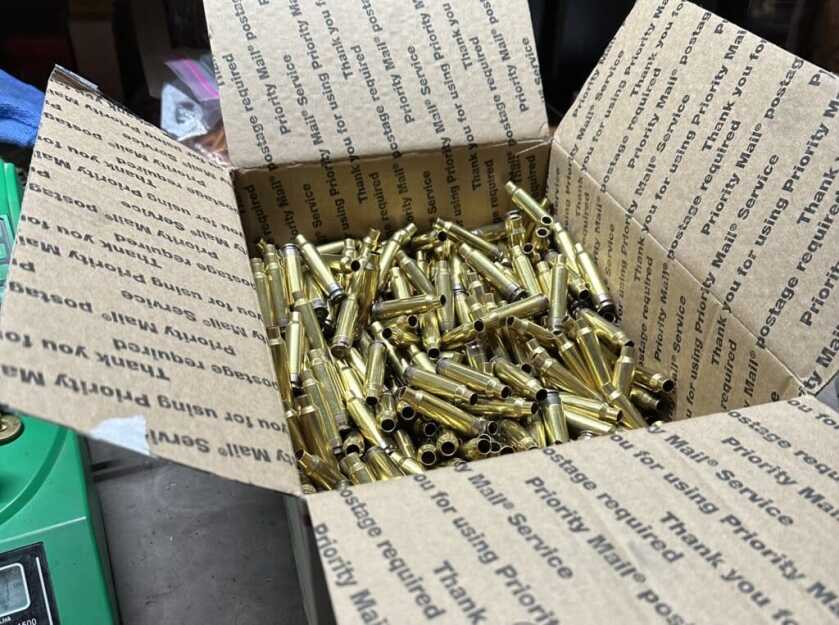
Keep in mind that they supply this hybrid brass in mixed lots. For example, you may buy 500 cases and end up with various headstamps that say, “SIG 24 6.8mm,” or “SIG 6.8x51mm,” or “SIG 277 SIG Fury.”
Different headstamps are worth noting because externally similar cases are not necessarily identical in their manufacturing history or internal properties. That’s an important distinction whenever someone is evaluating experimental ammunition components.
What the 375 Raptor Case Experiment Revealed
One of the more interesting parts of this project was seeing how the hybrid cartridge cases compared with familiar designs. The metal construction, shape, and overall finish gave me plenty to study, and every new batch offered another opportunity to compare the results.

Case forming also raises an important question about materials. Traditional brass and hybrid steel/brass cases do not necessarily behave identically under mechanical stress. Changes in dimensions and case condition require careful evaluation, particularly when the intended application involves unusually demanding operating pressures.
One thing I’ve learned from experimenting with unfamiliar cartridge designs is that appearance alone tells you very little about whether a finished case is suitable for firing. That’s exactly why I consider pressure verification, dimensional inspection, and the rifle’s engineering limits such important parts of the larger discussion.
Annealing, Material Properties, and Hybrid Case Research
Annealing is one of those subjects that gets a lot of attention in the reloading world, and for good reason. Brass changes as it is mechanically worked, and understanding those material changes is important when evaluating cartridge cases.
Annealing brass affects its internal structure and mechanical properties, but it doesn’t prove that a case can withstand a particular chamber pressure. The hybrid construction introduces additional considerations that are not present in a conventional single-metal case.
I’ve used an Ugly Annealer during my experiments. There are numerous annealing machines on the market, and my usual preference is to understand the equipment rather than spend money just because something has a fancy label.

There’s a meaningful difference between documenting an equipment setup and establishing a validated process for a pressure-bearing component. An annealing machine may be part of the research, but the relevant safety questions go well beyond the machine itself.
375 Raptor Case Geometry: Comparing the Finished Results
Part of the appeal of working with the 375 Raptor is its relationship to other familiar cartridges. Looking at the cases side by side gives a useful perspective on how much their geometry differs, despite some shared design heritage.
During my project, I used a variety of equipment, including Lee dies, to evaluate different case configurations. Like with everything else in this article, I paid for these tools with my own money. This is not a Lee advertisement. I just use their equipment and have had good experiences with it.

There’s also a practical reason to care about consistency. Small differences in a cartridge’s dimensions can matter when it comes to chamber fit, neck clearance, and ammunition performance. That’s true for traditional brass and especially relevant when studying a case design intended for higher-pressure applications.

Case Trimming Equipment and the Importance of Consistency
Another piece of equipment I’ve used during this project is an RCBS Trim Pro 2 case trimmer. I like equipment that can handle repetitive work, especially when I’m evaluating larger batches of cases.
Cartridge dimensions are an important part of ammunition design. Case length, neck dimensions, and chamber compatibility all matter. For experimental cartridges, those details need to be checked against an appropriate validated design rather than assumed from visual similarities with another cartridge.
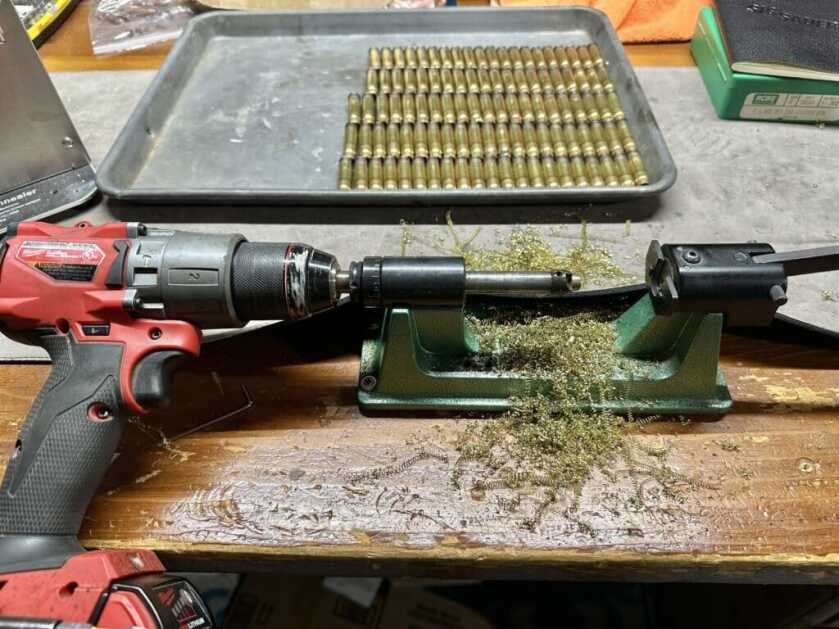
For me, the interesting part isn’t just the equipment. It’s the broader question of whether a case design developed for one cartridge family can offer meaningful benefits in another application. The answer has to come from consistent testing and sound engineering, not merely from producing a case that looks good on the bench.
High-Pressure 375 Raptor: Performance Versus Safety
Obviously, if you’re interested in 375 Raptor hybrid cases, the potential performance benefits are probably the most exciting part of this story. That’s where things get interesting, and where the engineering questions become especially important.
If you jump into high-pressure ammunition development blind, you may come out of it blind… or worse. This is not a subject where anyone should substitute guesswork for validated testing.
Internal ballistics software can be useful for studying theoretical cartridge performance, but modeled pressures and velocities are estimates. They are not substitutes for instrumented pressure testing or proof that a particular load is safe in a specific rifle.
It’s also important to understand that an ammunition manufacturer’s published pressure rating applies to a particular engineered cartridge system. It does not automatically transfer to another cartridge simply because the two use similar case materials.
The ammunition development side of this subject deserves its own discussion, especially when it comes to the relationship between case design, chamber pressure, bolt thrust, and velocity. For this article, I want to concentrate on why I pursued the project and what I observed.
11-Inch 375 Raptor Performance: The Result That Got My Attention
I’ll leave you with this tidbit: In my personal experimentation, I’ve observed performance from an 11″ barreled 375 Raptor SBR that approaches what I would normally expect from an 18-20″ barrel.
That’s a substantial difference in barrel length, and it’s exactly the kind of result that motivated this project in the first place. The possibility of maintaining useful velocity from a much more compact rifle is hard to ignore, particularly when suppressors enter the equation.
Those observations aren’t a published pressure-tested load specification, and they shouldn’t be treated as verification that a particular ammunition configuration can safely operate at 80,000 PSI. But they absolutely explain why I remain interested in the technology.
I hope this excites you as much as it excites me!

375 Raptor Hybrid Brass: Key Specifications and Reported Observations
The figures below come from the author’s article and describe the cartridges, components, and observations discussed. They are not independently verified loading specifications or recommended operating limits for a 375 Raptor rifle.
| Cartridge | 375 Raptor |
|---|---|
| Experimental Case Source | 6.8x51mm SIG Fury hybrid cases |
| Industry Pressure Technology Discussed | 80,000 PSI |
| 6.5 Creedmoor SAAMI Maximum Average Pressure | 62,000 PSI |
| Experimental Barrel Length | 11″ |
| Barrel Length Used for Performance Comparison | 18-20″ |
| Projectile Shown | 260 grain Nosler AccuBond |
| Reported Hybrid Case Purchase Price | 44.9 cents per case |
| Research Duration | Over two years |
| 375 Raptor Pressure-Tested Load Data | Not supplied |
375 Raptor Hybrid Brass: The Promise and the Tradeoffs
- Potential Advantages: Hybrid case technology creates opportunities for new cartridge designs, improved compact-rifle performance, and additional experimentation with short-barrel applications.
- Limitations: Higher-pressure ammunition requires engineering and verification of the entire firearm and cartridge system. Modified case strength alone does not establish safe operating pressure.
- My Take: The performance potential is exciting, but pressure validation and rifle compatibility have to come before any claim of a safe, repeatable load.
Final Verdict: Is Hybrid Brass the Future of the 375 Raptor?
After more than two years experimenting with the 375 Raptor and hybrid cartridge technology, I still think there’s an enormous amount of potential here.
The goal was never to make a complicated project just for the sake of making something complicated. I wanted to understand whether modern cartridge technology could help deliver the velocity I value without the barrel length I don’t always want.
What makes this technology worth watching is that companies like SIG and Federal are already changing expectations around ammunition design. Stronger case materials, new cartridge architectures, and rifles engineered for demanding operating conditions could influence the next generation of hunting and recreational firearms.
Will every traditional cartridge benefit from the same approach? Probably not. Will magnum cartridges eventually get the same attention? I certainly hope so, especially if somebody decides to give my beloved 338 EDGE a little love.
For now, my 375 Raptor experiment is an interesting example of why high-pressure hybrid brass deserves attention. There’s still plenty to learn, and meaningful pressure and performance verification remains essential.
But a compact rifle delivering performance associated with a substantially longer barrel? That’s enough to keep me interested.

Riley Baxter is a seasoned hunter, outdoorsman, and competitive shooter with deep roots in the backcountry. He has guided professionally for bears, bighorn sheep, and other big game across rugged terrain, bringing firsthand knowledge of what gear actually works in the field. When he’s not chasing game or running drills on the range, Riley is likely in the garage customizing his rifles, pistols, or backcountry kit.
A competitive pistol shooter and lifelong firearms enthusiast, Riley brings both precision and creativity to every piece of equipment he touches. Outside of the gun world, he works as a perfusionist in Montana, a vital role in heart surgery that demands attention to detail, critical thinking, and mental fortitude.
Experience:
– Professional Hunting Guide – Guided for bears, bighorn sheep, and more in some of the West’s toughest country.
– Competitive Shooter – Skilled USPSA pistol shooter with a passion for precision and performance under pressure.
– Custom Builder – Enjoys building and tuning firearms and equipment to meet the exact demands of the hunt or the range.
– Experienced Marksman – Experienced in long-range hunting and precision rifles to meet the demands of the terrain of the West.
– Montana-Based Perfusionist – Medical professional accustomed to making critical decisions in high-stakes environments.