
Estimated reading time: 11 minutes
Shot three times and still refusing to quit, Dr. Arthur Martin-Leake became one of only three men ever to earn the Victoria Cross twice. His story makes most definitions of courage seem inadequate.

There is kind of a weird dichotomy in my world. As a Bible-believing evangelical Christian who served as a combat arms officer, I came to grips with the peaceful tenets of my faith juxtaposed against the prospect of ripping the very life out of our great nation’s enemies. Then I left all of that and entered medical training, eventually formally taking the Hippocratic Oath.
The modern version of that pledge is actually fairly verbose. The last bit reads, “If I do not violate this oath, may I enjoy life and art, respected while I live and remembered with affection thereafter. May I always act so as to preserve the finest traditions of my calling and may I long experience the joy of healing those who seek my help.” That honestly seems a bit unduly touchy-feely to me, but you get the gist.
Curiously, the earliest surviving version of the oath of Hippocrates dates back to 43 AD and specifically forbids abortion. Additionally, the concept of “Primum Non Nocere” or “First Do No Harm” isn’t actually in there per se. “I will abstain from all intentional wrong-doing and harm” typically substitutes today.

It is respect for the Hippocratic Oath that typically keeps physicians from participating in state-sponsored executions. It’s pretty tough to “First Do No Harm” if your objective is to institutionally kill somebody. It can therefore seem a bit incongruous that a professional medicine man might pack a gun every day or bear arms in service to his country.
Personally, I never struggled with any of that. I read Christ’s mandate to turn the other cheek as a personal thing. Standing idly by while evil men harm innocent folk never seemed terribly righteous to me. That’s certainly not the way real men like Moses, David, Joshua, or Nehemiah might have done it. As such, while I do spend my days stamping out disease, I also pack a gun whenever I’m out where the Wild Things Roam and then sleep soundly afterwards. It turns out I am not the only physician to have found such balance.
The Guy
Born in April of 1874, Arthur Martin-Leake was the fifth son of Stephen and Isabel Martin-Leake at Standon outside Ware, Hertfordshire. Arthur also had two sisters. Four of the five male Martin-Leake siblings earned commissions in the British Army. The fifth was a Naval officer who captained the first combat vessel to be torpedoed by the Germans during WW1. One of his Army brothers perished in a ballooning accident over the English Channel while in uniform.

Martin-Leake attended Westminster School and then matriculated at University College Hospital. He graduated with his medical degree at age 19 in 1893. That seems a bit young to me, but medicine was not quite the complicated bucket of snakes back then that it is today.
After graduation, Martin-Leake served at Hemel Hempstead District Hospital. In 1899, the young doctor signed on with the 42d (Hertfordshire) Company, Imperial Yeomanry. The British Empire was at war in South Africa, and Arthur wanted to do his bit.
The Boer War was, in a word, complicated. There were several major phases, but the most compelling was the Second Boer War. This bloody counterinsurgency scrap cost the British Empire more than 100,000 casualties. 22,092 of these were KIA.
On the other side of the balance sheet, 51,555 Boer commandos and sundry auxiliaries were rendered hors de combat. Along the way, 26,370 Boer women and children perished in concentration camps alongside an unknown number of indigenous Africans. Atrocities were committed by both sides. It was a dark time. There were nonetheless extraordinary examples of individual heroism to be found in both camps.
The Warrior Doc

Martin-Leake spent a year in combat as a trooper with the Imperial Yeomanry. Afterwards, he remained in South Africa as a civilian surgeon before joining the South African Constabulary. The SAC was a paramilitary organization established in 1900 by the British Army to pacify areas captured from the Transvaal and the Orange Free State during the preceding unpleasantness. Keeping that mob in check was no mean feat.
At age 27, Arthur Martin-Leake was serving with the 5th Field Ambulance in 1902. The Second Boer War raged, and there was blood aplenty spilt on both sides of the line. In such a gory space, competent medical support was critical.
The Fight
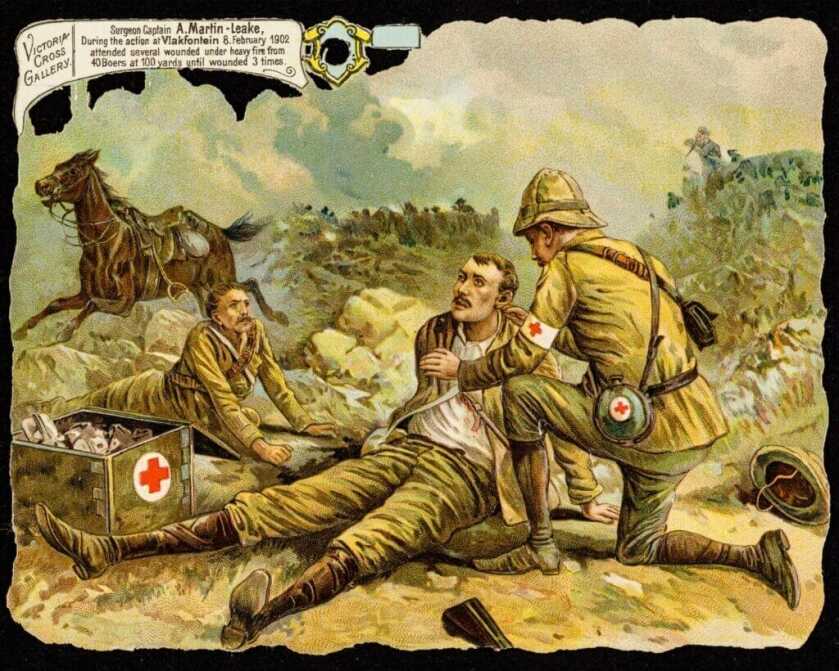
On 8 February while his unit was engaged at Vlakfontein, Captain Martin-Leake was called upon to tend to British wounded. King Edward VII later awarded the young Army surgeon the Victoria Cross for his actions that bloody day. This was the narrative:
“During the action at Vlakfontein, on the 8th February, 1902, Surgeon-Captain Martin-Leake went up to a wounded man, and attended to him under a heavy fire from about 40 Boers at 100 yards range. He then went to the assistance of a wounded Officer, and, whilst trying to place him in a comfortable position, was shot three times, but would not give in till he rolled over thoroughly exhausted. All the eight men at this point were wounded, and while they were lying on the Veldt, Surgeon-Captain Martin-Leake refused water till everyone else had been served.”
Now appreciate, this was a big deal. The Victoria Cross is the British equivalent to the American Medal of Honor. Since 1854, the VC has been awarded 1,358 times. 295 of those were posthumous. By contrast, since 1863, the MOH has been awarded 3,555 times.
Suffering from three bullet wounds, Martin-Leake was in quite the bad way. He was eventually evacuated back to Britain due to his injuries. The king presented his award on 2 June 1902.
A Warrior Without a War

Recovering from combat injuries was and is typically an arduous process. Particularly back in the heady days before antibiotic drugs, getting over a trio of bullet wounds took a minute. To keep himself occupied, Dr. Martin-Leake studied up on his surgery texts while he healed. In 1903, he qualified as a Fellow of the Royal College of Surgeons.
In addition to a quick mind and an almost lethal dose of patriotic fervor, Arthur Martin-Leake was afflicted with a most deplorable wanderlust. Once he healed sufficiently to travel, the certified war hero signed on as Chief Medical Officer with the Bengal-Nagpur Railway. It seemed Dr. Martin-Leake was now headed to India.
Along the way, he made time to get married. Arthur was the only one of the Martin-Leake children to do so. His wife perished shortly thereafter in India under suspicious circumstances. History seems to have forgotten the details.
Well, That Didn’t Take Long…
In 1912, Dr. Martin-Leake volunteered for the British Red Cross and was attached to the Montenegrin Army during the Balkan Wars. Dr. Martin-Leake subsequently tended to the wounded during the Siege of Scutari. At least this time he didn’t get shot.
The Balkans were the early 20th century version of the Middle East. Those lunatics were forever fighting over something or other. In fact, it was in the Balkans that the world’s next proper dustup conflagrated. In 1914 in Sarajevo, a disaffected anarchist named Gavrilo Princip assassinated Archduke Ferdinand and his wife Sophie. This kicked over an anthill that ultimately morphed into World War 1. Dr. Martin-Leake got in on the ground floor.
A Serious Scrap

Everything Martin-Leake had done up until this point was simply preparation for combat on the Western Front during the First World War. Martin-Leake fell in as a Lieutenant with his old unit, the 5th Field Ambulance of the Royal Army Medical Corps. Late in 1914, the 5th Field Ambulance was in action near Zonnebeke, Belgium. History has come to refer to this bloody fight as the First Battle of Ypres.
This was combat on a whole new scale. Unlike previous wars, this forsaken place saw the widespread use of such diabolical stuff as belt-fed machineguns and poison gas. Over 35 bloody days, a quarter of a million men were either killed or seriously wounded. 55,000 of those were British.
Borderline Unbelievable
Amidst the fetid trench warfare that so characterized humanity’s first truly industrialized war, LT Martin-Leake once again willingly placed himself in the thick of the action to rescue wounded Tommies trapped in No-Man’s Land. Miraculously, he was not himself killed. However, he did earn a second Victoria Cross. Here’s the citation:
“Lieutenant Arthur Martin-Leake, Royal Army Medical Corps, who was awarded the Victoria Cross on 13th May, 1902, is granted a Clasp for conspicuous bravery in the present campaign: — For most conspicuous bravery and devotion to duty throughout the campaign, especially during the period 29th October to 8th November, 1914, near Zonnebeke, in rescuing, whilst exposed to constant fire, a large number of the wounded who were lying close to the enemy’s trenches.”
In the annals of the British Empire, only three men have earned the Victoria Cross twice. Nineteen Americans can make a comparable claim with the Medal of Honor. In March of 1915, Martin-Leake was promoted to Major and assumed command of the 46th Field Hospital. He ended the war as a Lieutenant Colonel.
The Rest of the Story

When the guns fell silent, LTC Martin-Leake still couldn’t seem to settle down. He returned to India yet again seeking adventure and eventually retired in 1937. In the late 1930’s he purchased and apparently flew a de Havilland Tiger Moth airplane without bothering to obtain any formal training as a pilot. With the onset of World War 2, the aging warrior physician commanded an ARP post. ARP stood for Air Raid Precautions. These civil defenders helped protect British civilians during the Blitz.
LTC Martin-Leake, two-time recipient of Great Britain’s highest award for gallantry in combat, died at home in 1953 at High Cross near Ware. He was attended at his death by his faithful dog Waif. Waif later found a forever home thanks to a formal appeal by the Royal Army Medical Corps.
Martin-Leake’s Victoria Cross with bar is on display at the Army Medical Services Museum in Aldershot, England today. Arthur Martin-Leake was that rare hybrid warrior/healer. His extraordinary exploits were the stuff of legend.

Will is still trying to figure out what he really wants to be when he grows up. However, shooting guns and claiming it was work seemed like a pretty sweet hustle. As a result, Will serendipitously transformed an avocation into a vocation.
Raised in the Mississippi Delta, Will flew UH1H, OH58A/C, CH47D and AH1S helicopters operationally as an Army Aviator. He is SCUBA-qualified and has parachuted out of perfectly good airplanes at 3 o’clock in the morning. Will has summited Mount McKinley, Alaska, six times…always at the controls of an Army helicopter, which is the only way sensible folk climb mountains.
Will has delivered sixty babies and occasionally wrung human blood out of his socks. He is married to his high school sweetheart and has three awesome adult children. Turn-ons include vintage German machineguns, flying his sexy-cool RV6A airplane, Count Chocula cereal and the movie “Aliens.”
www.word-monkey.com
Experience:
-Professional Writer-thousands of publishing credits for dozens of titles
-Mechanical Engineer/Practicing Physician
-Instrument-rated Commercial Pilot
-Sunday School Teacher
Thank you Will, for another article that meets or exceeds your own high standards for tale-weaving. Thank you also, for unapologetically proclaiming your faith. Paul reminds us in Romans that not only are we to believe in our hearts, but also to confess with our mouths… (and word processors). If we fail to meet in this life, I look forward to shaking your hand in the Millennial Kingdom… or sooner if Christ delays His Second Coming. Keep up the good work, Brother!
As always I find your articles entertaining and informative. Your ability to weave history into compelling reading makes me wish I had a History teacher with a modicum of your abilities. Family man, doctor and story teller, keep up the excellent work. Perhaps, find time to write a book….Oh, and thank you for your service.
Great! Informative and entertaining! Thanks.