
Estimated reading time: 14 minutes
The Springfield Armory M1A Standard Issue puts nearly 70 years of M14 heritage behind every trigger pull. We shot this wood-and-steel .308 at 50 and 100 yards to see whether the old battle-rifle formula can still impress.

Table of contents
- Why the M14 Failed as a Standard-Issue Rifle
- M1 Garand to M14: The Family Tree Behind the M1
- The M14 Goes to Vietnam and Gets a Brutal Reality Check
- How the M14 Came Back as a Long-Range Fighting Rifle
- Springfield Armory M1A Standard Issue Features: Pure M14 DNA
- Springfield M1A Range Test: Iron Sights at 50 and 100 Yards
- Springfield Armory M1A Standard Issue Specifications
- M1A Standard Issue Pros and Cons: What Hits and What Hurts
- Is the Springfield Armory M1A Standard Issue Worth It?
How the M14 Became a 70-Year American Fighting Rifle
If the M14 rifle had the shortest standard-issue life of any U.S. service rifle, how did it become one of the longest-serving rifles in U.S. military service? The rifle has been in use for nearly 70 years. While the M14 didn’t prove to be an ideal standard-issue rifle, it did perform in specialized roles. Many users of the M14 have a personal connection to the weapon. Some used it during the Vietnam War, some used it more recently in Iraq. Others value the historical significance, while others use it in competition. Your experience with U.S. combat rifles is not complete without getting behind an M14. The Springfield Armory M1A Standard Issue is semi-auto only, but it is about as close as you can get to firing an original M14. Personally, I am always in a bit of awe after shooting an M1A. The performance, power, and accuracy, even when using iron sights, never fails to impress.
Why the M14 Failed as a Standard-Issue Rifle
The honest answer for why the M14 failed as a standard-issue rifle is that it was built for a war that never happened, and when the next war did happen, which was in Vietnam, it performed poorly. The M14 was designed in the era of wood and steel just after WWII and the onset of the Cold War. U.S. military strategists were convinced the next world war would be in Europe. And why wouldn’t they? Both World War I and World War II took place in Europe where long rifle shots decided the outcome of a battle. The U.S. Army brass loved the M1 Garand and wanted an updated version of the M1. After all, the M1 Garand performed well in WWII and in the Korean War. It just needed some updates like a detachable box magazine and maybe a less powerful caliber, and make the new rifle lighter, too.
🛒 Check Current Price for Springfield M1A on GunsAmericaM1 Garand to M14: The Family Tree Behind the M1
The U.S. military wanted a new version of the M1 Garand, and that is what they received. If you look at an M1 Garand and M14 side-by-side you can see the resemblance. Both the M1 Garand and M14 use a gas piston system with a rotating bolt. The difference is the M1 Garand uses a long stroke piston and the M14 uses a short stroke piston.

The big difference between the two rifles is the M1 Garand is chambered in .30-06 Springfield and the M14 is chambered in .308 Winchester/7.62 NATO. The bullet diameter for both is .30 caliber and the velocity and energy is similar between the two calibers when using 150-grain FMJ bullets. The other big difference is the M14 feeds from a detachable box magazine; the M1 Garand uses a fixed magazine loaded via an en bloc clip. The M14 was also equipped with select-fire, offering semi-auto and full-auto fire. More on that later. Other than that, the triggers and sights are nearly identical, and they both field strip in the same way. Remove the trigger group, drop the barreled action out of the stock, done.

The M14 Goes to Vietnam and Gets a Brutal Reality Check

The M14 was adopted in 1959 and deep-sixed in 1964; quickly replaced with the M16. The next war wasn’t in Europe but in a country few Americans knew about or could even pronounce. The place was Vietnam. The M14 proved to be heavy and long for combat in dense jungle vegetation. The wood stock would swell in the humidity, decreasing its effectiveness. In full-auto mode, the rifle was difficult if not impossible, to control. I have pals who participated in the war, and what they did like about the M14 was the power the .308 Win./7.62 NATO cartridge brought to the battle. Wars had changed, and the U.S. standard-issue rifle changed too with the adoption of the M16. You would think the M14 would have been forgotten as fast as a bad dream. But the M14 did not fade away, and during the Vietnam War the M14 was reconfigured to be a sniper rifle called the X21M. The transformation of the M14 to a sniper rifle and later designated marksman rifle blew new life and a new purpose into the M14.

How the M14 Came Back as a Long-Range Fighting Rifle
Since the time the M14 was dumped as the standard-issue rifle, variants were used by branches of the U.S. military as a sniper rifle and as a designated marksman rifle (DMR). What the M14 had over the M16 was distance. During the Iraq and Afghanistan wars the M16 was ineffective beyond 300 yards. The M14 stepped in with modifications like a scope, fiberglass stock, and bipod and was accurate and effective at long range engagements.

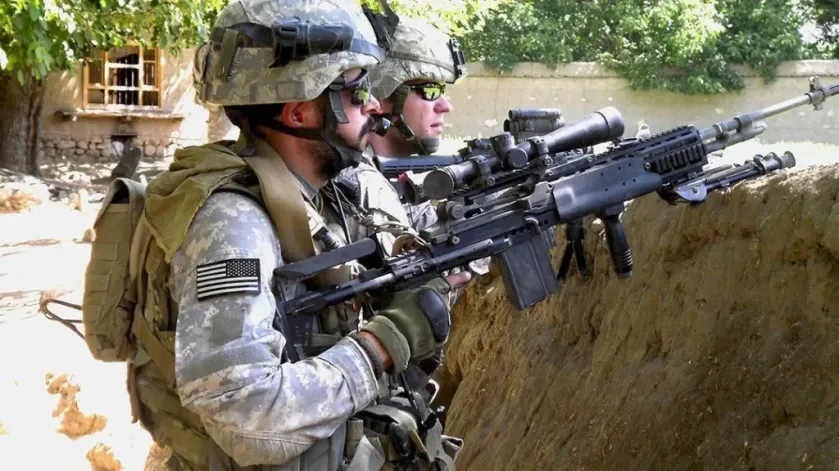
U.S. special forces like the SEALs use the Mk 14 Enhanced Battle Rifle or EBR. In this configuration the M14 is dropped into a chassis stock system and tricked out with a vertical fore grip, Picatinny rails, a flash hider, or a suppressor. Some are equipped with an AN/PVS-4 night vision scope. The most current use of the M14 in combat has been in Ukraine. Since the Ukraine war started, images of the M14 in training and on the battlefield have popped up on social media.

Word is the CMP is going to be selling surplus M14s with the receivers modified so they can’t be made to fire full auto.
Springfield Armory M1A Standard Issue Features: Pure M14 DNA
The M1A Standard Issue is as close to the standard-issue M14 as you can get. The M1A is semi-auto only and features the smooth wood stock and polymer handguard. The butt plate is hinged and is a throwback to the full-auto M14. Original M14 butt plates flipped up and provided more leverage to control muzzle climb in full auto. On the M1A, it is a reminder of the heritage of the rifle.

The M1A sports a 22-inch carbon steel barrel and is topped off with the iconic slotted flash suppressor. The open sights consist of a fully adjustable rear aperture sight and a blade front sight protected by two wings on either side. The sights are perhaps some of the best military sights ever designed. The knob on the left side of the rear sight adjusts elevation and there are reference marks on the dial so you can set a 100-yard zero then crank it up for longer shots as long as you know your dope. The knob on the right side is the windage adjustment. Windage adjustment points are found on the base of the sight so you can compensate for wind.

The M14 and M1A were never designed to be equipped with an optic, but a side mount is available from a number of manufacturers, including Springfield Armory. The best side mount I’ve used on an M1A is the ones produced by SADLAK Manufacturing. It takes a bit more effort to mount a scope on an M14 compared to an AR15, but that’s another story.

The two-stage military trigger on the M1A is consistent and crisp. On my sample after a short take up you hit the wall and 6.3 pounds tripped the hammer. The safety is a tab that snaps inside the trigger guard to let the user know the safety is on. Snap it outside the trigger guard with your trigger finger to disengage the safety and fire the rifle. It’s an intuitive design that goes back to the M1 Garand.

The charging handle reciprocates and locks back on the last shot fired. On the left side of the receiver is the bolt release button, or, to release the bolt, just slightly pull it back and let it fly forward.


Inserting the magazine is similar to an AK. It uses a roll and lock method. The magazine release lever is located outside the trigger guard and is pressed forward to release the magazine. On newer guns and magazines, you need to strip the empty magazine from the magazine well. The M1A has a stripper clip guide above the bolt. When the bolt is locked back and the magazine is empty you can load cartridges via a stripper clip.

Springfield M1A Range Test: Iron Sights at 50 and 100 Yards
I chose to shoot iron sights with the M1A and used a rest. A variety of 7.62 NATO was used with different bullet weights and shapes. I stuck with match ammo with BTHP bullets and FMJ training ammo. For training ammo I opted for Winchester white box with a 147-grain FMJ and a 150-grain FMJ from Aguila. Match ammo consisted of Black Hills New Rifle loaded with a 175-grain BTHP bullet and Hornady Match with a 178-grain BTHP.

At 50 yards, I got my dope and found the Springfield Armory M1A Standard Issue was shooting tiny groups as long as I paid attention. The sights were easy to see and use, and the trigger was nice for a military-style rifle.
Moving an official military bullseye target to 100 yards is where the rubber meets the road, as they say.

I have to say that I found it easy to keep 5 shots in the black at 100 yards even with open sights, especially with Hornady Match ammo. The M1A on average kept all 5 shots in the 6-3/8-inch bullseye. With Black Hills it took more effort to keep 5 shots in the black, but it was still possible.

Recoil and Offhand Shooting: Heavy, Steady and Addictive
Recoil is manageable with the M1A. The gas system and the weight of the rifle, which is over 9 pounds, helps take the edge off so you can concentrate on consistent shooting. I’m more accustomed to the cycle of an AR10. The M1A feels different when it cycles. I can feel the long operating rod working its magic on the rotating bolt.
I did attach an old Brownells Tactical Plus rifle sling. This sling is patterned after the military 1907 sling and can be a bit of a puzzle to install correctly, but I like wrapping the sling around my arm and shooting the M1A offhand. My groups opened up when shooting offhand but I was still averaging 5 MOA depending on the position.
Springfield Armory M1A Standard Issue Specifications
| Model | M1A Standard Issue |
|---|---|
| Caliber | .308 Winchester/7.62 NATO |
| Action | Semi-auto, short stroke piston, rotating bolt |
| Barrel Length | 22 inches |
| Overall Length | 44.3 inches |
| Weight | 9.1 pounds |
| Capacity | 10- and 20-round detachable magazine |
| Finish | Matte black Parkerized finish |
| Stock | Smooth walnut |
| Sights | Aperture rear/blade front |
| Trigger Pull | Two-stage, 6.3 pounds tested |
M1A Standard Issue Pros and Cons: What Hits and What Hurts
- Pros: Good accuracy, reliable, nice military-style trigger, excellent sights
- Cons: Heavy and long, more complicated to mount a scope
Is the Springfield Armory M1A Standard Issue Worth It?
Shooting the Springfield Armory M1A Standard Issue is addictive. I like the classic lines of the rifle with wood and steel. The M1A should definitely be on every rifle shooter’s bucket list. Why wouldn’t you want a go on a rifle that has been serving our country for near 70 years?
Related Reads from GunsAmerica Digest
- First Look: Springfield M1A in 6.5 Creedmoor
- M1 Garand Review: Features, Ammo, Accuracy
- M1A Sniper: Scope Installation and Options

Robert A. Sadowski is an American writer and journalist.
He has written about firearms and 2A issues for decades, and has trained with some of the country’s finest firearm instructors in handguns, rifles/carbines, shotguns and long-range shooting. He has also had the opportunity to interview numerous individuals deeply involved in protecting our 2nd Amendment.
He a is a frequent contributor to numerous gun-enthusiast publications, a few of which include:
- TheArmorylife.com
- TheTruthAboutGuns.com
- GunsAmerica.com
- GunBroker.com
- Gun-Tests.com
- Shooting Illustrated
- SHOT Business
- Gun Digest
Sadowski is also the author of numerous gun books, including: “9MM — Guide to America’s Most Popular Caliber” and “Book Of Glock,” both of which were #1 new releases on Amazon. He also wrote the popular DIY gun book series: Shooter’s Bible Guide to Firearms Assembly, Disassembly, and Cleaning Volume 1 and Volume 2. Other gun books authored by Sadowski include “50 Guns That Changed the World,” and edited “The M16A1 Rifle: Operation and Preventive Maintenance”originally published by the U.S. Department of the Army. He also edits the annual “Gun Trader’s Guide” to firearm values.
Sadowski is also the Treasurer/Secretary of the GLOCK Collectors Association, a non-profit organization with the mission to educate and preserve: Educate the public on the models, variations, and commemoratives built by GLOCK, as well as provide members with information on GLOCK serial numbers, importation, and other facts unique to GLOCK pistols.
My purchase decision was between the Springfield M1A or an original Belgian made FAL. I bought both. Kept the FAL as a safe queen.
Purchased my M1A ( M14 ) some 15 years ago .
Used it informally for shooting , as well as competitive
up at Camp Perry . She shines at 600 yards with the
168gr. BTHP bullet .
My late Father ( R.V.N. 1962-63 ) swore by it , and the
Garand as true ” battle rifles* . My Son now has my
Father’s M1A , and swears by it as well .
The M1A has three generations of my family as
loyal and dedicated shooters . We would never part
with them for love nor money . My Son will never let
his Grandpa’s rifle go either.
They are pricey , but in my opinion , one of the best
service rifles around today .
Three generations on the same rifle says more than any range report. 168 BTHP at 600 at Perry is exactly the job the M14 earned its second life doing. Keep it in the family.
Anyone know accurate information about the MAXIMUM bullet weight that can be used withOUT bending the Op Rod?
I was warned against 175gr ammo, factory OR handloads.
The rifle in this review shot Black Hills 175 grain and Hornady Match 178 grain. Factory 175 match is normal M1A food. The op rod horror stories are usually about handloads with slow powders, not bullet weight by itself. If you load heavy, stick to published M1A data and call Springfield before you go past 175.
Took my M1A and tricked it out to look like an X21M. Even added a GI bipod and sling. It definitely gets attention at the range. Fun to shoot prone and wildly accurate. Years ago I was given the opportunity to shoot an original M14 in full auto and I must admit it was a handful.
I enjoyed this article very much. I purchased a Springfield M1A/SOCOM16 a few years ago. It is a treat to use and one of my grandsons LOVES IT. He also enjoyes my Ruger Mini-14 too. So for us it turns out to be special memories for grampa and one of my grandson’s.
Iv got 2 M1As now both Springfield armory. I shoot them regularly. Iv had a few different ones over the years, im 62 and used to shoot service rifle matches. I have never had a Springfield armory jam on me EVER! Probably 10k rounds now easily. Iv have a bad magazine that when I racked it I saw the round not go into chamber and I after examination chunked the mag. I clean all my guns after each shooting. Iv seen bad ammo jam every rifle from time to time. But my M1As I would trust my life to them anytime.
I have a couple bits to pick. WWI and WWII battles were definitely not determined by the long range shots of American rifleman. Firefights were determined by firepower at close range (sub-250 yards). This was recognized in official reports on combat. Hence the superiority of squads armed with Garands over those armed with Kar98’s and Arisakas, and the game changing invention of the first assault rifle, the StG44. The Army brass refused to recognize the potential of a diminished rifle round intended for automatic fire. They were wedded to romantic notions of deadeye American riflemen firing long, slow shots even though they were clearly outclassed by the new AK-47. The U.S. forced NATO to adopt the 7.62mm cartridge and the rest is well known. The M-14 was an abomination and badly conceived for general service. Early in Vietnam, soldiers and Marines using M-14’s in jungle firefights against NVA equipped with AK’s realized they were badly overwhelmed in terms of the volume of fire. There was no way to gain fire superiority with a semi-auto, big caliber rifle that was even more worthless on auto.
As for the Springfield M-1A, I’ve owned one for 10 years. It’s a POS. I should have saved for a Fulton Armory rifle. If I still wanted one, there are more options to consider, especially a CMP offering. The Springfield is nice to shoot, when it decides to cycle. At first I thought it was a magazine or ammo issue. It wasn’t. Then I thought it was the spring tension and I bought a GI op rod spring. That helped. I’ve heard this is an endemic issue with Springfield M-1A’s. I’ve also had serious cycling and failure to feed issues with other Springfield products. I find Springfield to be poorly engineered. No matter how attractive their offerings may look, I won’t buy another Springfield.
Good article. I enlisted in the US Army during the “fun” years–1967 to 1970. From the beginning of Basic, I was issued an M14 and carried one at every duty station I was sent to, including Germany (3rd Infantry Division) and multiple NATO countries for REFORGER participation, then on to Fort Lewis US Army Training Command where guarding bunkers at McCord AFB was the name of the game while waiting for a departure flight to Vietnam that never happened due to Nixon’s halting of troop reinforcements and his “secret plan” to end the war. In late January of 1970, I was issued an M16 and spent the requisite time to qualify with it, yet still drew an M14 for guard duty.
I vividly recall periodic training and qualifying with the M14 in multiple venues and qualifying as Expert required 500 meter knockdowns on silhouette targets from prone, standing, kneeling, and sitting. We were all permitted one mag dump on full auto and we all knew that it was simply a waste of ammo but great fun. I know I’d never go full auto in combat, even for suppressive fire due to the inability to keep the muzzle from flying upward. The old beast that I and my contemporaries shot gave great confidence that whoever was in our sights would absolutely regret finding themselves facing damn fine American firepower.
I have two M1A’s today, one scoped (with Sadlak mount), and one plain old iron sights. They both shoot just like their ancestors and, while I have many choices to pick from in my gun room, there is nothing quite like the M1A/M14.
I have numerous young friends, including former SEAL’s and Green Berets who get a look in their eyes bordering on amazement and respect that these old school battle rifles were my generation’s instrument of war.
Thanks for writing this up.
Thanks, Jon. 500 meter knockdowns on irons is the part people forget. Robert called those some of the best military sights ever designed, and Expert quals like yours are why. Sadlak was also his pick for the best M1A side mount, so your scoped rifle is in good company.
Where’s the bayonet lug ?
If SA is trying to replicate the standard issue M14 , with the exception of full auto capability , why remove the bayonet lug ?
In some states, the bayonet lug is a specified feature that moves the M1A from being a simple semi-auto rifle to an “assault rifle”–with the various restrictions and outright bans that come with that designation. If you want a bayonet lug, you can buy a flash suppressor with it from various vendors and replace the original one on the M1A.
The US Army used to attend USMC Sniper Schools with the M-14. The USMC preferred the M-40 where a bolt action did not automatically eject a round and create a target indicator. With the USMC sniper and spotter roles, ideally the M-40 and M-14 are a better combination of primary arms than the M-40 and the M-16 or the M4. Both team members would use the same ammo and still have same security of a semiautomatic rifle with the same range capabilities. Over time the Army replaced the M-14 with their own specific version of “sniper” rifle with a bolt action. Now the choice of calibers has expanded considerably, and I have not followed all the current factors since I still think mainly in terms of the 7.62 or 5.56 for the rare long-distance shooting opportunities, I get to enjoy. Still, I suspect that the M-40 and M-14 combination are still probably as good as anything reaching out around1000 yards.
It’s worth mentioning that the M-14 and the Garand have the probably the best iron sights of any rifle ever issued to any rifle man throughout the world. That’s why the USMC rifle teams still use the M-14, and the drill teams use the Garand with the internal magazine. The Springfield M1903 is a nice drill rifle and a good shooter but not at the same level as a Garand. The FN FAL is a nice rifle but no windage adjustments are present, and the rear aperture is nowhere near the quality of the Garand or M-14.
My bad, eject a spent casing not a round.