
Estimated reading time: 10 minutes
Henry kept the Golden Boy Revolver’s steel, brass, walnut, and Old West flavor, then gave the Deadeye the sighting system it needed. After multiple loads, single-action accuracy testing, and fast double-action shooting, those upgraded sights proved to be far more than cosmetic.
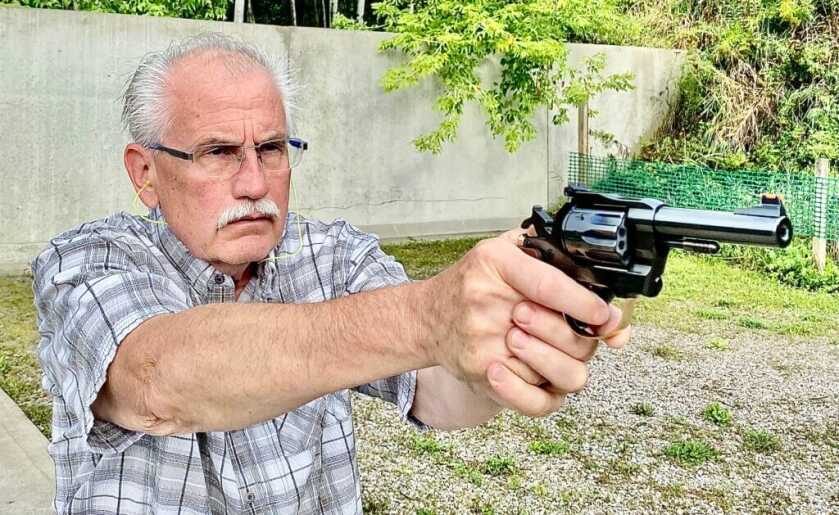
By Brian McCombie
Henry Gives the Golden Boy Revolver the Sights It Needed
Henry Repeating Arms jumped into the handgun market a couple of years ago with the introduction of the centerfire Big Boy and rimfire Golden Boy Revolvers. The revolvers had a classic look; kind of Old West meets turn of the 20th Century handguns.
I had the chance to review both the centerfire and rimfire versions of those revolvers. They filled my hands nicely, functioned great in single and double action, and looked cool. What more could a revolver aficionado want?
Better sights were the answer Henry arrived at, no doubt due to some customer feedback on the original revolvers.
That’s because these revolvers had sights very similar to the Colt Single Action Army revolver: a rear sight notch cut into the top strap and a half-moon front blade.
Enter the H16 Golden Boy Deadeye Revolvers chambered in .22 S/L/LR and the H17 Big Boy Deadeye Revolvers introduced in February 2026. The “Deadeye” designation means these handguns feature fully adjustable rear sights and high-visibility, red fiber-optic front sights.

I received an H16 Golden Boy Deadeye for test and evaluation and quickly realized that the new sights represent a definite improvement, especially for those of us who no longer have young eyes!

Yes, that includes this writer.
Steel, Brass, and Walnut Keep the Golden Boy DNA Intact
The two Golden Boy Deadeye Revolver models feature solid steel frames that are deeply blued and accented with polished brass backstraps and trigger guards. The four-inch round-profile steel barrels are also blued.
The model variation depends on which of the two grips are selected; both of them fashioned from genuine American Walnut. The more-compact Birdshead-style grips definitely remind one of the Old West, while the more-squared Gunfighter-style grips fill the hand better for added stability.

My test model Golden Boy Deadeye had the Gunfighter grip.

A 10-Round Cylinder and Substantial All-Steel Feel
The revolver’s steel cylinder held 10 rounds of .22 S/L/LR and featured a quick-takedown system. The ejectors kicked out spent brass nicely, and the cylinder release worked smoothly.

At a substantial 9.5 inches long, the Deadeye weighs 37 ounces with the Gunfighter grip, 36 ounces with the smaller Birdseye grip.

Golden Boy Deadeye Trigger: Crisp in Single Action, Smooth in Double
The nicely curved trigger averaged a very crisp 1 pound, 10 ounces of pull in single action. In double action, pressure was steady and even throughout the trigger cycle and averaged 4 pounds, 3 ounces of pull weight.

Adjustable Deadeye Sights Make Zeroing Simple
As noted, the rear sight blade is adjustable for elevation and windage. Elevation is changed using the screw atop the sight. With a standard screwdriver, the shooter turns/clicks the screw clockwise to move the point of impact down and counter-clockwise to shift the impact up. Each click represents approximately .25 inches of movement at 25 yards.
Likewise, a smaller screw on the right side of the sight blade adjusts windage. A tiny Allen grub screw on the top left of the sight allows the shooter to lock in the windage adjustment.
The fiber-optic front post sits approximately a half-inch high, and the bright red dot popped nicely in the rear notch during my shooting.
Henry Golden Boy Deadeye Accuracy at 12 Yards
At my outdoor shooting range, I initially ran the Golden Boy Deadeye at 12 yards and shot in single action from a sandbagged rest. For this I used my fast-dwindling and very old box of Federal Premium Auto-Match and its 40-grain solid-nosed bullets.

I fired a full cylinder’s 10 rounds at my target in single action, and the shots hit a good inch-plus high and left. I gave the rear sight four clicks clockwise/down and fired another cylinder at a new target. These shots clustered at the correct elevation, but to the left.
I adjusted the windage screw approximately one-quarter turn counter-clockwise/right and my next cylinder of ammo hit where aimed.
Easy sight in!
Four .22 LR Loads Put the Deadeye’s Accuracy to the Test
I continued shooting at this distance and in single action with three more brands of .22 LR:
- CCI special Henry Golden Boy Collector’s Edition rounds, 36-grain copper-plated hollow points.
- Remington Standard V, 38-grain round-nose bullets.
- Winchester Wildcat, copper-plated 40-grain solid-nosed bullets.
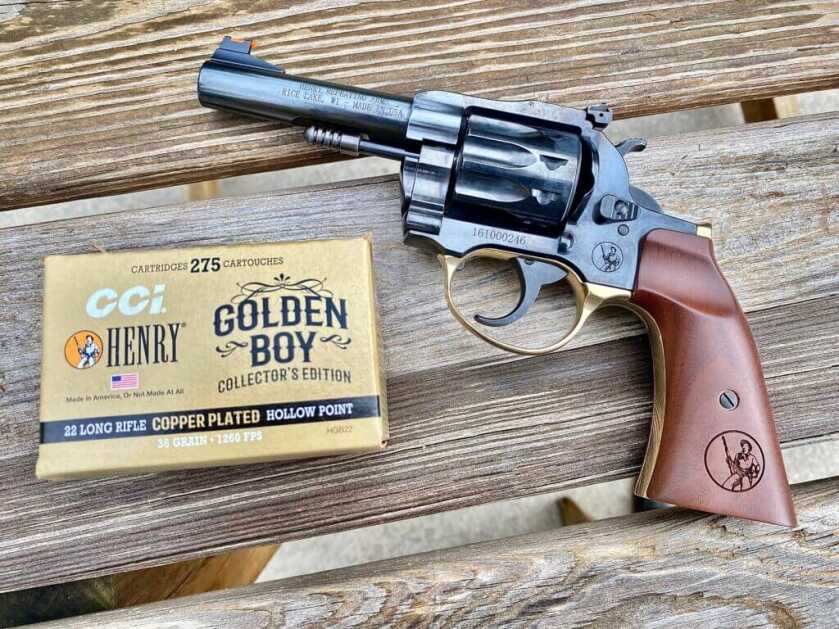
Accuracy was quite good, averaging just over one inch for five-shot groups with all of the above ammunition brands.

Then It Was Time to Double Up: Double-Action Testing
It was time to double up. As in, double action.

Arguments on social media about using/not using .22 LR handguns for self-defense are common. However, my job in evaluating the Henry wasn’t to enter that debate but to accept a simple fact: many people actually do rely on handguns chambered in .22 LR for concealed carry and general home defense.
Part of my work has me contacting FFL retailers across the country. When I ask which handguns the self-defense customers are buying, yes, 9mm models usually lead the list. Yet, .22 rimfire pistols and revolvers are often runners-up.
A fact which ammunition makers realize, too, as reflected by the many self-defense rimfire options in both .22 LR and .22 WMR now available.
Fast Double-Action Shooting at 7 Yards
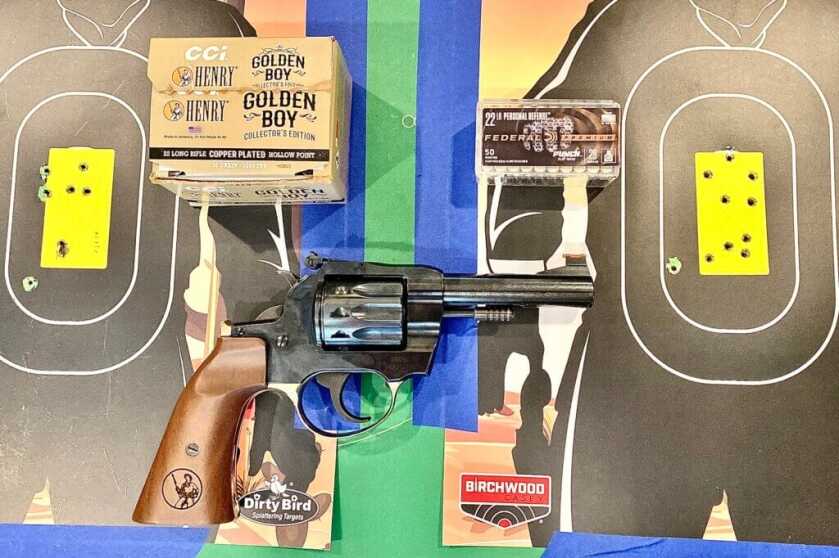
So, I shot the Golden Boy Deadeye at seven yards offhand and in double action, with three brands of .22 LR:
- The CCI Henry Collector’s Edition.
- Federal Punch featuring a 29-grain flat-nosed bullet.
- Winchester SilverTip loaded with 37-grain plated and segmenting hollow points.
The last two are specifically designed for self-defense, while the CCI Henry’s struck me as useable for this application, too.
For this shooting, I used Birchwood Casey Dirty Bird Gunslinger Skyline Splattering Targets. First, though, I placed colored strips of paper over the center of two Gunslingers. The strips measured 2.75 inches long by 1.5 inches wide.
I fired fairly fast, taking only enough time to get my sights back on target, and used up a full cylinder of the CCI Henry and Federal Punch. In both cases, I put 9 out of 10 rounds into the colored strips.
Winchester SilverTip Posts the Tightest Group
Then, I took my time with five shot accuracy groups. Best groups came in at 1.3 inches with the CCI, 1.1 inches using Punch, and the winner, Winchester SilverTip, at .75 inches.
Plinking and target practice, garden varmint eradication, and home/self-defense: the Golden Boy Deadeye can do it all and was a true pleasure to shoot. It would obviously be a real compliment to a Henry .22 rimfire lever action, too!

Henry Golden Boy Deadeye Pros and Cons: Accurate, Classy, Pricey
- Pros: Accurate, feels great in hand with the Gunfighter grip, and looks classy and classic. The solid steel build should last a few generations.
- Cons: Rather steep MSRP of $970. A scan of five gun-selling websites found it from $739.00 to $854.00, with an average at $780.00, still on the high end for a rimfire revolver. Also, can’t see any way to add an optic without a gunsmith’s help, a consideration for those whose eyesight really does require a red dot.

Henry Golden Boy Deadeye Revolver Specifications and Build Details
🛒 Check Current Price for Henry Golden Boy Deadeye on GunsAmerica| Caliber | .22 S/L/LR |
|---|---|
| Capacity | 10 rounds |
| Barrel | 4 inches, Round Blued Steel, 1:16 Twist Rate |
| Receiver | Steel, Polished Blued |
| Rear Sight | Fully Adjustable |
| Front Sight | Ramped Fiber Optic Bead |
| Optic Ready? | No |
| Grips | American Walnut, Gunfighter Option (as tested) |
| Safety | Transfer Bar |
| Overall Length | 9.5 inches |
| Weight | 37 ounces (as tested) |
| MSPR | $970.00 |
Available on GunsAmerica Now

Brian McCombie (Writer)
A full-time writer, Brian’s work focuses on hunting and firearms, day and thermal optics, and other shooting gear. He’s been fortunate enough to hunt much of the USA and Canada. His favorite hunt is chasing Texas hogs at night using a suppressed rifle outfitted with a thermal scope.
Dream hunt: Alaskan brown bear.
He’s taken handgun self-defense courses and long-range rifle classes for hunters. Brian continues to dive deeply into the new technologies so much a part of today’s hunting and shooting experiences.
His top firearms include AR-15’s and AR-10’s, double-stack 1911’s, and lever actions.
Experience:
Full-time writer since 1994
Has used thermal optics for over a decade
Written hundreds of firearm reviews and hunting stories
Loves the tech: night vision, thermals, suppressors, apps, etc.
Favorite handgun caliber, 10MM AUTO!