
Estimated reading time: 12 minutes
The Ruger No. 1 and No. 3 turn hunting into a one-shot proposition, pairing old-school falling-block simplicity with real hunting accuracy. One of these rifles even punched a 0.96-inch group at 100 yards.

Table of contents
- America’s Single-Shot Rifle Obsession Started Long Before Ruger
- Ruger No. 1 Falling-Block Action: Simple, Strong, and Compact
- Ruger No. 1 Variants: Six Ways to Build a Classic
- Ruger No. 1 vs No. 3: What’s the Real Difference?
- Ruger No. 1 International Range Test: 1-Inch Groups in 7mm Mauser
- Ruger No. 3 .45-70 Range Test: Recoil, Velocity, and Boar-Down Accuracy
- Final Verdict: Why the Ruger No. 1 and No. 3 Are Rifles You Regret Selling
Ruger No. 1: The Single-Shot Gamble That Paid Off
Ruger took a gamble in 1967 when it introduced the No. 1 rifle, an elegant single-shot rifle designed for hunters. But how could a single-shot rifle appeal to hunters chasing deer, elk, bear, and every other beast with bolt guns, lever-actions, and semi-automatics? The lure of the No. 1, like any single-shot rifle, appeals to the challenge the platform offers. You take the advantages and disadvantages with a single-shot and do so knowingly.
Ruger knew it couldn’t convert all hunters, so the focus was on those hunters who were traditionalists and believed one well-placed shot was better than dumping a full magazine at their quarry. If you are a hunter, you know you may only have one opportunity for one shot. With the No. 1 you literally have one shot, so that shot needs to be dead on. Are you up for the challenge of hunting with a single-shot rifle? If you hunt with a muzzleloader, you already know the challenge a single-shot brings to the hunt. Some straight-wall cartridge states specifically require a single-shot rifle. There are other more economical single-shot rifle options, but none is as elegant and classic as the Ruger No. 1.

America’s Single-Shot Rifle Obsession Started Long Before Ruger
The United States was pioneered with single-shot rifles from muzzleloaders to the introduction of metallic cartridges. Rifles like the Sharps 1874, Remington Rolling Block, and Winchester 1885 all played a part. These rifles were used for hunting as well as competition shooting, and were chambered in all sorts of calibers, from petite rimfire calibers all the way up to massive .50 caliber cartridges loaded with a handful of black powder. A common feature of all these rifles is a block of steel that shuts behind the cartridge like a bank safe door. The actions are strong and can handle powerful loads.

The Sharps and Winchester 1885 both use a falling-block action where a solid piece of steel slides down as the lever is opened, allowing a cartridge to be inserted into the chamber. The Remington Rolling Block uses a steel block that rotates, allowing access to the breech. Generally speaking, falling-block designs are stronger than Remington’s rolling-block. The Ruger No. 1 has more in common with the Sharps and Winchester, yet is different.


Ruger No. 1 Falling-Block Action: Simple, Strong, and Compact
The No. 1 uses a modified Farquharson-style hammerless falling-block action. The original Farquharson action was designed in 1872, so by the late 1960s the patent had long expired. Ruger was a master at recreating existing firearm designs and making them easier and cheaper to build as well as making them more durable.

The action on the No. 1 is as simple as it is elegant. A lever is used to lower the falling block and provide access to the chamber. Load a cartridge and close the lever and the rifle is ready to fire. Closing the lever cocks the internal hammer. The Sharps and Winchester work in a similar way except the hammer needs to be cocked; the lever just opens and closes the breech. The advantage of the No. 1’s action is its strength and compact size. Since the action has a small footprint, the barrel length can be increased without lengthening the rifle, so a No. 1 with a 26-inch barrel has a shorter overall length compared to a bolt-action rifle with the same barrel length. The compact action also makes the rifle lighter.
The controls are simple. There’s the lever and the safety located on the receiver tang that is friendly to left and right handed shooters.

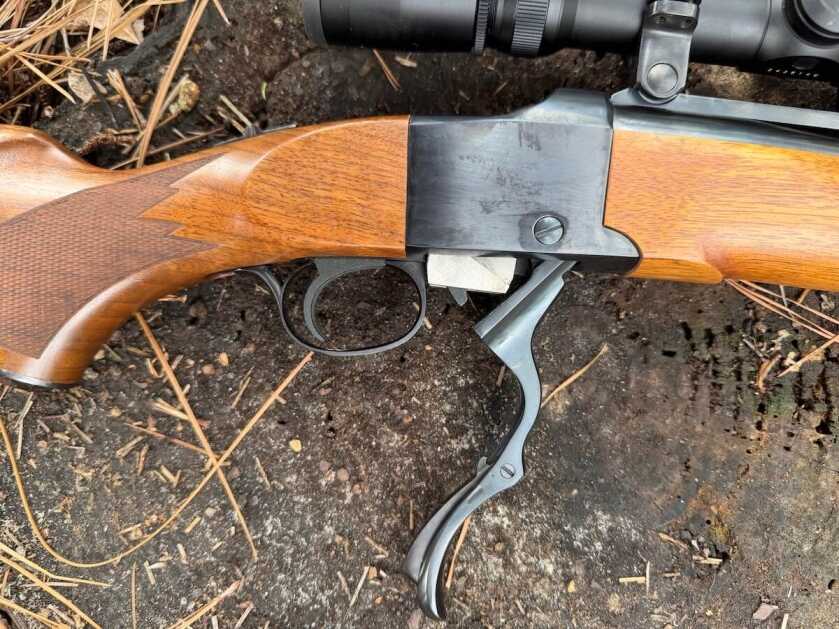
Name a rifle caliber and the Ruger No. 1 has probably been chambered in that caliber. From .204 Ruger to .480 Ruger and nearly every caliber in between, the No. 1 has been used to whack prairie dogs at extreme distances to hunting Cape buffalo up close and personal.

Ruger No. 1 Variants: Six Ways to Build a Classic
During the course of the No. 1 production, there were six main variants. These models differed in barrel length, weight, caliber, and stock configuration. Most featured blued steel and checkered walnut stocks. There were also stainless steel versions with walnut or black laminated stocks. Here is a list of those Ruger No. 1 models and their characteristics.

Ruger No. 1 Light Sporter: This No. 1 model featured the Alexander Henry style forend, a 22-inch barrel with Ruger’s integral quarter rib scope mount and open sights. It weighs about 7.2 pounds and was available in calibers ranging from 22 Hornet and .204 Ruger up to .243 Win. and .30-06 and many calibers in between.
Ruger No. 1 Standard: This model had a semi-beavertail forend and a barrel length of 22 or 26 inches, equipped with the integral quarter rib scope mount and no sights. Calibers ranged from .204 Ruger to .338 Win. Mag.
Ruger No. 1 Medium Sporter: The Medium Sporter is similar to the Light Sporter but with a 22- or 26-inch barrel, quarter rib scope mount, and sights. Calibers ranged from .218 Bee up to .480 Ruger.
Ruger No. 1 Tropical: The Tropical was chambered in dangerous game calibers starting with .375 H&H Magnum up to .458 Win. Magnum. It sports a 24-inch barrel with a quarter rib scope mount and sights.
Ruger No. 1 International: This No. 1 sports a full-length Mannlicher-style stock and 20-inch barrel with the quarter rib and sights. Calibers ranged from .243 Win. to .300 RCM.
Ruger No. 1 Varmint: This model had a heavy profile barrel of 24 or 26 inches with target scope blocks and no sights. Calibers ranged from .204 Ruger to .300 Win. Mag.
Ruger No. 1 vs No. 3 Specs: What Actually Changes?
| Specification | Ruger No. 1 International Tested | Ruger No. 3 Tested |
|---|---|---|
| Action | Modified Farquharson-style hammerless falling-block | Same action as Ruger No. 1 |
| Caliber | 7mm Mauser / 7x57mm | .45-70 |
| Barrel Length | 20-inch | 22 inches |
| Overall Length | Not stated | Not stated |
| Weight | Not stated | Not stated |
| Capacity | Single-shot | Single-shot |
| Stock | Full-length Mannlicher-style | Smooth military style straight grip |
| MSRP | Not stated | Not stated |
Ruger No. 1 vs No. 3: What’s the Real Difference?
The Ruger No. 3 is the plain, less fancy version of the No. 1. They are identical except the locking lever lacks the locking bar and the stock is smooth with a military-style straight grip. Barrel length was 22 inches and caliber choices ranged from .22 Hornet to .45-70.


Ruger No. 1 International Range Test: 1-Inch Groups in 7mm Mauser
Of all the rifles I regret selling, Ruger No. 1 rifles I had are at the top of the list. I did save one Ruger No. 1, an International model chambered in 7mm Mauser, and I’m glad I did. The entire rifle is unique due to the full-length Mannlicher-style stock and the 7x57mm, or just plain 7mm Mauser for short, a nice caliber for deer hunting. I mounted a Leupold VX-3 3.5-10x40mm scope to the No. 1 and have fond memories of taking this rifle into the hardwoods back home chasing whitetails. It is short like a carbine and lively in hand.
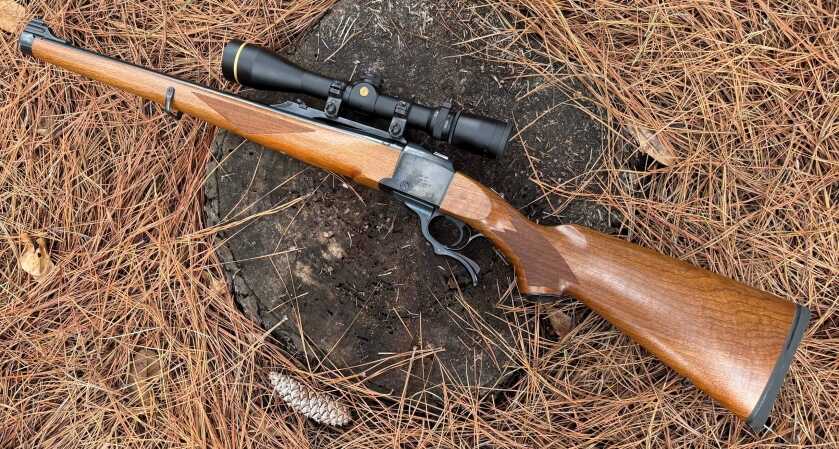
My supply of range ammo included Winchester Power Point with a 145-grain SP bullet and PPU 139-grain JSP. Both bullets I’ve used for deer hunting. With both loads, my best 3-shot groups measured an honest 1 inch at 100 yards. On average, the PPU grouped 1.5 inches, and the Winchester averaged 1.3 inches. Recoil is mild with the 7mm Mauser, similar to 6.5 Creedmoor.
Ruger No. 3 .45-70 Range Test: Recoil, Velocity, and Boar-Down Accuracy
While the No. 1 in 7mm Mauser would be fine for hogs, I couldn’t help picking up a lightly used No. 3 in .45-70. This rifle is light and fitted with an affordable Hawke Vantage IR 3-9x40mm scope with the reticle calibrated for straight-wall cartridges like 350 Legend, 360 Buckhammer, 400 Legend, 450 Bushmaster and .45-70 Gov’t. The vertical post has additional aiming points calibrated for Hornady’s Leverevolution 325-grain FTX bullets. I’ve also used it with other 45-70 loads and like the simplicity of the optic.

I had on hand for range testing Federal PowerShok with a 300-grain JSP, Remington Express Rifle with a 400-grain SP, and Hornady Leverevolution with a 325-grain FTX bullet. All pig-smashing loads. If my science teacher had used recoil as an example of inertia, I would have paid attention. Needless to say the lightweight Ruger No. 3 and hot Hornady Leverevolution demonstrated the effect. Recoil was stout with the Hornady, but very manageable, even when shooting from a bench. Muzzle velocity averaged 1990 fps. Average 3-shot groups at 100 yards measured 1.84 inches. Recoil with the Federal and Remington loads was tolerable and, dare I say, pleasant; muzzle velocity was 1782 fps and 1201 fps, respectively. Average group with the Remington was 1.71 inches, and for the Federal it was 0.96 inches. Boar-down accuracy.
Ruger No. 1 and No. 3 Pros & Cons: Beauty vs Simplicity
- Pros: Strong and compact falling-block action, classic wood-and-steel styling, numerous caliber options, short overall package for a given barrel length, simple controls, hunting-ready accuracy, and unmistakable old-school character.
- Cons: You get exactly one shot before reloading, No. 1 rifles are expensive, current production is limited to a few calibers a year, and the light No. 3 can remind your shoulder exactly what a hot .45-70 load is doing.
Final Verdict: Why the Ruger No. 1 and No. 3 Are Rifles You Regret Selling
Ruger’s No. 1 and No. 3 single-shot rifles offer classic looks, great accuracy, and come in many caliber flavors depending on your quarry. No. 1s are expensive but they offer that traditional wood and blued steel look of rifles from long ago. Current production is limited to a few calibers a year, but there are used No. 1s and No. 3s on the market, and I know exactly what those former owners will say once their Ruger is sold: That’s the one rifle I should have kept.
Related Reads from GunsAmerica Digest
- Ruger’s New 250th Anniversary Lineup
- Henry Brass .45-70 Lever Action Review
- The New Marlin Model 1895 SBL in .45-70

Robert A. Sadowski is an American writer and journalist.
He has written about firearms and 2A issues for decades, and has trained with some of the country’s finest firearm instructors in handguns, rifles/carbines, shotguns and long-range shooting. He has also had the opportunity to interview numerous individuals deeply involved in protecting our 2nd Amendment.
He a is a frequent contributor to numerous gun-enthusiast publications, a few of which include:
- TheArmorylife.com
- TheTruthAboutGuns.com
- GunsAmerica.com
- GunBroker.com
- Gun-Tests.com
- Shooting Illustrated
- SHOT Business
- Gun Digest
Sadowski is also the author of numerous gun books, including: “9MM — Guide to America’s Most Popular Caliber” and “Book Of Glock,” both of which were #1 new releases on Amazon. He also wrote the popular DIY gun book series: Shooter’s Bible Guide to Firearms Assembly, Disassembly, and Cleaning Volume 1 and Volume 2. Other gun books authored by Sadowski include “50 Guns That Changed the World,” and edited “The M16A1 Rifle: Operation and Preventive Maintenance”originally published by the U.S. Department of the Army. He also edits the annual “Gun Trader’s Guide” to firearm values.
Sadowski is also the Treasurer/Secretary of the GLOCK Collectors Association, a non-profit organization with the mission to educate and preserve: Educate the public on the models, variations, and commemoratives built by GLOCK, as well as provide members with information on GLOCK serial numbers, importation, and other facts unique to GLOCK pistols.