
Estimated reading time: 15 minutes
The PTR-91 puts the HK G3’s roller-delayed Cold War muscle back in your hands, complete with hard-running reliability, excellent iron sights, flying brass, and accuracy that still earns respect at 100 yards.
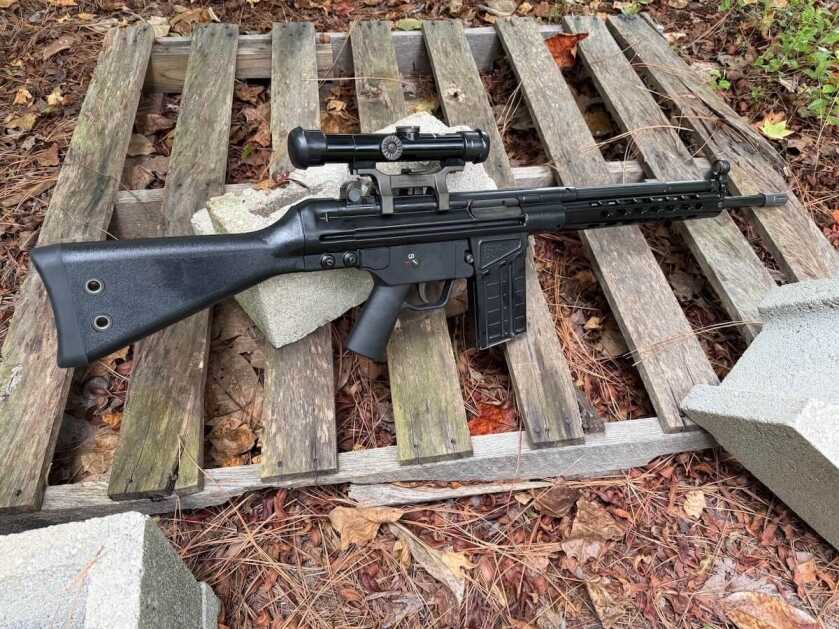
Table of contents
Why the HK G3 Still Matters in an AR-Crazy World
You might ask yourself why the H&K G3 matters. Here in the U.S., we sometimes have AR myopia and forget there are other rifle designs besides the AR. The G3 is one of those designs, and once you get outside the AR bubble, its influence is impossible to ignore. Over 70 countries equipped their forces with a G3, and some 8 million G3s have been produced to date. The rifle has been in service since 1959 and is still very active in countries ranging from Afghanistan to Zimbabwe.
The G3 has made its presence known in conflicts since the 1960s. The design is modular, easy to manufacture with a stamped steel receiver, and reliable, so much so that other HK weapons morphed from the G3, including the MP5, HK33, and an arsenal of others. At the heart of it all is a roller-delayed blowback action. If you want to continue the Cold War shooting experience, then the H&K G3 is next on your list. These are the rifles to shoot. Let’s start with the Heckler & Koch G3.
From Sturmgewehr to CETME: How the HK G3 Was Born
The genesis of the Heckler & Koch G3 began just as WWII was ending. Mauser was working on a prototype rifle chambered in 7.62x33mm Kurz. You know the caliber. It was used in the StG 44, or Sturmgewehr 44, the rifle that coined the term assault rifle. The Mauser prototype never saw the light of day, and some of the German engineers working on the rifle were sent to France, where they tinkered more on the design. Finally, a viable combat rifle was taking shape, and the head designer moved to Spain, where the CETME Model A emerged. That’s when the Germans became interested.

The West German Bundesgrenzschutz, or Border Guards, needed to re-equip in a NATO-spec caliber, which at the time was 7.62x51mm. The West Germans asked CETME to develop the rifle in the NATO-approved caliber and asked that the Heckler & Koch team assist. This produced the CETME Model B, which Spain, a member of NATO, adopted in 1958.
The West Germans, however, scratched the CETME Model B. They were going with the FN FAL and adopted it as the Gewehr 1, or G1. In the meantime, the newly formed West German Bundeswehr, or military, was digging the new CETME after holding trials with the SIG SG 510, U.S.-made AR10, and Belgian-made FN FAL.
Remember the four rifles I had you text to yourself? The AR10, M14, FN FAL, and H&K G3? These combat rifles played a pivotal role in the new world order after WWII. Anyway, long story short, Heckler & Koch HK-ed the CETME, and in 1959 the Bundeswehr was jazzed with the latest version called the G3. The only caveat was the Bundeswehr wanted to license the rifle and build it in West Germany. Some back-room deals were made, and Heckler & Koch obtained the rights.
Inside the HK G3: Roller-Delayed Blowback Explained
The G3 and many H&K variants use a delayed blowback system with twin rollers. These rollers are located on the bolt on each side and lock into detents in the trunnion of a stamped steel receiver. When a round is fired, force on the bolt keeps the action locked until the bullet exits the barrel. Then the action unlocks and the bolt moves rearward against spring pressure. The bolt returns to battery, stripping a cartridge from the magazine along the way and chambering the round. The roller-delayed system is brutally simple, mechanically distinctive, and famously reliable.

The charging handle is located on the left side of the rifle, allowing a right-handed user to use the support hand to manipulate it. The charging handle is non-reciprocating. Unique to the chamber are longitudinal flutes. These cuts in the chamber wall assist case extraction because the flutes allow gases from a fired round to flow between the case and chamber.
The G3 is known to eject brass cases forcefully, flinging them into the next zip code, 10 to 15 yards away. Many times the cases are dented. That is part of the G3 experience. It does not gently lay your brass in a neat little pile beside the shooting bench.

HK G3 Variants: From Battle Rifle to Sniper Rig
During the Cold War, Heckler & Koch licensed its tooling to several state-run factories worldwide, including Pakistan, Brazil, Iran, France, Greece, Norway, Mexico, Myanmar, Portugal, Saudi Arabia, Sweden, and Turkey.
FMP in Portugal manufactured G3s on H&K tooling. Many surplus parts kits today originate from FMP. EBO in Greece produced licensed military G3s and imported the SAR-3 and SAR-8 variants to the U.S. during the mid 1980s.
In Turkey, MKE produced a variety of roller-delayed firearms under H&K license, with importers like Zenith bringing a variety of H&K-designed guns to the U.S. The Z-3 is the modern equivalent to the G3.
With the design licensed to many countries, there are many different variants of G3. The G3 was also enhanced over the years, creating the G3A1, which had a retractable stock. The G3A2 was equipped with a drum-style rear sight. The G3A4 is perhaps the most common. This version had a fixed plastic stock. A K variant was also procured. This was a carbine version. A few G3s set up for sniper use had legendary accuracy. Here are a few specialized G3s used by German forces.
G3A3ZF: The ZF stands for Zielfernrohr (Telescopic Sight), which was a Hensoldt Fero Z24 4×24mm scope that attached to the stamped steel receiver via a claw-and-rail. These were developed for use by designated marksmen.

G3SG/1: This accurized G3 was developed for sniper use. The SG stands for Scharfschützengewehr (Sharpshooting Rifle). These rifles were hand-picked from G3 production for accuracy and equipped with a fixed-mount Zeiss optic, an adjustable trigger, and an adjustable cheek riser on the stock.

MSG90: This is another G3 set up for sniper use with a longer 23.6 barrel. The receiver was strengthened and the stock was user adjustable. MSG stands for Militärisches Scharfschützengewehr (Military Sniper Rifle).

PSG1: The PSG, or Präzisionsscharfschützengewehr (Precision Sniper Rifle), featured a free-floated 23.6-inch barrel and a retractable buttstock.

HK G3 Clones in the U.S.: PTR and Century Arms
Here in the U.S., there are two main G3 clone manufacturers and/or importers.
Century Arms International: Century Arms International builds a series of HK-derived firearms called the AP (Apparatus Pistol) series. These firearms, which are imported from MKE in Turkey, include the AP51 PDW, which is based on the iconic HK51 PDW. It is a large pistol format chambered in 7.62x51mm NATO with an 8.3-inch barrel.
PTR Industries: PTR manufactures semi-automatic copies of the HK G3 called the PTR 91, using tooling from the FMP arms factory in Portugal, which was licensed to build HK G3 rifles. Pistol, SBR, and rifle clones come out of PTR, ranging from retro-looking rifles to guns with modern updates like Picatinny rails and collapsible stocks.
PTR-91 Range Review: Putting the G3 Clone to Work
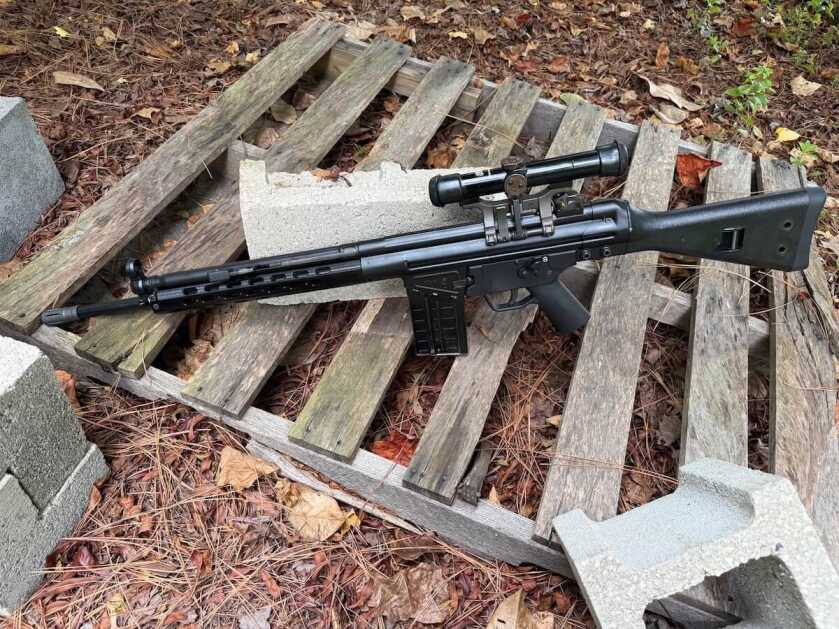
PTR Industries has been producing H&K G3 clones since the late 1990s, and over the years improved the platform by adding modern optics compatibility and suppressor-ready capability. My G3 clone is a PTR-91 C, which is similar to the current PTR GI. The main difference between the two is that the 91C has a slim aluminum handguard and a push-button magazine release. The GI has a polymer handguard and a paddle and push-button magazine release for both right- and left-handed shooters. Other than that, the two rifles are the same.

The GI is the retro model and as close to an original H&K G3 as you can find in a newly manufactured clone. This GI is equipped with an 18-inch threaded barrel with a multi-port compensator and excellent iron sights. The rear drum and hooded front sight are fast and simple to use.
Controls consist of a thumb-operated selector switch and a push-button and paddle magazine release. The charging handle is located on the left side and allows a right-handed shooter to easily rack the handle back with the left support hand. The pistol grip module is polymer, as is the fixed stock. The rifle is hefty at 9.5 pounds, and that weight helps mitigate the felt recoil.

It feeds from 20-round aluminum or steel magazines. Surplus magazines in like-new shape are inexpensive, less than $20 a piece.

Old-School Steel Meets the Hensoldt Z24 Optic
The receiver keeps its heritage and looks like the original platform. The weld marks on the stamped steel receiver look out of place today, and that’s because most modern combat rifles are forged and milled from aluminum alloy like the AR15, or the stamped steel receiver is riveted like in many AK variants.
The receiver preserves the legacy mounting compatibility of the claw-style optic mounting interface. A surplus Hensoldt Fero Z24 4×24mm scope attached to the PTR easily without much effort.

The Hensoldt Fero Z24 4x24mm is as legendary as the H&K G3. This scope was German military-issue, manufactured by Zeiss/Hensoldt, and originally designed as a designated marksman optic for the G3 and HK91/93 rifles.
The optic features 4x magnification and a 24mm objective lens. It is renowned for exceptional clarity and durability. The reticle is similar to a German #4 reticle with heavy posts at the 3, 6, and 9 o’clock positions. It is very simple and uncomplicated. The turrets require a small screwdriver to loosen the turret before adjustment. The lens caps are rubber and are turned inside out to position them away from the lens.
100-Yard Accuracy: The PTR-91 Still Has Teeth

I had 150-grain FMJ Winchester white box, Federal Gold Medal 175-grain Sierra Matching BTHP, and 168-grain BTHP Hornady Match on hand. At 50 yards, I dialed in the PTR with the Z24 scope. Turrets are old school with two set screws on each turret, then the turret turns.
Moving to 100 yards, the best group with Winchester white box was 1.45 inches for 5-shots; average was 1.8 inches. Moving to the Federal Gold Match, my best 5-shot group measured 1.46 inches; average was 1.53. Not bad for a nearly 50-year-old surplus optic.

Iron Sights, One Pulled Shot, and a Bruised Ego
Detaching the scope and using iron sights, I rotated the rear drum until groups were at the correct elevation and consistent. I had a 2-inch group with 4 shots, all in the black; then I pulled the last shot and last bullet into the 8 ring. Ouch. That hurt my ego, but it also proved the PTR was accurate.

Shooting the PTR-91: Recoil, Controls, and Flying Brass
I had no issues operating the G3 clone, though charging it using my support hand was different than using my support hand to run an AR. The bolt doesn’t lock back on the last shot. It is satisfying to slap the charging handle to close the bolt. The rifle’s action has a mechanical sound as it cycles. That mechanical clack is part of what makes the G3 experience feel so different from an AR.
It also throws brass out of eyesight. G3 clones abuse brass, denting it and leaving ridges in the case from the fluted chamber. Recoil is tolerable. The rifle weighs more than 9 pounds, and that helps stifle the punch to your shoulder. I’d say the recoil is more pronounced in a G3 clone than an AR10.

PTR HK G3 Clone Specifications at a Glance
| Model Tested | PTR-91 C |
|---|---|
| Comparable Current Model | PTR GI |
| Operating System | Roller-delayed blowback |
| Barrel Length, PTR GI | 18-inch |
| Weight, PTR GI | 9.5 pounds |
| Standard Magazine Capacity | 20 rounds |
| Magazine Material | Steel or aluminum |
| MSRP | Not provided in original article |
Are HK G3 Clones Worth It? The PTR Makes Its Case
If your definition of worth includes rugged construction, serious historical significance, and stubborn reliability, then investing in an HK G3 clone like one of the PTR rifles is a must-buy. You’ll pay a fraction of an original HK, yet reap all the benefits in performance and reliability.
It is heavy. It kicks harder than an AR10. It does not lock open after the last round, and it treats fired brass like it owes the rifle money. None of that makes the PTR less interesting. In fact, those quirks are part of the experience.
The PTR-91 delivers the mechanical soundtrack, charging-handle slap, roller-delayed action, stamped-steel personality, and old-school sights that made the HK G3 famous. Better yet, this one backed up the nostalgia on paper. With the surplus Z24 optic, the PTR repeatedly produced groups in the neighborhood of 1.5 inches at 100 yards, and it still impressed after the optic came off.
If you’ve spent enough time behind AR-pattern rifles and want to know what the other side of the Cold War battle-rifle world feels like, the HK G3 clone deserves a turn at the range. Just don’t stand to the right of the ejection port unless you enjoy hunting brass in the next zip code.
PTR G3 Clone Pros and Cons: Cold War Charm Included
- Pros: Rugged roller-delayed design, excellent reliability in testing, strong 100-yard accuracy, excellent iron sights, inexpensive surplus magazines, classic HK G3 handling and history.
- Cons: More than 9 pounds, recoil is more pronounced than an AR10, bolt does not lock back on the last shot, and the fluted chamber can dent and mark fired brass.
Related Reads from GunsAmerica Digest
- The G3 Is Back! PTR Industries’ GI Model 7.62x51m
- GI PTR 100: Roller Delayed Phenomenon from South Carolina
- PTR GIRK: New Take On A Cold War Classic
Available on GunsAmerica Now

Robert A. Sadowski is an American writer and journalist.
He has written about firearms and 2A issues for decades, and has trained with some of the country’s finest firearm instructors in handguns, rifles/carbines, shotguns and long-range shooting. He has also had the opportunity to interview numerous individuals deeply involved in protecting our 2nd Amendment.
He a is a frequent contributor to numerous gun-enthusiast publications, a few of which include:
- TheArmorylife.com
- TheTruthAboutGuns.com
- GunsAmerica.com
- GunBroker.com
- Gun-Tests.com
- Shooting Illustrated
- SHOT Business
- Gun Digest
Sadowski is also the author of numerous gun books, including: “9MM — Guide to America’s Most Popular Caliber” and “Book Of Glock,” both of which were #1 new releases on Amazon. He also wrote the popular DIY gun book series: Shooter’s Bible Guide to Firearms Assembly, Disassembly, and Cleaning Volume 1 and Volume 2. Other gun books authored by Sadowski include “50 Guns That Changed the World,” and edited “The M16A1 Rifle: Operation and Preventive Maintenance”originally published by the U.S. Department of the Army. He also edits the annual “Gun Trader’s Guide” to firearm values.
Sadowski is also the Treasurer/Secretary of the GLOCK Collectors Association, a non-profit organization with the mission to educate and preserve: Educate the public on the models, variations, and commemoratives built by GLOCK, as well as provide members with information on GLOCK serial numbers, importation, and other facts unique to GLOCK pistols.
Thanks for the review! In my early days as a US Cavalry trooper, I got to fire a G3 with my partnership unit in Germany in 1992. It was a good rifle, except that it felt like all the weight was at the front, so much that a bipod would have been nice. Does the updated one feel more balanced?
This reminds me of the 1980s when you could get a real CETME for $399.00. That was a lot of money back then. I’m guessing $1,200 to $1,800 for this copy. Stay safe. j
Also, not as accurate as an AR-10, in my personal experience.
But, I love the rugged reliability.