
The .32 ACP is the cartridge everybody loves to dismiss and nobody seems able to kill. It has been riding in pockets since John Browning designed it, it shared the Walther PPK with the .380 for generations, and Beretta still builds a pistol around it. So the .32 ACP vs .380 question is worth a straight answer, not a gun counter sneer.
Here is the short version. The .380 ACP carries a heavier bullet at similar speed, which gives it far more energy and a far wider choice of guns and defensive ammo. The .32 ACP kicks less, and in the right gun it is pleasant enough for shooters who struggle with any recoil at all. Paul Helinski chronographed Winchester 71 grain .32 ACP ball at 700 fps from a Kel-Tec P-32, which works out to 77 ft-lb. He put typical .380 carry ammo, in the 90 grain range, at about 200 ft-lb.
That gap is not small. It is more than double.
So here is where I land. For most people choosing a pocket pistol in 2026, the .380 is the better cartridge. The .32 earns a spot when recoil, hand strength, or a particular gun you love, like a Tomcat or a PPK, makes the difference between carrying and leaving the gun home. Our best .380 ACP pistols guide covers the .380 side in depth.
Table of contents
Buyer’s Guide: .32 ACP vs .380
Two Browning Pocket Cartridges
Our mouse gun history traces both rounds to Browning. The .32 ACP began as his 7.65mm pocket-pistol round, and the .380 ACP, or 9x17mm, followed shortly after. In the interwar years both found a home in the Walther PPK, long seen as the pinnacle of the mouse gun. The two are not interchangeable. Each pistol is built for one or the other.
Energy
Helinski did not mince words in his P-32 review: the ballistics of the .32 ACP are dismal. Ball ammo came in at 77 ft-lb from his gun, and he calculated lighter .32 hollow points at around 120 ft-lb. The .380, with a bullet around 90 grains at similar velocity, comes out near 200 ft-lb with carry ammo. Federal rates its .380 Punch load at 180 ft-lb. On energy, the .380 wins easily.
Penetration and Bullet Choice
Small cartridges force a choice between expansion and depth. Helinski chose not to carry hollow points in his .32 at all, because he wanted maximum penetration. Our mouse gun piece makes the same argument: even the .32 ACP can reach vital structures, but a hollow point that does expand may stop short, so the author would load FMJ and count on penetration. The .380 has more room to work with, but as Rob Garrett’s 10-load gel test showed, load choice still decides whether it hits the FBI’s 12 to 18 inch window.
Recoil
This is where the .32 earns its keep. Helinski noted the 6 ounce P-32 kicks significantly less than Kel-Tec’s nearly identical .380 P-3AT, and that most people find even a steel PPK in .380 unpleasant to shoot. Travis Pike found the Beretta Tomcat in .32 ACP very loud but soft shooting, easy to fire quickly and accurately at close range and easy to run one-handed.
Gun Selection
The .380 market is huge and modern: the Sig P365-380, Glock 42, Ruger LCP Max, Springfield Hellcat in .380, and plenty more. The .32 ACP list is much shorter. Walther has paused production of the PPK, PPK/S, and PP series for a multi-year redesign, according to our November 2025 news coverage, so new .32 PPKs are limited to what dealers already have.
Ammo Limits in Small .32s
Read the manual. Pike reports the Tomcat ships with a warning not to use ammunition exceeding 129 foot-pounds, because hotter .32 ACP loads can crack the frame or slide of the small blowback pistol. A .380 pocket gun has its own quirks, but the Tomcat rule is a real limit on which .32 loads you can carry in it.
.32 ACP: Best for the Most Recoil-Sensitive Shooters (2026)
The .32 ACP makes the most sense in a gun built around it. The Beretta 3032 Tomcat is the obvious choice today. It is a direct blowback pistol with a tip-up barrel, 2.4 inch barrel, 14.5 ounces, and no extractor. Pike put several hundred rounds through his and called it quite reliable, with one failure to extract that took tens of seconds to clear. He also called the gun finicky: use the wrong ammo and it breaks, and the slide can bite. Mitchell Graf’s look at the redesigned 30X Tomcat at SHOT Show 2024 noted an 8+1 capacity and a threaded barrel that ran suppressed without issue.
Read our full Beretta Tomcat review here.
Key Specs
- Origin: Browning’s 7.65mm pocket-pistol cartridge
- Example Load: Winchester 71 grain ball at 700 fps, 77 ft-lb (Kel-Tec P-32)
- Hollow Points: Around 120 ft-lb (Helinski’s calculation)
- Tomcat Ammo Limit: 129 ft-lb maximum per Beretta
- Example Guns: Beretta Tomcat, Kel-Tec P-32 ($318 MSRP in 2014), Walther PPK ($969 MSRP in 2024)
Pros
- Very soft recoil
- Easy one-handed shooting in the Tomcat
- Tip-up barrel loads without racking the slide
- Can still penetrate to vitals with FMJ
Cons
- Less than half the energy of .380 carry ammo
- Few current guns, and PPK production is paused
- Ammo energy limits in the Tomcat
- Expansion is unreliable, so most carry FMJ
🛒 Check Current Price for .32 ACP Pistols on GunsAmerica
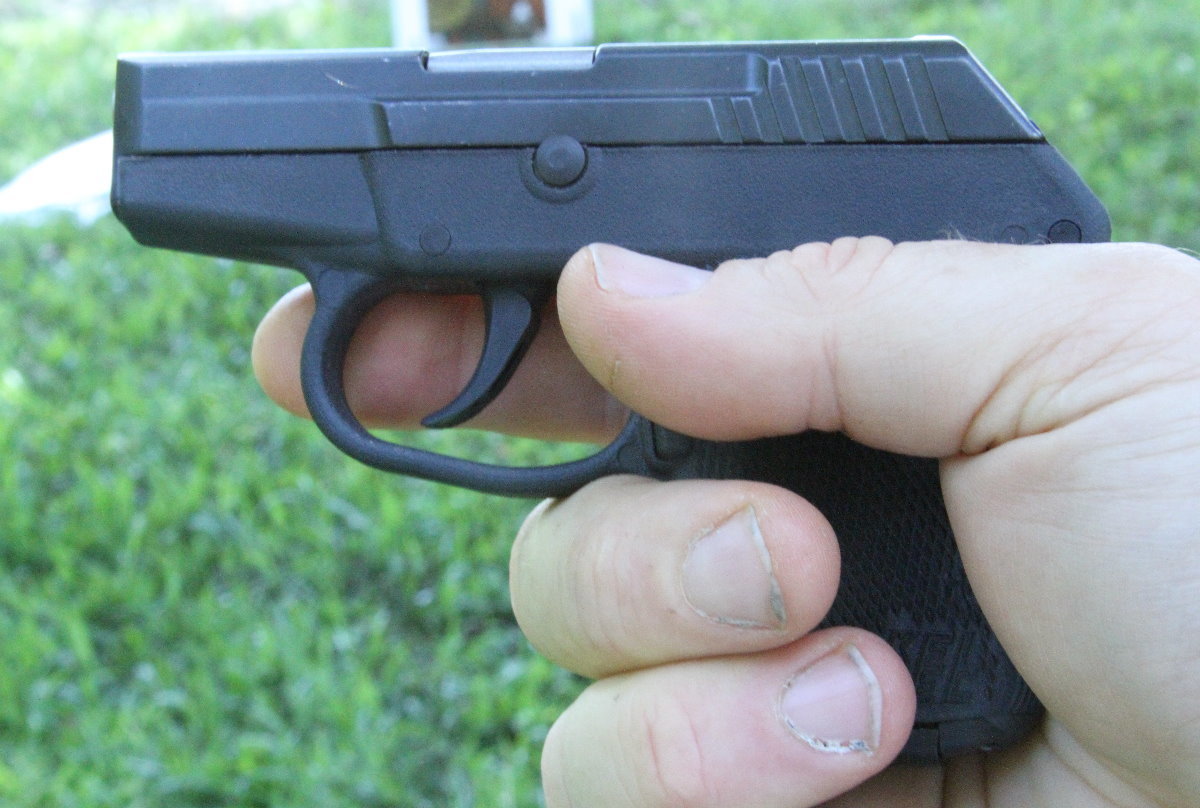
The P-32 is the budget path. Helinski found them at street prices in the mid $200s in 2014, shot two boxes through his review gun with no failures, and kept every shot in the chest area at 10 yards.
Read our full Kel-Tec P-32 range report here.
.380 ACP: Best Pocket Pistol Cartridge for Most Carriers (2026)
The .380 is the pocket cartridge that most of the market has settled on, and for good reason. It roughly doubles the .32’s energy in guns that are almost the same size. Helinski noted Kel-Tec’s .380 P-3AT is nearly the same size as the P-32. Dave Higginbotham carried his P-3AT for more than three years as his warm weather pocket gun and estimated at least 2,500 rounds through it. Modern .380s go further: Mitchell Graf’s Sig P365-380 holds 10 rounds, weighs 15.7 ounces, and shot much smoother for him than the 9mm version.
Read our full .380 ACP gel test here, and our Kel-Tec P-3AT three year review.
Key Specs
- Also Known As: 9x17mm, 9mm Kurz
- Typical Bullet Weight: About 90 grain
- Energy: About 200 ft-lb with carry ammo per Helinski; Federal Punch rated at 180 ft-lb
- Gel Standouts: Federal Hydra-Shok Deep averaged 15.9 inches in Garrett’s bare gel test
- Example Guns: Sig P365-380, Glock 42, Kel-Tec P-3AT, Ruger LCP Max
Pros
- More than double the energy of .32 ACP ball
- Wide choice of modern pocket and micro pistols
- Defensive loads that can reach FBI depth
- Guns barely bigger than .32s
Cons
- Snappier recoil in tiny guns
- Load choice still critical
- Micro 9mm pistols are nearly as small
🛒 Check Current Price for .380 ACP Pistols on GunsAmerica

.32 ACP vs .380: Head to Head
- Energy: .380, by more than double with typical loads.
- Recoil: .32 ACP.
- Gun selection: .380, by a wide margin.
- Defensive ammo choice: .380.
- Nostalgia and classic pistols: .32 ACP.
Which Should You Buy?
The .32 ACP vs .380 choice is lopsided for most buyers. Buy the .380. It offers twice the energy, many more guns, and defensive loads with real gel data behind them, in pistols nearly as small as any .32. If you can handle a little more, our 9mm vs .40 comparison shows how the next step up stacks up.
Buy the .32 ACP if recoil is the barrier, if you want a Tomcat’s tip-up barrel because racking a slide is hard for you, or if you simply love classic pocket pistols. Load it with ammo your gun is rated for and practice with it. A gun you carry and shoot well beats the bigger one you leave at home. GunsAmerica.com lists both new and used pocket pistols in each caliber.
If .380 is on your short list, our 9mm vs .380 comparison covers the next step up.

As the Chief Operating Officer of GunsAmerica.com, Chris blends his passion for firearms with years of experience in marketing, communications, and technology. A dedicated 3-Gun competitor, firearm collector, and staunch Second Amendment supporter, he is deeply involved in the shooting community.
Beyond the firearms world, he’s an avid overlander, nature lover, and sailor.
Experience
Tech Founder:Specializing in accelerated growth and digital transformation.
Competitive Shooter: Active 3-Gun competitor with a strong foundation in practical shooting disciplines.
Advanced Training: Completed high-level courses in pistol, carbine, concealed carry, shotgun, and precision rifle.
2A Advocate: Committed to promoting responsible gun ownership, education, and 2A rights advocacy.
Outdoor Enthusiast: Avid overlander, sailor, and adventurer, with a background in self-reliance and off-grid exploration.