
Estimated reading time: 15 minutes
The Uberti 1873 Sporting Rifle brings the Gun That Won the West back to life with a slick toggle-link action, gorgeous Old West looks, mild .44-40 recoil, and a best five-shot group of 0.97 inches at 25 yards. This old-time rifle still has some game.

Table of contents
- How Repeating Rifles Set the Stage for the Winchester 1873
- Inside the Winchester 1873 Toggle-Link Action
- Why .44-40 WCF Made One Cartridge Work in Rifle and Revolver
- The Winchester 1873 “One of One Thousand” Accuracy Legend
- Winchester Model 1873 Calibers, Barrels and Factory Options
- Modern Winchester 1873 Rifles and Clones Keep the Legend Shooting
- Shooting the Uberti 1873 .44-40: Slick, Mild and Accurate
- Uberti 1873 Sporting Rifle .44-40 WCF Specifications
Why the Winchester Model 1873 Became the Gun That Won the West
The actual phrase, “The Gun That Won The West,” originated in 1919 and was coined by one of Winchester’s employees as part of a marketing campaign. By that time, the Old West was just a moment in time in the memory of old cowpokes and retired lawmen. It’s not clear if the phrase was meant for the Winchester Model 1873 specifically or one of the other iconic Winchester rifles of the time like the Model 1886, Model 1892, Model 1894, and others. Maybe the phrase was vague enough to cover all the Winchester rifles that were used during the Old West?
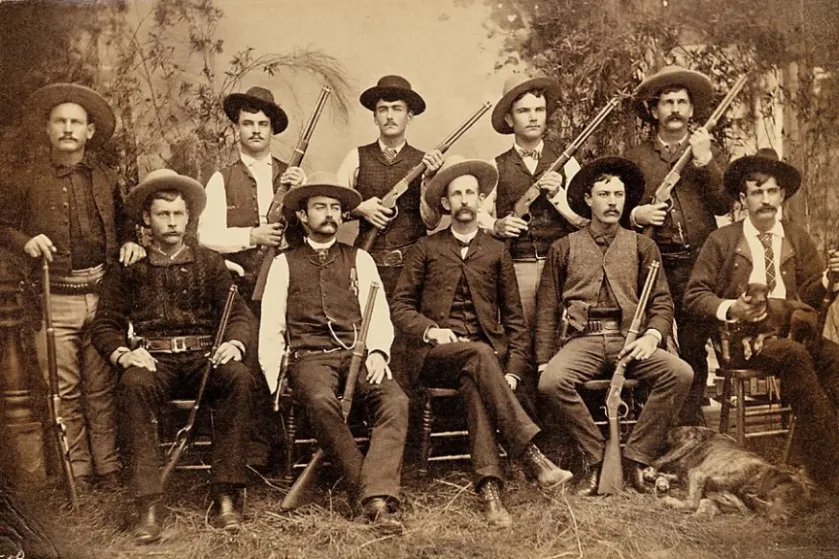
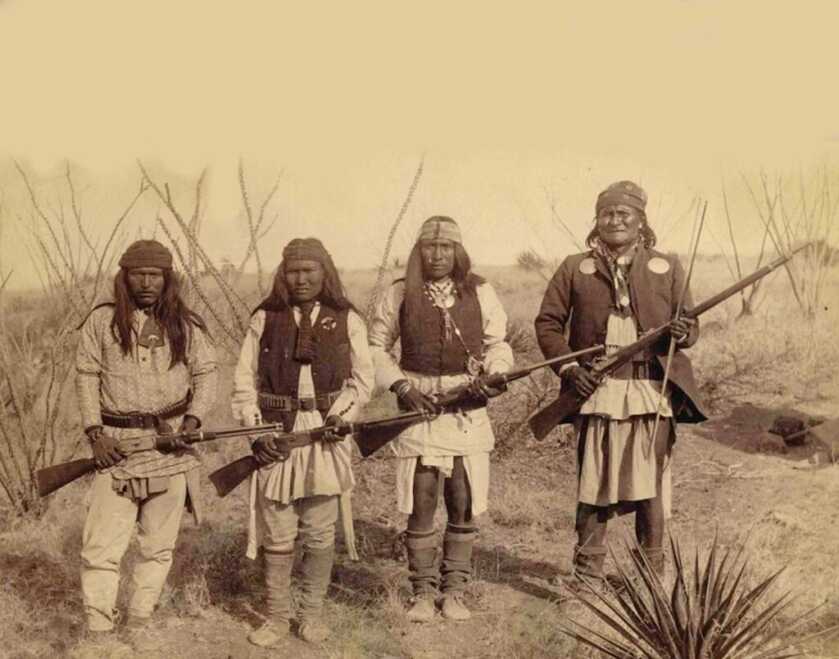
The consensus today is that the ’73 was saddled with the phrase and became legend. There are plenty of stories about Winchester Model 1873 rifles being used by outlaws, lawmen, native Americans, showmen, and just plain homesteaders and hunters whose names might not be remembered, but they played a role in settling the West, and so did the Winchester Model 1873. I think the ’73 deserves the title because it was the first lever-action rifle Winchester produced that combined a strong receiver with a slick operating lever and a powerful cartridge. It really is the stuff of legends.
How Repeating Rifles Set the Stage for the Winchester 1873
The repeating rifle was a marvel when it emerged in the 1860s. The Henry Model 1860 was the first successful lever-action rifle, and it held 15 rounds in a tubular magazine. You have to remember that at this time, single-shot, muzzle-loading rifles were the standard issue to armies and used by civilians. During the Civil War, the Henry Model 1860 was deployed by the Union Army on a small scale and demonstrated how firepower could dominate the battlefield. Confederate soldiers referred to the Henry as “that damned Yankee rifle that can be loaded on Sunday and fired all week.”

The evolution of the Winchester lever-action rifle commenced when Oliver Winchester bought the Henry Rifle design, reworked the design, slapped his name on it, and introduced the Winchester Model 1866. This rifle was chambered in the same .44 Henry caliber as the Model 1860, but had a loading gate on the right side of the receiver. Like the Henry, it had a brass frame and became known as the Yellow Boy. Since these two successful rifles used a brass receiver, they couldn’t be chambered in more powerful calibers.

The Winchester Model 1873 solved this issue by using a steel frame and chambering the rifle in a new, more powerful centerfire caliber, the .44-40 WCF (Winchester Center Fire) or just .44-40 for short. The combination of Winchester Model 1873 rifle and .44-40 cartridge is the GOAT of lever-action rifles.

Inside the Winchester 1873 Toggle-Link Action
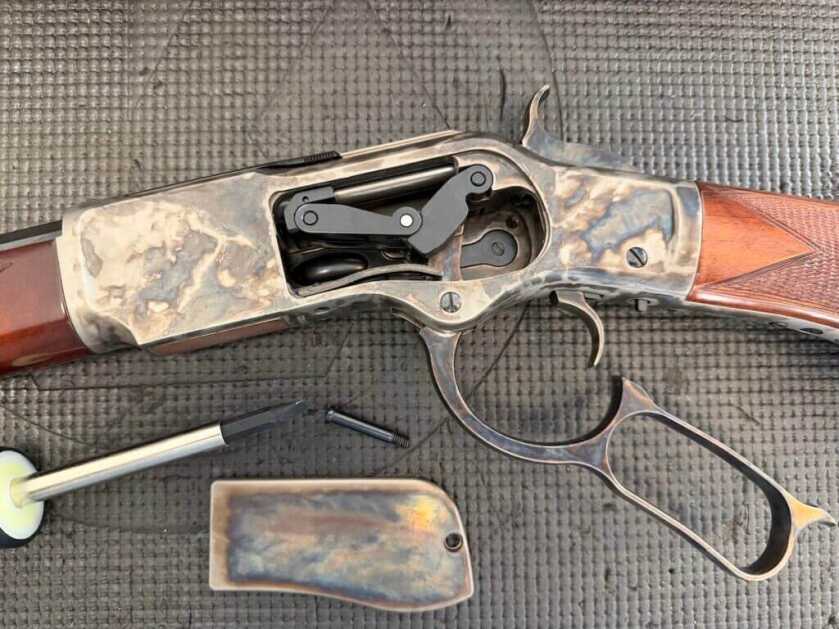
When the lever on a Model 1873 is pushed down, the toggle links inside the receiver rotate to pull the breech bolt rearward and cock the hammer. At the same time, the lifter raises a cartridge. On the rear cycle of the lever, the breech bolt is pushed forward, which in turn pushes the cartridge into the chamber, and then the toggle locks the breech bolt in place. The actual action of the ’73 is very similar to the Henry 1860 and Winchester 1866.
Why .44-40 WCF Made One Cartridge Work in Rifle and Revolver
The popularity of the .44-40 caliber forced Colt to chamber their SAA revolver in the caliber, because cowboys and lawmen preferred a rifle and pistol that use the same caliber. It made life easier since there were no big box stores in the Old West. You carried what you needed until the next town and hoped that town had your ammo in stock. If it was .44-40, the general store usually had it available.
The Winchester 1873 “One of One Thousand” Accuracy Legend
The Model 1873’s reputation was further enhanced in 1875 when Winchester advertised a special “One of One Thousand” special grade. A thousand ’73 rifles were tested for accuracy and the most accurate one was selected. These rifles were coveted back then by hunters and to this day by collectors.

In fact, the 1950 movie, “Winchester ’73” is all about a Winchester Model 1873 “One of One Thousand” special grade rifle. If you like westerns, Model 1873s, and Jimmy Stewart, it is worth a watch. By 1877, Winchester realized the emphasis on one rifle was counterproductive to sales. If only one rifle was accurate, did that mean all the other rifles had mediocre accuracy? Sometimes market schemes work, sometimes they don’t.

Winchester Model 1873 Calibers, Barrels and Factory Options
Eventually the original ’73 was also chambered in .32-20 WCF and .38-40 WCF. Some were chambered in .22 rimfire cartridges. Original carbines had 20-inch round barrels. Rifles had either 20 or 24-inch barrels. Special order Model 1873s could be ordered from the factory in a variety of barrel and stock configurations. The Model 1873 was produced well past its prime when newer Winchester lever guns in more powerful calibers were the darlings of shooters, hunters, lawmen, and other users. Production ceased in 1919, giving the Model ’73 about a 49-year production span.
Modern Winchester 1873 Rifles and Clones Keep the Legend Shooting
In the 1980s, Italian firearms companies like Uberti began importing lever-action cartridge rifles since their reproduction cap-and-ball revolvers were going gangbusters. As cowboy action shooting took off, the Model 1873 fit in perfectly and became the undisputed king in competition circles due to its smooth-cycling lever and ability to be tuned. Calibers also changed in modern variants of the Model 1873 due to the better steels available. The .40-40 is still available in some guns, but the majority are chambered in .357 Magnum and .45 Long Colt. Here is a short list of clones:
Uberti 1873 Special Sporting Rifle: This replica ’73 has a 24.2-inch octagon barrel, pistol grip, checkered stock, case color receiver, and comes in .45 Long Colt.

Taylor’s & Co. 1873 Carbine: This reproduction is chambered in two unusual calibers for the ’73; the powerful .44 Magnum, making it a great choice for deer hunting. The TC9 model is chambered in 9mm. Both have a straight grip and smooth stock.
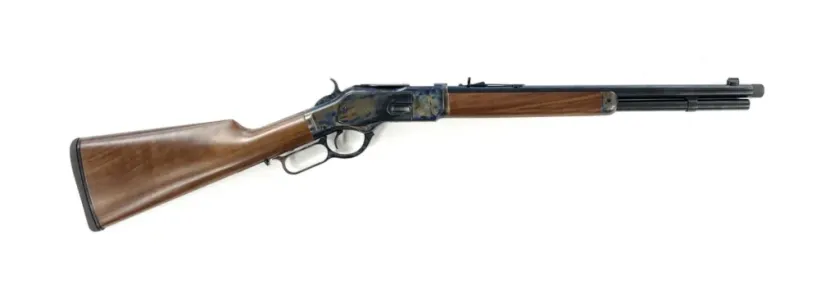
Cimarron Texas Brush Popper: This ’73 clone is designed for balance and speed when shooting at cardboard outlaws and steel plate bison in cowboy action shooting events. It features a pistol grip stock and 18.5-inch octagon-to-round barrel.

In 2016, Winchester restarted production of the Model 1873 in Carbine, Short Rifle, Deluxe Sporting, and other models that range from plain blued steel and smooth wood to frothy case-hardened steel receivers and fancy checkered stocks. These are made in Japan, not New Haven, Connecticut, and they pick up where the original ’73 left off. Here are a few new Model 1873 rifles made by Winchester.
Winchester Model 1873 Carbine: This is the classic carbine with smooth straight grip stock and 20-inch round barrel. I ran one of these a few years back and it had the slickest cycling lever I have ever used. Why did I sell it? I still ask myself that question.
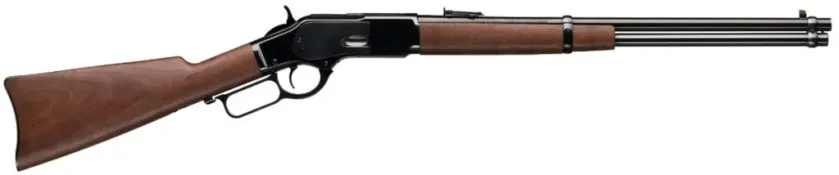
Winchester Model 1873 Sporter: Equipped with a 24-inch octagon barrel and straight-grip stock, this ’73 is one I love to have laying across my lap while in a tree stand on opening day. Deer season.
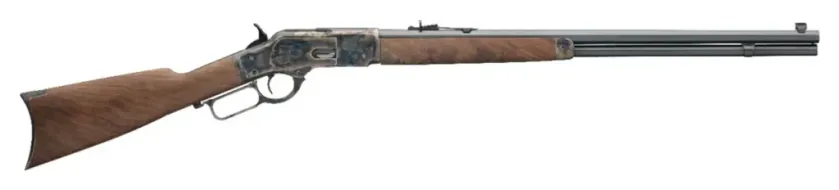
Shooting the Uberti 1873 .44-40: Slick, Mild and Accurate
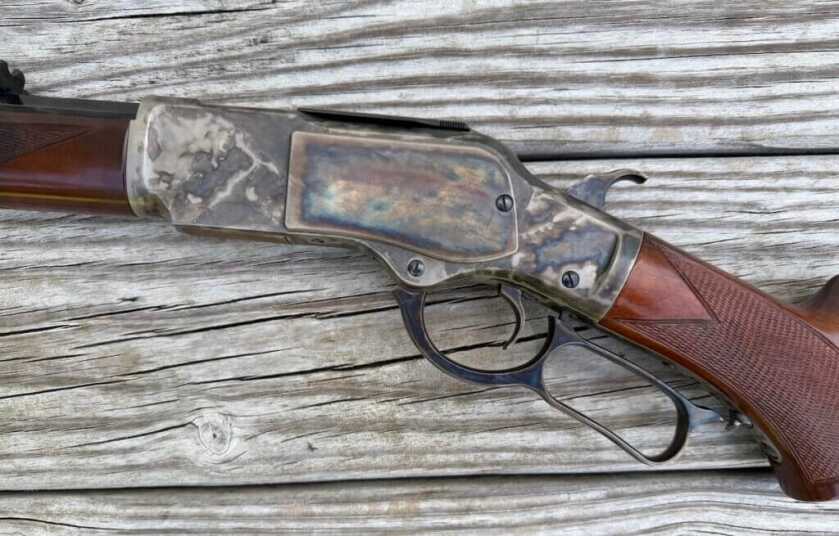
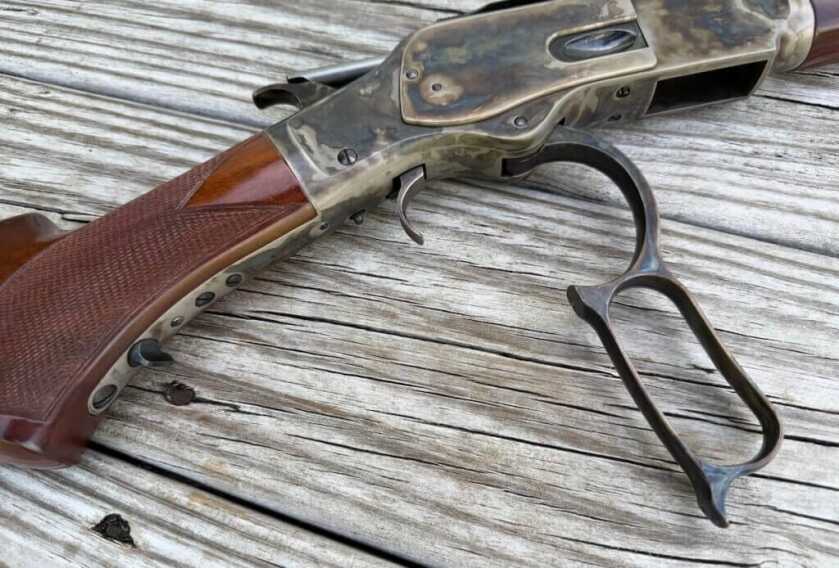
The Uberti Special Sporting has a pistol-grip stock, so the loop is slightly curved to match the stock. In my opinion curved loop levers are not as comfortable to cycle due to the inward curved lever against your knuckles. The Special Sporting’s action was slick.
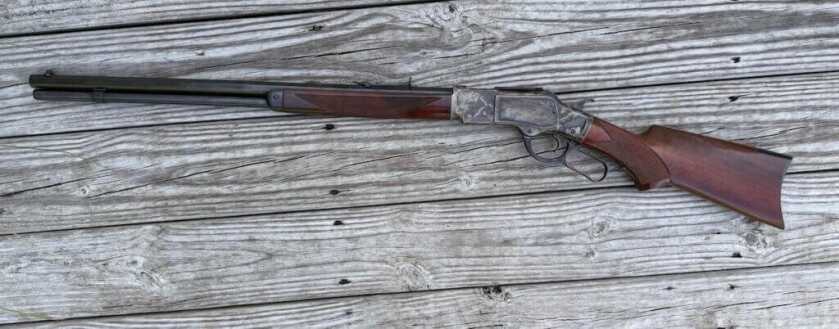
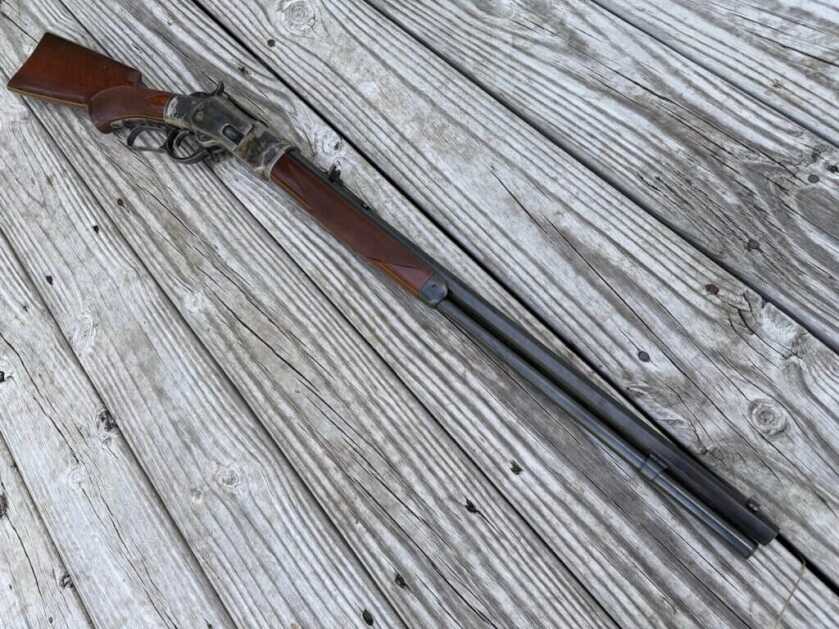
The receiver, lever, and hammer are a rich case-hardened blue, and the barrel and magazine tube are a deep blue. The walnut stock had an oil finish and is checkered at the pistol grip and the forend.
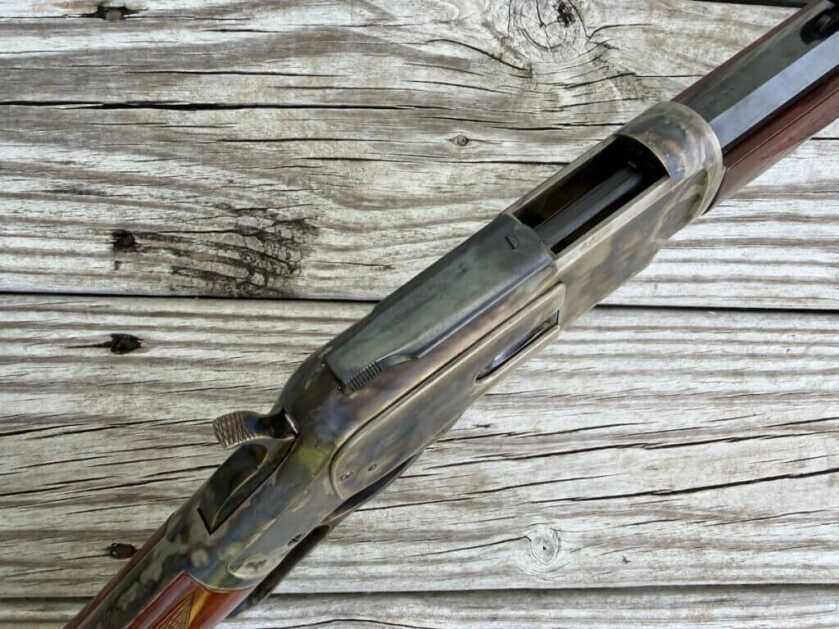
The crescent buttplate is metal and is no help reducing recoil. But, because the rifle weighs over 8 pounds recoil is mild. The rear semi-buckhorn sight is adjustable for windage and elevation, and a post front-sight blade. There was some take-up with the trigger, and it broke at a very heavy 7.4 pounds. The heavy trigger didn’t affect accuracy since I was able to squeeze out some nice groups.
Uberti 1873 Accuracy: The .44-40 Still Has Some Game
You get extra bucket list points for shooting a ’73 in .44-40. This Uberti is chambered in .44-40. Finding mild cowboy loads is easy. Magtech Cowboy Action Loads runs a 200-grain LFN bullet. Choice Ammunition Cowboy also runs a 200-grain bullet, but it is a RNFP with a Hi-Tek Black coating. My best five-shot group at 25 yards was fired with Choice Ammunition Cowboy and measured 0.97 inches; average was 1.00 inches. This old-time rifle has some game. Magtech Cowboy Action Loads measured 1.06 inches; average was 1.79 inches.


.44-40 Cowboy Loads Keep Recoil and Muzzle Jump Low
Cowboy loads slink out of the barrel at low velocities, so there is less recoil and muzzle jump. The Magtech averaged 951 fps, and the Choice was even slower at 823 fps. Original .44-40 ammo was loaded to a muzzle velocity of about 1,245 fps and used a 200-grain bullet.
A ’73 begs to be fired fast, so I obliged and fired it standing, pushing myself on speed while still being accurate. At 15 yards, five-shot groups averaged between 3.2 to 2.7 inches. How’s that for channeling my inner cowboy? The combination of the sights, slick action, and ok trigger ensured I could be fast and dead on.
Uberti 1873 Review Verdict: Old West Soul That Still Shoots
That is what makes the Uberti 1873 Sporting Rifle more than a handsome reproduction. The case-hardened receiver, deep blue barrel, walnut stock, crescent buttplate, semi-buckhorn sight and sliding dust cover deliver the visual details, but the range is where the old design earns its keep. The lever is slick, recoil with cowboy .44-40 loads is mild, and the rifle produced groups that make it clear the Model ’73 is not surviving on nostalgia alone.
The curved lever and 7.4-pound trigger are not my favorite parts of the package, but neither stopped the Uberti from shooting well. Run it slowly from a rest, and the rifle can print tight five-shot groups. Stand up, speed up, and channel your inner cowboy, and the same slick action that made the Model 1873 famous starts making a lot of sense. If a Winchester Model ’73 is missing from your lever-action education, this Uberti gets you awfully close to the original experience without sending a 19th-century collectible to the firing line.
Uberti 1873 Sporting Rifle .44-40 WCF Specifications
| Model | Uberti 1873 Sporting Rifle |
|---|---|
| Caliber | .44-40 WCF (tested), .45 Long Colt |
| Action | Lever |
| Barrel Length | 24 inches |
| Unloaded Weight | 8.2 ounces |
| Capacity | 13 rounds |
| Frame | Steel |
| Front Sight | Dovetailed post |
| Rear Sight | Adj. Semi-Buckhorn |
| Stock | Checkered walnut, pistol grip |
| Trigger Pull | 7.4 pounds |
| MSRP | $1,749 |
Uberti 1873 Pros & Cons: Slick Action, Heavy Trigger
- Pros: Slick cycling action, mild recoil with cowboy .44-40 loads, authentic Winchester Model 1873 looks, rich case-hardened finish, checkered walnut furniture, strong 25-yard accuracy, and pure bucket-list lever-action appeal.
- Cons: Curved loop lever can press against the knuckles, the metal crescent buttplate does nothing to soften recoil, and the tested trigger broke at a very heavy 7.4 pounds.
Related Reads from GunsAmerica Digest
- Cowboy Time Machine: Uberti 1873 Carbine Review
- Shooting History: Winchester 1873 Old Gun Review
- Taylor’s & Company TC73: The 9mm 1873 Lever Gun

Robert A. Sadowski is an American writer and journalist.
He has written about firearms and 2A issues for decades, and has trained with some of the country’s finest firearm instructors in handguns, rifles/carbines, shotguns and long-range shooting. He has also had the opportunity to interview numerous individuals deeply involved in protecting our 2nd Amendment.
He a is a frequent contributor to numerous gun-enthusiast publications, a few of which include:
- TheArmorylife.com
- TheTruthAboutGuns.com
- GunsAmerica.com
- GunBroker.com
- Gun-Tests.com
- Shooting Illustrated
- SHOT Business
- Gun Digest
Sadowski is also the author of numerous gun books, including: “9MM — Guide to America’s Most Popular Caliber” and “Book Of Glock,” both of which were #1 new releases on Amazon. He also wrote the popular DIY gun book series: Shooter’s Bible Guide to Firearms Assembly, Disassembly, and Cleaning Volume 1 and Volume 2. Other gun books authored by Sadowski include “50 Guns That Changed the World,” and edited “The M16A1 Rifle: Operation and Preventive Maintenance”originally published by the U.S. Department of the Army. He also edits the annual “Gun Trader’s Guide” to firearm values.
Sadowski is also the Treasurer/Secretary of the GLOCK Collectors Association, a non-profit organization with the mission to educate and preserve: Educate the public on the models, variations, and commemoratives built by GLOCK, as well as provide members with information on GLOCK serial numbers, importation, and other facts unique to GLOCK pistols.
Very good article Robert. I wish I could write like that!!
Dr. Enoch Pardee was an avid shooter back in the early 1870’s. He purchased Winchester 73′ #644, and shot made 30 consecutive shots at 110 yards…of which they all grouped just over 3″. His testimonial was sent to Winchester. Winchester published his testimonial in their 1875 catalog. The testimonial was also published in the August 21, 1875 Forest & Stream publication. Winchester presented a 1 of 1,000 rifle to him in 1876…#19,243.
Also, the Stewart brothers enjoyed shooting their two 1 of 1,000 rifles at 500 yard targets in the mid 1870’s.
Thank you for your articles.
Let me tell you about my experience with Uberti…
I purchased their 1873 LIMITED EDITION SHORT RIFLE DELUXE in 45 colt a couple years ago. It came with one of the screws sticking out of the bottom where the receiver screws into the stock. It was sticking out about 3 mm and I had trouble chambering around. I had to rock the lever a couple of times to get the cartridge to feed. So I sent it back under warranty for them to fix it. It came back with that same screw STILL sticking out about 2 mm. I don’t know if they corrected the chamber issue because I didn’t leave the shop with it. The shop was kind enough to go down into their stock and bring me another one and at least the screw was not sticking out.
What kind of a company would’ve allowed that rifle to leave their factory with that screw sticking out in the first place, let alone receiving it back and sending it back out a second time, with the screw still sticking out? When I got home I tried chambering a round in this and still had the same issue. I can see they should’ve put a little bit of a ramp on the receiver so when I get time I’ll file that down to remove the lip that’s on it.
Shit company with shit QC and even worse… Incompetent employees that can’t fix an error when it’s pointed out to them. Fuck Uberti!
Thanks for spelling that out. A protruding screw and feeding problems are the kind of QC details other buyers actually need to hear. This review’s sample was a .44-40 that ran well, so your .45 Colt experience is a good reminder that Uberti results can vary gun to gun. Glad you pushed it through warranty, and hopefully the next trip back gets the feed side sorted for good.
Back in the early 90’s when I still had an FFL, Uberti had a less than stellar reputation for poor quality control issues. At almost $1800 w/tax, I hope that reputation has improved. I will say this, they make some beautiful guns – at least the pictures are beautiful!
Any of you Uberti owners out there that want to school me on how the quality has improved enough for me to fork out this much coin, I’m all ears! But it’ll be a 45-70!
Fair question. This review was on an Uberti 1873 Sporting Rifle in .44-40 (MSRP listed at $1,749), not a .45-70. On that sample the author saw a slick action, solid finish work, and good accuracy. The nits called out were the curved lever feel and a heavy 7.4-pound trigger, not fit-and-finish rejects. Uberti QC can still be sample-dependent though, so if you are shopping near that $1,800 mark it is worth buying from a shop that will let you inspect the rifle and will stand behind warranty work. For a modern .45-70 lever comparison from the Digest side, this Henry write-up is a useful read: https://gunsamerica.com/digest/henry-45-70-review-brass-lever-action/
Would love to have you do a write up on .45-70 lever action rifles with their various models as well if possible.
Clark, good request. For a deep dive on a modern brass side-gate .45-70, we already have Clay Martin’s Henry H24 Signature write-up here: https://gunsamerica.com/digest/henry-45-70-review-brass-lever-action/ If you meant a broader Guides-style roundup across Henry/Marlin/Winchester models, that is a solid future piece.
A few years back, Winchester, as a complement to it’s 1873, reintroduced the Yellowboy 1866 in .38 Special. What a nice rifle, and I never understood why they discontinued it after a seemingly short run.
I have one of the 1873 carbines and it’s not going anywhere.
Great article on old steel. Some current prices and links might be nice.
But – I will continue to complain about the boring and nauseating Ai format until human writing returns.