
Estimated reading time: 16 minutes
If you are new to deer hunting or long-range shooting, chances are that a rifle chambered in the .243 Winchester cartridge has come up in conversation as you weigh your options. That choice comes with good reason. The .243 offers a lighter bullet and consequently lighter recoil than bigger rounds that start with bigger numbers: .270, 7mm, .30, and so on. You get less movement of the rifle. This helps curb bad shooting habits and allows you to get off a quicker second shot if you need it.
It also helps that manufacturers have long made shorter-stocked rifles intended for young and shorter-statured hunters. Inevitably, these youth rifles are chambered in .243. But there is more to the .243 than its status as a starter round. Despite its smaller size, it is capable of downing whitetail and more..
It has even gained a following among experienced hunters and long-range sport shooters. As homespun as the .243 has become since its introduction, it can be hard to recall that it is the original 6mm hotrod before it was cool.
Table of Contents
The .243 Winchester in Context
Even before the jump from black powder to smokeless had been made, it was realized that smaller caliber, faster bullets could be propelled at higher velocities. That higher velocity translated to a flatter point blank range, less holdover, and better wind resistance. Big-bore .45 caliber and 11mm rifle cartridges in use by the shooting public and the world’s militaries gradually gave way to smaller .30 caliber or 8mm rounds.
The Swedes, Italians, and Japanese went a step further by developing 6.5mm smokeless rifle cartridges with longer bullets that better defied gravity and the wind. The obvious next step was to go even smaller. The US Navy and Marine Corps adopted the M1895 Lee rifle in lieu of the Krag Jorgensen. The Krag was chambered in the .30-40 Krag, but the Lee was chambered in a proprietary 6mm rifle round. It was a hotrod of a round, enough to wear out the barrels on the rifles. 1
A Proof of Concept
The Lee Navy was quickly supplanted with the Krag in 1899 after the Spanish-American War, but the idea of a 6mm rifle round stayed in the public mind. A lighter 6mm bullet, propelled fast enough, could punch with energy approaching conventional .30 caliber rounds within a reasonable range but with less recoil imparted to the shooter, along with all the other aforementioned ballistic advantages. Warren Page, editor of Field and Stream magazine, managed to keep the idea alive by wildcatting his own 6mm cartridges through the 1940s. Fred Huntington, a long-time wildcatter who would go on to found RCBS in 1943, developed a .243 caliber rifle based on the .257 Roberts cartridge.
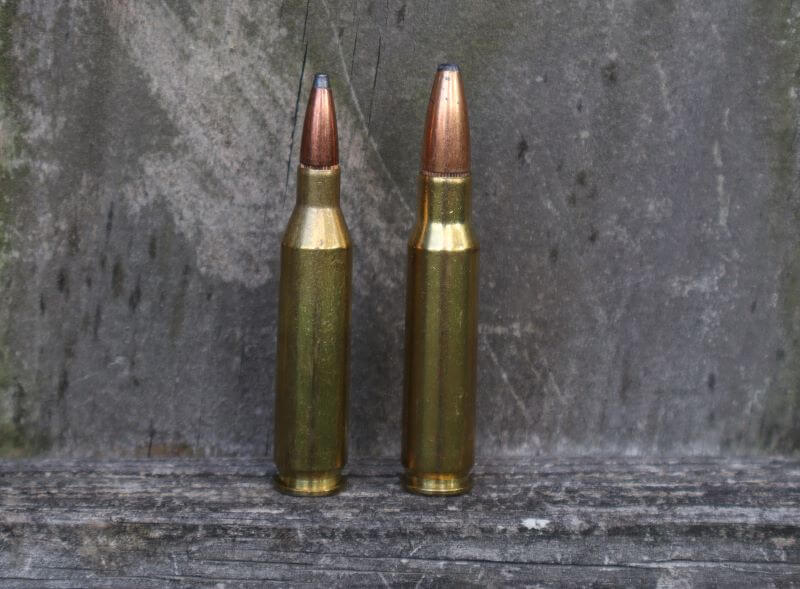
These vanity projects remained just that until after World War II. Returning GIs were intimately familiar with bolt-action and semi-automatic rifles. This made greater inroads in the hunting world, where the lever action held sway. The .30-06 and its many derivatives, which enjoyed some popularity in the interwar years, exploded onto the scene. Just as quickly, shooters were looking to squeeze as much performance out of their rifles as they could.
Rollout of the .243 Winchester
The introduction of the .308 Winchester in 1952, which provided .30-06-like power in a short-action cartridge, created a new generation of rifle cartridges. Huntington, in partnership with Remington, debuted the .244 Remington in 1955. It took a lightweight .243 inch diameter bullet on a necked-down .308 Winchester case. That same year, Page’s efforts were rewarded by Winchester, who adapted the .308 case to .243 caliber. 2 3
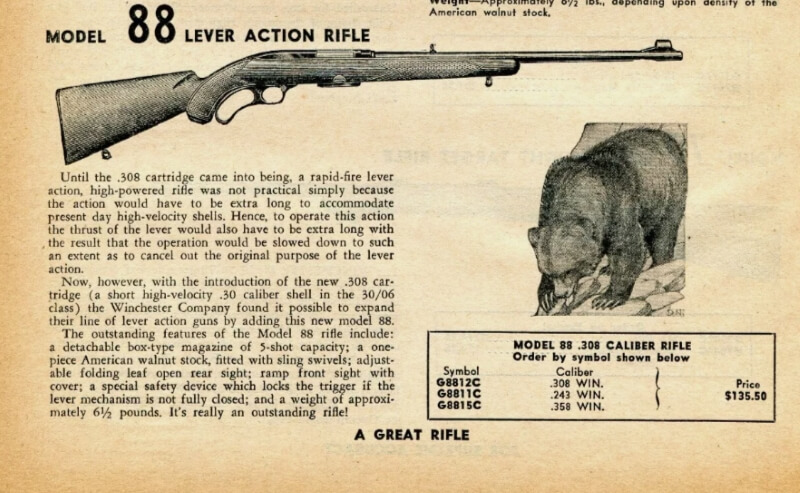
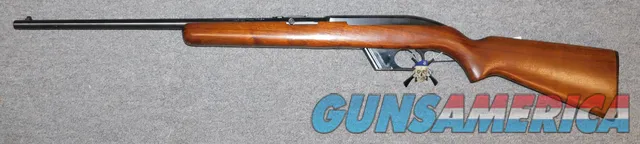
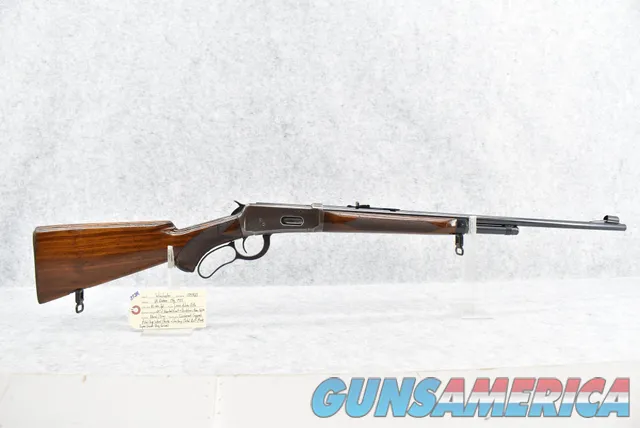
The new .243 Winchester cartridge was offered in Winchester’s famous Model 70 bolt-action and Model 88 lever-action. The .244 was picked up in rifles like the Remington Model 700 and 722. It uses lighter bullets compared to the .243 and has a case shoulder of 26 degrees, while the .243 has greater potential with a 20-degree shoulder. The more flexible .243 Winchester left the .244 Remington in the dust almost immediately to become the preeminent 6mm hunting cartridge.4
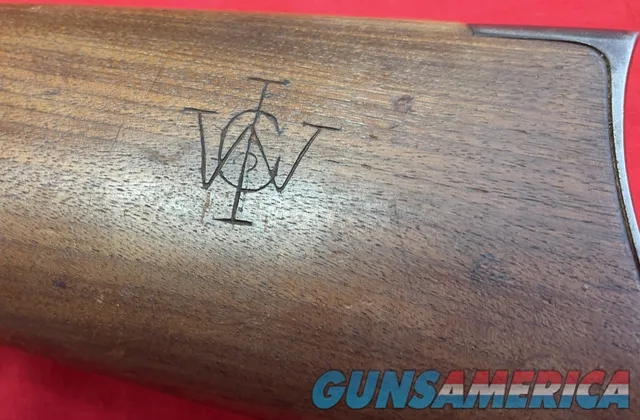
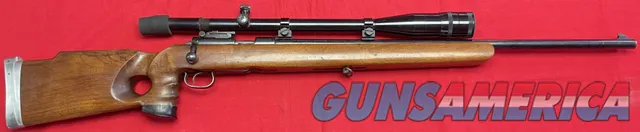
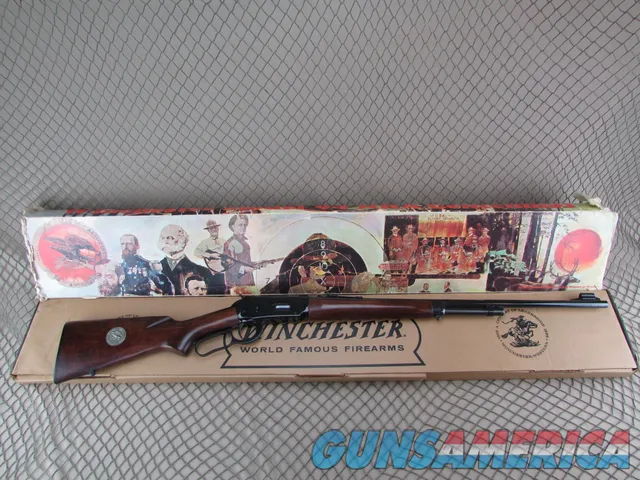
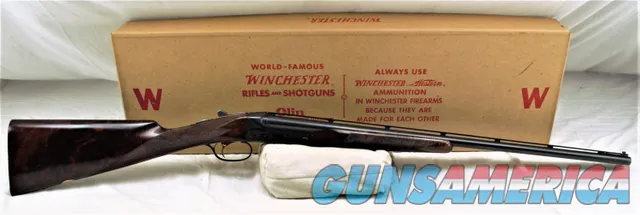
Available on GunsAmerica Now




The .243 as a Dual-Purpose Cartridge

The current SAAMI specs of the .243 Winchester cartridge. 5
The .243 was specifically aimed at hunters who were seeking out medium game like whitetail deer, but could also use a varmint rifle. Ideally, the hunter with one rifle had the best round for each task with a simple change in the ammunition. But there is no free lunch. Most .243 rifles have a 1:10 inch twist rate in the bore, which is fast enough to stabilize rounds as heavy as 100 grains. 6Attempting to go heavier is possible, but tends to degrade accuracy. Some competitive shooters opt for custom rigs with 1:8 or faster rates, which give 115 grain pills like the Berger LVD and Nosler RDF. But these kinds of rounds are usually encountered in rifles chambered in newer 6mm rounds like the 6mm Creedmoor and the 6mm ARC.7
Common Uses of .243 Winchester
Despite the march of new rounds and an inherited handicap, the .243 Winchester is still represented in competition. But its true calling is as a deer cartridge, particularly among new hunters. In lightweight rifles, the .243 generates approximately 11 pounds of recoil energy. Its parent, the .308 Winchester, generates upwards of 18 pounds of energy. In terms of felt recoil, the .243 rivals the venerable .30-30 Winchester, another lower-recoiling option for new shooters. 8But the .30-30 is handicapped with a lower velocity and blunt-nosed rounds needed as a dedicated lever-action platform, whereas the .243 in a bolt-action or semi-automatic rifle has longer legs and more downrange hitting power.

The .243 Winchester is typically found in bolt-action rifles ranging from the Remington 700 to the Savage Axis to the Tikka 3x. Although full-sized models are available, it is equally possible to find models set up for younger and smaller-statured shooters. These youth model guns feature shorter barrels and shorter buttstocks for quicker handling and shouldering. But you don’t have to settle on a bolt-action to take advantage of the .243. Rossi and Henry Repeating Arms both offer a single-shot rifle geared toward newer shooters. Henry and Browning also offer their Long Ranger and BLR lever-action rifles in .243. Lastly, fans of the semi-automatic AR platform can enjoy the .243 in upsized AR-10 style rifles like the Wilson Combat Ranger and Alex Pro Varmint.
The .243 Winchester vs. The World
At over seventy years old, the .243 Winchester is no stranger to holding its own against its contemporaries. Its longevity has ensured a bright future with rifles and ammunition readily available. But how the .243 stacks up to the competition is more dependent on the shooter’s intent than the cartridge and its peculiar limitations.

.243 Winchester vs. .30-30 Winchester
The aforementioned .30-30 Winchester is one of the most popular deer cartridges and boasts felt recoil similar to the .243. It is generally available in ambidextrous-friendly lever-action rifles, and the cartridge’s flat-nosed bullet is noted for dumping blood at closer distances in spite of its lower velocity. A typical .30-30 150 grain flat point round out of a 20-inch barrel travels at about 2,300 feet per second. That yields a muzzle energy of 1,762 foot pounds of energy. Yet a lighter 100 grain .243 soft point hocked at 3,000 feet per second yields nearly 2,000 pounds of energy. The .243’s energy advantage only grows with distance as the .30-30’s flat-point bullet bleeds energy and hits the wind.
.243 Winchester vs. .308 Winchester
The .243 was developed off of the .308 as a lighter, flatter shooting cartridge that could serve as both a varmint and deer round. At 500 yards, the .308 drops as much as ten inches lower than the .243, and the latter’s lightweight bullet yields sufficient explosive energy for varmint. In terms of raw power, the .243 is behind the .308 from the start. Common .308 Winchester loads feature a 150 grain bullet traveling at about 2,700 feet per second for over 2,400 foot pounds of energy. But where the .308 shines most is its ability to buck the wind as its heavier round drifts less than the comparatively lighter .243. 9
.243 Winchester vs. .223 Remington
The popularity of the AR-15 has sparked greater interest in the .223 Remington cartridges outside the tactical sphere. Originally marketed as a varmint cartridge when it first hit the civilian market in 1963, the .223 Remington has gone on to achieve some success on whitetail deer at closer distances. Due to its longstanding military and civilian acceptance alongside the AR platform, .223 Remington ammunition is thrifty to shoot compared to the .243. As it were, the .223 is also available in more semi-auto rifles. However, it is no stranger to single-shots, bolt actions, and even lever-action rifles.
Like the .243 compared to heavier calibers, the .223 trades weight of bullet for speed. The most common weight is a 55-grain bullet traveling at 3,200 feet per second. Lightweight varmint loads like the Hornady .223 35 grain NTX load achieve impressively flat trajectories approaching 4,000 feet per second from the muzzle. 10 The more generous case capacity of the .243, however, produces even higher velocities with heavier bullets. .223 Remington ammunition nominally tops out with a 70-77 grain bullet at 2,700 feet per second, one step behind .243 Winchester 100 grain deer loads.

.243 Winchester vs. 6.5 Creedmoor
The 6.5 Creedmoor originated as a target cartridge that has enjoyed success as a medium game cartridge. In some ways, it has even stolen some of the .243’s thunder, given that the 6.5 Creedmoor is used in short-action rifles. It is also a lower recoiling option, boasting only 15 pounds of recoil energy. 11The 6.5 Creed is not the highest velocity 6.5mm round. However, it relies on a generous case neck and long bullets to achieve good velocity downrange.
As a varmint cartridge, the .243 has an edge with greater ammunition variety and higher velocities over the 6.5. Where the 6.5 comes through is with longer distance shots. The 6.5 Creedmoor nominally uses 130-140 grain bullets, with the heavier ammunitions achieving muzzle velocities of 2,650 feet per second with slightly more energy than the .243 Winchester. The ballistic trajectory between the 6.5 Creed and 100 grain .243 ammunition is comparable out to 500 yards, but the gap in energy between the two widens as the lighter, shorter .243 round bucks the wind less efficiently. 12
.243 Winchester vs. 6mm Creedmoor
In the long-range competition sphere, the old .243 Winchester is joined by several identical-caliber 6mm cartridges, the most popular of which is the 6mm Creedmoor. The 6 CM has the same generous 30 degree case shoulder, a similarly long case neck, and heavy pills like the 6.5 Creedmoor. But the lighter 6 generates velocities of over 3,000 feet per second for a flatter overall trajectory over its parent. Over the .243 Winchester, rifles chambered in 6 CM feature a 1:7-1:8 twist that can stabilize bullets heavier than 100 grains. Common loadings range from 103 to 115 grains in weight. This gives the 6 a slight edge over the .243 at extended ranges. But like rifles in .243, the high velocity 6mm Creedmoor is not as popular as it could otherwise be, as it has a reputation for short barrel life, estimated at under 2,000 rounds. 13
Best in Class: .243 Rifles for Your Next Adventure
Most major rifle makers have at least one offering in .243 Winchester. Below are just a few that cover the gamut of platforms now available.
Henry Long Ranger
The Henry Long Ranger is Henry Repeating Arms’ first box magazine-fed lever-action rifle. First released in 2017, the Long Ranger is available in .223 Remington, 6.5 Creedmoor, .308 Winchester, and, of course, .243. Available with or without iron sights, the Long Ranger in .243 features an American walnut stock and a 20-inch barrel. Weighing just seven pounds unloaded, the Long Ranger in .243 can perform equally well as a fast-handling brush gun or as a deliberate intermediate range shooter.
Wilson Combat Ranger
Semi-automatic rifles chambered in .243 are few, but increasing. Case in point is the Wilson Combat Ranger. Based on the AR-10 platform, the .243 Ranger takes standard AR-10 magazines with capacities ranging from ten rounds on up. It features a 16-inch barrel and a recoil-reducing Q-Comp muzzle break and is threaded for 5/8×24 suppressors. The Ranger has a lightweight aluminum upper and lower receiver and an M-Lok handguard for bipods, lights, and foregrips. For those who fancy the AR platform, the Ranger is a lightweight, flat-shooting, and soft-shooting option.
Remington 700
The Remington 700 is a standard of measure by which other bolt-action rifles are judged. The 700 and the .243 Winchester cartridge have been paired together since the 1970s, and it is still very much available today. Currently, the .243 is available in the 24-inch barreled Model 700 SPS and SPS Stainless models, as well as the ADL, which comes with either a compact stock and a 20-inch barrel or a full stock and 24 inch barrel. Whether you are looking for your first or next bolt gun, the 700 is a favorite, and the .243 may just hit the spot.
Tika T3X
Tikka of Finland hosts several models of .243, including the compact T3X. The T3X is built on the same long-action as all other Tikka rifles, but this youth-sized bolt gun chambers the short-action .243. It holds four rounds in a detachable box magazine and wears a 20 inch barrel. Weighing just 6.4 lbs. unloaded, the T3X further fits the youth niche, but will also make a handy pack rifle. Other features include a single-stage trigger and a short 60-degree bolt throw for rapid cycling.
Henry Single Shot Rifle
Whether you are a self-assured veteran hunter or looking for a nonintimidating start, the Henry Single Shot Rifle in .243 has an equal blind of simplicity and quality. Single-shot break-action .243s are nothing new, but the Henry is one of the few remaining where workmanship takes first prize. Featuring a checkered walnut stock and blued furniture, the Henry Single Shot is a classic single-shot crack barrel that is easy to load, unload, and has a short overall length thanks to the lack of a reciprocating action. The Henry Single Shot rifle in .243 Winchester is available in two different configurations: a 22 inch barreled standard model and a 20 inch Youth model with a shorter 13 inch length of pull. Both feature Marbles iron sights but come equipped with a Weaver base for your favorite scope.
Stevens 334
Savage Arms produces forty different models of their bolt-action rifles in .243 Winchester. Their economic model, the Stevens 334, is also available. This three-shot bolt action is produced in Turkey on CNC machinery for Savage and is a good starting point for getting into the .243. Available with either a black synthetic, camouflage, or Turkish walnut stock, the Stevens 334 features a three-position safety and a beefy billeted steel receiver. The bolt handle is positioned at a 60 degree throw for quick cycling, and the barrel length comes in at twenty inches. One compelling aspect of the 334, aside from its price, is its full adult size. It weighs in at eight pounds and has a 14 1/2-inch length of pull, which makes it a rock-steady shooter for taller shooters.
READ MORE HERE: Best 300 BLK Ammo For Hunting
.243 Winchester FAQs
What Caliber is the .243 Winchester?
The .243 Winchester round is derived from .243 inch diameter or 6mm projectiles. That puts it between the .223 Remington and 5.56 NATO cartridges, which use a .224 inch bullet, and 6.5mm rounds, which use a nominal .264 inch bullet.
What Suppressor Should You Use With a .243 Rifle?
Existing 6.5mm or .30 caliber cans work with the .243 Winchester. The standard thread pattern for .243 rifles is 5/8 x 24.
How Much Recoil Does the .243 Have?
Depending on the weight of the rifle and the load tested, the .243 Winchester yields 10-12 foot pounds of recoil energy. That is significantly less than the 16-18 pounds produced by the .308 Winchester and rivals the .30-30 Winchester. Felt recoil is more than the familiar .223 Remington, whose energy ranges from just 4-5 pounds.
What Are the Best and Propellants for the .243?
The .243 Winchester is readily reloaded with a variety of powders, but efficiency comes down to whether you go for a lighter or heavier bullet. IMR 4064, IMR 4350, and Ramshot Magnum are among the most flexible powders to use. 14 Varget and IMR 4895 also work well with light varmint loads.
What Can You Hunt with the .243 Winchester?
The .243 Winchester is best known as a whitetail deer cartridge, but light 58-80 grain rounds excel for varmint and small predators such as coyote. Heavier 80-100 grain bullets have been used successfully on elk and black bear, but the .243 is considered the minimum caliber threshold for these heavier game. 15
Do police and military use the .243?
16In the formative years of the LAPD’s SWAT in the 1960s, the Winchester Model 70 in .243 was fielded for the urban sniper role. Since then, with advances in rifles and ammunition, .223 Remington rifles have come to dominate the role.
Find the .243 Winchester here.
Notes
- The Model 1895 Lee Navy: Background & Value | An Official Journal Of The NRA ↩︎
- The Gently Lethal .243 | Boone and Crockett Club ↩︎
- The .243 Winchester: History & Performance | An Official Journal Of The NRA
↩︎ - Greatest Cartridges: 6MM/.244 Remington and the Name Game – Gun Digest ↩︎
- SAAMI Z299.4 – 2025 ↩︎
- Rifle Barrel Twist vs. Bullet Weights – RifleShooter ↩︎
- 6mm Creedmoor: Competition Born and Bred – The Armory Life ↩︎
- Rifle Recoil Table ↩︎
- 243 vs 308: Which Hunting Round is Best for You? : Gun University ↩︎
- 223 Rem 35 gr NTX® Superformance® ‑ Hornady Manufacturing, Inc ↩︎
- 6.5 PRC vs 6.5 Creedmoor | Outdoor Life ↩︎
- Head to Head: .243 Winchester vs. 6.5 Creedmoor | An Official Journal Of The NRA
↩︎ - 6mm Creedmoor: Competition Born and Bred – The Armory Life
↩︎ - The .243 Winchester: History & Performance | An Official Journal Of The NRA ↩︎
- Is the .243 Winchester a Viable Elk Cartridge? – Petersen’s Hunting ↩︎
- The .243 Winchester: History & Performance | An Official Journal Of The NRA ↩︎
*** Buy and Sell on GunsAmerica! ***

Jim Maybrick has been a consistent voice in the firearms world for over a decade, writing hundreds of articles and producing dozens of videos that span nearly every corner of the shooting sports. With a background in military and economic history, Jim has a talent for weaving compelling stories around historic firearms designs and the rise and fall of legacy manufacturers.
But Jim’s interests go far beyond the past—he’s just as comfortable diving into muzzleloading traditions as he is testing the latest rimfire loads or mastering cutting-edge modern systems. His thoughtful, data-driven approach brings clarity and depth to every review.
When he’s not at the range or deep in a spreadsheet, you’ll find him enjoying time with family, chasing game, or refining the lost art of starting a perfect campfire.
Experience:
– Veteran Writer & Content Creator – Over twelve years of experience in firearms journalism with hundreds of published pieces.– Military & Economic Historian – Academic background that fuels in-depth analysis of historic firearms and industry trends.– Versatile Shooter – Covers a wide range of topics from muzzleloaders and rimfire ballistics to today’s most advanced platforms.– Storyteller at Heart – Known for insightful writing that blends technical detail with engaging historical context.– Outdoorsman & Family Man – Reconnects with nature through hunting, fishing, and old-school firecraft.– Analytical Mindset – Brings precision, structure, and storytelling to every article—whether it’s a gear review or a deep historical dive.
Mentioned that the source of 6mm/244 brass and ammo had dried up at one time. Failed to note my Reminton 788 in 6mm was also stolen shortly afterwards. It would consistently shoot (3) shots groups at 100 yards that would have all (3) bullets touching. None of the gun stores had another rifle in 6mm available.at that time. Father’s Remington 700 in 243 would never group as well, even with all of the effort to create a handload powder/bullet combo it would like. Only took three attempts to get sub-MOA groups with the 788. Same lot of powder, bullets and primers were used for both rounds.
The model 788 was a better rifle than anyone gives it credit for, likewise, same for the 244 “corrected/updated” to 6mm. If Reminton brought out the model 788 in 6mm today, wonder how many folks would think it the latest “wonder 6mm” combo??? I miss the 6mm, but the 243 for deer, varmints, and many tines even hoggs, is a viable option. That is the majority of what the average person would likely hunt.
Extremely thorough article, and I look forward to reading it again in detail. This is a small, but pertinent point. Lever action rifles haven’t been solely relegated to “blunt nose” projectiles since the introduction of Hornady’s Leverevolution rounds two decades ago. That point does nothing to diminish the successful history and ballistics of the .243 Win., but by now authors shouldn’t still be writing as though one can’t shoot a “pointy” bullet from a lever gun.
243 Winchester has always been and will forever be a lady’s gun. It shines at wounding deer size game. It’s right there with the 6.5 needmore.
Nothing wrong with the 243 especially if you’re older or a youth. Shot placement is key, so either you’re not that good of a shot or you’re so manly you feel the need to use a cannon……..gezz.
LOL! Have you really used one? I suspect not. I once tracked a deer for hours shot by my buddy with a .308, he needed to practice, not up his caliber.
I’ve dropped several with my 6mm Remington, the ballistic equal to the .243.
It’s perfect for deer, and an overall small to medium sized game getter.
Really love my .243 in an old Remington 7400. In my stupid No Assault Weapon state, its a poor man’s legal AR10. I’m thinking of shortening the barrel to 18″ and adding a can.
The Model 88 was not among the first, it was the first. Winchester introduced the .308 and .243 with the model 88. Great article, thanks!
Remington blew it with the 244/6mm cartridge. The 244/6mm, with the correct twist rate, would outperform the 243.with 90 or 100 grain bullets. Note that many of the current crop of wildcats and semi wildcat cartridges only duplicate the performance of older rounds, and many older rounds can be improved with the newer types of powders now available. I did reload both the 243 and 244/6mm, finding it easy to get better performance from the 244/6mm when using similar reloading data. But the source of good 244/6mm brass dried up, and I could no longer reload 244/6mm. Little or no readily available ammo finally killed the 244/6mm. Too bad for the 244/6mm.
While the latest crop of 6mm cartridges are interesting, Winchester got it right with the 243 from the start. For up to 90% of shooters. the 243 does everything well and has done so for decades. Low recoil and good accuracy potential is a hard combination to beat.
I have loaded and shot the 6mm Rem.in several Rifles for over 48 years, it was my first and favorite Caliber. I never had a problem sourcing any components.
I shoot a HB Mod. 700 for Prairie Dogs. With the Nosler 55 gr. ballistic tip and Hercules Varminter powder, I obtain 4000 + FPS, making it a great long range Rifle. I’ve use 90 Gr solids and lower loads for shooting Fox and Coyote back in the days I was fur hunting for profit.
It is, and always will be, my go to caliber for deer and under.
I love the 6’s
Remington blew it with the 244/6mm cartridge. The 244/6mm, with the correct twist rate, could outperform the 243.with 90 or 100 grain bullets. Many of the current crop of wildcats and semi wildcat cartridges only duplicate older rounds, and many older rounds can be improved with the newer types of powders now available. Too bad for the 244/6mm.
While the latest crop of 6mm cartridges are interesting, Winchester got it right with the 243 from the start. For up to 90% of shooters. the 243 does everything well and has done so for decades. Low recoil and good accuracy potential is a hard combination to beat.
You’d be a fool to hunt Elk or Bear with a -243 unless you restricted you shots within 50’ and n my opinion. A .338 is much better to not loose the animal & to avoid attack from the bear.
And yet I’ve seen many Elk here in Colorado go down to the 6’s. It’s legal here. And Black Bear are NOT as tough as their bigger cousins.
Interesting article. Back in the 90’s, I bought a stainless Ruger M77 MKII ultralight .243 with the skeletonized stock and due to the thin barrel, you couldn’t put more than a couple of rounds through it without allowing it to completely cool down.
I noticed while sighting it in at the range the groups would open up quickly after just a couple of rounds at 100yrds. That barrel was just too thin with the hot little.243 round, I guess. You could argue why you would even need to use more than a round or two while deer hunting anyway, but I also enjoy getting in some range time with my rifles. Putting 3 rounds through it, then having to wait 30 minutes to let it cool down sucked! I ended up trading it in for a M77 .308 with the heavier barrel – problem solved!