
Estimated reading time: 11 minutes
Ruger’s new $749 Harrier ran flawlessly and delivered sub-MOA best groups with every load tested. The trigger needs help, but this affordable, mil-spec-compatible AR-15 shoots like it has something to prove.
Ruger’s new Harrier rifle isn’t just Ruger’s old AR with a facelift. It’s an entirely new, affordable, and accurate design springing from Ruger’s acquisition of AR powerhouse Anderson Manufacturing.
Ruger’s New Harrier Is More Than a Reworked AR-556
Table of contents
- Ruger’s New Harrier Is More Than a Reworked AR-556
- Ruger Packs Modern AR-15 Features Into a $699 Rifle
- How Anderson Manufacturing Helped Create the Ruger Harrier
- Ruger Harrier 28601 vs. 28600: Which Version Fits?
- Threaded Barrel Gives the Harrier Suppressor-Ready Flexibility
- Mil-Spec Compatibility Makes the Harrier Easy to Upgrade
- Sub-MOA Surprise: The Ruger Harrier Hits Hard at 100 Yards
- Can the Ruger Harrier Beat Other Budget AR-15s?
- Ruger Harrier Range Results: Four Loads at 100 Yards
- Ruger Harrier Pros and Cons: Accuracy Wins, Trigger Loses
- Ruger Harrier Model 28600 Specifications
- Final Verdict: Ruger’s Budget Harrier Has Serious Teeth
- Related Reads from GunsAmerica Digest

Ruger surprised the shooting world this year when the company unveiled a completely reengineered and affordable AR-15 rifle called the Harrier. The Harrier differs dramatically from Ruger’s discontinued AR-556. Unlike that original platform, the Harrier’s all-new receivers are mil-spec compatible out of the box. With its impressive list of contemporary features, the Harrier is arguably the AR-15 that Ruger should have built long ago.
The Harrier isn’t just a redesign of the AR-556. With this gun, Ruger insisted on meeting baseline expectations of customers in an entry-level rifle, including free-float M-LOK handguards, improved furniture, optional mid-length gas systems, and a tighter receiver fit.

Ruger Packs Modern AR-15 Features Into a $699 Rifle
Best of all, the rifle is priced for the masses with an MSRP of just $699 for a base version and $749 for an upgraded version. Street prices are even less. The significance of this pricing is hard to overstate. It puts the Harrier within reach of most every budget and makes it a welcome competitor to other budget ARs, but with broad mil-spec component compatibility and the backing of Ruger’s reputation and customer service operation.
The AR market may be somewhat mature, but there’s still plenty of room for a gun like the Harrier. It will likely pressure some other manufacturers to adjust pricing to compete, and it’s going to put even more ARs into common use at a time when the Supreme Court is poised to decide the fate of so-called “assault weapons” bans.

How Anderson Manufacturing Helped Create the Ruger Harrier
Ruger unveiled the Harrier just six months after acquiring Anderson Manufacturing, and that was no accident. Ruger bought Anderson with the specific goal of expanding Ruger’s product line. Anderson was formerly a top-ten producer of AR-pattern rifles, receivers, and components in the U.S. The company supplied parts or manufacturing services for a significant portion of the AR market, giving Ruger access to mature production know-how.
Ruger didn’t just acquire intellectual property. Ruger bought a fully equipped, AR-focused manufacturing facility in Hebron, Kentucky, including extensive CNC machining capability and a large-scale receiver and component manufacturing operation. Equally important, Ruger acquired a workforce skilled in specialized machining, finishing, assembly, and quality control that’s not easy to build quickly from scratch.

Ruger Harrier 28601 vs. 28600: Which Version Fits?
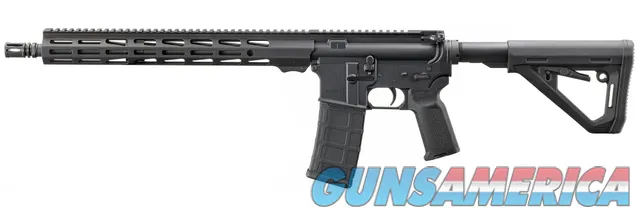
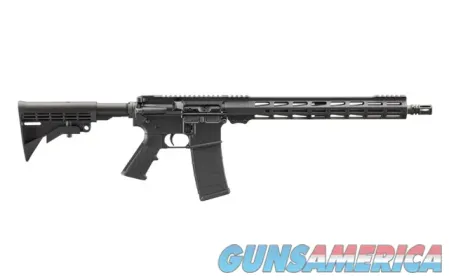
Ruger initially offers the Harrier in two versions. The basic version of the rifle (model 28601) has a carbine-length gas system, A2-pattern pistol grip, and M4-style buttstock. It also has a partial Picatinny rail, at the front and rear, atop a slim-profile, free-floated M-LOK handguard. Weight is just 6.6 pounds.
The upgraded version of the Harrier (model 28600), which I tested, has a mid-length gas system, which many shooters prefer over a carbine-length system for smoother shooting and potentially greater component life. This model features upgraded furniture with a Magpul MOE-K2 grip and Magpul DT Carbine collapsible buttstock, and tips the scales at 6.8 pounds. The gun has a full-length Picatinny rail atop the free-floated M-LOK handguard, with attachment slots at the 3:00, 6:00, and 9:00 o’clock positions. This setup gives you more space to set up sights, optics, and accessories without having to buy another handguard. Each model has QD sling sockets on both sides of the rail and the buttstock. Other than the rail, gas system, and furniture, virtually everything else is the same on the two models.
If you’re looking for a ready-to-go platform out of the box and don’t plan on making a lot of modifications, stick with the model 28600. If you want to make extensive modifications, the basic model 28601 rifle may be your best bet.

Threaded Barrel Gives the Harrier Suppressor-Ready Flexibility
The Harrier’s upper and lower receivers are machined to mil-spec dimensions from 7075 aluminum forgings. They are protected with a Type III hardcoat anodized finish. The finish looks smooth and uniform, and everything on this rifle seems to fit snugly. I found no wobble between the upper and lower, and that’s due to the fact that the lower has a tension screw to eliminate play between the upper and lower. It’s a nice touch on a gun in this price category. The upper receiver includes a standard forward assist, dust cover, and brass deflector. As you would expect, the magazine well is flared for quick, snag-free loading.
Barrels on both models measure 16.10 inches and have a “government” profile that’s relatively lightweight and serves well on a general-purpose rifle. Barrels are made of 4140 chrome-moly alloy steel and are button rifled with six grooves and a 1:8 rate of twist. They are protected, inside and out, with a nitride finish. Barrels come with an A2 flash hider attached. However, muzzles are threaded ½ x 28, so you can remove the flash hider and attach other muzzle accessories.

Mil-Spec Compatibility Makes the Harrier Easy to Upgrade
The bolt carrier group, which has a properly staked gas key, is also nitrided for protection. The safety selector, magazine release, and bolt catch are all located in the usual locations and are all basic mil-spec. Unfortunately, that also applies to the rifle’s trigger. As with so many factory ARs, a mil-spec trigger is not a good thing. The single-stage trigger on my test rifle broke at a cringe-worthy pull weight of 7 lbs., 12 oz., and had a lot of creep. It is the first thing I would replace on this rifle, followed by the smallish, non-ambidextrous charging handle. Of course, those are the two things I’ve always replaced on most factory ARs, and that’s to be expected with budget-priced guns.
The good news about the Ruger Harrier AR-15 being based on common, mil-spec AR standards is that you can pretty much plan on being able to upgrade or reconfigure the gun with mil-spec-compatible stocks, grips, drop-in triggers, and other controls, as well as muzzle brakes and suppressor mounts.

Sub-MOA Surprise: The Ruger Harrier Hits Hard at 100 Yards
In range testing, the Harrier ran flawlessly. Muzzle velocities for four tested loads were several hundred fps slower than factory-stated numbers for the loads, but that’s normal for rifles with relatively short 16-inch barrels. Most of the loads launched bullets in the 2,700 to 2,900 fps range.
I was able to achieve surprisingly good accuracy with the Harrier despite being handicapped by the heavy, creepy trigger and shooting in wind gusting to 15 mph. Accuracy testing was done at 100 yards with one of my favorite LPVOs, the Zeiss Conquest V6 1-6×24, mounted on the gun.
All four tested loads printed sub-MOA best groups at 100 yards. Loads with the heaviest (77-grain) and lightest (55-grain) bullets produced sub-MOA average groups, but two loads with 62-grain bullets did not fare as well, turning in average groups measuring 1.59 and 1.92 inches. The most accurate load tested was Hornady’s 223 Rem Varmint Express 55-grain V-MAX load, which produced 0.58-inch average groups and a 0.51-inch best group. A Black Hills 5.56 mm 77-grain OTM load wasn’t far behind with a 0.55-inch best group and 0.92-inch average groups.

Can the Ruger Harrier Beat Other Budget AR-15s?
The Harrier compares quite favorably to other big-name budget ARs. Some have a long and successful record, especially with first-time AR buyers, but may be somewhat lacking compared to the Harrier. The Smith & Wesson Sport III, for example, is comparable to the Harrier, but it costs more even though it lacks QD sling sockets and has less furniture, including a wobbly M4-style buttstock. Other manufacturers may offer more aggressive prices at times and a larger selection of rifle configurations, but quality control may be inconsistent with some. Still others, offering essentially the same features, may cost more.
ARs are widely available in a mind-boggling array of specialized configurations, but there’s still tremendous demand for an affordable AR-15 in a general-purpose configuration suitable for hunting, recreational shooting, and home defense. Many buyers are perfectly happy with a budget-priced AR when it already has contemporary features and delivers reliable performance and good accuracy.
That defines the Harrier, and I’m betting it will become a very popular rifle.
Ruger Harrier Range Results: Four Loads at 100 Yards
| Load | Avg. Velocity (feet per second) | Avg. Group 100 yards | Best Group 100 yards |
| Black Hills 5.56 mm 77 gr. OTM | 2,728 | 0.92 | 0.55 |
| Winchester Target & Practice 5.56 mm 62 gr. FMJ | 2,958 | 1.59 | 0.99 |
| Hornady Black 223 Rem 62 gr. FMJ | 2,826 | 1.92 | 0.94 |
| Hornady Varmint Express 223 Rem 55 gr. V-MAX | 2,842 | 0.58 | 0.51 |
Note: Velocity was an average of 3 shots, measured with a Garmin C1 Pro chronograph. Accuracy is taken from three three-shot groups at 100 yards in wind varying 7-15 mph.

Ruger Harrier Pros and Cons: Accuracy Wins, Trigger Loses
- Pros: The rifle is affordable, accurate and reliable. It’s ready to go out of the box, and since it’s based on common mil-spec AR standards, you can customize all you want.
- Cons: No ambidextrous controls, and you’ll want to replace the trigger and charging handle.

Ruger Harrier Model 28600 Specifications
| Model | Ruger Harrier Rifle Model 28600 5.56 NATO |
|---|---|
| Caliber | 5.56 NATO/223 Rem. |
| Action | Direct-impingement semi-auto |
| Magazine | Detachable PMAG Gen M2 |
| Capacity | 30 |
| Barrel | 16.10-inch, 6-groove button rifling, threaded |
| Rate of twist | 1:8 |
| Barrel Finish | External and internal nitride |
| Stock | Magpul DT Carbine collapsible |
| Grip | Magpul MOE-K2 |
| Handguard | Full Picatinny with M-LOK slots |
| Weight | 6.8 pounds |
| Length | 35.87 inches extended |
| MSRP | $749.00 ($699.00 for basic version) |
Final Verdict: Ruger’s Budget Harrier Has Serious Teeth
The Ruger Harrier review results are difficult to argue with. The rifle ran flawlessly, every tested load produced a sub-MOA best group, and the most accurate ammunition averaged just 0.58 inches at 100 yards. That is serious performance from an affordable AR-15 with an MSRP of $749.00 in the tested configuration.
The heavy, creepy trigger and small, non-ambidextrous charging handle are the obvious weak points, but neither is unusual on a budget-priced AR. More importantly, the Harrier’s mil-spec compatibility makes both easy to replace. Ruger paired that familiar modularity with a snug receiver fit, useful furniture, a free-floated handguard and the kind of accuracy that can make a cheap trigger seem even more irritating.
Ruger could have released another basic entry-level rifle and relied on the name stamped into the receiver. Instead, it built the AR-15 it arguably should have built long ago. The Harrier is affordable, reliable, accurate and ready to customize. That is a strong combination, and I’m betting shooters are going to notice.
Related Reads from GunsAmerica Digest
- An Everyman’s AR? The Ruger AR-556 Full Review
- Best AR-15 Rifles Ranked by Price
- Ruger Mini-14 Ranch Review: Classic Bite, Better Accuracy
Available on GunsAmerica Now

Mike Dickerson is an award-winning writer who has published thousands of magazine and newspaper articles. He is an avid hunter and recreational shooter with decades of experience, specializing in rifles, shotguns, optics, and ammunition. He is also a proud Vietnam veteran who maintains close ties with the US military.
Experience
Decades of hunting experience spanning North America
Deep relationships with major industry manufacturers
Extensive training in long-range shooting
Stories published in virtually every major American hunting and gun magazine
Highly experience wildlife and landscape photographer
Hi Mike,
What is the source of information on the steel of the barrel ?
Ruger does not specify this anywhere…
If I can afford an $1800 scope I’m not putting it on a $750 rifle.
The scope, the mount and the tripod are more interesting than the lower end rifle. I bet the scope and mount were separated from the rifle soon after the range session ended.
I’ve been extremely happy with my 12 year old AR-556. I’ve yet to understand what everyone is complaining about that is not MIL-Spec on it. The Ruger style barrel nut was a little different but not much and you can still replace it with a standard style, especially if you go with a free floating hand guard. Mine is the M-16 style carbine fixed gas block with the A2 front sight. I’ve since swapped that out for a UTG full length rail/MLock hand guard that has a slot to let the stock sight poke out. I think it’s cool and allows for co-witnessing without needing more attachments. Sure, it’s still not free floating since it used the front gas block as a mount point for the hand guard, but you have to be pretty picky to worry about a possible .10-.50″ deviation at 100yards. I paid $475 out the door in 2014 and it has yet to fail out of probably about 2000 rounds.
It’s been pampered with a Radian Raptor ambi charge handle and Talon ambi safety, 3.5lb singe stage semi flat trigger who’s name I’ve forgotten since they went out of business 10 years ago, Sig Romeo5 & Juliet5 red dot & magnifier, No-name (Amazon) single point sling with rebound dampened end, and finally, a YHM Fat Cat suppressor or VG6 GAMMA 556 Gen 2 muzzle brake adorn the business end, depending on what I’m doing.
I’m sure the Harrier would be just as fine a rifle if it were in my possession, but the author made it sound like the AR-556 wasn’t much to talk about. Heck, even Honest Outlaw was impressed with it!
I ended up with a Ruger AR-556 pistol version in a trade. I haven’t shoot it much, but when I did, she ran great, leaving a good impression when you could see pricing & performance yourself. I ended up having an inexpensive folding stock adaptor put on it and it became a great hotel gun. I’d fold it up, stick it in almost any travel case, bag, backpack I had and stroll through any hotel lobby without anyone knowing any better. I fell in love with that concept–having an AR alongside me in my hotel room. I’ve always had a full-size handgun with some 5 extra magazines at the ready. And I never felt like I was “under-safed” at any point. Now, I just feel more comfortable with an AR between my socks and underwear. (In my suitcase! Geez!)
As a custom Anerican Musket builder, it makes it even harder to compete with these prices and also these claims of accuracy.
The potential buyers will say, why should I pay $1500-$2500 on your custom AR, when I can go get one for $699 or $799 or even $499 like PSA! Pricing me right out of the average Joe market! Even after listing all the custom high-end parts and drop-in triggers( like ATC AR Gold)!
It’s always been hard to compete with mass production and corner cutting!
OH WELL! I’ll just keep on keeping on!
Why are all these writers now reporting three shot groups. I can understand using three shots for big magnum cartridges, but never for a .223.
Good point……but it’s been my experience that the 3-round rule was started back years ago, before 2000. I saw a catalog for Les Baer Customs, more known for custom 1911s than for AR-platform rifles when I noticed it. His accuracy guarantee was something like this-
I guarantee my rifles to shoot 1/2 MOA or better. We shoot two 5-shot groups to ensure it’s that or better.
Ever since then, I look to see what every write-up has to say about their accuracy testing. I’m sure there’s a reason behind the 3-shot group vs.5-shot groups or even 10. It became a necessity during the ammo shortages prior to, during, and even after the CCP’s population-control trails using the fake flu pandemic.
Howdy,
What mount did you use for your optic?
Thanks.
That was a Burris PEPR