
Estimated reading time: 9 minutes
A real WWII gold grab with OSS shadows and missing bars reads like Kelly’s Heroes with receipts. The chaos was real, the loot was massive, and the ending still stings.
Why Nazi Gold Made The Perfect Movie Villain Fuel
Second only to Aliens, Kelley’s Heroes is my favorite movie. Featuring an ensemble cast led by Clint Eastwood, Telly Savalas, Donald Sutherland, and Don Rickles, Kelley’s Heroes is equal parts comedy, caper movie, action film, and subtle antiwar commentary. Even with the benefit of half a century’s worth of hindsight, I don’t think I’d change a thing. It was perfect.
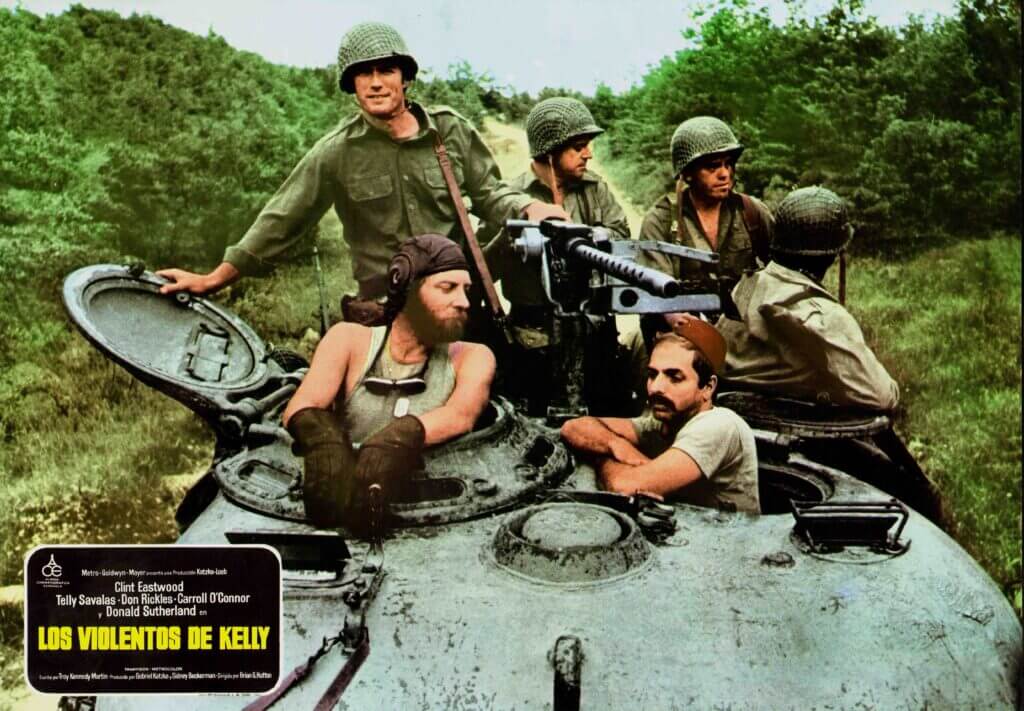
If you haven’t seen it yet, drop what you’re doing and check it out. You can stream it on Hulu Premium for free or most anywhere else for less than four bucks. It doesn’t matter if you are driving an 18-wheeler, leading a board meeting, flying an airplane, or delivering a baby; do it now. You’ll thank me later.
Table of contents
From Merkers To Mittenwald: How The Gold Got Loose
The basic premise is indeed intoxicating. What if a bunch of normal guys found themselves in the sort of place where they could knock over a bank and get away with it? That would presuppose a catastrophic yet transient breakdown in social order, something you might find in the waning days of a dying empire. While Kelly’s Heroes was indeed a delightful watch, it was actually based on a real heist. This robbery was orchestrated by an eclectic amalgam of American GIs, German soldiers, and a couple of real-deal spies in the chaotic last days of World War 2. Depending upon how you rate them, this was arguably the most successful bank robbery of all time.
The Setting
There is a reason the Nazis make the best movie villains. They had all the trappings of the ideal bad guys. They were snappy-dressing narcissists who were also inveterate racists. They believed to their core that they were the super race destined to rule over the rest of humanity with an iron fist. Curiously, the rest of humanity was not terribly keen on that. By 1945, the Third Reich’s pigeons were coming home to roost.

In addition to seizing most of Europe by brutal force of arms, the Germans also ruthlessly looted their occupied territories. Many priceless art treasures made it into Herman Goering’s private collection. Untold tons of precious metals and sundry valuables stolen from the occupied lands were moved to the Reichsbank in Berlin for safekeeping.
In February of that year, nearly 1,000 American heavy bombers hammered the German capital. The Reichsbank employees weathered the raid in the basement of the structure, while the upper portion of the building was pulverized. As a result, Hitler directed that the pilfered loot be relocated to decentralized holding areas to keep it from being destroyed.
Much of that stuff was subsequently moved to repurposed repositories in southern Germany and Austria. Most Germans appreciated that the war was lost. The planned protracted insurgency that was to erupt after the formal shooting stopped was going to cost a fortune. The plan was to utilize this stolen gold and pilfered currency to keep that insurgency burning.

One of the primary hiding spots was the Merkers potassium mine southwest of Berlin. This exceptionally deep mine ended up the repository for around 100 tons of gold, along with paper currency from a variety of occupied countries and assorted valuables. This included priceless artworks by the great masters.
The total value of these Nazi gold stocks was approximately $520 million in 1945. That’s around $8 billion in today’s money. A period inventory reported 3,682 large bundles of German Marks, 80 bags of assorted foreign currency, 8,307 gold bars, 55 boxes of gold bullion, 3,326 bags of gold coins, 63 bags of silver, 1 bag of platinum bars, and 207 containers of assorted loot. There were also 8 bags of stolen gold rings, most of which came from the death camps.
The Scenario
That’s a lot of gold, but that wasn’t all of it. What remained, an estimated $151 million at the time, was moved to the resort town of Mittenwald in Bavaria. There it was stashed away at a remote lodge.
Gold is dense and heavy. Moving this much of it was harder than you might think. Two of the German officers tasked with spiriting this stuff away divided the massive horde into smaller chunks and then cached them separately around the area. Throughout it all, the Americans doggedly followed up rumors in an effort to secure these Nazi gold reserves. After interrogating several captured German soldiers, a small American motorized engineer unit discovered a total of 728 bars hidden underneath a tree stump adjacent to Lake Walchen. Is this starting to sound familiar?
Each of the 728 bars was worth $15,000 at the time. That’s about $267,000 apiece or a total of $194 million today. That’s a whole lot of money. These engineers dutifully removed the gold to the Reichsbank vault in Frankfurt. However, while these 728 bars were impressive, a larger stash of 2,500 just disappeared. These 2,500 bars were originally divided up into 25 crates of 100 bars apiece.

Most of what we know of this story comes from interviews with SGT Albert Singleton. Singleton was assigned to the office of the Provost Marshal for the 10th Armored Division. He reported that his commander, a CPT Craig, was ordered to head up into the mountains with a halftrack, a guard detail, and a couple of captured German officers to retrieve a rumored gold stash. En route, they purportedly encountered a pair of American OSS officers with two deuce-and-a-half trucks. The Office of Strategic Services was the wartime predecessor to the CIA.
The OSS guys already knew where this cache was hidden. They led CPT Craig and his men up to a 12 by 12-foot bunker hidden underneath a trap door that was stacked to the ceiling with boxes of gold bars. This bunker was oriented fairly high up a mountainside. The men fashioned a slide they used to move the individual bars down the mountain before putting them into sacks and loading everything onto the trucks.
Singleton testified that the following day, he received a telegram reporting that the recovered cache was safely secured in Munich. However, amidst the fog of war, the details of this stash were conflated with the 728 bars that had actually made it to Frankfurt. When queries were made to Munich later, there was no record of their receiving any recovered gold bullion.
Did They Get Away With It The Evidence Says Yes
1.25 tons of pure gold bullion simply vanished. The authorities investigated, but nothing materialized. In the chaos that was the end of the war in Europe, there were bigger fish to fry.

The Guinness Book of World Records once sported this entry under the heading of Greatest Bank Robbery of All Time:
“The greatest robbery on record was of the German National Gold Reserves in Bavaria by a combine of US Military personnel and German civilians in June 1945, A total of 730 gold bars valued at £3,528,000 together with six sacks of banks notes and 25 boxes of platinum bars and precious stones disappeared in transit but none of those responsible has been brought to trial.”
In reality, this report stemmed from the original confusion between the 728 bars that were actually recovered and the 2,500 that were lost. Presuming the bars were the same size, that was the modern equivalent of $666 million. That would be more than adequate to set a couple of ex-OSS guys up very nicely on a beach somewhere after the war. CPT Craig and the security detail also likely got a pretty healthy cut. Perhaps those two German officers who were in the halftrack got a little sweetness to help keep them quiet, as well. By my count, that was maybe eight guys total. They never talked. Nobody will ever know the details.
What Vanished Gold Teaches Us About War And Chaos
With American airpower systematically deconstructing his nation’s military in 2003, Saddam Hussein dispatched his son Qusay to Iraq’s Central Bank with a handwritten note demanding he be given access to the vaults. Qusay left with around a billion dollars in cash. $350 million of that was never recovered. We may explore that story in this space at some point in the future. Adjusted for inflation, these opportunistic GIs operating at the end of WW2 got away with more than that.

Kelly’s Heroes was indeed an epic movie. Three Kings, with Mark Wahlberg and George Clooney, enjoyed a very similar plot set during the First Gulf War. Regardless of the details, it seems that, yet again, art imitates life.
WWII Nazi Gold Heist Facts And Figures
| Primary Repository | Merkers potassium mine |
|---|---|
| Total Value Noted 1945 | $520 million |
| Modern Rough Equivalent | $8 billion |
| Recovered Bars | 728 bars at Lake Walchen |
| Per Bar Value Then | $15,000 |
| Per Bar Value Now | $267,000 |
| Missing Stash | 2,500 bars in 25 crates of 100 |
| Hidden Bunker Size | 12 by 12-foot |
| Gold That Vanished | 1.25 tons |
Related Reads from GunsAmerica Digest

Will is still trying to figure out what he really wants to be when he grows up. However, shooting guns and claiming it was work seemed like a pretty sweet hustle. As a result, Will serendipitously transformed an avocation into a vocation.
Raised in the Mississippi Delta, Will flew UH1H, OH58A/C, CH47D and AH1S helicopters operationally as an Army Aviator. He is SCUBA-qualified and has parachuted out of perfectly good airplanes at 3 o’clock in the morning. Will has summited Mount McKinley, Alaska, six times…always at the controls of an Army helicopter, which is the only way sensible folk climb mountains.
Will has delivered sixty babies and occasionally wrung human blood out of his socks. He is married to his high school sweetheart and has three awesome adult children. Turn-ons include vintage German machineguns, flying his sexy-cool RV6A airplane, Count Chocula cereal and the movie “Aliens.”
www.word-monkey.com
Experience:
-Professional Writer-thousands of publishing credits for dozens of titles
-Mechanical Engineer/Practicing Physician
-Instrument-rated Commercial Pilot
-Sunday School Teacher
Each of these links are broken :
WWII OSS Weapons Guide
Best WWII Movie Guns Ranked
The Real Guns of Kelly’s Heroes
I receive a 404 Error when click on each one .
Three Kings was a good movie. The end was perfect. The people were saved and the Kings moved on. Good story. Enjoyed the exploding footballs and the cow and mines scenes.
Art truly imitates life! Often less interesting so. Enjoyable read as usual Dr. Dabbs. Thank you!
I also love Kelly’s Heroes. Saw it as a kid and it’s one of those movies that stick with you forever.
Lets do some math though; 2,500lbs of gold, 8 people, that’s 315lbs each. They didn’t stuff that in their rucksack and carry it home. There had to be some logistics to shipping it, which would have created more opportunities for it to be discovered. I surmise a more plausible account is that the Americans stuffed what they could in their ruck, and someone else in-country got the best deal.
So let’s say the American’s stuffed ~75lbs in their ruck and were able to keep it secret. That’s 75 x 16oz/lb = 1,200 oz. @ ~$4,500/oz today, that’s $5,400,000 in today’s dollars… Wow.
Gold is measured in troy ounces. There are 14.58 troy ounces to a pound. So the math isn’t quite correct.
Jeff, that ruck math is the fun part of the Dabbs story. 2,500 pounds split eight ways is not something you casually hump out of the mountains, so some kind of staging, transport, or local help almost has to be in the picture if the haul was real. Your “keep what fits, leave the rest to whoever is already in-country” read lines up with how messy wartime logistics usually are. Either way, Kelly’s Heroes still hits.
Monunents men is also a must-see, but not so comedic, tho still with it’s war-is-hell elements.
Well, Will, go figure: we have similar taste in movies. Now add The 13th Warrior for the perfect tripyich. ( We already know it’s based on a true story 😉)
Makes you wonder how many CIA officers through the years have done the same or worse.
If you believe the rumors, the CIA has been involved in heroin and cocaine trafficking for decades.