
Estimated reading time: 19 minutes
After more than 1,300 rounds and 12 months of regular carry, the Kimber CDS9 has become my go-to EDC. It is accurate, distinctive, and flawless for me unsuppressed, although suppressor testing exposed one weakness worth knowing about.
Table of contents
- Kimber CDS9 Review: The Cure for Polymer Pistol Fatigue?
- Kimber CDS9 Explained: A Metal-Frame Micro 1911 for EDC
- Kimber CDS9 Unboxing: What You Get for the Money
- Kimber CDS9 Ergonomics: Where the Metal Frame Earns Its Keep
- Optics Ready: Setting Up the Kimber CDS9 for the Range
- Shooting the Kimber CDS9: Snappy Recoil, Killer Trigger
- Kimber CDS9 Accuracy: 1-Inch Groups From a Micro-Compact
- Kimber CDS9 Suppressor Testing: Where Reliability Fell Apart
- Kimber CDS9 Maintenance: Inside the Metal-Frame Micro
- Carrying the Kimber CDS9: A Year of Real EDC Use
- 1,300+ Rounds and 12 Months of Carry: The Kimber CDS9 Verdict
- Kimber CDS9 Models Compared: Which Variant Makes Sense?
- Kimber CDS9 Pros and Cons After 1,300+ Rounds
- Should You Buy the Kimber CDS9?
Kimber CDS9 Review: The Cure for Polymer Pistol Fatigue?
Since the release of the SIG P365 and Springfield Hellcat, striker-fired micro-compacts have dominated the EDC world, and for good reason. They are lightweight, high-capacity, simple to operate, affordable, and reliable. But after nearly a decade of seeing various iterations of polymer micro-compacts, and shooting most of them, there’s part of me that just wants something different. The polymer fatigue is real, and it’s been a long time since I’ve been excited about new EDC pistols.
In early 2025, Kimber released the CDS9 OR RL TFS (Covert Double Stack, 9mm, Optics Ready, Rail, Threaded or Suppression). Despite the weird naming convention, the CDS9 piqued my interest. Its aluminum frame and stunning design stood out in the sea of black polymer pistols. Before we get too far into this Kimber CDS9 review, I do want to say it isn’t the cheapest option. The model featured in this review has an MSRP of $1,129. As of publishing this article, I’ve seen them selling online closer to the $875 mark. Kimber has other CDS9 variants that can be found from retailers for less than $700. Compared to similar offerings on the market, like the Wilson EDC X9 or Staccato HD C3.6, the CDS9 punches well above its price point.

Kimber CDS9 Explained: A Metal-Frame Micro 1911 for EDC
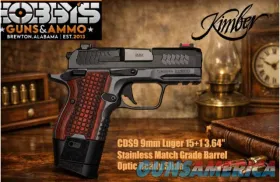
The CDS9 is a micro-compact 1911-style double-stack 9mm pistol with a black T6 aluminum frame wearing orange/black G10 VZ frag pattern grips with matching frag pattern front strap and mainspring housing. It has a gray “KimPro II” finished slide featuring fish-scale front and rear serrations with an optics-ready RMSc direct-mount optics cut that houses a 3.64” match-grade 1/2×28 threaded barrel. Design-wise, the two-tone finish and orange color pop from the VZ grips resonate with me. Kimber undoubtedly produces some of the most aesthetically pleasing handguns out there.
As implied by the name, the CDS9 is intended for concealed carry. Both the slide and frame have a “full-melt” treatment with completely radiused edges, resulting in a snag-free and comfortable-to-carry experience. There’s a two-slot Picatinny rail on the dust cover for a weapon light or laser. With it having such a short rail, you’ll need to verify the weapon light you’re using will fit. It feels just as good in the hand as it looks. If you’re fond of 1911s and how they feel, you’ll appreciate the CDS9.
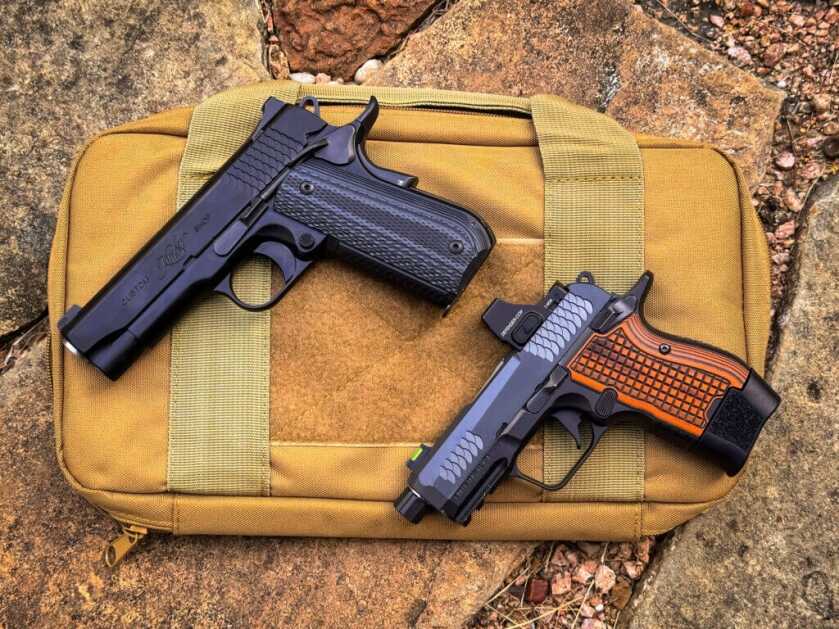
My first 1911 was the Super Carry Pro Custom HD (another mouthful), and its legacy is apparent in the CDS9. Weight was the problem for me with the Super Carry Pro HD, which made it impossible to comfortably carry IWB. The CDS9, however, has been my go-to carry for the last 12 months.
Kimber CDS9 Unboxing: What You Get for the Money
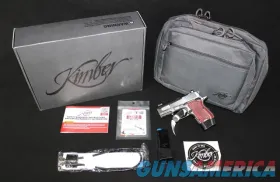
Kimber ships the CDS9 in a gray canvas range bag that can hold up to two pistols, with a second storage compartment for up to five magazines. Two magazines are included: one 13-round and one 15-round. Both magazines come with pinky extensions which allow for a full four-finger grip. For those in restricted states, Kimber also sells 10-round magazines.

The bag contains a “CDS9 Service Pack” providing additional fiber rod inserts for the front sight and spare set screws. Kimber partnered with TAG Precision for the front/rear sights and included green, red, orange, and black fiber rods to pick the one you like best. The front sight uses a set screw at the front-end to hold the fiber rods which makes swapping them out a breeze. Green was the one I opted for.
Kimber CDS9 Ergonomics: Where the Metal Frame Earns Its Keep
Holding the CDS9 for the first time instantly made me smile. Fit and finish are what you’d expect from a pistol at this price point. Absolutely no slide wiggle with flawless machining all around. A generous undercut at the rear of the trigger guard provides a higher and more controllable grip surface, while the deep beavertail prevents slide bite.

A reversible mag release comes installed from the factory on the left side of the frame. Both the slide release and thumb safety are fully ambidextrous and sit relatively flush with the frame. I’ve had no issues engaging or using the safety thanks to the stepped milling pattern that creates a positive grip surface when using it. I have seen others complain about the thumb safety being too small. Personally, I don’t have any issues with its form, and it functions well. This is the only external safety the CDS9 features. There is no grip safety.

Empty, the CDS9 weighs only 20.8 oz. This is almost identical to a P365 XL and it balances exceptionally well in hand. I expected it to weigh more with the aluminum frame.

Optics Ready: Setting Up the Kimber CDS9 for the Range
As my eyes get older, I prefer red dots over iron sights and decided to install a Vortex Defender CCW red dot. Just keep in mind you will lose the rear sight since it’s integrated with the optics cover. This is another reason why I picked the Vortex Defender CCW. It has a rear backup sight built into the housing that co-witnesses nicely with the front sight post. Installing it was simple and straightforward. Take off the optics plate cover and screw on the red dot. No adapter plate is required for RMSc red dots. Time to take it to the range.
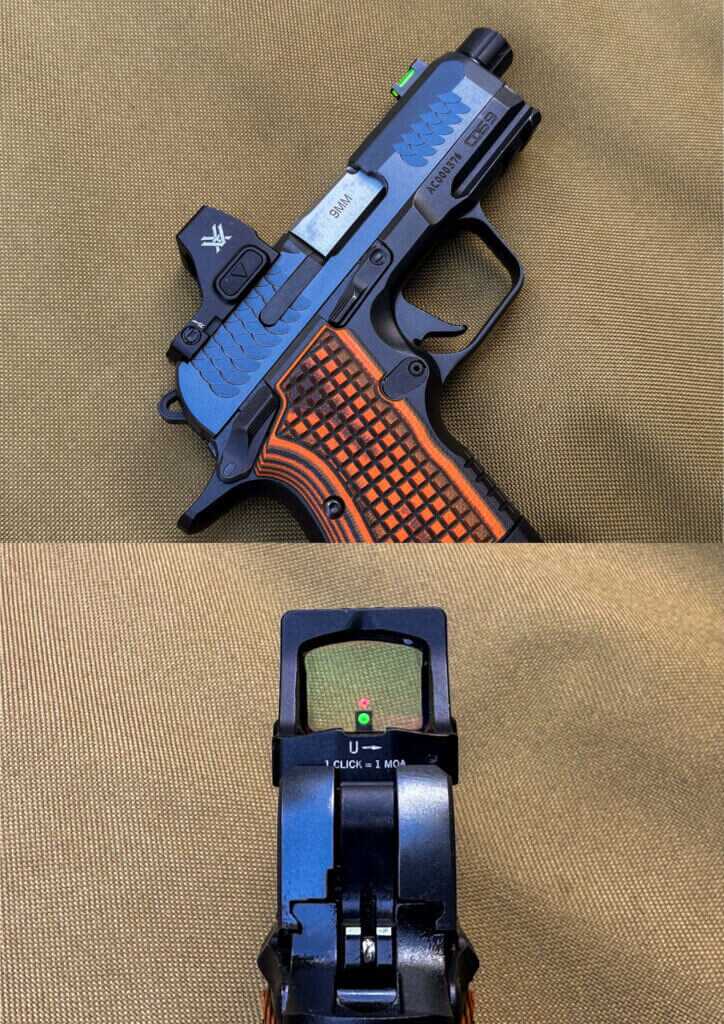
Shooting the Kimber CDS9: Snappy Recoil, Killer Trigger
Loaded up with 115gr FMJ Monarch brass ammunition and using a bench rest, I started out at 7 yards to sight in the red dot. My first impression was that the recoil did feel a bit snappy compared to both my Hellcat Pro and P365XL. The recoil is still very manageable, and the frag patterned VZ grips provide excellent control. With proper grip techniques, the CDS9 is easy to handle but not something I’d hand to a first-time shooter and expect them to enjoy shooting. Kimber employs a stacked dual recoil spring assembly, which helps mitigate some of the felt recoil. After getting the red dot zeroed in at 7 yards, I progressed back to 25 yards and fine-tuned the zero until I was getting consistent hits in the X ring.
Trigger pull on the CDS9 is superb. It’s akin to a fine 1911 with a crisp break, and no trigger creep. The reset is short and pronounced. Exactly what you’d want and expect from any high-end pistol. Mechanically, the trigger is slightly different than a traditional 1911. The CDS9 has a hinged trigger that pivots rather than being a straight, linear pull, like a 1911 has. Either way the result is a much better trigger feel compared to striker-fired platforms. It’s like a breath of fresh air compared to the spongey break felt in most striker-fired polymer guns. Currently, the trigger weight averages 5 lbs. 1 oz. on my Wheeler digital trigger gauge.

I put 250 rounds, unsuppressed, through the CDS9 on my first range visit, all 115 gr. FMJ Monarch ammunition, and had zero malfunctions. Although I had applied blue Loctite to my red dot mounting screws, I had an issue with them coming loose at the end of my visit and packed up for the day.
The following weekend I headed back to the range. This time with various brands of self-defense ammunition and suppressors in tow. I also marked my optics screws with a metallic Sharpie to make sure they weren’t backing out.
I started the session off testing Hornady Critical Duty 124 gr. FlexLock ammunition. The +P ammunition had a bit more recoil than the 115 gr. FMJ, but was still easy to shoot and accurate. There were no malfunctions or issues. I moved on to the SIG V-Crown 115 gr. JHP ammo and put another 15 rounds downrange. Again, there were no issues, and the CDS9 fed and cycled reliably. Speer Gold Dot 124 gr. HP was next and performed just like the rest. No issues or malfunctions. Finally, I ran 15 rounds of old Inceptor 9mm ARX 65 gr. I had lying around, and still the CDS9 cycled flawlessly. My confidence was building.
Kimber CDS9 Accuracy: 1-Inch Groups From a Micro-Compact

Shooting slow offhand at 10 yards, I was able to achieve 1-inch groups with 115 gr. FMJ ammunition. Picking up the pace, you can easily average 2 to 3-inch groups at 10 yards. At 25 yards with rapid shots, my groups opened up around 4 to 5 inches. The CDS9 is an incredibly accurate micro-compact. Having a 1911-esque trigger is the biggest game changer with accuracy and quick follow-up shots.

Kimber CDS9 Suppressor Testing: Where Reliability Fell Apart
Using standard 115 gr. FMJ Monarch brass ammunition, I started to test the CDS9 suppressed with my SilencerCo Omega 9K. First shot went off fine, but the slide failed to return to battery completely. A light tap on the back of the slide and I was back in business. Second shot: stovepipe. Rack, tap and third shot: failure to feed. Frustrated, I removed the Omega 9K and let it cool down so I could clean and lube the piston. In the meantime, I ran several more magazines with no malfunctions.

After cleaning and lubing the piston, I reinstalled the Omega 9K and resumed with the suppressor testing. It managed to get through 15 rounds before another stovepipe malfunction on the next magazine. At this point, I also noticed my red dot getting carbon fouled from the barrel witness hole venting gas straight on the lens. This problem isn’t unique to the CDS9 and is one of the reasons why I hate witness holes, but something worth mentioning.

The only other pistol suppressor I have is a SilencerCo Osprey .45 (with a 1/2×28 piston). So, I swapped suppressors and tried again. This time I managed to make it through 25 rounds before having another fail to return to battery. It seems the CDS9 isn’t enjoying my suppressors. I tried again with more 124 gr. Hornady Critical Duty and still no joy. It continued to have failure to feed or failure to return to battery malfunctions.
That said, I have yet to contact Kimber about the issue of running suppressed and I haven’t had a chance to try 147 gr. subsonics. I do believe there is a suppressor/ammo combo the CDS9 will reliably cycle with, I just haven’t found it yet. In the end, it’s not a huge deal for me since I don’t plan on ever carrying with a suppressor.
Kimber CDS9 Maintenance: Inside the Metal-Frame Micro
Breaking down the CDS9 is done in a similar way to 1911s. Hold the slide in the rearward position to the first takedown notch before the slide catch and use a small punch, or in my case the wooden stick of a RamRodz swab, on the right side of the slide to push out the slide release towards the left side.

Looking inside the CDS9 is where we can see some unique design changes. For example, the slide rails are T-Shaped for a tighter fitment. Examining the trigger area, you can see the pivot point that differs slightly from a traditional 1911. There’s also a Series 80-style firing pin safety on the slide and frame, which is the same system that makes 1911s drop safe.


After a thorough deep cleaning and scraping off the carbon buildup around the barrel, I reassembled the slide with some oil, and it looks just like new again.
Carrying the Kimber CDS9: A Year of Real EDC Use
At this point, the only malfunctions I’ve had were with suppressor use. I was wholly confident the CDS9 would perform unsuppressed, so I started looking for holsters. There weren’t many companies making holsters when I started this review. Fortunately, Muddy River Tactical was one of the few who had IWB Kydex holsters ready to ship. I ordered their IWB appendix holster with Topo lines on grey Kydex with an Ulti-Clip and claw attachment for better concealment.

I chose to go with the Ulti-Clip since I don’t like to wear belts often. When I do wear a belt, I can still clip the holster to my pants, and the belt completely covers the clip. The Ulti-Clip worked great with my drawstring shorts and athletic shorts. I was surprised how well the Ulti-Clip held on to my clothes and secured the holster in place as I practiced drawing the pistol from concealment. If I wore a belt regularly, I would opt for standard metal clips to fit around the belt. I can’t say enough good things about the Muddy River Tactical holster. It retains the pistol well, has adjustable mounting points for different ride heights, and smooth rounded edges for comfortable EDC.

With the 13-round magazine, the CDS9 is easy to conceal, and I was never concerned about printing. The 15-round magazine is a little more difficult to carry without some minor printing. If you’re concerned at all with concealment, I’d recommend purchasing the 10-round magazine. Over the past year, however, several other companies have launched their own CDS9-compatible holsters, but I’d still recommend looking at the Muddy River Tactical offerings.

1,300+ Rounds and 12 Months of Carry: The Kimber CDS9 Verdict
Over the course of the last 12 months, I’ve put well over 1,300 rounds through the CDS9 and not once experienced a malfunction while shooting unsuppressed. Maybe it would run better with a different suppressor, but it’s not happy with the ones I own.
I appendix carry 4-5 days/week and it is my current go-to choice for EDC. The micro-compact form and 13+1 capacity make it an easy decision to reach for. I’ve trained with it enough to know it’s reliable with all types of ammunition. I haven’t experienced any holes developing in my shirts from carrying regularly. I’ve had that happen from other pistols with aggressive grip texture. Or the rear sights cause my T-shirts to tear where the pistol sits IWB. The smooth edges and frag pattern grips eliminated that problem for me.
Wear and tear on the CDS9 is minimal, and the KimPro II finish is holding up surprisingly well under regular holster use. Some light finish wear is developing on the slide and bottom of the mag well from reloads. The slide fit is still tight with no wiggle, and there’s no significant wear patterns developing on the aluminum frame rails. You can see where the finish has rubbed off in some places but it’s nothing I’m concerned about.

The external extractor still has good tension, and ejection patterns have remained consistent. I haven’t needed to change or replace the recoil spring (recommended replacement at 5,000 rounds per the operator manual), and the barrel is still in great shape. I’ve kept the magazines fully loaded 90% of the time since I carry them often and haven’t noticed any spring fatigue yet. I typically give it a good cleaning every 200-300 rounds, run a patch down the barrel, oil the rails, wipe it down, and call it good.
Kimber CDS9 Models Compared: Which Variant Makes Sense?
If I were to do it again, I’d go for the CDS9 OR RL (Rail) or the CDS9 (OR) Classic version, depending on if you want to install a light or not. Mainly because the threaded barrel variant is 0.5” longer, so I’m carrying nearly half an inch of extra barrel for a feature I rarely use. Below is a full table of the variants, features, and specs for your comparison from Kimber’s website:
| Model | MSRP | Barrel | Optic Cut | Sights | Grips | Finish |
| CDS9 (OR)(RL)(TFS) | $1,129 | 3.64″ threaded, 1/2×28 | RMSc direct mount | TAG Fiber Lock | VZ Frag G10 | KimPro II, black frame + grey slide |
| CDS9 (OR)(RL) | $1,115 | 3.18″ | RMSc direct mount | TAG Fiber Lock | VZ Frag G10 | KimPro II, grey frame + black slide |
| CDS9 Stainless (OR)(RL) | $865 | 3.18″ | RMSc direct mount | White dot | Textured Polymer | KimPro Silver frame + Matte SST slide |
| CDS9 Black (OR)(RL) | $839 | 3.18″ | RMSc direct mount | White dot | Textured Polymer | DLC Black frame + slide |
| CDS9 Classic (OR) | $865 | 3.18″ | RMSc direct mount | TAG Fiber Lock | Textured Polymer | KimPro II, two-tone |
| CDS9 Classic | $795 | 3.18″ | None | TruGlo Tritium Pro, Orange ring | Textured Polymer | KimPro II, solid gray |
Kimber CDS9 Pros and Cons After 1,300+ Rounds
- Pros: Excellent 1911-esque trigger, impressive accuracy, aluminum frame, comfortable full-melt treatment, easy concealment, strong fit and finish, 13+1 capacity, optics-ready RMSc direct mount, and zero unsuppressed malfunctions over well over 1,300 rounds.
- Cons: Snappier recoil than my Hellcat Pro and P365XL, premium price compared to polymer micro-compacts, rear sight is integrated into the optics cover, and my suppressor testing produced repeated failures to feed or return to battery.
Should You Buy the Kimber CDS9?
Overall, the CDS9 is an excellent EDC option that is easy to conceal and a pleasure to shoot. It’s one of the few micro-compact 1911-style pistols in the market that’s saturated with black polymer striker-fired pistols. If you enjoy the aesthetics, feel, and triggers of traditional 1911s without the $2,300+ price tag from Staccato, the CDS9 would be at the top of my recommendation list.
Related Reads from GunsAmerica Digest
- Kimber CDS9 News and Related Coverage
- SIG P365XL Reviews and EDC Testing
- Springfield Hellcat Pro Reviews and Range Testing
Available on GunsAmerica Now

C. Travis has spent more than 28 years shooting, hunting, and occasionally wasting good money on gear that taught him exactly what not to buy. He grew up chasing dove and quail behind his Vizslas and later competed nationally in Olympic-style bunker trap.
With a background in mechanical engineering, he tends to look at gear through the lens of use case and practicality. A product can be excellent and still be overkill, overpriced, or simply wrong for the job. His GunsAmerica reviews focus on where a firearm or piece of gear actually fits, what it does well, where it falls short, and whether it makes sense for the person buying it.
When he’s not shooting, hunting, or testing gear, he’s usually chasing around his three kids. Being a dad is the job he takes the most pride in.