
Center Axis Relock (CAR) is a handgun shooting system developed by former police detective and trainer Paul Castle. You stand bladed to the target and hold the pistol close to the chest in a high position, then roll it out to an extended position aligned with one eye. The aim is better weapon retention, a stable hold and no double sight picture.
I learned it through Sabre Tactical’s eLearning course. Below: how it works, benefits and drawbacks, what trainers told me, and where I use it.
Table of contents
CAR at a Glance
| Center Axis Relock | |
|---|---|
| Developed by | Paul Castle, former law enforcement detective and training officer |
| Stance | Bladed, support shoulder toward the target |
| Positions | High (gun at center chest, level) and Extended (rolled out, sights aligned with one eye) |
| Claimed benefits | Weapon retention, stability, single eye sight picture, works seated, smaller target profile |
| Main drawback | Turning to face threats to your strong side or moving off line is slower than with Modern Isosceles |
Does Center Axis Relock Work?
For me it works in two places: from a vehicle seat and at contact distance with a single attacker. The trainers I asked at PFC Training, one of whom trained with Paul Castle, consider Modern Isosceles the better system overall and see CAR as a niche tool. I use both and can move from CAR to Isosceles as the situation changes.
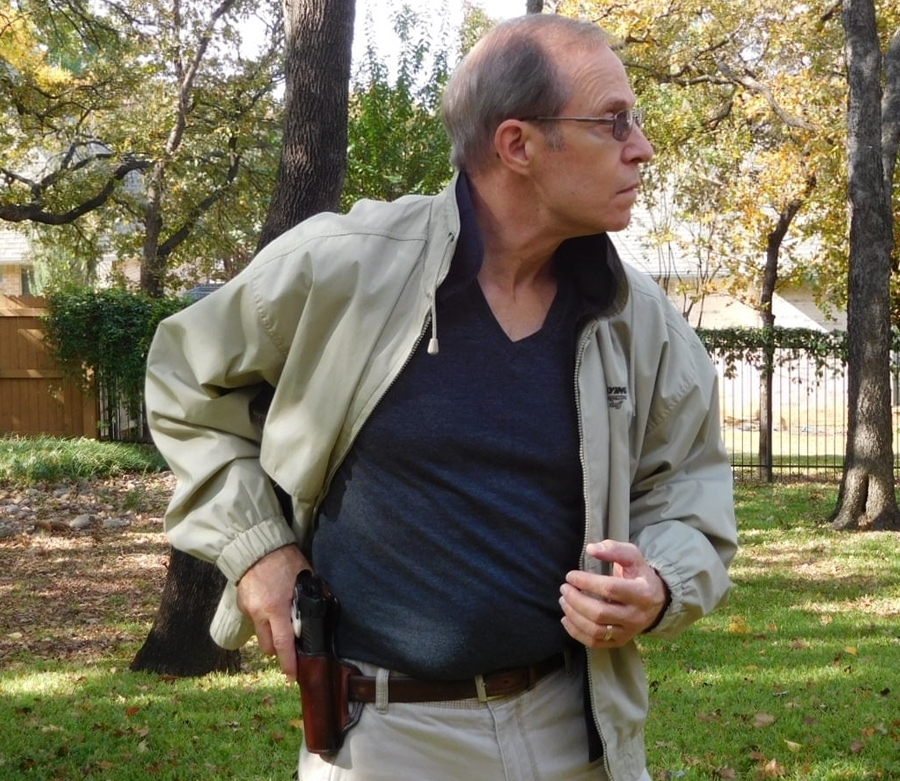
Clearing the covering garment and establishing a grip on the firearm using the Center Axis Relock (CAR) system.
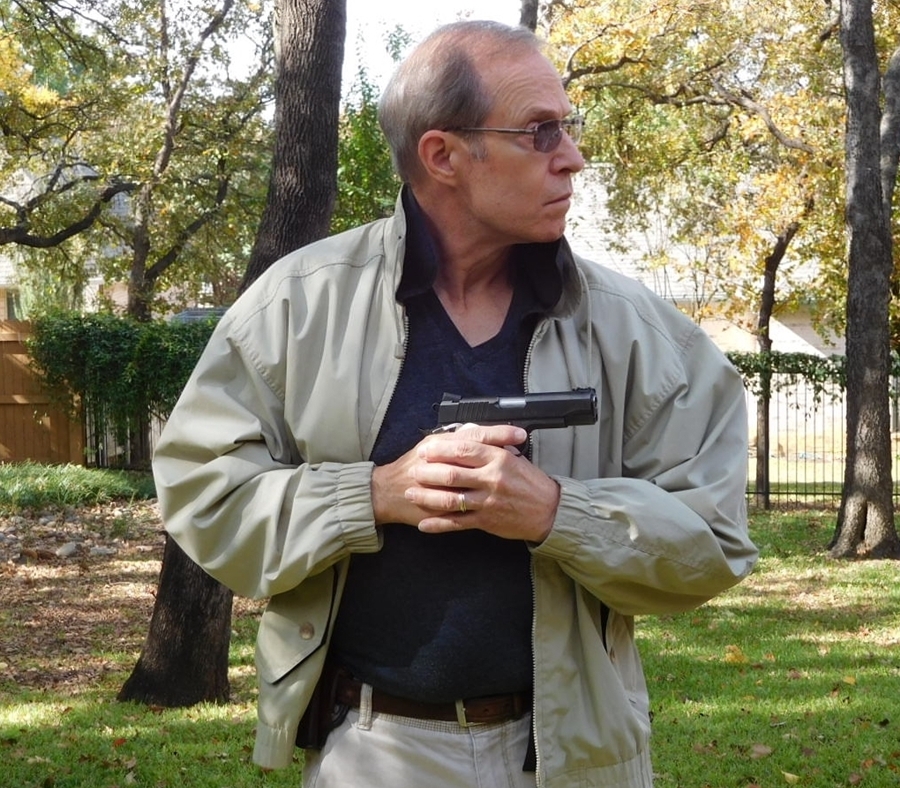
The firearm at the high position parallel with the shoulders and pointing at the target.
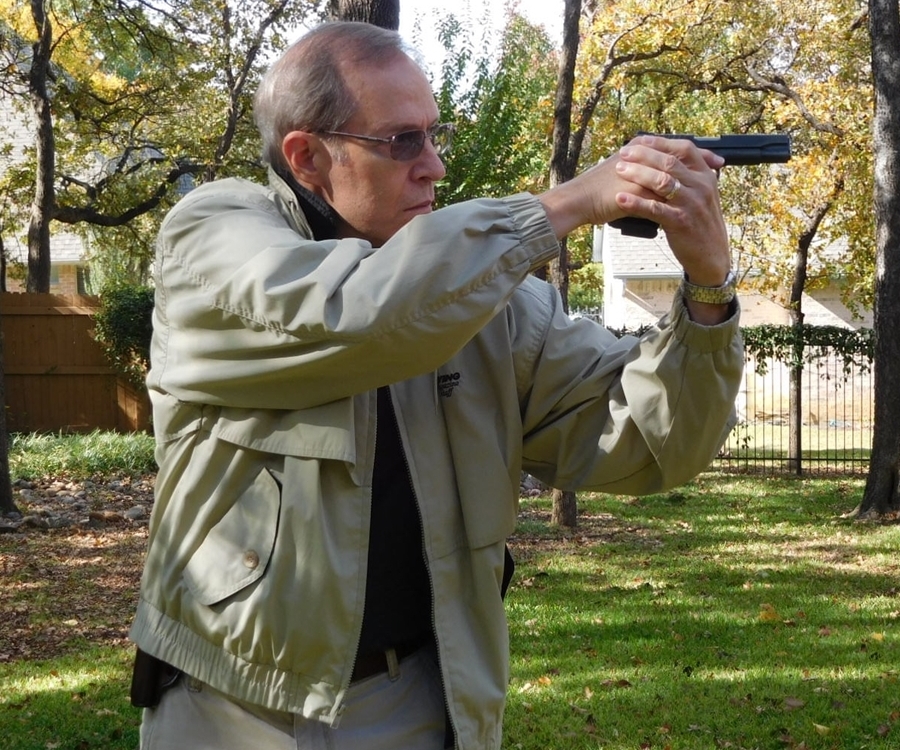
Then roll up to the extended position. This is the primary CAR firing position.
Center Axis Relock
I don’t generally get excited about a new shooting method, but Center Axis Relock, or simply CAR, caught my interest. It is a shooting system meant to provide a stable firing platform in several scenarios and to aid weapon retention.
Being shot with your own gun is a major concern in real-world self-defense shooting situations and CAR is designed to address this while helping you place shots quickly. It got my attention.
In most self-defense situations you start out behind the eight ball since you’re reacting to a threat. Worse case, your assailant has their gun or other weapon ready before you even begin to draw. A fast reaction is necessary and anything that improves your reaction time is a good thing.
If you’ve maintained your situational awareness, you’ve been paying attention to where you are and what’s happening around you, you may not be far behind, but you’re still behind. Through economy of movement that incorporates your body’s natural instincts, Center Axis Relock can help you respond, draw and get on target quickly.
The Fundamentals
Center Axis Relock was developed by Paul Castle who served in law enforcement as a detective and training officer. After retiring he decided to put his experience to work to develop a method to increase the safety and effectiveness of law enforcement and military personnel in close quarters situations. As most self-defense scenarios take place either at short ranges or in confined spaces, the methods he developed for professionals also serve private individuals and concealed-carriers.
In addition to taking advantage of human physical responses, CAR addresses some of the shortcomings of other prominent shooting stances including Weaver and Modern Isosceles. In both of these styles, your arms are either nearly extended or fully extended and many instructors teach shooters to close or partially close one eye to improve sight and target acquisition.
But for many shooters, the difference in perspective between left and right eyes isn’t enough. Your eyes can only focus on objects at one distance at a time, so when you focus on your front sight with both eyes open you see double targets. When you focus on the target as you do when defending yourself against an attacker, you see double sights.
Without strong eye dominance, especially under pressure, it’s possible to pick the wrong sight picture or wrong target. You may have struggled with this in your own shooting; I know I have.
Center Axis Relock keeps your gun close to your body and aligned with a single eye, reducing the unsteadiness caused by fully extended arms, and, for me, it removes the double sight picture so that I can quickly get your sight picture and place multiple rounds where they need to go to stop the bad guy.
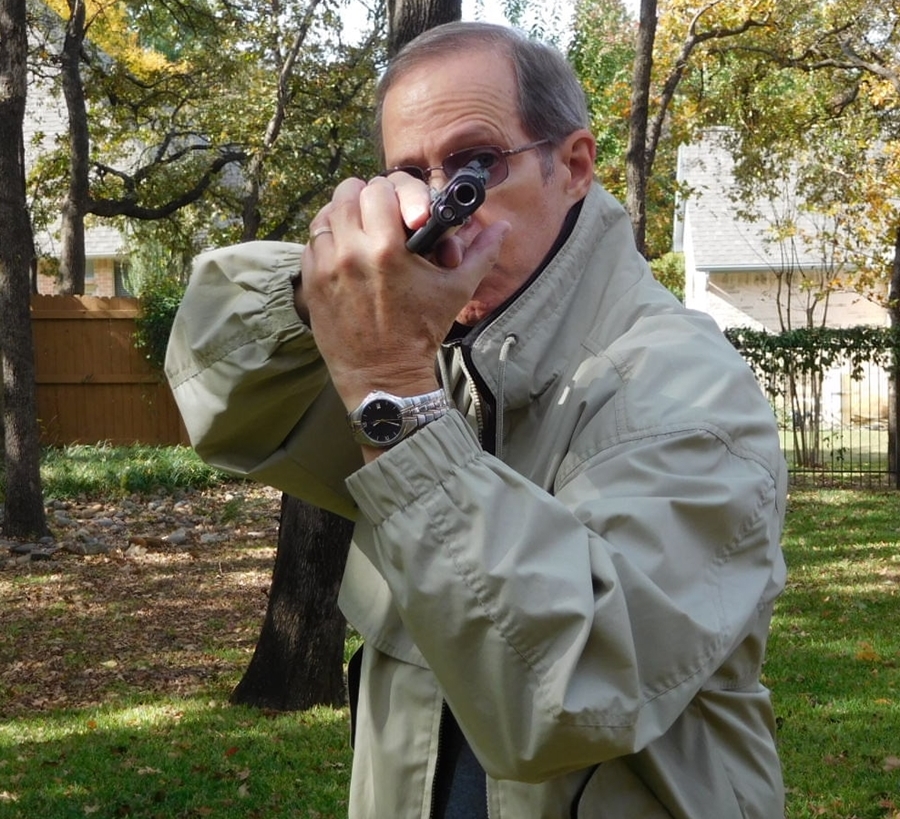
In the Extended Position, you can use the sights without dealing with a double sight picture or having to close one eye.
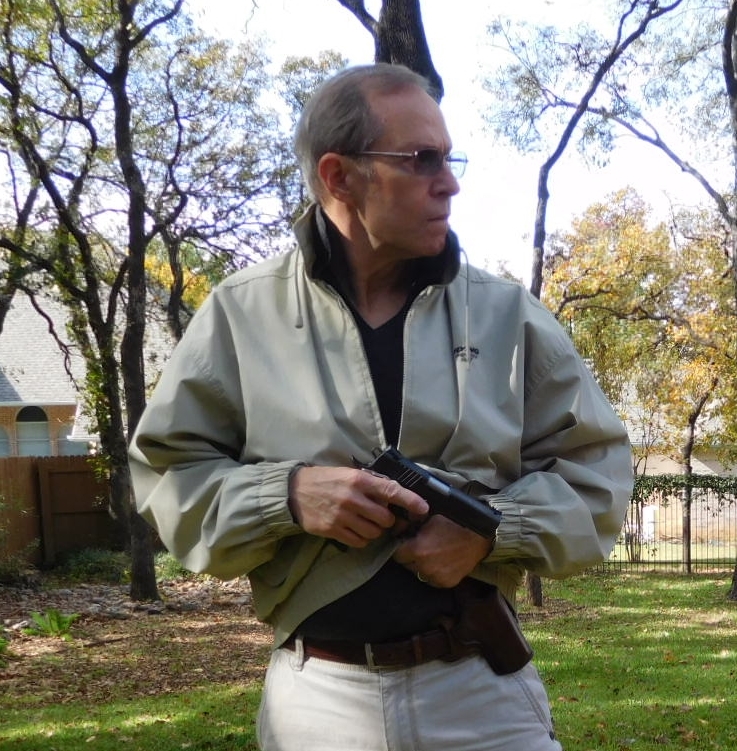
Crossdraw holsters work well with the CAR system. The garment clearing hand remains behind the weapon and is brought to the weapon from underneath.
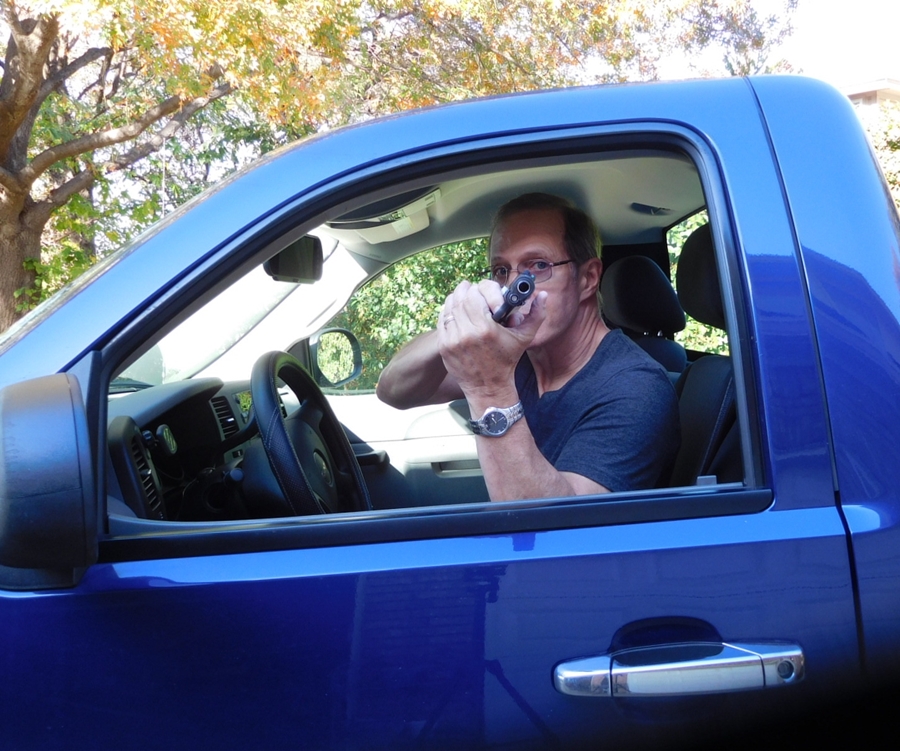
The Center Axis Relock is well-suited to being used in a seated position, such as from a car.
From Weaver to Isosceles to CAR
I started shooting handguns with the Weaver stance, with one foot forward and one placed back, using the push-pull grip, but I later adopted Modern Isosceles as it emerged as a more effective stance for tactical situations. With the improved Isosceles stance you stand with both feet planted under your shoulders; you face the target with knees slightly bent, bent forward at the waist and fire with both arms extended in front of you.
The Modern Isosceles is a great position for moving in the open and for maneuvering indoors where you have walls, corners and furniture behind which an adversary can hide. One drawback to the Isosceles is that it presents the full width of your body to your assailant and if you need glasses to see your sights, like I do, the Isosceles position has you looking through the top of your glasses at the sights, not the lower part where your near-vision prescription is. Blurry sights do not help you shoot accurately.
There are two Center Axis Relock primary positions: “high” and “extended.” In both positions you stand bladed to the target; your support-side foot is closer to the target with your weapon-side foot farther away. That puts your shoulders 90 degrees to the target with your support side shoulder pointing directly at it. This offers a smaller target for your attacker. Believe me, when someone’s shooting at you, you want to get very small.
With Center Axis Relock you draw into the high position and bring your gun up to the center of your chest with the barrel level and parallel to your shoulders. If your shoulders are pointing toward your attacker, your gun is also pointing at your attacker and you can quickly fire one or more shots at your attacker’s position if you don’t have time to aim down the sights and he is right on top of you.
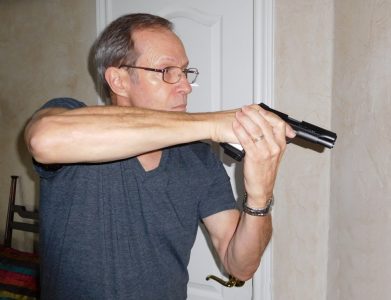
Bringing the muzzle down from the Extended position gives you a good room-clearing position. If possible retreat to a safe place, of course, and call law enforcement. But if you must, this is a good position to use while moving through the house.
During the draw, your support hand moves up beneath your gun in your strong hand. It is very important to never sweep your support hand during the draw. In addition, your support hand is pulling your gun away from the target while your gun hand is pushing it toward the target, forming a very stable triangle. This allows you to move in any direction quickly and easily while keeping your attacker covered. You can also use your elbows for elbow strikes if your attacker is that close.
If you have the time and distance from your attacker necessary, you go to the extended position. You smoothly roll the gun up and towards the target. Don’t lower your head to the gun, bring the gun into your line of sight so that the sights are between your eyes and your target. Keeping your head upright helps maintain your balance and allows you to move more freely. The extended position is the intended firing position for accuracy.
The CAR Benefits
- Stability: Holding your weapon close to your body is more stable than holding your firearms with your arms fully extended
- Eliminates double vision: With the sights held close to your face at reading distance, it removes the double sight picture for many shooters
- Improves weapon retention: Holding the weapon close to your body makes it more difficult for an attacker to take it away
- Can be used when seated: CAR adapts well to shooting from a car or another seated position
- Makes a smaller target: By presenting only one side your body to your attacker, it makes you harder to hit
- Reduces recoil: Proponents say using the body’s support structure reduces felt recoil and helps you stay on target
- Universality: Proponents say CAR works regardless of age, size, strength or gender
- Speed: With the weapon close to the body, reloads and stoppage clearing can be faster
- Instinctive: CAR incorporates your body’s natural reactions
Drawbacks
There are drawbacks to Center Axis Relock. If you enter a room and you don’t know which side the bad guy’s on you may have to turn your entire body to face your target, which takes time you won’t have. The Modern Isosceles stance facilitates faster movement in this kind of situation giving you better reaction time. In an armed encounter, moving off the line between you and your attacker could also help you survive. Here the Isosceles method has the edge because it is more natural for shooting while moving.
What the Professionals Think
My go-to-guy for questions related to training/technique is Steve Krystek, CEO of PFC Training. Steve has twenty-some years experience in military, law enforcement, and security, and has developed tactics for SWAT teams as well as other elite military and law enforcement units.
I’ve taken half a dozen courses at PFC and value its scenario based training.
When I contacted Steve about Center Axis Relock, I found out that he’d trained with Paul Castle, the developer of CAR. He said that in most situations Modern Isosceles was a superior system overall. His chief instructor, Steve Hartman, mirrored that opinion saying that CAR only serves a narrow niche.
Hartman added that “Every technique can have some merit to it.” In other words, the more you know, the more effective you can be. And the more tools you have in your toolbox, the better prepared you can be for unexpected situations.
Technique is Personal
What’s right for me may not be what’s right for you. I spend a lot of time in my vehicle and like CAR for defending myself from the driver’s seat. I also like it for contact-distance encounters with a single attacker because it provides good weapon retention and the ability to quickly place multiple shots on target.
In addition, I’ve found that the elimination of double vision in the extended position allows me to get my sight picture more quickly and to shoot more accurately at distances of more than 8 to 10 feet. For multiple attackers, I prefer the Modern Isosceles for the ability to cover a wider area with the greatest speed. I’ve also found that I can quickly transition from CAR to Isosceles depending on the situation.
In the course of training more than ten thousand students around the world, the folks at PFC have found the Modern Isosceles to be a more effective method, overall. I can’t argue with that. They’re experts in both tactics and training. But you can only learn what’s most effective for you by training with as many techniques as possible and developing your own personal style. In my opinion, it’s worth some time at the range to see for yourself if it gives you an advantage in self-defense encounters. My bet is that you’ll find that some of these techniques work for you too. The more arrows you have in your quiver, the better.
Mr. Castle has since passed away, and the company he founded, Sabre Tactical, carried on his work. I learned the technique through Sabre Tactical’s at home eLearning course.
Live fire training was offered through the Sabre Tactical Associate Program. It’s an easy system to learn but does take practice, especially if you’re accustomed to using a different method.
Keep training and stay safe.
Mr. Lincourt is a U.S. Army combat veteran. He fought in five campaigns and was awarded four medals for heroism. As a lifelong student of close quarters combat, Mr. Lincourt has attended multiple live fire courses in pistol shooting, tactical carbine and shotgun shooting, as well as trained in knife fighting, stick fighting and unarmed defense against guns, knives, and sticks. He is the author of two anti-terrorism thriller novels, “Deadly Deception” and “Death rides the River” and has written for GunsAmerica.com.
FAQ
Who developed Center Axis Relock?
Paul Castle, a former law enforcement detective and training officer.
What are the two CAR positions?
High, with the gun at the center of the chest and level, and Extended, rolled out toward the target with the sights aligned with one eye.
Is Center Axis Relock better than Isosceles?
The trainers I consulted prefer Modern Isosceles overall and see CAR as a niche tool. I like CAR from a vehicle and at contact distance.
I strongly disagree with the smaller silhouette argument. If you are wearing body armor, exposing your sides isn’t a very good idea and getting shot in the front is always better than getting shot on the side, why? A bullet that would go through your left lung and exit can go trough the poor lung, heart and damage your right lung.
Imho I think all three systems have merit. Here’s my train of thought:
CAR: best for close “halitosis” range.
Modified weaver: most versatile in term of movement. Partially lateral movement while try to get to cover. So I consider it a medium range all
Around approach. Weaver grip also works kneeling and prone
Isosceles: offer good grip and recoil control particularly with weak hand thumb forward grip. It has a vary stable if some what less mobile stance. I think of it as a long range prescion style.
Bottom line they are all good. They all accomplish the same thing, giving us a stable play form from which to send lead down range. Just like in martial arts, it’s not style or system but the practitioner.
For you car guys, I have a question : when you are hold the gun close to body, does it work for revolvers too? Does the cylinder gap gasses ever cause a problem?
I represent the largest demographic of pistol owneing Americans. I have owned and recreationally shot pistols for 50 years. I’m not an “operator”, LE or military. I go to the range, on average, 10 times a year. In 50 years, I have taken only 4 courses…..and that may be more than most in my group. NRA into course, carry course, CAR taught by Paul Castle about 17 years ago and a recent CAR refresher.
For me, and I suspect for most of us that do not or can not continuuiously train and practice….the CAR system of “gun fighting” is effective, easy to understand and to use. The key word for CAR is intuitive. That makes it easy to retain without the luxury of 50+ hours a year at the range. I’m extremely thankful for Paul Castle for the development of a system that just works.
I think one of the “drawbacks” for modern isosceles is completely dependant on the situation. A big reason you square up with your threat in that stance is to allow your plate carrier to maximize it’s effectiveness, where blading up to the target exposes unprotected, vital areas that are not as well protected.
This is irrelevant if you aren’t in an occupational capacity that provides this protection, or if you don’t use plates.
I don’t believe law enforcement agencies should teach a method of shooting that renders protective equipment useless.
Wow I was a touch redundant there haha.
Well, shades of Paris Theodore! What’s with the crosseyed pistol hold? I see only one advantage to using this presentation: It appears that it would work very quickly when you’re sitting behind the steering wheel and shooting out the driver’s side window.
Otherwise the CAR hold would throw all of my meticulously ingrained body centerline indexing off; and, quite frankly, while I am completely ambidextrous with all hand tools and weapons, I prefer to shoot using the same eye and hand. I, also, know better than to limit myself to using only a two-handed hold.
Another thing: Many years ago I learned to do everything possible to avoid exposing the sides of my body to incoming fire – Especially when I’m wearing a vest! Bullets that strike a humanoid target along the sides of the body have the most peculiar way of just plain doing more damage!
Would I use CAR? I might. Would I use it, more or less, exclusively? Never!
Good points Dave, Sorry I’m a little late getting in on this. I had the honor, and luck, to spend some quality time with a well known (now deceased) retired Border Patrolman at our hunting lodge in Alabama. In my late 30’s then, half a lifetime ago, I got the nerve up to ask him- “I know you been in a lot of gunfights and scrapes, and I’ve heard of the Weaver stance, modified Weaver and one that starts with an i that I can’t pronounce, what did you find that worked best for you?” he thought a second, slow smile, and said; “Amigo, If you’ve got time to get into a “stance”, you’re probably not in a gunfight.” Since then I have always tried/trained with new methods and techniques, put them in the little tool box in the back my head to pull out and use as the “situation” demands.
Just read the article and in the section that talks about draw backs when entering a room and having to expose yourself to an assailant that may be there. You should come to California and get our training because this is one of the hall marks of how great this system really is. Without giving any techniques away, we stress that C.A.R. allows you to stay protected without exposing yourself to unfriendly gun fire. The system was designed for Close Quarter Combat in an urban situation where using Iso/Weaver stance is ludicrous and can only get you killed. Dan O’Neal is correct when he stated that any negative comments on C.A.R. shows how much you don’t know.
I am a CAR Instructor and have been trained and shown all kinds of techniques. I have been a Police Officer and I have trained numerous departments and government agency personnel. The CAR system has so many merits and is based on harmonious body movement and bone and barrel alignment. It also does not discriminate with left or right handed people or eye dominance. For the person above that made comments about we’re idiots just shows how little you know about this system. It has superior advantages and very few if any disadvantages. As with all systems and techniques you do need to work with what is best for you. Training in various techniques only adds to your tolls in the toolbox and makes you able to adapt to multiple situations. Also the disadvantage that is stated in this article is not applicable due to the fact with the CAR system you can shoot left or right handed. This is what we show you and train you how to do effectively and safely and accurately. I am dumbfounded why anyone would not want to explore how to do this from professionals that have been trained and fully understand the science behind it. Trying to evaluate this system from an internet video on something that took Paul Castle 20 years to create and research to perfection just blows my mind. This system is by far one of the best. Not the only one, but definitely a good one to know if you are LE or Government official. We can be found for training at http://www.civilianarmstraining.com. If you are LE or Government please ask for Dan O’Neal. PS Shrugger – You touch your thumbs together.
hmm, interesting. But what do I do with my thumb? I keep mine pressed over the thumb safety on my 1911. =/
The idea that one particular gun control system is the best is asinine and insures failure in actual armed confrontations!
The system that works BEST is the one that SAVES your bacon at the moment, from whatever position of engagement, PERIOD!
It my belief “That an armed society is more polite society”. It is funny how the Clintons and the liberal news etc, never mention the people that are saved by using a gun to protect themselves, yes even in the event of domestic violence. The trouble comes when someone merely threatens to use a weapon and allows the perp to get close enough to get the weapon away from them. If you are going to use it do not produce it. My opinion. At least I believe we still allowed to have an opinion, what it NSA????
If you want to see CAR used on a bunch of Russian mobsters, check out the movie “John Wick”. He’s the guy you hire to kill the Boogey Man.
Another Hollywood Hombre with NO CLUE!
I have personally seen these IDIOTS out shooting holding their guns sideways and emptying the magazines in rapid fire and never hitting anything!
These kind of IDIOTS is the kind that gives all responsible gun owners a bad image in the public eye!
To call people who actually train in this system “idiots” is insane. Learning different styles of shooting, as you would with martial arts, not makes you a better overall shooter. I am an extremely responsible gun owner and teach such safety to all of my students. We do not hold our guns “sideways” as you think. It is at a 45 degree angle to align bone and barrel to reduce recoil of the firearm. I would like to offer you a day to come out and train just a single day with CAR. There are so many merits behind the system that can be utilized in real world scenarios. You cannot judge something like this without trying it out yourself from a certified instructor. Please take my sincere offer and try it out one time before making such ignorant claims.
Actually…. Keanu Reeves could probably school most of the people commenting on this article.
https://www.youtube.com/watch?v=rCIgpUTvfsA
Oh look!!! Keanu’s shooting pistol really quickly and really accurately and he’s using………Isoceles! I rest my case your Honour.
Another gimmick.
CAR changed the way I shoot. I happened upon a video extolling its virtues and I thought I’d better try it for science; long story short, I abandoned most of it. I more or less shoot isosceles, but being left handed and right-eyed I found I could incorporate the basic sight-picture part of CAR by turning my head toward my left bicep and blocking my left eye with my nose. It looks silly, but I basically get a cheek weld on my bicep and sight down my arm, very stable, I don’t see double and I never close an eye.