
It can work, but in our test it was not much better than .22 LR. From two identical Smith & Wesson J-frames, all three .22 WMR defensive loads expanded in bare gel and averaged 11.76 to 12.48 inches of penetration, but none expanded through four layers of denim, while Federal Punch 29 grain .22 LR averaged 15.13 inches bare and 14.33 through denim. Our tester would pick the cheaper, softer shooting .22 LR revolver, and either rimfire is a compromise next to a centerfire.
Table of contents
- .22 Magnum vs .22 LR for Self-Defense at a Glance
- Why We Tested .22 LR and .22 Magnum
- The Test Revolvers: S&W; 43C and 351C
- How We Tested
- .22 LR Test Results
- .22 Magnum Test Results
- Average Penetration Compared
- Cost, Recoil and Practice
- Our Tester’s Conclusion
- Is a .22 Magnum Good for Home Defense?
- .22 Magnum for Self-Defense FAQ
.22 Magnum vs .22 LR for Self-Defense at a Glance
| Load (from our test) | Bare gel penetration | Through denim | Expanded? |
|---|---|---|---|
| Federal Punch 29 gr .22 LR | 15.13 in | 14.33 in | No |
| CCI Mini-Mag 36 gr CPHP .22 LR | 11.35 in | 11.90 in | No |
| CCI Mini-Mag 40 gr RN .22 LR | 11.40 in | 12.78 in | No |
| Federal Punch 45 gr JHP .22 WMR | 12.28 in | 11.08 in | Bare gel only |
| Speer Gold Dot 40 gr HP .22 WMR | 12.48 in | 11.81 in | Bare gel only |
| Hornady Critical Defense 45 gr FTX .22 WMR | 11.76 in | 11.09 in | Bare gel only |
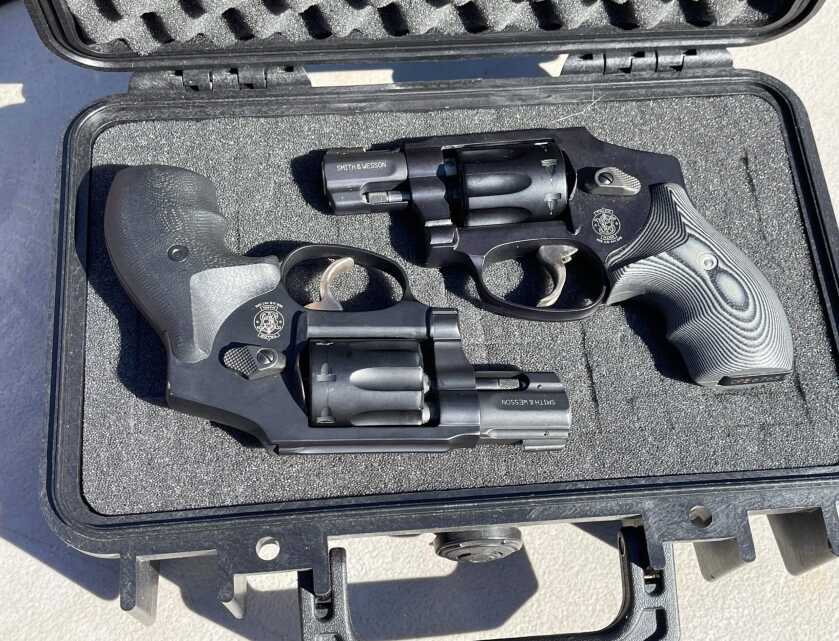
- Test guns: S&W 43C in .22 LR (8 shots) and 351C in .22 WMR (7 shots), both 11.5 ounce J-frames with internal hammers, $799 MSRP (2026) each.
- Ammo cost: Federal Punch .22 LR $11.99 per 50 and Federal Punch .22 WMR $27.99 per 50, both MSRP (2026).
- Our tester’s pick: the 43C in .22 LR with Federal Punch.
Why We Tested .22 LR and .22 Magnum
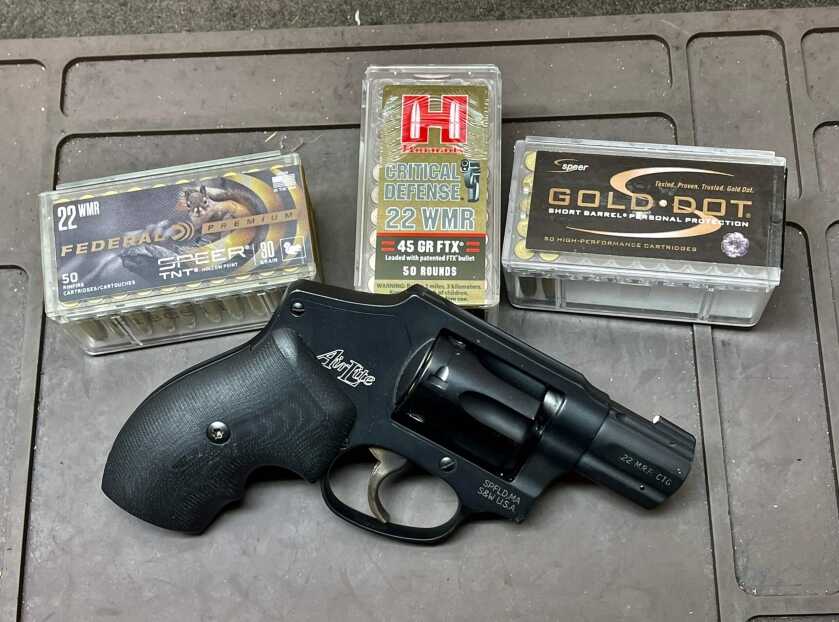
Small revolvers have made a comeback for personal defense, and rimfire versions keep coming up. They are light, easy to shoot and have little recoil, which appeals to shooters with limited hand strength or a strong recoil sensitivity. Federal’s introduction of Personal Defense Punch in both .22 LR and .22 WMR, the first .22 LR load we know of developed and marketed specifically for personal defense, raised two questions. Is either .22 a viable defensive option, and is the magnum significantly better than the long rifle?
The Test Revolvers: S&W; 43C and 351C
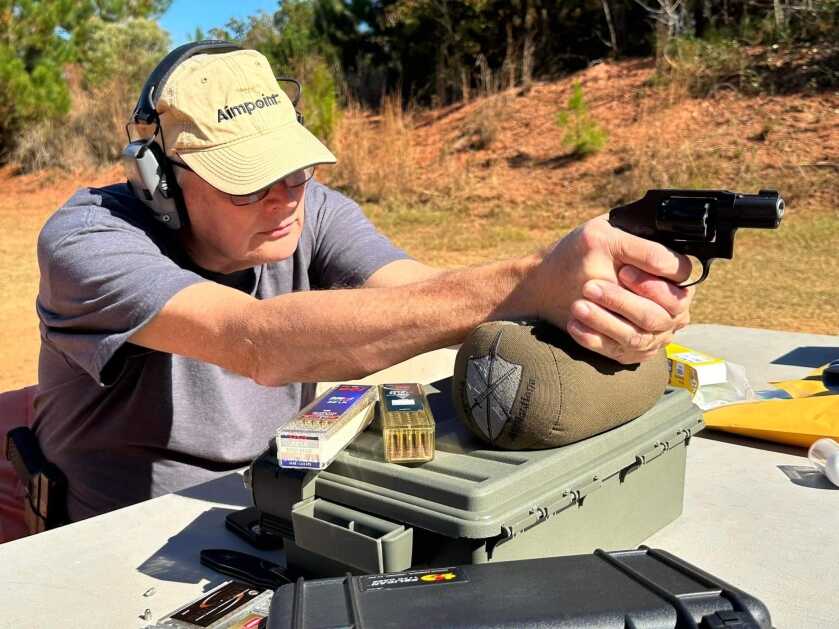
Our tester used two Smith & Wesson Centennial-style J-frames he has owned for several years: the 43C in .22 LR and the 351C in .22 WMR. Both have an internal hammer, making them double action only, an aluminum alloy frame and cylinder with a stainless steel barrel, lightening cuts in the backstrap and trigger guard, a fixed notch rear sight and an XS white dot front sight. Smith & Wesson lists both at 11.5 ounces. The 43C holds eight rounds and the 351C holds seven. MSRP for each was $759 in 2023 and is $799 MSRP (2026).
Both revolvers have been completely reliable for him. The 43C needs more frequent cleaning because .22 LR uses lead bullets, while all the magnum loads tested used plated or jacketed bullets.
How We Tested
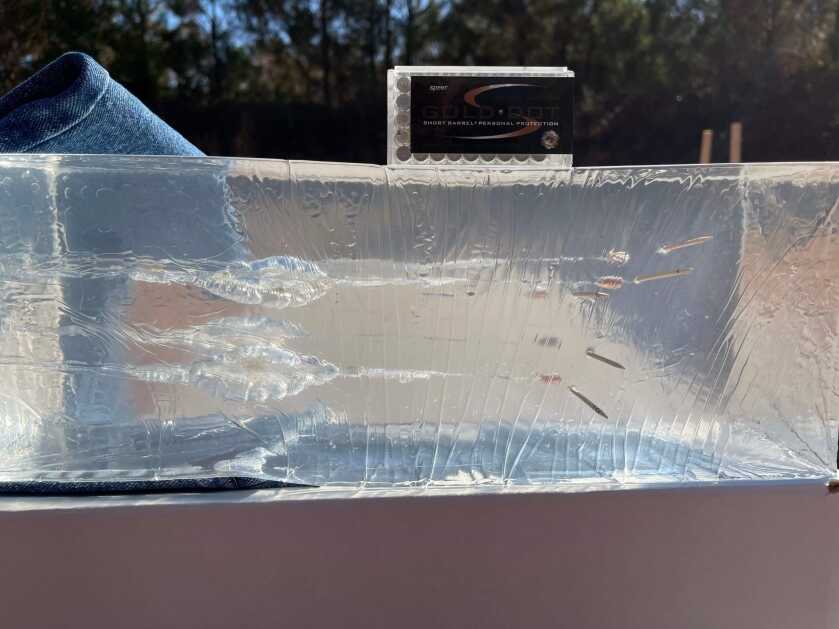
- Gel: two blocks of Clear Ballistics 10 percent synthetic gel, which is not the same as calibrated organic ordnance gelatin.
- Distance: 10 feet from muzzle to gel, with a chronograph in front of the block.
- Conditions: bare gel, then gel behind four layers of denim cut from old jeans.
- Measurements: every shot was chronographed, measured for penetration, and recovered.
- Temperature: 72 degrees at the start, rising to 80 degrees.
- Loads: three in each caliber, listed below.
Gel is not flesh and bone, and this was not a full FBI protocol test with heavy clothing, wallboard, plywood, sheet metal and auto glass. It does provide a consistent way to compare loads against each other.
.22 LR Test Results
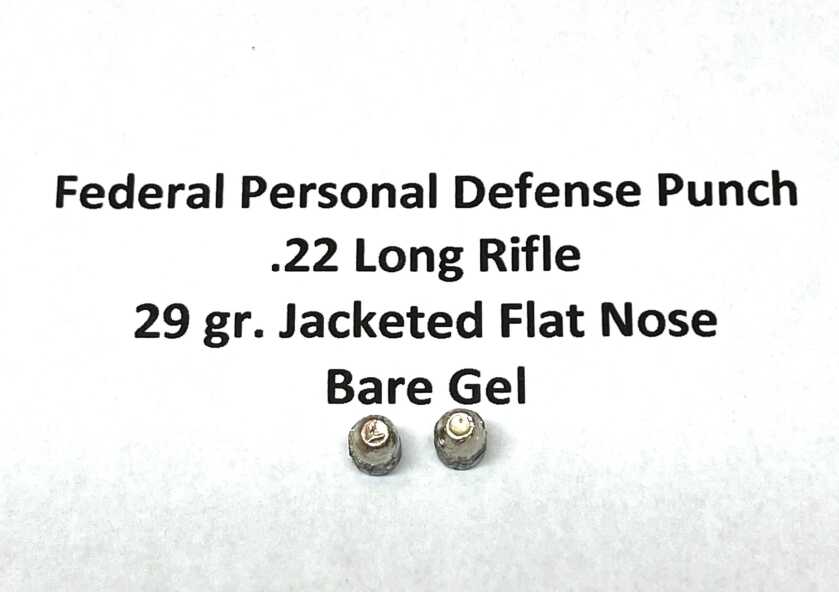
None of the .22 LR loads expanded or even deformed, in bare gel or through denim.
Federal Personal Defense Punch .22 LR, 29 Grain Flat Nose
- Average velocity: 1,203 fps bare gel, 1,187 fps through denim
- Average penetration: 15.13 inches bare, 14.33 inches through denim
- Range: 13.25 to more than 16 inches bare, 11.50 to more than 16 inches through denim
- Three rounds exited the block in bare gel and two through denim, so true average penetration was deeper than measured
- Expansion: none
CCI Mini-Mag .22 LR, 36 Grain Copper Plated Hollow Point
- Average velocity: 993 fps bare, 1,009 fps through denim
- Average penetration: 11.35 inches bare, 11.90 inches through denim
- Range: 10.38 to 12.25 inches bare, 10.63 to 12.75 inches through denim
- Expansion: none
CCI Mini-Mag .22 LR, 40 Grain Round Nose
- Average velocity: 938 fps bare, 940 fps through denim
- Average penetration: 11.40 inches bare, 12.78 inches through denim
- Range: 10.0 to 12.0 inches bare, 9.25 to more than 16 inches through denim, with two rounds exiting
- Expansion: none
The lighter, faster Federal Punch clearly outperformed the two heavier CCI loads on penetration, the key measure for a non-expanding bullet.
.22 Magnum Test Results
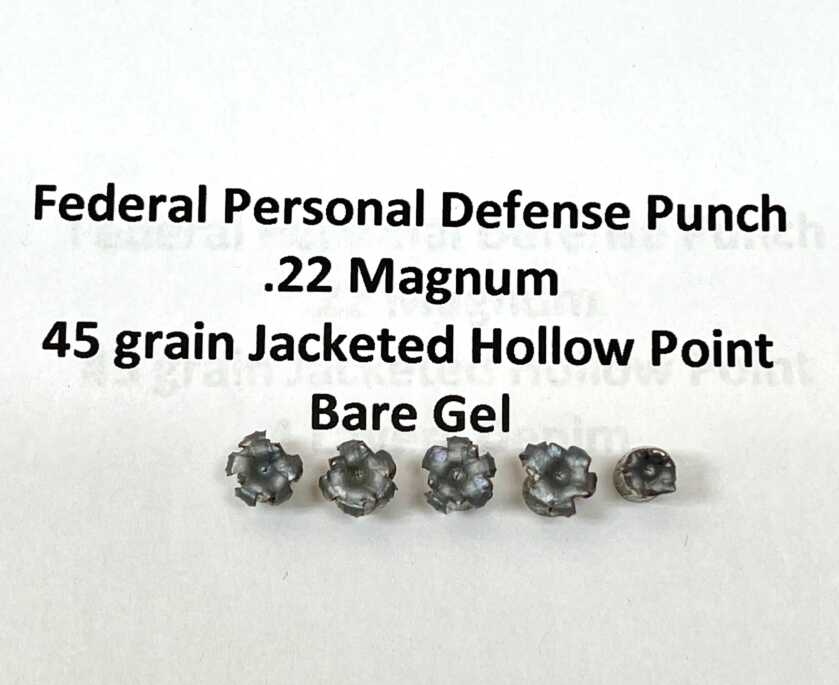
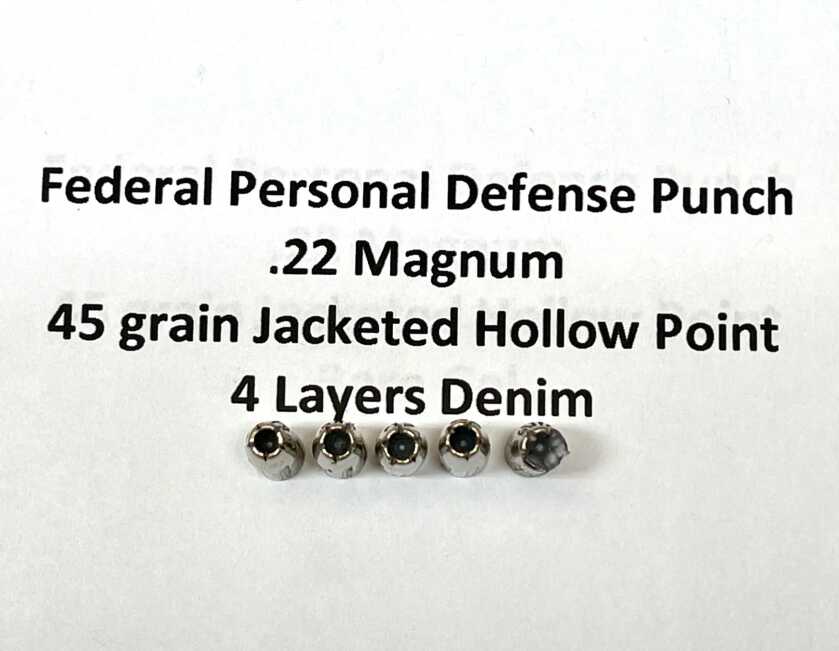
The three .22 WMR loads were close in bullet weight and velocity, and their results were very similar. All three expanded consistently in bare gel. Through four layers of denim, none expanded or deformed. The recovered hollow points were not plugged with denim, so our tester concluded the denim slowed the bullets below the velocity they need to expand.
Federal Personal Defense Punch .22 WMR, 45 Grain JHP
- Average velocity: 1,055 fps bare, 1,064 fps through denim
- Average penetration: 12.28 inches bare, 11.08 inches through denim
- Range: 10.25 to 13.25 inches bare, 10.31 to 11.65 inches through denim
- Expansion: yes in bare gel, none through denim
Speer Gold Dot Short Barrel .22 WMR, 40 Grain Hollow Point
- Average velocity: 1,080 fps bare, 1,076 fps through denim
- Average penetration: 12.48 inches bare, 11.81 inches through denim
- Range: 10.88 to 14.25 inches bare, 11.20 to 13.06 inches through denim
- Expansion: yes in bare gel, none through denim
Hornady Critical Defense .22 WMR, 45 Grain FTX
- Average velocity: 1,018 fps bare, 1,013 fps through denim
- Average penetration: 11.76 inches bare, 11.09 inches through denim
- Range: 10.63 to 13.50 inches bare, 10.33 to 11.60 inches through denim
- Expansion: yes in bare gel, none through denim
Average Penetration Compared
- Federal Punch 29 grain .22 LR: 15.13 inches bare, 14.33 inches denim
- CCI Mini-Mag 36 grain CPHP .22 LR: 11.35 inches bare, 11.90 inches denim
- CCI Mini-Mag 40 grain RN .22 LR: 11.40 inches bare, 12.78 inches denim
- Federal Punch 45 grain JHP .22 WMR: 12.28 inches bare, 11.08 inches denim
- Speer Gold Dot 40 grain HP .22 WMR: 12.48 inches bare, 11.81 inches denim
- Hornady Critical Defense 45 grain FTX .22 WMR: 11.76 inches bare, 11.09 inches denim
Only Federal Punch .22 LR averaged inside the FBI’s 12 to 18 inch window in both conditions. The .22 WMR loads averaged just over 12 inches in bare gel and around 11 inches through denim. That FBI standard was written for law enforcement, which often has to shoot through barriers, so treat it as a benchmark, not a pass or fail line for every situation.
Cost, Recoil and Practice
Our tester found .22 WMR more than twice the price of .22 LR. Federal now lists .22 LR Punch at $11.99 MSRP (2026) per 50 rounds and .22 WMR Punch at $27.99 MSRP (2026) per 50, up from $10.99 and $25.99 in 2023. CCI Mini-Mag 36 grain HPs are still $12.99 MSRP (2026) per 100. Cheaper ammo means more practice, and in a small, light revolver, practice matters. The magnum also has a louder report, more felt recoil and more muzzle flash.
The .22 WMR does have one advantage: more loads designed specifically for personal defense.
Our Tester’s Conclusion
The only place the .22 WMR clearly beat the .22 LR was expansion in bare gel, and that advantage disappeared behind denim. With a .22 caliber bullet, expansion adds little in any case. If he could own only one, our tester would choose the 43C in .22 LR loaded with Federal Punch, for its penetration, low cost and wide availability. A fellow tester’s independent results closely matched his.
This was a limited test. If you are considering a .22 for personal defense, do your own research, practice with your chosen load, and compare it with centerfire options. For more on small defensive cartridges, see our 5.7 Fest coverage and our 5.7×28 ballistics guide, our guides to the best .22 revolvers, the best snub nose revolvers and the best defensive revolvers, our .22 LR handgun woods gun test, our J-frame carry test and our Walther WMP .22 WMR review.
Is a .22 Magnum Good for Home Defense?
Same answer, same caveats. Our test was about short barrel revolvers, and in them the magnum’s edge was expansion in bare gel that disappeared behind denim. A .22 you shoot well beats a bigger gun you can’t run, but if you can handle a centerfire, that is the stronger choice. For more on rimfire carry, see our .22 LR for self-defense piece, our 6.7 ounce Sidewinder .22 Magnum review and our best .22 Magnum guns guide.
.22 Magnum for Self-Defense FAQ
Is .22 Magnum better than .22 LR for self-defense?
Not by much in our testing. The .22 WMR loads expanded in bare gel but not through denim, and they penetrated less than the best .22 LR load, Federal Punch. The .22 LR costs less than half as much and recoils less.
How deep does .22 Magnum penetrate in gel?
From an S&W; 351C at 10 feet, our three defensive loads averaged 11.76 to 12.48 inches in bare synthetic gel and 11.08 to 11.81 inches through four layers of denim.
Does .22 Magnum expand?
All three loads we tested expanded in bare gel. None expanded after passing through four layers of denim.
What is the best .22 LR load for self-defense in your test?
Federal Personal Defense Punch 29 grain. It never expanded, but it penetrated deepest, averaging 15.13 inches in bare gel and 14.33 inches through denim, with some rounds exiting the block.
Is a .22 revolver good enough for self-defense?
It is a compromise. A .22 you shoot well and carry every day is better than nothing, but centerfire calibers offer more reliable penetration and expansion. Choose based on testing and your own ability to shoot well.
Why do rimfire revolvers suit some shooters?
They are light, have very little recoil and need no slide to rack, which helps shooters with limited hand strength. A double action revolver also avoids the need to manipulate a safety.

Rob has been writing for the firearms industry for over 40 years as well as 38 years of law enforcement experience. With over 1,000 published article, he enjoys bringing a historical perspective to many of his articles. An ardent revolver enthusiast, Rob understands the practical application of the “art of the revolver.” In many articles, Rob includes ballistic testing data of many of the popular personal defense loads.
When not at the range, or pounding the keyboard, Rob enjoys spending time with his family, is active in his local church, and networking with an ever expanding group of like minded shooters.
Experience
40+ Years writing for the firearm’s industry
Retired Lieutenant with a large Georgia law enforcement agency
Avid shooter and daily practitioner
Consultant in the firearm’s space
Great research and a lot of work ! Very interesting and very helpful !
Thank you . . .
My recent article on the .22:
https://www.goodhillpress.com/2022/10/the-case-for-discreet-carry-22.html
Great article and convincing evidence that a .22 mag doesn’t make much difference in a shorter barrel
That being said, I think a Walther PPK-S in .22 lr with 10+1 capacity would be the way to go versus a hammerless revolver
Because of ammo reliability as well as terminal ballistics, there is NO rimfire that would be my first (or second or third) choice for a personal defense firearm. However, a .22 may be the only choice for someone with an infirmity that keeps them from using a centerfire. And the difference between bare hands and a .22 is greater than the difference between a .22 and a .45.
I understand your concern. I will say that I had zero issues during with the several hundreds rounds we fired during this test. The quality ammo, CCI & Federal, appears to be very reliable. Bill ammo and some of the other manufacturers, not so much.
Thanks
Rob
Since these “new” Personal Defense rounds are marked as such and accordingly priced, it would be an interesting follow up to have a response from the manufacturers of each as to what if any measures were taken to improve the reliability of ignition. Seldom if ever do I go to the range and not see multiple 22LR rounds on the ground with primer strikes and failure to fire. I have always heard that this issue was the Genesis of the 25ACP, needing the reliability of a center fire with the base footprint of a 22LR. IF these “new” rounds are in fact intended to perform for the application in which they are marketed, it would seem to me that some additional measures would be taken to address this, and be thus advertised. Simply sticking a new fancy bullet in the same mass produced primed rimfire case does not sere to instill a level of confidence, nor justify the added expense for packaging and marketing.
As for the sticking issue, I have found that many 22LR are over lubed for a revolver (or bolt action rifle), and a simple solvent wipe down makes extraction much easier and reliable.
The bottom line is as follows –
better the (insert ANY model/cal here) than the “Dirty Harry .44mag” that happens to be at home in the gunsafe. I’ve had a Beretta 950BS (.25 acp) in my pocket (almost) daily for almost 35yrs. It has served as either primary or a “back-up”.
Its the barrel length. Snubbies don’t give the mag enough barrel to utilize the extra powder. Put them in longer barrels, or rifles and the difference becomes clearer. How many people wear the equivalent of 4 layers of denim? When it gets that cold, you might step up to a .38, a 9 or a .357, either mag or SIG. Still, a well placed shot should deter any further aggression. Good article.
My past experience with .22 WMR revolvers was not so positive. Extraction was very sticky and sometimes just plain difficult. My old Smith & Wesson 651 was a pretty good shooter but the old Federal 50gr. JHP were the best in that gun and extracted a bit better than other loads. The CCI’s all stuck in the chamber so bad that I kept a rawhide mallet handy to get the cases out of the chamber by tapping the ejector rod down. The barrel and was always cleaner in my Smith & Wesson 34 in .22LR and ejection was always positive and without effort. The cylinder and barrel were always filled with unburned powder in the 651 .22 WMR. Tedious to say the least.
I have a personal preference for the lcr. great trigger the coating on the cylinder allows easy removal of fouling(22s are dirty lil birds) it’s accurate as well.
I have a personal preference for the lcr. great trigger the coating on the cylinder allows easy removal of fouling(22s are dirty lil birds) it’s accurate as well.
I don’t think trying for expansion should be a big goal in using .22 for defense. It is a pretty rare event out of a short barrel, as this testing suggests. And that right there takes away most of the advantages of using .22WMR instead of .22LR.
But I DO think .22LR can be effective for defense in a revolver; the revolver config minimizes some of the downsides of the less-reliable rimfire, and one need only check how many people are killed by .22LR every year to see that it can indeed be lethal. I advocate using 60-grain heavy .22LRs, such as those made by Aguila. Expansion? Never. Penetration? Plenty, and they sometimes turn on their side as they do so, as well as demonstrate a reasonably well-known tendency of .22s to bounce around inside the body and inflict significant damage.
One must of course aim carefully, but this is true anyway.
I’ll never criticize one’s choice of defensive weapon . That
is not within my nature , knowing that no firearm is the perfect
fit for all individuals .
I will mention the penetration of the .22 WSM round . One
could cause inadvertent damage behind the target , and would
hope they are aware of the possibility of that situation .
Choose whatever “ floats the boat “ , but be aware of the
unexpected and unintentional hazards .
Good shootin’ !
My better half was unable to carry her S&W Model 60 at her employers. No matter what we tried, with the required uniform, printing was too obvious.
Because of the area where the office was located (a lot of vagrants and Crack Heads), she wasn’t comfortable being Unarmed. On a whim, I picked her up an NAA Mini Revolver in .22 WRM, with the optional .22 LR cylinder. She loves the gun, and AR 15′ can keep all 5 rounds in a 3″ circle. I’m going to have to pick up some of the Federal Punch in .22 LR for her to try, instead of the Hornady Critical Defense se’s been using
I’d prefer that she could carry something in a bigger caliber, but the uniform issue prevents that. She’s petite and has trouble operating a slide, so that stopped that line of thought.
But even a .22 is better than nothing at all. Same for a SA gun. Though she’s gotten pretty quick at drawing and cooking the wee gun. Even my LCP II was printing on her.
I appreciate the work you put into this article Rob. I’d wondered if the .22 Mag had any advantages out of such a short barrel, and your work showed the advantage is minimal.
Now, to find some of that “Punch.”
when it comes to minis having control of it is important. if you are using a 22mag frame naa try a black widow or mini master grip on it and see how her ability to quickly handle and deploy improves. yes concealment is a little reduced but it’s a good trade. the naa store sells these
Did you guys try a PHLster Enigma with a snub or similar carried completely below the belt line?
Because of the superior expansion, the Magnum wins hands down. The seven shot snubby is a winner, too. The .22 concept is great for shooters who are sensitive to recoil. An acquaintance sent his daughter off to college packing a .22 pistol. I think it was a wise choice. One thing some of us might not realize is that a 22Magnum revolver is extremely loud, every bit as loud as a .38spl. I would like to see this gun made with an external, shrouded hammer. I really prefer the single-action option. Stay safe.
Old story about a guy who was continually harassed/threatened by an obnoxious co-worker. He finally had enough and brought his .22LR revolver to work. The next time the threats occurred he pulled out the gun and told the idjit to knock it off. He said that’s ‘only’ a .22, it ain’t gonna hurt much. The worker said yep but it will ‘only’ hurt much SIX times. The message was received and there were never any further problems.
Moral of the tale is – any gun is better than no gun.
FWIW if I had to go to either I would choose the 351C as it holds SEVEN rounds, YMMV of course.
great article very informal
Thank you sir.
Rob
Dude in the pic with the aimpoint hat on probably shouldn’t put those 22 shells into the pistol he is holding. Looks like a 38 to me. This little story comes from the UP, where we don’t necessarily hunt or shoot humans, as we simply do not have that problem. I have several 22s and 22 mags. Both rifles and pistols. My favorite 22 mag is a SS revolver, S&W 651 (they called it a kit gun) 4 inch barrel, excellent sight. It’s accurate, and I am very confident at 25+ yards with it. I carry it various ways, on a waist belt center back while e-biking, strapped onto my 4 wheeler when cutting open (miles of) forest trails, strapped to my canoe gunnel while river fishing, etc. The 4 inch barrel will double or triple your accuracy. (I did put rubber grips on it).
I use whatever ammo, as at close range there all about the same. Now when I happen to take out one of the Henry’s, the small Savage SS bolt, or even the savage O/U 20 guage w/ 22mag on top, the higher power ammo can give a little better mark at 100 yards, but there all still pretty close. The real challenge is paper plate size at 200 plus, freehand that is. I even asked Anthony at Henry if he could come up with a “mini bolt” youth model in 22 mag for me. He did respond!… unfortunately with a not available. So would a buy a 22 mag with a 2 inch barrel? Nope! Should S&W bring back the 4 inch 22 mag? Absolutely.
The dude in the hat is me! 😎 The ammo in the photo is proper for the pistol shown. Zoom in and it’s clear from the cylinder and sleeved barrel that it’s not a .38.
Thanks
Rob (hat dude)
Actually, ammunition costs are not (should not be) a prime consideration in choosing a self defense weapon. Yes, I need a couple hundred rounds to get comfortable with the weapon, but after that, it mainly rides along loaded but quiet.
Now, in contrast, I have competition guns that eat a hundred rounds+ every month. On these, ammunition costs are a factor: lots of practice, relatively fewer rounds for matches.
So, realistically, I’d go with the .22 magnum for personal defense. You’re only going to pull the trigger twice or maybe three times in actual crisis situations in your lifetime. That’s going to render you temporarily deaf, and if it’s at night, blind, too.
It ain’t like a range day or a shooting match. You gotta get out of the fantasy world.
Thank you for doing this test. I have to imagine the .22lr “Punch” round would be a great hunting choice for a rifle.
With that said, I carry my 9mm or .45acp. . . . . .I doubt this .22 loading would stop the threat from a drunk meth head.
We have a habit of thinking about what would stop a sane person, and this is not who we will be facing in many scenarios.
great article although you might have gotten better results with the standard 22 LR round by using the CCI Segmented HP.
I did test this load. How ever it only penetrated 6”-8” which is inadequate for personal defense.
Thanks
Rob
I did test that load. How ever it only penetrated 6”-8” making it unsuitable for personal defense. I limited the article to three loads in each caliber
Thanks
Rob
I did test that load. How ever it only penetrated 6”-8” making it unsuitable for personal defense.
Thanks
Rob
One thing to consider regarding using any rimfire revolver for self defense L.R. or Magnum is the intrinsic objectionably heavy trigger pull weight in a revolver platform. This is unavoidable due to the fact that manufactures are compelled to use heavier spring systems to reliably ignite rimfire ammunition. Even improved designs such as the Ruger LCR have a much heavier trigger pull weight than their center fire counterparts.
At first glance it may not seem to be much of an issue for the average ‘ HE Man” among us but certainly can be for the elderly or women where hand strength issues are real, and that is the group most likely to consider a RF revolver for self defense. Not so much for carry perhaps but certainly for home defense a mid weight .38 special like an early model S&W model 10 which always have a sweet trigger may provide a better option. If locked in to using a rimfire it might be a bit more prudent to consider a compact size auto loader.
There don’t seem to be any ballistics for CCI HP?
Could I sense some anti CCI bias?
I did test this load. How ever it only penetrated 6”-8” which is inadequate for personal defense.
Thanks
Rob
Excuse the wrong reply. The data for the CCI 36 gr. HP load I shown right before the photos.
Do bias at all. It’s there.
Thanks
Rob
Thank’s for this interesting comparison. While I won’t carry any 22 as my primary defense weapon it could be what you have on hand, for a lot of reasons, when you find yourself in trouble. In that sense, your comparison is really helpful to realize the limitations of such calibers. I am really surprised to see so little difference in velocity between the LR and the Mag though. Probably the barrel is way too short for the Mag. Nevertheless it would be equally interesting to compare velocities of the same rounds in standard rifles, maybe also the Mags loads are too much watered down. Anyway, thank you
Great comparison article. How about a comparison of the muzzle flash. My experience with a .22 WMR handgun was thwarted by the significant muzzle flash nearly blinding me on my first shot. I found my vision impaired enough to question my confidence on follow up shots.
A great idea but I don’t have access to a range that will let me shoot after dark.
Thanks
Rob
Interesting but I’ll stick with the .38 snub that I’ve been carrying for years!
I carry a S&W 442 performance center, every day.
Back during the Detroit riots, my friends mother shot two intruders with her semi auto Marlin. Distance was about 15 feet. First bad guy was shot in the mouth. Second man shot in the middle of the chest. They ran out of the house but the second man died in the front yard. The first man went to a hospital. The bullet had badly damaged his tongue and broke off teeth. He was on parole for a previous crime and sent to prison. Later, he was stabbed to death in prison. In this case, the 22 LR was an effective deterrent.
I own a S&W 351PD Airlite- the 22 Magnum hammer model cousin to the authors 2 guns. All last summer and into late fall my little revolver rode in a Galco horizontal shoulder holster. The combination weighs nothing. Working on my property,on/ off the tractor,running chainsaws the little gun was up out of the way. It seems in my case anyway that most outdoor work is at waist level and a belt holster quickly becomes annoying. Heres something: If you have a choice buy the 22 Magnum and heres why- you can run 22 LR in them. Thats right. I have some inserts I bought years ago, 22 mag to 22 lr. I can run solid bullet or shotshells mix and match. Hows that for versatility? Yes these are expensive little revolvers but the quality is there- just dont dink with the trigger/ springs to show what a brilliant gunsmith you are- S&W got it balanced right. If its too much for your dainty finger to squeeze get something else.
If a .22 is all you can shoot due to disability, fine. Any gun is better than no gun. If you can handle a .38, and choose to carry a .22. I question that!! I think as a practice weapon .22’s are great!! Just shoot your carry gun also.