
Estimated reading time: 14 minutes
The Smith & Wesson M&P Shield X is not just a stretched Shield with a fresh label slapped on the box. It shoots flatter, carries easier than a thicker compact, and makes a very strong case for being the smarter slimline 9mm for everyday carry.
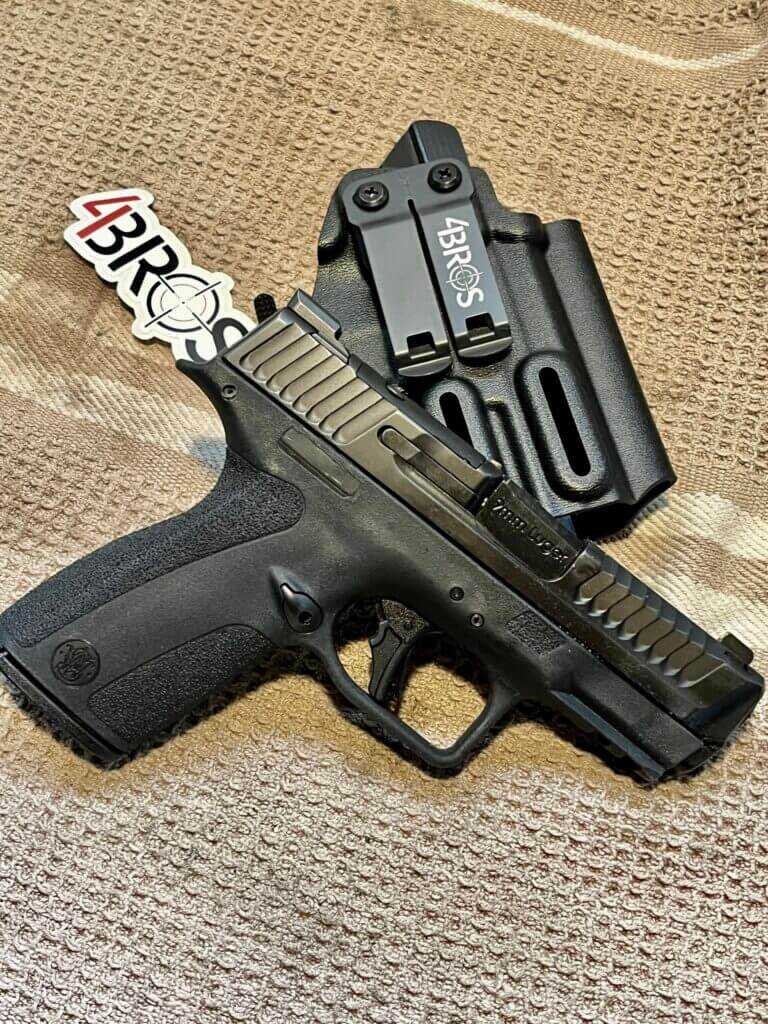
In 2025, Smith and Wesson brought their latest iteration of the Shield line, the Shield X, to the market. It is a larger micro gun, similar to the Hellcat Pro or Sig P365XL. Was Smith and Wesson just late to this XL CCW micro gun market, or were they saving the best gun for last?
I have seen statements from YouTubers calling this the “ultimate EDC” and other similar things. Is it true? I got the chance to find out.
Table of contents
- The Shield Legacy: How Smith & Wesson Built the Platform
- Meet the M&P Shield X: Smith & Wesson Enters the XL Slimline Fight
- What Comes in the Box with the M&P Shield X
- M&P Shield X Fit and Finish: Clean Lines, Smart Upgrades, No Nonsense
- How the Shield X Feels in Hand: Slim Grip, Full Control
- Shooting the M&P Shield X: Soft Recoil and Bigger-Gun Confidence
- Shield X Chronograph Data: Does the 3.6 Inch Barrel Matter?
- M&P Shield X Specifications and Velocity Table
- Carrying the Shield X: Slim Width, Easy AIWB Comfort
- Shield X vs Shield Plus vs Glock 43X: Real-World Carry Comparison
- Pros and Cons of the M&P Shield X
- Final Verdict: The Shield X Is Not Just Another Shield
- Related Reads from GunsAmerica Digest
The Shield Legacy: How Smith & Wesson Built the Platform
In 2012, Smith and Wesson introduced the M&P Shield in 9mm and .40 S&W as a micro compact pistol. Prior to this time, most concealed carriers were stuck with the likes of subcompact models of full-size guns, like the Glock 26, or a small revolver. The new Shield offered a 7-8 shot shotgun in a much thinner package, and shooters flocked to the new pistol.
I was one of many who adopted the Shield as a primary CCW weapon. The hinged trigger was…well…not great. But the advantages of a gun this size far outweigh the trigger on a defensive handgun. Soon, many flavors of this little gun came out, from ones with a 4-inch barrel, to performance center guns, to even one I saw that was Tiffany blue. Regardless of the version, though, the capacity remained the same at 7-8 rounds.
Then came the era of the micro-9mm. The Sig P365 shook the world with a pistol the size of earlier .380 Autos that carried 10 rounds of 9mm and was shootable. I believe I heard the expression “voodoo magic” used when gun writers tried to explain how it was done. Other manufacturers raced to meet this new challenge, Springfield with the Hellcat, Glock with their 43 and 43X, although neither of these really met the challenge of the P365, and Ruger’s Max-9, to name a few.
Smith and Wesson came out with the Shield Plus at this moment, making the same Shield, but with a 10-round magazine and only a marginal widening of the grip. They also used a much improved trigger that did away with the hinged design and incorporated a more familiar dingus trigger safety like the Glock.
The micros were all the rage until the market changed again, thanks to Sig Sauer’s P365 XL and X Macro, which increased the grip, capacity, and slide sizes, while still keeping the gun thin. Shooters wanted the diminutive width of the micro-9, but the slightly bigger size for better handling, with capacities that matched service gun capacity. Soon, the market rose to meet the challenge again with models like Springfield’s Hellcat Pro and the Glock 48.
Meet the M&P Shield X: Smith & Wesson Enters the XL Slimline Fight

Smith and Wesson has now brought their newest offering to the market. The Shield X was introduced with a longer, 3.6-inch barrel and a longer grip that will host a 13-round magazine for those in a free state. For those like me in restricted states, it still holds 10. The new gun also incorporated more improvements, such as front slide serrations and a tritium front sight.
What Comes in the Box with the M&P Shield X

The pistol comes wrapped in the familiar blue bag in an S&W cardboard box. Also in the box are the instruction manual, lock, a chamber flag, and two magazines. For non-restrictive states, the gun will come with a flush-fit 13-round magazine and an extended 15-round magazine. Mine came with two 10-round magazines. That’s California for you… I was easily able to purchase two additional 10-round magazines to have on hand.
M&P Shield X Fit and Finish: Clean Lines, Smart Upgrades, No Nonsense
Fit and finish were excellent on mine. The top end is a mildly shiny black finish in what Smith calls Armornite. Because mine is a California version, we have a manual safety on the left side, a magazine disconnect safety, and a small, but shiny gold colored loaded chamber indicator. The gun comes optic-ready.
The polymer frame is black and has some added improvements. The aggressive checkering on the grip has been muted, with the texture being smooth on strips of the side, which will be a relief for those who wear the gun against their skin. There is now an accessory rail on the dust cover with two slots for lights. Additionally, the gun has a much deeper beavertail that allows your grip to get much higher into the gun, and close to the bore axis. Finally, the trigger guard is squared off and seems bigger, which will be an advantage for gloved fingers. I would keep this in mind if you’re hoping to use a holster for a previous version of the Shield, as my older Shield Plus holsters did not fit because of this.

As I said before, the finish on my gun’s slide was flawless, and the matte black looks clean. The gun comes with a front night sight that has a bright yellow-green outline, and a blacked-out rear sight. The slide has serrations on both front and back. The serrations on the front are not abbreviated either, but go up onto the edges of the slide’s top. These are not the old, fish-scale serrations of the older S&W Shields, but clean, angled cuts that look all business and are very functional.

The crowned barrel sits flush with the end of the slide, and it looks a little beefier than my older Shield Plus. Not a bull barrel per se, but beefier. The edges of the slide also appear a bit softened as well for concealed carry. I did note the single-piece recoil spring rod sits recessed in the slide. My only concern with this is that it could allow your gun to come out of battery if the slide comes in contact with your threat, which would then disable the trigger.

How the Shield X Feels in Hand: Slim Grip, Full Control
The Shield X’s grip feels slimmer than the Shield Plus’s, but not in a bad way. The texture on the front and back straps is adequately aggressive and gives you a solid purchase. The sides of the grip have sections about 3/4″ wide without stippling, which was great when carrying appendix. Also, as mentioned earlier, the gun also sits lower in your hand with that newly designed beavertail, which may be why it handles so well overall.
In hand, the longer grip feels great. I mean, really great. This is the advantage of these bigger micro guns, giving the grip length of a bigger gun with the narrow width of a micro. The fuller-sized grip made me feel very much in control of the gun under recoil and have a confident master grip right from the draw. If you are used to a more conventional grip angle, the Shield X is definitely going to fit the bill.
Shooting the M&P Shield X: Soft Recoil and Bigger-Gun Confidence
I was wondering if the narrower grip of the Shield X would change how the gun would feel under recoil. I was pleasantly surprised.

On my first outing with the Shield X, I shot it side by side with my Glock 43X and Shield Plus. I was surprised at how pleasant the gun was to shoot. I do not know if this is a function of the longer barrel or the newly designed grip that gets your hand up higher in the gun, but either way, it was the least recoiling of the three. I have always noticed the Shield line has always shot like a bigger gun, and the Shield X was no exception.
Point shooting at close-in distances put everything in the Alpha zone of my target. Follow-up point shooting to the head box during failure drills at 3 yards was easy at speed. The gun is fully capable of bigger gun performance, and could easily fit into other roles aside from strictly CCW.
I did have one failure to go into battery fully on my second round while the gun was right out of the box. This was the only such malfunction, and I had to chalk this up to breaking in.
Shield X Chronograph Data: Does the 3.6 Inch Barrel Matter?
I decided to check the velocity changes on a few types of ammunition to see if the 3.6-inch barrel makes a significant difference. A fellow instructor I work with often suggests that a defensive gun needs to have a 4″ barrel to get enough velocity to open the hollow point of a defensive round. I decided to see how close the Shield X could get to the rounds’ stated velocity. Using my Garmin Xero C1 Chronograph shows a net loss of around 30-50 FPS from the 4″ to the 3.6″ barrel of the Shield X.
M&P Shield X Specifications and Velocity Table
| Model | Smith & Wesson M&P Shield X |
|---|---|
| Caliber | 9mm |
| Barrel Length | 3.6 inch |
| Weight | 20.8 oz |
| Capacity | 13+1 or 10 rounds as configured |
| Optics Ready | Yes |
| Sights | Tritium front sight, blacked-out rear sight |
| Firearm | Blazer Brass 115 gr. FMJ | Fiocci Range 115 gr. FMJ | Browning 115 gr FMJ | Hornady Critical Duty 135 gr. FTX 1010 FPS | Federal HST 147 gr JHP 1000 FPS |
| S&W Shield Plus (3.1″ barrel) | 1040.5 FPS 279.2 ft/lbs | 1088.7 FPS 302.6 ft/lbs | 1083.6 FPS 299.8 ft/lbs | 1052.0 FPS 331.7 ft/lbs | 967.2 FPS 305.4 ft/lbs |
| Glock 43X (3.41″ Barrel) | 1065.6 FPS 289.0 ft/lbs | 1093.9 FPS 305.6 ft/lbs | 1097.0 FPS 307.3 ft/lbs | 1070.6 FPS 343.5 ft/lbs | 958.1 FPS 299.8 ft/lbs |
| S&W Shield X (3.6″ Barrel) | 1073.2 FPS 294.1 ft/lbs | 1117.9 FPS 319.1 ft/lbs | 1109.2 FPS 314.1 ft/lbs | 1081.4 FPS 350.5 ft/lbs | 970.4 FPS 307.5 ft/lbs |
| S&W M&P 2.0 Compact (4.0″ Barrel) | 1124.9 FPS 323.1 ft/lbs | 1152.6 FPS 339.3 ft/lbs | 1174.3 FPS 352.1 ft/lbs | 1116.4 FPS 373.5 ft/lbs | 1011.4 FPS 335.2 ft/lbs |
Carrying the Shield X: Slim Width, Easy AIWB Comfort
I was able to get an Appendix IWB holster quickly from Four Brothers Holsters. I have had really good luck with their holster for my J-Frames, and reached out to them. The construction of their holsters is solid with appropriately thick Kydex, and they do an amazing job of keeping the pistol secure while preventing printing. I asked if they had one for the Shield X, and they did…so I was off to the races.
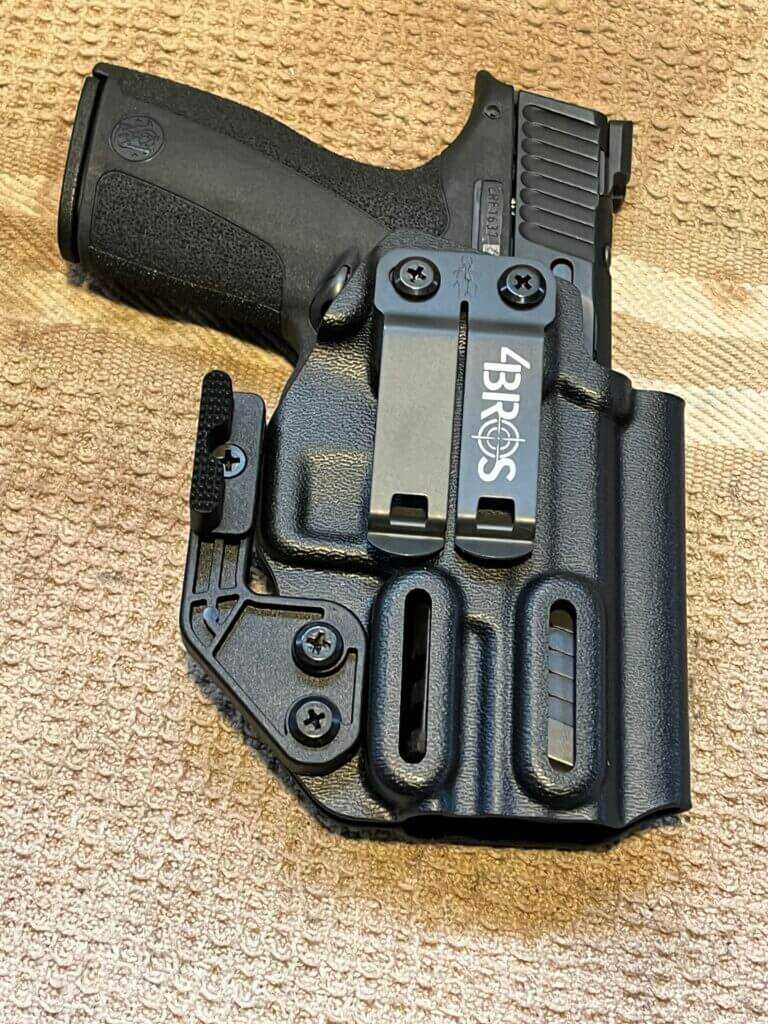
The gun stowed effortlessly and was held right in place when carried by the Four Brothers AIWB holster. The longer grip did not cause undue printing, but that is more a function of the holster and belt than the gun. The width, however, is really what makes carrying these micro guns so much better. The width tends to be what I feel the most when carrying, so thinner for me is always better. It is like having the best of both worlds. The bigger footprint of a compact gun, like a Glock 19-ish pistol with a thinner profile.
Out and about, you can forget you have the gun on. In free states, you’re walking around with 13 +1 rounds in a tiny package that shoots like a bigger gun, but one that feels smaller. In a civilian CCW situation, you will have more than enough to defend yourself should trouble come knocking.
Shield X vs Shield Plus vs Glock 43X: Real-World Carry Comparison
I decided to compare the Shield X to my other two main carry micro 9’s, a Shield Plus, and a Glock 43X MOS. The grip on the Shield X feels slimmer than both but is very similar in size to the 43X, although the barrel is longer in the Shield X. Recoil was noticeably less in the Shield X. My Shield Plus has been getting steady carry time and is starting to show a little wear. I will say the feel of the Shield X was close to the 43X as far as grip, but less squared off.

The extra weight of the Shield X was insignificant to carry. You never feel it. For just straight numbers, the Shield X weighs in at 20.8 oz versus the Shield Plus at 19.9 oz, and the Glock 43X is 18.7 oz. All carry 10 rounds as configured.

Pros and Cons of the M&P Shield X
- Pros: Softer recoil than the Shield Plus and Glock 43X in this test, longer 3.6-inch barrel, excellent fit and finish, strong in-hand control, optic-ready slide, accessory rail, very easy AIWB carry, improved grip shape, and beavertail.
- Cons: One early failure to return fully to battery out of the box, older Shield Plus holsters may not fit, the California version adds manual safety, magazine disconnect, and loaded chamber indicator that some shooters will not want.
Final Verdict: The Shield X Is Not Just Another Shield
In the growing field of micro guns, how does the Shield X stack up? This version gives you more to hold onto, more barrel, giving you more velocity, and shoots like a bigger gun. This is not just another Shield, it is a better Shield and can compete side by side with its other X and XL competitors.
The gun will still need an optic like a Vortex Defender CCW or other enclosed red dot. Since the Shield uses the RMSc / K footprint, we have ample options that will mount directly to the slide.

Many of us generally shoot duty-sized guns, but often have to choose to carry a micro because of the need for a gun we can efficiently conceal. Now you have another option to both carry and shoot. Yes…I’m a convert.
Related Reads from GunsAmerica Digest
- Concealed Carry Perfection? Smith & Wesson’s Shield Plus Takes a Legend to the Next Level
- Glock 43X: Now with 15 Round Flush Fit Capacity
- Smith & Wesson M&P 9 Shield Range Report
S&W Shield X: https://www.smith-wesson.com/products/shield-x
Four Brothers’ Holsters: https://fourbrothersinc.com/
Brian Jensen has been a shooter for over 45 years, and served in law enforcement for over 30 years in Southern California. During that time he served for over 27 years on the Department Range Staff. Brian has written for Guns America and Harris Publications, and currently trains law enforcement trainees in a local police academy as well as civilians for CCW courses.
Away from writing Brian does photography and exploring the southern California backcountry.
Experience:
-45+ years as a shooter
-Prior Law Enforcement for over 30 years
-27+ years instructing firearms for peace officers
-Civilian CCW Instructor
How do you find the trigger?? I’ve had the shield plus since it came out and has been my primary for all training for the last few years, including some 1000 round weekend classes. I’ve had some issues with the trigger of the Shield X being a little gritty, not the same as the shield plus AT ALL. I’ve also had some instances where, left hand shooting, not engaging the safety part of trigger so it will fire. It maybe with my left hand, my finger is higher on trigger where hinge is, vs on the end of trigger, but I never had issues with shield plus and I have two of them. I do love the feel of X and longer grip, as I have pretty big hands, but have switched back to the plus for my EDC, until I spend more time with it.
I just saw this issue with the trigger finger not hitting the safety. My only suggestion is to adjust your finger placement. The same issue was not present on the Shield plus. I have not had the issue in my shooting, but my shooter who did have issues had shorter hands / fingers which is not your issue.
As far as the trigger being gritty, I havent seen that at all on this gun. My Shield Plus did have this issue but it smoothed out after a bit of shooting (200-300 rounds).