

Estimated reading time: 7 minutes
Seven decades in and the 243 Winchester still runs flat, hits hard for its size, and keeps varmints and whitetails honest while treating your shoulder kindly.
Why 243 Winchester Still Works: Flat, Fast, Proven
If you’ve been in the hunting world longer than a hot second, you’ve seen the pattern. Every year, the New Hotness cartridges are announced. Flatter trajectories, short actions, compatibility with the AR platform, they’re always touted as better than the dusty old stuff. And hey, sometimes they’re worth investing in. But more often than not, you’ll find the classics worth sticking with. The 243 Winchester is a great example of that, and I’m going to tell you why you should either keep yours around or get one.
Table of contents
- Why 243 Winchester Still Works: Flat, Fast, Proven
- History Of The 243 Winchester: From Wildcat To Workhorse
- How The 243 Winchester Shoots: Recoil You Can Run All Day
- Hunting With 243 Winchester: Coyotes To Cornfield Bucks
- It’s Tactical Enough: 243 Win Has Seen SWAT Service
- Long Range With 243 Winchester: Tune Loads, Ring Steel
- Still Relevant After 70 Years: The Smart Shooter’s .243
History Of The 243 Winchester: From Wildcat To Workhorse
Whether you’re a gun history buff or not, it’s always worth a quick spin through the background of a cartridge. The 243 Winchester first hit the market in 1955. It was designed by Winchester but preceded by wildcat rounds. Exact details are a little fuzzy, but we do know Fred Huntington, founder of RCBS, worked on fine-tuning what he called the 243 Rockchucker. Huntington’s wildcat was based on a 257 Roberts cartridge. Right about the same time, the Shooting Editor over at Field & Stream, Warren Page, was working with Remington’s Mike Walker on a round they called either the 240 Page Super Pooper or the 243 Page Pooper (depending on which version of ammo history you dig into).
It wasn’t long before Winchester took the reins and decided on final dimensions for what would become the renowned 243 Winchester. The official parent cartridge of the round is 308 Winchester. This cartridge was designed for whitetail hunters, but it was also suitable for varmint hunters. It was meant to be a dual-purpose round, and it took off quickly. It remains in production today, although we no longer receive as many new rifles chambered in it.

How The 243 Winchester Shoots: Recoil You Can Run All Day
The nice thing about the 243 Winchester is that it doesn’t produce the felt recoil of its 308 Win parent cartridge. On average, 243 Win dishes out 10 foot-pounds of recoil into your shoulder, 308 Win delivers as much as 18 foot-pounds, depending. That’s a significant difference and one reason so many hunters gravitated to it when it was new.
Ballistics: Flat To 400, Know Your Drop At 500
Ballistically, this is a cartridge that performs well at moderate distances. Of course, I say moderate, but it maintains a good trajectory for the first 400 yards. Once you hit 500 yards, most loads drop precipitously, think three feet or more, but the fact that it maintains such a good trajectory to that point makes it a versatile round. But what makes this such an awesome hunting round is the energy and velocity.
Running Federal American Eagle Varmint & Predator 243 Win 75 grain JHP through a 22-inch barrel, muzzle energy is 1892 foot-pounds and muzzle velocity is 3300 feet per second. According to ballistics charts, that translates to 2551 feet per second and 1082 foot-pounds at 200 yards. At 400 yards, velocity is 1860 feet per second, and energy drops to 577 foot-pounds. The sweet spot takes you to about 250 yards before velocity and energy drop rapidly. What that means is you can hunt varmints like prairie dogs at 400 yards with factory loads and whitetail deer to around 250 yards. Could you shoot further? Yes, but it’s important you know the drop and drift of the load you’re using and don’t get cocky.
Bottom line is that the 243 Winchester is a spicy little round capable of a flat trajectory and effective results on game at a variety of distances. For a comparison point, consider the fact that the 243 Winchester easily outshoots the 223 Remington from a ballistics perspective.
Ballistics And Cartridge Specs For 243 Winchester
| Cartridge | 243 Winchester |
|---|---|
| Introduced | 1955 |
| Parent Case | 308 Winchester |
| Example Load | Federal American Eagle Varmint & Predator 75 grain JHP |
| Test Barrel | 22 in |
| Muzzle Velocity | 3300 fps |
| Muzzle Energy | 1892 ft-lbs |
| 200 yd | 2551 fps, 1082 ft-lbs |
| 400 yd | 1860 fps, 577 ft-lbs |
| Approx. Recoil (rifle) | 10 ft-lbs (243 Win); 18 ft-lbs (308 Win) |
Hunting With 243 Winchester: Coyotes To Cornfield Bucks
You’ll find the 243 Winchester remains a favorite among varmint hunters (or at least those who see no need to abandon a proven platform). It’s great for coyotes and fun with prairie dogs. And thanks to the truly manageable recoil, it’s one you can be comfortable shooting at length.
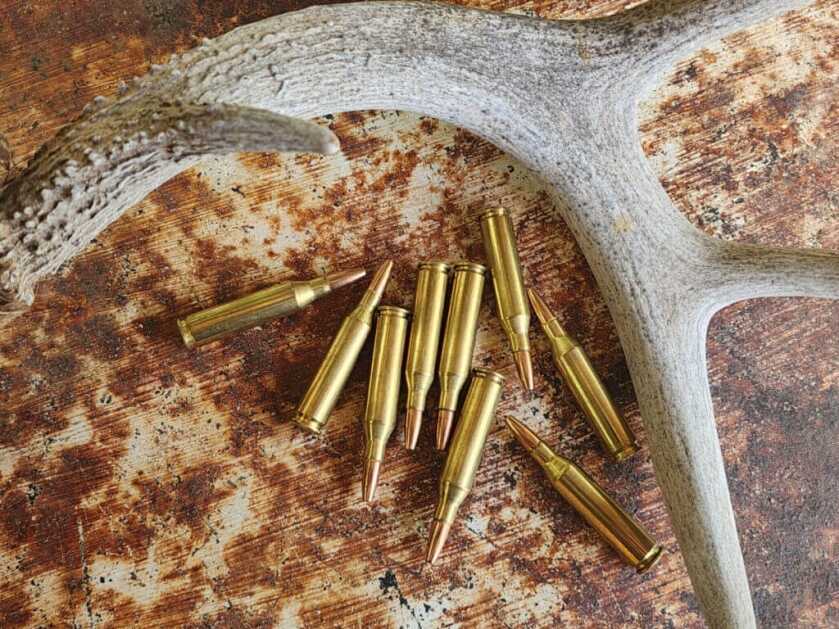
Whitetail hunters can, and do, benefit from using this cartridge, too. It’s certainly a lighter bullet than some, but that doesn’t mean it’s ineffective. Thanks to advances in technology, today’s 243 Win loads are even more capable than those of the past. There’s no reason not to hunt with it. Go with a heavier bullet like the Barnes 80-grain TTSX or Browning Max Point 95-grain Polymer Tip, and you’re set. Don’t dismiss 243 Win because you’re not a fan of 223 Rem for deer, either, because they’re two different rounds. The 243 Win is far superior for hunting.
I’ll drop a sidenote here that this is also a solid round for hog hunting. Given the proliferation of guys out there shooting at pigs with 223 Rem and 300 BLK, you’d think the advantages of 243 Win would get more attention. I’m here to tell you that if you prefer a short action with a lighter round, rather than going for a 308 Win or 6.5 Creedmoor, try out 243 Win.
It’s Tactical Enough: 243 Win Has Seen SWAT Service
Although the knee-jerk reaction is to say this isn’t meant for tactical applications, it’s been used for just that. It’s been used by the LAPD’s SWAT team. Granted, that was years ago, but it doesn’t mean it’s irrelevant now. Let’s put it this way. If you think 223 Remington is a useful option for home defense or use as a truck gun, then so is 243 Win, if not more so.
Long Range With 243 Winchester: Tune Loads, Ring Steel
It’s a toss-up whether it’s the varmint hunters or the long-range rifle shooters that get the most use out of 243 Win. This is absolutely a popular cartridge for long-range shooting, although it isn’t necessarily at the top of the list for competition. But thanks to its trajectory and the fine-tuning you can do with handloading, a lot of shooters do use it for long-range target shooting.

Still Relevant After 70 Years: The Smart Shooter’s .243
Seven decades after its creation, this remains a relevant and useful round. It’s a shame more shooters and hunters don’t get use out of “older” cartridges, because you all are missing out. You can find the 243 Win in bolt actions and also AR platform rifles, and, of course, bolt pistols. There are plentiful factory loads suited to whatever you’re doing, and if you handload, it’s even better.
Debates over old-versus-new cartridges happen all the time. Sometimes it’s a situation where the fans of the older round are just stuck in their ways and refuse to acknowledge better options. But in others, such as this, the long-term round does offer many benefits and is well worth having. It’s a favorite for a reason, and it isn’t going anywhere anytime soon.
Find a selection of 243 Win here.
Related Reads from GunsAmerica Digest
- The .243 Winchester: More Than a Youth Round
- 6.5 Creedmoor vs .308 Win: Which Do You Run?
- .223 Remington vs .243 Winchester: Trajectory and Energy

Kat Ainsworth Stevens is a prolific outdoor writer based in North Texas. Her love and enjoyment of firearms extends to both self-defense and hunting, and she’s driven to teach safe gun handling. Kat’s the author of several books and thousands of articles as well as a successful editor with more than a decade of experience in marketing. With experience in everything from defensive handgun use to field dressing a deer, Kat’s background is varied and extensive. She firmly believes in the importance of protecting the Second Amendment as well as the First.
When she’s not behind a gun or processing her own game meat, Kat can be found trapping, boating, doing yoga, and mudding. The outdoors and the Lone Star State are where she belongs.
Experience
Author:
Handgun Hunting and anthologies including The Deer Shot Back: And Other Hunting Tales and How Not to Shoot Fish and Other Deer That Got Away.
Dedicated Outdoorsman:
Year-round enthusiast of hunting, trapping, and fishing.
Advanced Training:
More than 1000 hours of training in defensive handguns, long guns, edged weapons, self-defense law, force-on-force, handgun retention, and related topics.
Focused Specialty Skills:
Expert witness. Massad Ayoob Group certified Deadly Force Instructor and graduate of Active Self Protection The Practice & Preparation of Being an Expert Witness.
Then learn to shoot, or change bullets. I’ve shot countless deer with my 243. As well as hogs. It’s NOT the caliber. It’s the shooter
.243 Caliber is NOT a deer rifle! I have shot four mule deer with this caliber. Not one escaped, but none went down in its tracks. I have had two sons who used the same rifle. One son shot a nice three point mule deer. I finished it off with my .270. No, it was not going anywhere, but it did go fifty yards before I put it down. The other son has shot two mule deer with the same rifle, a two point and a four point. Niether one went right down and both needed a second shot. All these deer were hit in the chest heart-lung area. When you hit a deer, you want it to stop. Yes, the recoil is very nice, but of you shoot a deer atop a rifge, you do not want it to run over the top of that ridge and down into a canyon before it croaks.
I must agree, this is a lovely coyote rifle and I have shot several coyotes with it.. One day I got two out of three coyotes with that gun which were in one group It is NOT a deer gun. I have also shot coyotes with a .17 HMR. The same appllies: The .17 is not gun enough for a coyote, even though one went down like the rug was jerked out from under it. Another coyote hit that same day with the .17 got away.
I always laugh when people think you need a 50bmg to kill a deer. A 243 is MORE than capable of taking deer. I’ve taken countless deer and even hogs with mine.
If there is a problem, it’s bullet choice or skill level.