

In a significant shift in federal firearms policy, the Bureau of Alcohol, Tobacco, Firearms and Explosives (ATF) announced on October 9, 2026, that it will no longer enforce key National Firearms Act (NFA) requirements for short-barreled rifles (SBRs), short-barreled shotguns (SBSs), silencers (suppressors), and “any other weapons” (AOWs). The change, detailed in an Open Letter from ATF Director Robert Cekada and accompanying Frequently Asked Questions, stems from a federal court ruling and follows Congress’s elimination of the longstanding $200 making and transfer taxes on these items.
The policy takes effect immediately and applies nationwide as a matter of enforcement discretion, extending beyond the limited scope of a recent judicial injunction. It marks a practical deregulation of the federal approval and registration process for these categories of firearms while leaving other federal and state restrictions intact.
Background: Tax Elimination and the Texas Court Ruling
The foundation for the change was laid by the One Big Beautiful Bill Act, enacted in 2025. That legislation reduced the NFA making and transfer taxes to zero for short-barreled rifles, short-barreled shotguns, silencers, and AOWs. Machineguns and destructive devices retained the traditional $200 tax.
On August 5, 2026, U.S. District Judge James Hendrix of the Northern District of Texas issued an injunction in Silencer Shop Foundation v. ATF (No. 6:25-CV-056-H). The court held that once the tax was eliminated, the NFA’s registration and transfer provisions for these items could no longer be sustained as an exercise of Congress’s taxing power. The judge further concluded that the challenged provisions could not be upheld under the Commerce Clause because Congress had not relied on that authority when it originally enacted the NFA in 1934.
The injunction barred ATF from enforcing the requirements to approve the making or transfer of these firearms, the mandate to register them in the National Firearms Registration and Transfer Record (NFRTR), and the associated criminal prohibitions on making, transferring, receiving, or possessing unregistered examples of the covered items. Critically, the order applied only to the plaintiffs in the case and to the specific $0-tax categories. It left machineguns and destructive devices fully subject to the NFA.
Following the ruling, ATF received requests for clarification from litigants, members of Congress (including a letter from 47 House and Senate members), state attorneys general, industry groups, and the public. Many urged the agency to apply the court’s reasoning nationwide rather than create a patchwork of differing enforcement rules which would avoid the cumbersome and (hopefully) unsustainable scenario of gun owners facing a two-tiered system of more or less restriction and regulation based on who you gave money to or purchased products from.
DOJ and ATF’s Nationwide Enforcement Discretion
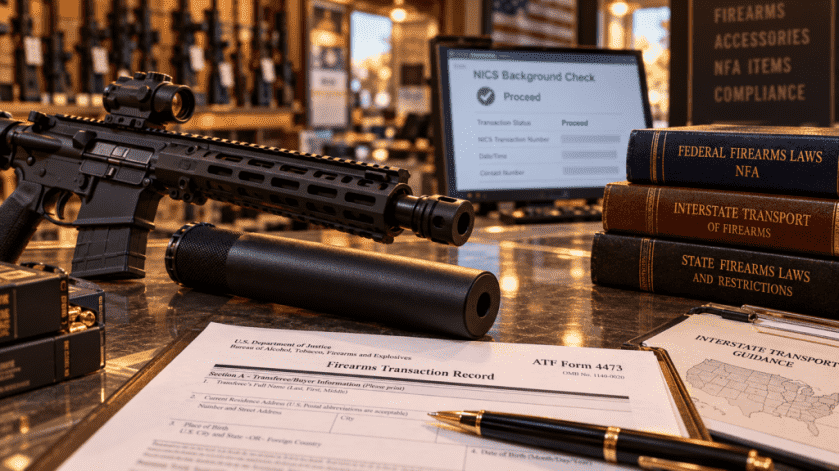
Although the district court’s order was party-specific, the Department of Justice and ATF elected to exercise enforcement discretion for uniformity. Effective October 9, 2026, ATF will no longer require individuals to seek prior ATF approval under the NFA before making or transferring short-barreled rifles, short-barreled shotguns, silencers, or AOWs. Registration of these items in the NFRTR is likewise no longer required. The policy applies to everyone subject to the NFA, not solely the plaintiffs.
Significantly, ATF will continue to administer the NFA on a voluntary basis. The agency will accept Form 1 applications from those who wish to make or register covered items, Form 3 or Form 4 applications for transfers or registrations, and Form 2 reports of manufacture from manufacturers. Because many state laws still require federal registration of NFA items, ATF will process voluntarily submitted applications.
Important Limits Remain in Place
The Open Letter carefully delineates five key boundaries of the new policy:
Special Occupational Taxes Remain
Special Occupational Taxes (SOT) remain. Persons engaged in the business of manufacturing, importing, or dealing in NFA firearms—including the $0-tax categories—must still pay applicable special occupational taxes. The injunction did not affect these business taxes.
Machineguns and Destructive Devices Are Unaffected
Machineguns and destructive devices are unaffected. All NFA provisions, including the $200 tax, registration, and approval requirements, continue to apply in full to machineguns and destructive devices.
Gun Control Act Requirements Continue
Gun Control Act (GCA) requirements continue:
Short-barreled rifles, short-barreled shotguns, silencers, and AOWs remain “firearms” under the GCA (18 U.S.C. § 921(a)(3)). They may not be possessed by prohibited persons. Recordkeeping, background checks via NICS, and other GCA obligations remain fully in force. Federal firearms licensees (FFLs) must still complete ATF Form 4473 for transfers to non-licensees.
Interstate Transportation and Sale Rules Still Apply
Interstate transportation and sale rules for SBRs and SBSs: The GCA restrictions on transporting and selling short-barreled rifles and short-barreled shotguns (18 U.S.C. § 922(a)(4) and (b)(4)) were not enjoined. Individuals transporting these items should continue to file ATF Form 5320.20 for approval, even if the firearm is unregistered under the NFA. ATF is working to issue new regulations authorizing FFL transfers of SBRs and SBSs under the GCA; in the interim, the agency will not enforce § 922(b)(4).
State and Local Laws Are Unaffected
State and local laws are unaffected. The federal non-enforcement policy does not override state or local prohibitions or registration requirements for NFA items. Many states ban or heavily restrict possession of short-barreled rifles, short-barreled shotguns, silencers, or AOWs, often with exceptions only for items registered under federal law. FFLs remain prohibited from transferring firearms in violation of state or local law (18 U.S.C. § 922(b)(2)). Individuals should consult local authorities or legal counsel before making, possessing, transferring, or transporting unregistered items, particularly across state lines. It remains unclear whether the GCA’s interstate transportation safe harbor (18 U.S.C. § 926A) will apply to unregistered NFA items in restrictive states.
Practical Implications for Federal Firearms Licensees and Individuals
For federal firearms licensees, the most immediate change concerns silencers and AOWs. These may now be transferred like ordinary GCA firearms: complete a Form 4473, conduct a NICS check (unless an exception applies), observe residency requirements, and maintain acquisition-and-disposition records. No NFA Form 4 or tax stamp is required federally. Transfers of SBRs and SBSs are more complex pending new GCA regulations, although ATF has confirmed non-enforcement of the specific GCA transfer restriction in the interim.
Unlicensed individuals no longer need prior ATF approval (Form 1) to make or transfer covered items. Interstate transportation of unregistered silencers or AOWs is no longer prohibited under the NFA’s specific ban (26 U.S.C. § 5861(j)), though state restrictions still apply. ATF Form 5320.20 continues to be the required vehicle for interstate movement of SBRs and SBSs.
Those who previously registered items or have pending applications may continue the process voluntarily or, in some cases, seek to discontinue registration. ATF will maintain the NFRTR for voluntary filers.
Risks and Uncertainties
The policy is an exercise of enforcement discretion, not a repeal of the underlying statutes. Future administrations, courts, or Congress could alter the landscape again, returning us to the status quo prior to the injunction (including treatment of unregistered items as contraband) or anywhere in between. Individuals who possess unregistered $0-tax items under the current non-enforcement posture may not be “grandfathered” if legal circumstances change; the Open Letter and FAQs caution that registration opportunities may or may not be provided later. State prosecutions remain possible where state law criminalizes unregistered possession.
What Does the Future Hold?
No one knows for sure. For now, the practical effect is clear: at the federal level, the decades-old NFA approval-and-registration regime for suppressors, short-barreled long guns, and AOWs has been suspended nationwide. Compliance with the Gun Control Act, special occupational taxes for businesses, and the full range of state and local laws remains mandatory. Gun owners, dealers, and manufacturers must navigate this new landscape carefully, with particular attention to the patchwork of state restrictions that the federal change does not alter or eliminate.
At the end of the day, much of this non-enforcement declaration is nothing more than a practical policy decision which can be undone as quickly as it was done. Future court cases or legislation may codify or nullify part or all of it.
Parting Shots
Never take free legal advice from the internet and this is not a time to be complacent or lazy. In an era of hot takes, each individual will have to do their own research and make an informed decision on how to best proceed for their own circumstances. Being a former NFA employee, my curiosity is running amok pondering the possible long and short-term impacts on inbound applications, registration removals, and what else may come to be.
Sometimes, people get to witness history being made. Some recognize it at the time, while others may only see it in hindsight or even leave it to future generations. I believe we are living one of those events now. If you would have asked me two years ago if I could envision this level of dismantling of decades old restrictions on law-abiding gun owners – “No way”. We do not yet know what the final outcome may be, but I believe this event will be long remembered and discussed in our community

As the Editor-in-Chief of GunsAmerica, Hunt365, Decoding Darkness, and Suppressor Academy, True Pearce brings a rare blend of legal expertise, competitive shooting credentials, and deep hunting knowledge to the forefront of the firearms world. A former professional sponsored 3-Gun and Multigun competitor with multiple championships and titles, True’s shooting career began in long-range and tactical sniper matches—and he still burns powder in precision competitions, now branching into Hunter NRL.
A certified firearms instructor who has trained over 10,000 students face-to-face, True has also served on both sides of the courtroom as an attorney and currently as an elected Prosecuting Attorney. He has prosecuted and defended high-profile self-defense and firearms cases, giving him a unique, real-world perspective on the Second Amendment.
Outside the courtroom and off the range, True is a true western outdoorsman. A lifelong hunter and rancher, he rides and hunts off his own string of horses and pack animals, chasing elk, mule deer, wolves, coyotes, and anything else in season. He’s a longtime reloader, producing both precision rifle ammo and, back in the day, handloading over 40,000 rounds of 9mm and 5.56 annually for competition.
He’s also a thermal and night vision expert, known for his obsession with high-end optics, and is rarely found without a camera or a guitar nearby. Whether he’s glassing a distant ridge, reviewing cutting-edge gear, or deep in legal research, True brings passion, precision, and grit to everything he does.
Experience:
– Professional Shooter – Sponsored 3-Gun & Multigun competitor with multiple titles and a foundation in long-range and sniper/tactical matches.– Firearms Instructor – Certified instructor with over 10,000 students trained face-to-face.– Elected Prosecuting Attorney – Attorney with real-world experience defending and prosecuting self-defense and gun-related cases.– Hunter & Rancher – Horseback hunter with a working ranch, passionate about elk, deer, predator, and backcountry hunting.– Reloading & Ballistics Expert – Precision reloader and former high-volume competition handloader.– Optics Authority – Known for his deep knowledge and unrelenting standards in optics, thermal, and night vision gear.– Outdoor Creative – Avid photographer, guitar player, and outdoorsman with a sharp eye for gear and storytelling.– 2A Advocate – Committed to protecting the Second Amendment and educating Americans about their rights and responsibilities.