
Estimated reading time: 12 minutes
We put the Henry Lever Action Supreme through a real range test, from 100-yard groups to 1,045-yard steel, highlighting its AR-style magazines, adjustable trigger, suppressor-height sights, and modern lever action performance.

The lever-action rifle has seen a resurgence in recent years. Classics have been re-envisioned with tactical furniture, threaded barrels, and red dot optics. With few exceptions, they have remained the same in their core design. Enter the Lever Action Supreme Rifle from Henry Repeating Arms.
Drawing from over twenty-five years of manufacturing their extensive line of lever-action rifles, Henry’s engineers put in the time to create what may be one of the most advanced lever-action designs to come to the market.
Table of contents
- First Impressions: Henry Lever Action Supreme Balance, Barrel, and Handling
- Stock, Grip, and Recoil Control on Henry’s Supreme
- Forend, Free-Floated Barrel, and Suppressor-Height Sights
- Inside the Receiver: AR-Style Magazines, Tang Safety, Adjustable Trigger
- Long-Range Setup: Optic, Pic Rail, Rings, and Suppressor
- 100-Yard Groups and Velocity: Real Accuracy Test
- Stretching Distance: 675 to 1,045 Yards with .223 Loads
- Final Verdict on the Henry Lever Action Supreme
- Pros and Cons
- Related Reads from GunsAmerica Digest
First Impressions: Henry Lever Action Supreme Balance, Barrel, and Handling
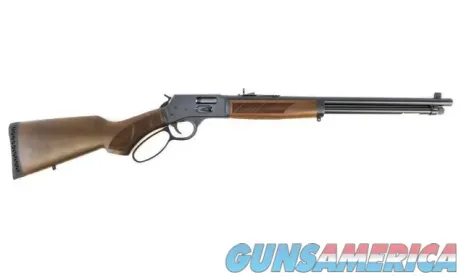
Weighing just over 6.5 pounds and 38” long, the Supreme Rifle is well balanced. The 18” barrel on the .223 Remington/5.56 NATO model I am testing is long enough to produce solid velocities, yet short enough to be quick handling in close quarters. The .300BLK version features an even shorter overall length, thanks to its 16″ barrel.
🛒 Check Current Price for a Henry Lever Action Supreme on GunsAmericaStock, Grip, and Recoil Control on Henry’s Supreme
A thick rubber recoil pad and sling stud adorn the tail end of the satin-finished American walnut buttstock. The stock is an ergonomically-tapered design that swells into the curved pistol grip. The grip itself features deep-cut diamond checkering, offering substantial purchase in any weather. Henry’s signature cowboy logo is engraved into the base of the grip.

Forend, Free-Floated Barrel, and Suppressor-Height Sights
The ten-inch long walnut forend features the same deep checkering as the buttstock, as well as a sling stud at the front. Set far enough back from the nose of the curved forend, this sling swivel has just enough space on all sides to properly support a Harris-style bipod. The forend is bolted to a supporting stud which extends from the receiver and provides the substantial rigidity needed to take shots at distance.

The free-floated barrel features a six-groove, 1 in 8” twist, and is threaded for the muzzle device of your choice. Mounted to the barrel is a set of Henry’s patent-pending iron sights. A stark departure from buckhorns and beads, the front sight is a sharp triangular shape, while the rear notch is more trapezoidal. The rear sight is fully adjustable for windage and elevation with an included hex key, and is grooved to reduce glare.
I found these irons provided an exceptionally clear sight picture and precise aiming point. Adjustments were easy, and, despite being suppressor height, I had no issue at all clearing the objective bell of my optic.

Inside the Receiver: AR-Style Magazines, Tang Safety, Adjustable Trigger
The receiver and action of this rifle are what set it apart from other lever gun designs. The most visible change is the use of detachable AR-style magazines. A ten-round Magpul PMAG and a five-round limiter are included in the box, but any AR-15 magazine that matches the caliber of the Supreme Rifle can be used. The patent-pending magazine release is ambidextrous and checkered for ease of use.
Inside the magazine well is a raised pin to hold the follower just low enough to prevent the bolt from locking open when the rifle is empty.

Another visible difference is the lack of an external hammer. The hammer is housed completely inside the receiver, keeping it protected from dirt and debris, and eliminating the need to work around scope eyepieces. Where you would typically find the external hammer is an ambidextrous tang safety. As I am used to manually cocking the hammer on my other lever guns, sliding the safety off was an easy transition, and the raised notches in the switch ensure positive grip in any condition.

The match-grade single-stage trigger itself is entirely of Henry’s design, and can be adjusted with the same hex key as the iron sights. It is advertised as a 4lb trigger with a 1lb range of adjustment. Out of the box, mine was dialed in right at 3lbs, and had a total range from 2.5 to 3.5lbs. The trigger break was very consistent, and its wide, curved shape distributes finger pressure, keeping trigger fatigue to a minimum.
A bonus: Henry mentions in their user manual that this rifle is designed to withstand high volumes of dry fire without risk of damage.

The receiver is hard anodized aluminum and made of two parts. One part holds the barrel and forend, while the other contains the firing assembly, the lever mechanism, and the buttstock. The two parts interlock and are held in place by two punch pins, which make field stripping and cleaning a simple process.

The action’s lockup is achieved through the use of a seven-lug AR-15 bolt, which locks into a barrel extension, also borrowed from the AR platform. Bolt rotation is accomplished thanks to a cam pin in the compact bolt carrier, and the free-floating AR-type firing pin rides in the center of the bolt, retained by a cotter pin. The underside of the carrier is tapered to allow it to smoothly cycle over a loaded magazine.
The square edges of the carrier ride on guide rails machined into the receiver. A series of steel linkages connecting the carrier to the lever allows maximum movement with minimal effort, making this, without question, THE smoothest lever action I’ve ever operated. A detent in the stock secures the large-loop lever in place, and an integrated safety ensures the rifle will not fire unless the lever is closed all the way and the bolt is fully into battery.

Long-Range Setup: Optic, Pic Rail, Rings, and Suppressor
With a quick confirmation of zero on the iron sights, the rifle is ready to go out of the box, but I wanted to maximize the rifle’s capabilities. I started by mounting Henry’s Picatinny rail scope base to the four threaded steel inserts in the receiver. The Picatinny slots are grooved down the middle to allow the use of the iron sights without removing the rail. I chose 30mm Warne Hyperlite medium-height rings to secure my optic to the rail.
Warne’s proprietary MagnaFusion alloy makes these rings lighter than comparably sized aluminum rings. I also mounted a Warne Vapor bubble level for shooting extended ranges.

My optic of choice for this rifle was a Vortex Viper HD 3-15×44. This second focal plane optic offers crisp clarity barely a step below the Razor HD line. The capped windage turret prevents unwanted adjustments, while the locking elevation turret allows me to quickly dial for distance. The 3x low end of the magnification still allows for close and quick shots, while the 15x upper end gives me the clarity I need to reach out to .223-capable distances with ease.
At only 22.5 ounces, this optic offers a heavy-hitting, but lightweight package. Thanks to quality coatings on the very low dispersion glass, the Viper HD offers exceptional image quality with very little aberration.

I mounted my SilencerCo Omega 300 to the threaded muzzle using SiCo’s ½”-28 titanium direct thread mount with their .224-cal titanium front cap, which kept overall length and weight as low as it could be with this can. Despite the added length and weight, the rifle still feels very nimble in the hand and balances well.
Available on GunsAmerica Now



100-Yard Groups and Velocity: Real Accuracy Test
Myself and my buddy Bruce drove out to a long-range shooting facility that would provide the ultimate test of the Supreme Rifle. After a break-in of the barrel and a reasonable time to cool, I zeroed my optic at 100 yards. I began testing accuracy and velocities. See the following table for those results.
Factory Load Avg Velocity Avg 5-shot, 100yd Group Size
Hornady 53gr VMax Superformance Varmint 3,111 fps 0.70”
Hornady 55gr VMax Varmint Express 2,886 fps 0.70”
Hornady 75gr BTHP Match 2,629 fps 0.98”
Berger 73gr BT Target 2,813 fps 0.91”

Stretching Distance: 675 to 1,045 Yards with .223 Loads
Shortly after releasing the Supreme Rifle, Henry published a video on social media shooting the .223 Supreme Rifle out to 800 yards. Not many lever guns were made for that kind of distance, and I wanted to push it even further with this one. The weather was perfect with low wind and overcast skies. With my buddy on the spotter and my data entered into the ballistic calculator, I began stretching the rifle out to distance.
I loaded the 53-gr V-Max, which came screaming out of the barrel at 3,111fps. Starting at 440 yards, I engaged a C-Zone IPSC Silhouette, followed by an 8-inch circle plate beside it. Satisfied with my impacts, I ranged my next set of targets at 675 yards. Here, I confirmed wind and elevation on a full-size IPSC Silhouette, then panned over to the life-sized coyote target at the same distance.
The shot broke, closely followed by Bruce’s “HIT!”, confirming impact on target. At 675 yards, I was well into the transonic portion of flight, and the stubby V-Max bullet was beginning to destabilize. After a couple of misses and a few more hits on the coyote at this range, I was really pushing my limits with this bullet.
I opted for the Berger 73-grain BT Target round, which holds better stability through transonic and into subsonic flight. Using my Kestrel to confirm my DOPE, I then engaged another life-size coyote, this time at 862 yards. My first shot, the bullet splashed in the berm to the right of the steel. After a quick windage correction and another shot, Bruce confirmed I was on target. At this point, I had exceeded the published video, but I wanted to see if I could reach at least 1,000 yards.
The next targets were a full-sized IPSC and an 18” gong at 1,045 yards. I dialed in my elevation and added just a bit more to my previous engagement’s wind hold. Call it luck if you will, but the first shot I fired at that distance impacted steel. I took multiple shots, scoring a sufficient number of hits, with a few misses only needing minor windage adjustments to get back on target.
While the bullet was dropping at a pretty substantial angle at that point, it was quite exciting to reach that kind of distance with a lever-action rifle. In Bruce’s words, “Watching the metal plates wiggle at that distance was very impressive.”

Final Verdict on the Henry Lever Action Supreme
With a name like Lever Action Supreme Rifle, my expectations were set very high, especially with an MSRP of $1,299. Pulling from their 25+ year history of lever guns done well, Henry made this one even better. Carefully designed ergonomics give this rifle the quick and easy handling of traditional lever guns, while the updated and reengineered internals make it one of the smoothest operating, most forward-thinking lever actions ever built.
At the time I am writing this article, Henry offers the Supreme in either .223/5.56 or .300BLK. While discussing the rifle at length with some of the team at Henry and what the potential this rifle could hold for different calibers and configurations, they assured me, “This is only the beginning of the future for Henry Repeating Arms.”

Pros and Cons
- Pros: AR-15 magazine compatibility, sub-MOA accuracy potential, threaded barrel and suppressor ready, match-grade adjustable trigger, smooth cycling and easy field stripping.
- Cons: MSRP in premium bracket, .223 bullet selection matters past transonic, additional weight with can and optic.
Related Reads from GunsAmerica Digest
- Smith & Wesson Model 1854 Stealth Hunter Review
- Henry Lever Action Supreme Uses AR Mags – SHOT Show
- Tactical Lever Action Rifles: Guide and Picks
- Savage Revel: A New Lever-Action 22
- S&W Expands Model 1854 Series

As a freelance writer for GunsAmerica, Ben is able to blend his love for firearms, hunting, and photography together. Originally from the Midwest, Ben grew up in the outdoors and in the last few years, has grown professionally through many facets of the outdoor/firearms industry.
Outside of shooting and hunting, he is also an experienced wildlife and aviation photographer. Currently living in the Pacific Northwest, Ben enjoys spending time at the range for both his work as a gun writer and for fun as a dabbling
competitive shooter. A large part of hunting season each year is spent chasing upland birds and
waterfowl hunting with his wife, son, and a pack of bird dogs.
Experience:
– Outdoor & Firearms Television videographer/field producer
– Marketing/Manufacturing at a precision rifle manufacturer
– Writer/Photographer for multiple outdoor media publications
– Avid Hunter of Upland and Big Game species
I bet my classic 1946 Vintage Mint Condition Marlin 39A is more accurate at 30 yards than this.
I don’t like the looks of this gun. I like my Lever action guns to look classic old school like fine wine.
I have a question about the rifle and want to make sure I understand what you wrote correctly. Did you indicate that the rifle had a pin in the magwell that holds the follower in the magazine down just enough to prevent the bolt from locking open when the rifle is empty? If that is correct, I’d like to ask why this would be a desirable feature? Also, a follow-up question on that feature, can it be disabled?
Thank you.
Bring it out in one of the greatest unsung cartridges- the 350 Rem Mag. No it won’t take AR mags. So what.
Henry’s are not good rifles. They are made with poor quality parts and their customer service is bad too. I don’t know a single person who is happy with their Henry. Buy uberti, cimmaron, rosi, or marlin. That way your gun won’t break.
Oooooooooooo….Oh no he did int!!!!😮💥😝
Im sorry if im gonna have a magazine hanging, it will be in a semi auto. If I take my many levers in the woods its a marlin in 45-70. I also have model 94 winchesters in 30-30. And my beaters that get thrown around daily in the UTVs m92 rossi in 357 or 44 depending how far the work is out. There is no need for a can on a working ranch. Sometimes we even use the rifle report as communication. I used a Henry fir awhile in a 44 and the tube loading just got bent at the end of the barrel and was not reliable and was sold off eventually.
As a tradionalist, I have no interest in Henry’s “modern” guns. My 60+ year old Winchester 94 .30-30 is best for me.
Truthing!
If I could buy one that had two upper receivers/barrels, on in .223 and one in .300 blackout (maybe .350 legend), I’d be all over it. Easy to change barrels with separate scopes already set up? Yes please.
Excellent synopsis. One is on its way to me.Black 300. My Savage 99 in will look great next to it.Thrilling 300!
Great overview. I have one coming in .300 BLK. It will go good next to my Savage 99 in .300 Savage!