
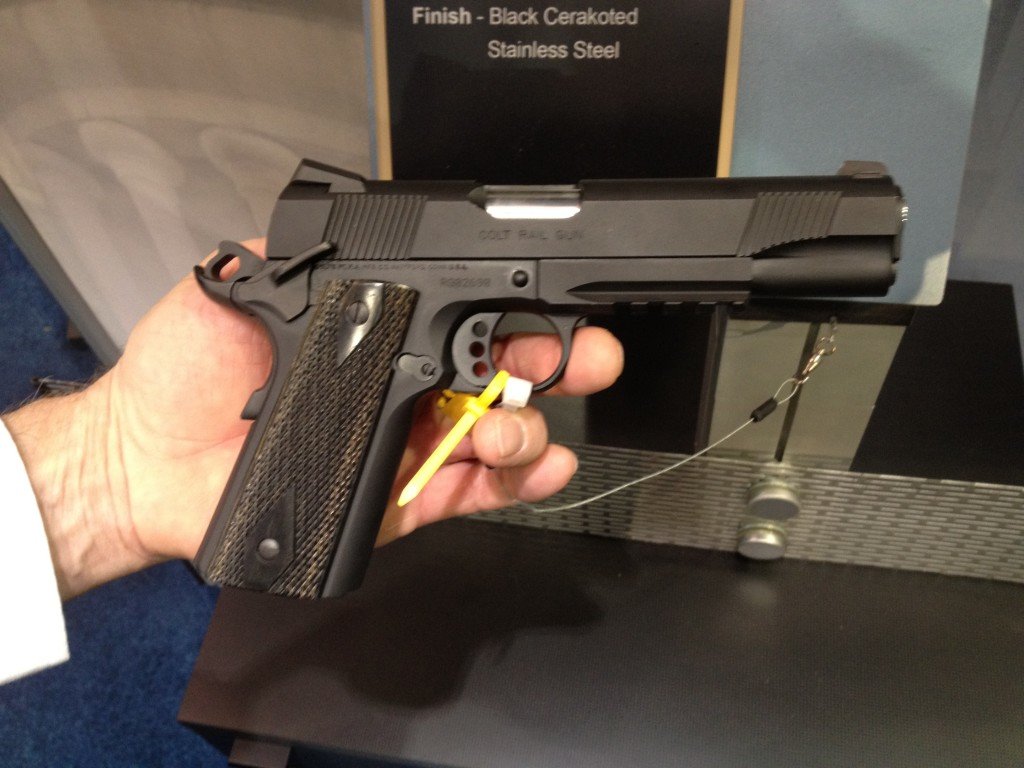
SHOT Show is always an exciting time for us gun enthusiasts, as we wait with baited breath for new models. This year is no different, but Colt did one better, they re-introduced a longtime favorite, while continuing to build on their winning line of 1911-style pistols.
Handguns
Show First

Springfield Armory XDS Single Stack .45ACP Micro
Published: January 17, 2012 { 359 comments }So far the biggest story I have seen at SHOT Show 2012 is the XDS from Springfield Armory. It is a single stack .45ACP that holds 5 rounds in the magazine and 1 in the chamber. The barrel is 3.3 inches, and the overall length is 6.3 inches. It is only one inch thick. Empty the XDS weighs 21 ounces, and it is a striker fired pistol in the tradition of the XD and XD(M), with a polymer frame and forged steel slide.
I don’t know how many times we need to say that Springfield Armory is always raising the bar, but Springfield Armory is always raising the bar. Last year at SHOT Show about a half a dozen companies came out with single stack 9mm ultra-compacts. Over the past year they have all come into the market, with mixed reviews on most (our favorite was by far the Walther PPS). This year some of those guns have now been released in .40S&W, and it is common for 9mm and .40S&W to share the same frame in pistols. But when you want to make a pistol that small in a .45ACP, you have to go back to square one and make a whole new gun, and that is what Springfield Armory did.
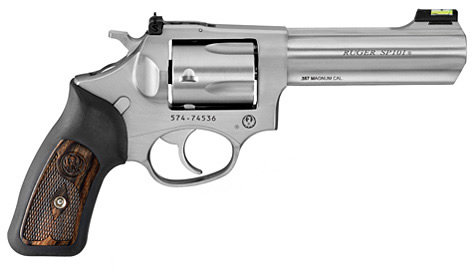
New Ruger SP101 4.2″ w/Adjustable Sights
Published: January 15, 2012 { 41 comments }Introducing the newest addition to the SP101 line. It has a 4.2″ barrel and an adjustable rear, and fiber optic front sight. If you know and love the SP101 series from Ruger, This is the same bulletproof reliable gun in a gun suited for all day holster carry, as a truck or pack gun, or as a backup for dangerous game.
Ruger LCR-22 New Gun Review
Published: January 15, 2012 { 143 comments }
Break out the party hats, Ruger’s LCR just got a little brother! The newest member of the LCR family shares all the great features of its brethren and is now available in .22 caliber. The LCR-22 is light, fast handling, and accurate for a 1.875” barrel, and it’s a ball to shoot.
If you’re not familiar with Ruger’s LCR (Lightweight Compact Revolver) which debuted in January of 2009, it is best known as the first production polymer framed revolver. Several others have come out since but Ruger was ahead of the pack with the LCR.
The polymer lower part of the frame houses all components of the fire control mechanism and is mated to an aluminum alloy upper which houses the stainless steel cylinder and barrel liner. Polymer is a rugged material, rust and corrosion proof, and light weight. The aluminum upper and heavy fluting on the cylinder contribute additional weight savings. My review gun came in at 14.8 ounces empty on my stamps.com electronic scale, but the reported weight is 14.9 ounces. The balance point is at the back of the cylinder which I consider ideal for a snub nose revolver. It comes on target out of the holster quickly, thanks in part to the great balance as well as the natural grip angle and excellent rubber grip from Hogue.
The hammer is completely enclosed making, this a double-action-only (DAO) revolver and eliminating a potential snag for anyone interested in concealed carry. The DAO trigger, like its bigger brothers, is very smooth with no stacking and little overtravel. It measured right around 12 pounds but didn’t seem that much thanks to the way they cam the trigger.
The LCR-22 is compact, little more than 6.25” long and 1.25” wide. It sits so lightly in a holster or in your pocket that you’ll forget it’s there
The big news, of course is that you can now get it in .22 caliber which opens the opportunity to do a lot more shooting since .22 ammo is inexpensive and widely available. The LCR-22 will handle .22 short, .22 long, and .22 long rifle ammo, including shot shells, which means that you can personalize it for your needs.
I see this fun little revolver filling a number of roles. The most important component to shooting any gun accurately, aside from the gun itself, is practice. No matter how good (or bad) you are, more practice will make you better. Unfortunately, center fire ammo can get expensive, especially if you want to shoot hundreds of rounds a month. With a .22, you can shoot for pocket change.

Coonan Arms Classic .357 Magnum 1911 Pistol
Published: January 8, 2012 { 82 comments }What do you call a giant stainless steel .357 Magnum 1911 pistol? Well, if you listen to Coonan Arms, maker of this righteous beast called the Coonan Classic .357, the answer is that it may be many things, but it is for sure…
Not Your First Pistol!
The .357 Magnum is considered by many to be the most effective handgun round for human sized targets. But unfortunately the cartridge was created for revolvers, not pistols. So for fans of 1911 and other auto pistols, the .357 Magnum isn’t practical. It has a rim around the back of the case, unlike a .45ACP or 9mm that are flat and don’t. The extra lip that sticks out of the .357 Magnum and other rimmed cases creates trouble in semi-auto pistol magazines, and the .357 Magnum case itself is very long to fit lengthwise in the grip of a pistol as well.
This leaves 1911 fans who are also devotees of the .357 Magnum in a lurch, because though you can carry several guns at one time, you can only shoot one gun effectively at a time. Until now you had to choose between a 1911 and a .357 Magnum revolver. The Coonan Classic .357 seeks to combine these two choices, and they have done a really great job of it. If you are fan of both the 1911 and the .357 Magnum, you will be pleasantly surprised with this gun. It definitely isn’t for the uninitiated, but with a proper understanding of how the gun works and why, it isn’t a gun to be afraid of as a novice shooter . It works really well and is also a lot of gun for the money.

Cimarron Evil Roy Cowboy Colt Replica
Published: January 4, 2012 { 28 comments }We are often so focused on the black guns these days that sometimes you miss what is going on in other parts of the shooting and hunting world. A lot of it is deeper and a more enjoyable than all of the tactical stuff combined. Cimmaron Firearms specializes in cowboy era firearms, from the percussion age of the 1830s through 1873, and the cartridge guns from Colt, Winchester, Smith & Wesson, Marlin, Sharps, and others through the turn of the century. The dawn of the repeating firearm is not only a lot of fun historically, you can actually live it and breath it through a very popular shooting organization called the Single Action Shooting Society, or SASS. Cowboy Action Shooting is a lot of fun, and if you are of the competitive bent, at the regional and national level the competition is fierce.
This “Evil Roy” model of the 1873 single action Colt Peacemaker is engineered to meet the needs of the discriminating SASS competitor. More than 90% of the people who shoot Cowboy Action are not competitive and have no interest in winning anything, but we all like to shoot good. And for that small percentage of serious competitors, they are really serious and like to shoot perfect, not just well, and win the prized trophy SASS belt buckles. All of the SASS shooting is on metal plates, not paper, and the plates are set as close to the shooter as is safe for splatter. This makes Cowboy Action really easy to shoot well, so the competition really boils down to speed. Hit the metal plates, every time, as fast as you can.

Ultimate Plinker – New Ruger SR22 Pistol
Published: January 2, 2012 { 184 comments }Every gun nut looks for that perfect .22 pistol that will always be a staple of their gun collection. Even if you have more than one, and most of us do have several, a .22 pistol is lifetime purchase, so even though they are less expensive than most centerfire pistols, you have to choose carefully.
The “old” Ruger .22LR pistol, currently called the Mark III, is one of those guns you can always advise someone to choose and they will never regret it. The classic Luger lines of the gun and the hefty weight of 30oz. and up make it easy to shoot for novice shooters, and steady and accurate for a lifetime of punching paper and eliminating the dreaded grey squirrel. The Ruger Mark III will never let you down. But the world has moved on from steel guns, and most people want a .22LR pistol that looks and feels like the centerfire pistol they use for home defense, concealed carry, or competition.
UPDATE! Springfield XD(M) 5.25 9mm, 40S&W, 45ACP Field Test
Published: November 10, 2011 { 18 comments }
The last time we saw the new Springfield Armory XD(M) 5.25 I was only able to try the gun for about an hour before having to send it on to the next reviewer. GunsAmerica was the first to have pics and tests of this exciting new competition pistol designed by champion shooter Rob Leatham. At the time it was only available in 9mm as well. Several of the comments that came in asked the question, when are they going to offer it in .40S&W and .45ACP? The answer is “right now.” The guns should be on your dealer shelves, and there is still some time on the 3 magazines promotion from Springfield.
For competition, Springfield Armory has upped the game on the 5.25 with these two new guns. Both calibers give you more flexibility than the 9mm in competition. They give you the ability to make what is called “major power” in USPSA and other competitive shooting rule systems, and you can make doctored loads for what is called the “power floor.” With the .45ACP you can experiment quite a lot, as you’ll see we did some, and the .40S&W just makes the floor for major power factor, and may be your best option if you want to use the gun in competition as well as self defense or duty.
Power factors are all based on published rules for what the individual competition organizations. The speed of the bullets is measured by a chronograph at the competition itself. To calculate the power factor and figure out the power floor you multiply the weight of the bullet, in grains, with the measured speed in feet per second, divided by a thousand. So for a 125 grain 9mm travelling at 1100 feet per second it works out to 135. A 230 grain 45acp at 850 feet per second is 195.
You will notice that the power factor computation is far different than the foot/pounds computation we have covered in a number of other articles. In the latter, velocity is squared before it is multiplied. In power factor it is simply multiplied. So while in foot/pounds calculations velocity is king, in power factor bullet weight has much more impact.
To “make major” in USPSA for the Open division the power factor is 160, and it is 170 for the Standard and Modified divisions. The minimum caliber to “make major” in the Standard division is .40, which gives you two XD(M) 5.25 guns to choose from. Note also that there is an absolute power floor for USPSA and other competitions of 125. So if you are concerned only with competing at the division level without shooting to make major, you can load to the absolute floor for little or no recoil, if you can get the gun to work properly with low powered loads, as I will explain a bit later.
Taurus Judge Public Defender Poly Review: Ballistics Tested
Published: November 7, 2011 { 84 comments }The Taurus Judge Public Defender Poly is a 23 ounce, five shot polymer revolver that fires .410 shotshells and .45 Colt. In our test it was comfortable to shoot all day, but the 2 inch barrel cost a lot of velocity: Winchester PDX1 averaged about 625 fps against the 750 on the box, and patterns [...]

Shooting the Desert Eagle .44 Magnum
Published: October 9, 2011 { 71 comments }Do you want a shock? If you have an Android phone, go into the Marketplace and search for the word “guns.” Hundreds of apps will appear relating to every angle on guns and shooting you can imagine. What I found interesting was that by far the most common picture of a gun chosen for the thumbnail is none other than the Desert Eagle. As guns go, the Desert Eagle is not that common, but maybe due to video games, or movies, or just plain old coolness, it is one of the most notorious guns of all time.
Most people think of the Desert Eagle in the most famous .50AE (Action Express) caliber, but when it comes to actually buying a gun to shoot, I would suggest the far more affordable .44 Magnum. Brass is plentiful, and you can buy the ammo on the shelf at Wal-Mart or Bass Pro Shops. Ballistically, the .50AE is overkill in a pistol and rocks your world far too much to be an effective weapon anyway. It is more of a novelty cartridge that a functional participant in shooting sports, unlike the .44 Magnum that is used extensively and successfully in self defense, handgun hunting and as a backup for dangerous game.
To understand the difference in ballistics of the two cartridges, the standard 300gr. bullet in a .50AE travels at roughly the same 1400fps. that a 240gr. bullet travels in a .44 mag. In muzzle energy this equates to a 50% advantage for the .50AE, 1449ft./lbs vs. 971ft./lbs. for the 44 mag. With a similar weight 300gr. bullet, the .44 mag comes in at even less, at 881ft./lbs. But when it comes to hand cannons, how much is too much? Even against a Grizzly, the ability to aim a follow up shot quickly should you miss is more important that eeking out every foot-pound of energy from a gun when you are limited to carrying a pistol.
This is why I ordered a test gun in .44 Magnum. As romantic as the “Big 50” may be, I wanted to see what it was like to shoot this famous and enormous gun with a practical cartridge. My perspective is, most .44 Magnum shooters shoot revolvers, Smith & Wesson Model 39s, Ruger Super Redhawks, etc. With a .44 Magnum Desert Eagle, you have 8+1 rounds, not just six, and you can slap a mag if this isn’t enough to get the job done, or if you need to be ready for the next threat. Compared to a revolver the Desert Eagle is far more firepower, and let’s face it, the gun is among the coolest on the planet. It looks like a Battlestar Gallactica blaster for heaven’s sake!
Weighing in at nearly four and half pounds (70.5 oz.), the Desert Eagle .44 Magnum still has a good deal of recoil and muzzle flip. It may not be the biggest boy on the block anymore, but the .44 Magnum is still a beast of a cartridge. I would not call it punishing though. I have fired lightweight alloy J-frame revolvers with .357 Magnum loads that were a lot more unpleasant to shoot than this.
Using the gun successfully takes some practice though, and Magnum Research provides a picture guide to help you save frustration. The Desert Eagle is not a gun you can just take out of the box and shoot properly. Many of the good habits you may have developed from shooting large revolvers don’t apply to the Desert Eagle, and you have to consciously change them or the Desert Eagle doesn’t work so good.
With a big, .44 Magnum revolver, like a Ruger Super Redhawk, (for a right handed shooter), you hold your left hand under the grip to apply two handed counter pressure to shoot the gun. When you shoot it, you allow the revolver to roll backwards with the recoil. If you do this with the Desert Eagle, the next round won’t lock up correctly and it will behave like a standard failure to feed correctly. Two things about this you have to consciously change.
Read More…