
Estimated reading time: 8 minutes
Someone in SIG’s marketing department deserves a raise. Seriously, whoever thought of calling their red dots Romeos and their magnifiers Juliets is an absolute genius. Minus the Shakespearian tragedy part, the Romeo and Juliet pairing is perfect. SIG sells itself as a total systems provider, and they mean it. SIG wants to make your rifle and all the crap you shove on it. To make it even more appealing, they took the Romeo MSR 2 and the Juliet3 Micro and packaged them at a tough-to-beat price point.
Table of contents
Romeo and Juliet – A Complete Package
There can be something comforting about purchasing a combination of red dot and magnifier as a complete package. It’s typically wise to purchase a magnifier from the same company that made your red dot. It’s not necessary, but there is some comfort in knowing the two were made each other. When they are packaged together, you know that right out of the box, the two will be best friends.
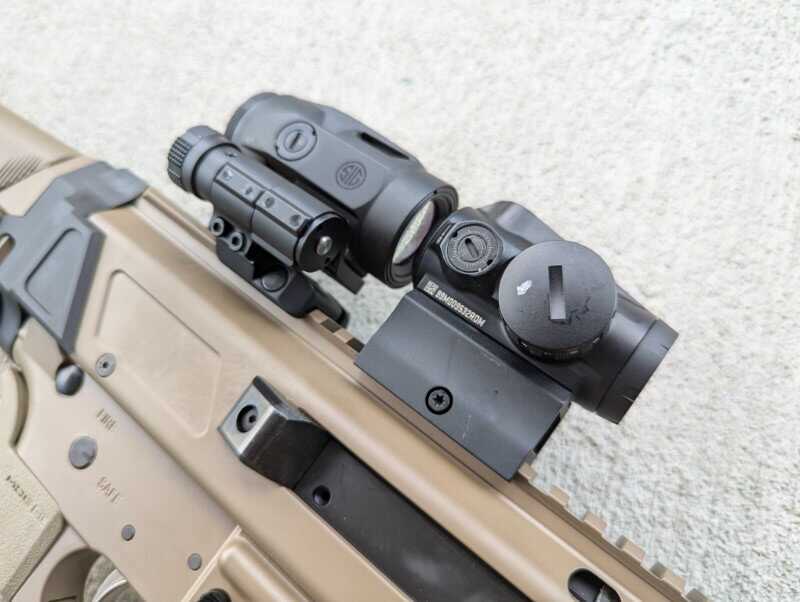
Or lovers, I guess, because we call it the Romeo and Juliet. You know, let’s stop humanizing these things. The Romeo and Juliet package is designed to work together, but you could split the two optics if you so choose. The Juliet3 magnifier comes with spacers to allow you to adjust the height. AR height optics come at different heights, and for a magnifier to work, it needs to align with the height of the red dot.
The Romeo and Juliet system does provide the user with a plug-and-play one-box option. Open the box, install, zero, and call it a day. There are two main benefits to purchasing the package deal. First, it’s just cheaper to buy the system as a package. Second, it’s just plug-and-play, and we’ll talk a bit more about that at the range review.
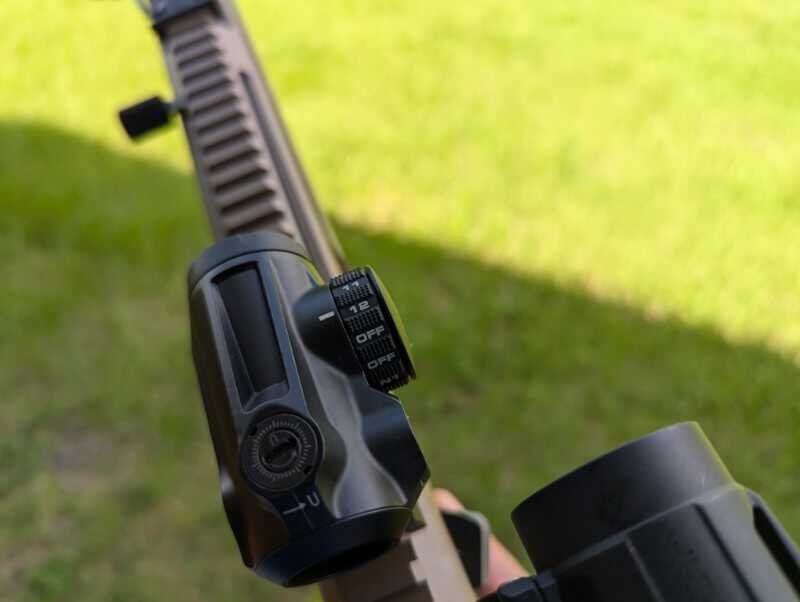
Not super High Quality
It’s worth mentioning that both the Romeo MSR 2 and the Juliet3 Micro are on the lower end of SIG’s optics. They aren’t bad optics but wouldn’t be used for duty use. They are fine for home defense and great for competition. My role in these optics was to learn the ins and outs of the magnifier/red dot combo. I wanted to check out the idea at a lower price point to see if I like the concept before I invest in a pricier setup.
Why It’s Worth a Hoot
The Romeo MSR 2 and Juliet3 align perfectly when installed, which makes zeroing a lot easier. If the optic isn’t centered on the red dot, the dot won’t be centered, which is where we run into parallax issues. You have to adjust the magnifier to compensate for any problems centering. Zero might not be the right term for adjusting the magnifier, but it best describes what we are doing.
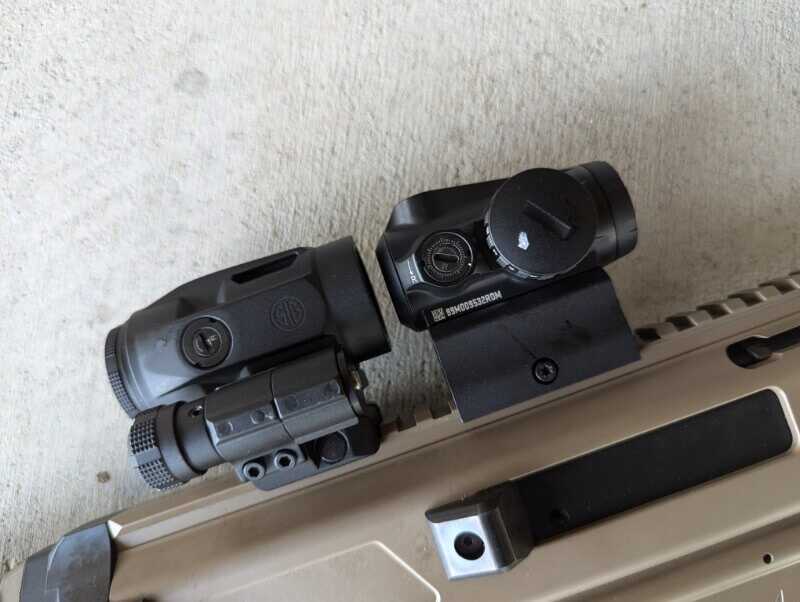
To be clear, I didn’t have to do this with the Romeo MSR 2 or the Juliet 3. They aligned and were centered perfectly. I zeroed the red dot, flipped the red dot over, and confirmed my zero. It was drama-free. In other cases, you have to zero the dot, flip the magnifier in place, and check your zero. If the zeroes aren’t the same, then you have to adjust the magnifier via windage and elevation.
During zeroing, I noticed that the view was surprisingly clear. The Romeo MSR 2 has very little noticeable notch filter, which is surprisingly pleasant for such a budget-worthy optic. The Juliet3 is also fairly clear. It wouldn’t be mistaken for a Nightforce, but from 50 to 200 yards, I could easily see and identify white targets against a sand-colored background.

The combination of the two gives us a solid sight picture. The Romeo MSR 2’s red dot reticle isn’t all that impressive. It’s a 2 MOA dot, and at higher brightness levels, it does become a bit starburst with a distinct tail. This effect becomes magnified under the literal magnifier.
Snapping In With Romeo and Juliet
Does it stop me from hitting the target? Nope, not at all, but it’s worth noting. It’s a product of a lower-priced optic. The reticle does get quite bright and has no problems standing out in the high noon of Florida against a bright white sand background.

I started at 50 yards and worked quick-up drills with the combination of the dot and magnifier. I was checking for eye box and eye relief. The Juliet3 is quite generous in both regards. Magnifiers kind of suck in the eye relief department, with 1.5 inches being the norm, but the Juliet3 gives us 2.5 inches. The eye box is like Santa Claus, meaning it’s generous. You can snap in quickly and easily without worrying about scope shadow.
I used the Sage Dynamics printable targets as my villains for the day. I used the head targets and worked just headshots at various ranges in standing and kneeling positions. My only supported shooting was when I zeroed the gun.

At 100 yards, I had no problems putting 5.56 rounds into the center of the forehead in the standing position. I snapped the magnifier in place behind the dot and aimed just a hair low. My 50/200 yard zero would have my rounds hitting high. From what I could tell, I aimed at the nose area and dropped those rounds right where they needed to be.
Going the Distance
At 200 yards, things were trickier. The target is fairly small. At this range, the magnification is fighting for its life on a small target. I took my time, and while I hit the target most of the time, the group was all over the place.
Most of them hit the 8.5 x 11 piece of paper, but they weren’t all in the head of the target. As a man who likes his ego stroked, I transitioned to a full-sized IPSC steel target and laid down some 55-grain rounds into it. I got my ego back when the rounds rang steel.
Read More: SIG Romeo 1 Pro Optic

Up close, the Romeo MSR 2 works very well. It’s a basic red dot and works as you’d expect. Just hit the button, flip the magnifier to the side, and boom, we are ready for those room-to-room, street-to-street fights. At the beep of the shot timer, I work transitions from left to right and from right to left over several targets. I stuck to IPSC-sized A-zones
The bright dot is easy to see, and the refresh rate impressed me. I wasn’t dealing with a laggy dot that became a pain when transitioning between targets. I shot at 10 to 50 yards with the Romeo MSR 2 and had no problems doing red dot things. We rang steel, shot Bill Drills, and worked my doubles taps on multiple targets.
The Romeo and Juliet Optics Option
It’s a smart move to package a red dot and magnifier together. It’s an efficient way to create a complete package for the red dot and magnifier curious. The Romeo and Juliet optics are a solid setup by itself, and the budget mindset doesn’t mean it’s not worth long-term use. It’s an efficient and affordable way to dive into the world of magnifiers and red dots. I’m slowly becoming a convert, and I might be the system against an LPVO sooner or later.
*** Buy and Sell on GunsAmerica! ***

Travis Pike is a dedicated firearms writer, a Second Amendment Advocate, and a subject matter enthusiast for all things firearms. He is an amateur competitor with dreams of one day not coming in 4th place at a local defensive match. If he’s not putting text to word processor, he’s likely spending time with family, enjoying Florida’s Nature Coast, or drinking hipster beer. As the resident Florida man he has a preference for obscure guns and calibers.
Experience
- Hunter – Long time deer and hog hunter in the swamps of Florida
- Instructor – Volunteers to teach basic firearm safety classes to kids, adults, and cats
- Wannabe Competitor – Has recently dipped his toes into competitive shooting and has happily discovered an expensive hobby.
- Marine – Served five years with the infantry before transferring to the First Civ Div.
Very good review. Do both units have a Sig Optics Guarantee? Year, years, Lifetime?