
Estimated reading time: 16 minutes
Is there anything more American than the classic S&W M&P K-frame in .38 Special? Okay, arguably, some guns are at least equally American, the M1911, the pump shotgun, the AR-15, but the K-frame in .38 Special sits mighty high in the American Hall of Fame. Of these classic K frames, the Model 10, aka the S&W M&P, aka the Victory Model, aka the Smith & Wesson .38 Hand Ejector Model of 1899, the Smith & Wesson Military & Police is without a doubt the original gangster.
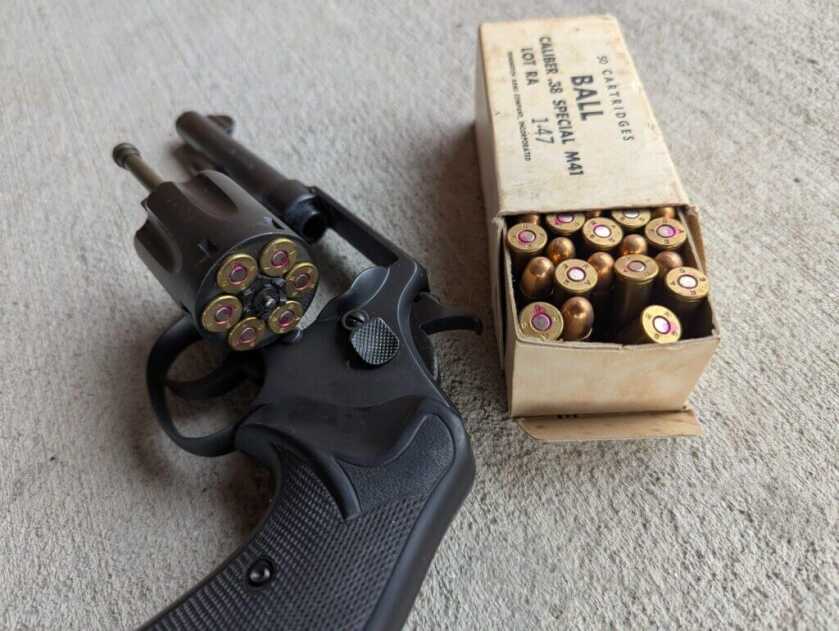
Table of contents
S&W M&P K-Frame History
Since its first incarnation in 1899, the S&W M&P has had many names and several changes. It’s only improved, at least until they introduced that stupid lock system in the 1990s. S&W also produces the Model 64, which is a Model 10 in a stainless finish. Since the gun has been produced since 1899, you can bet your bottom dollar there are tons and tons on the market.
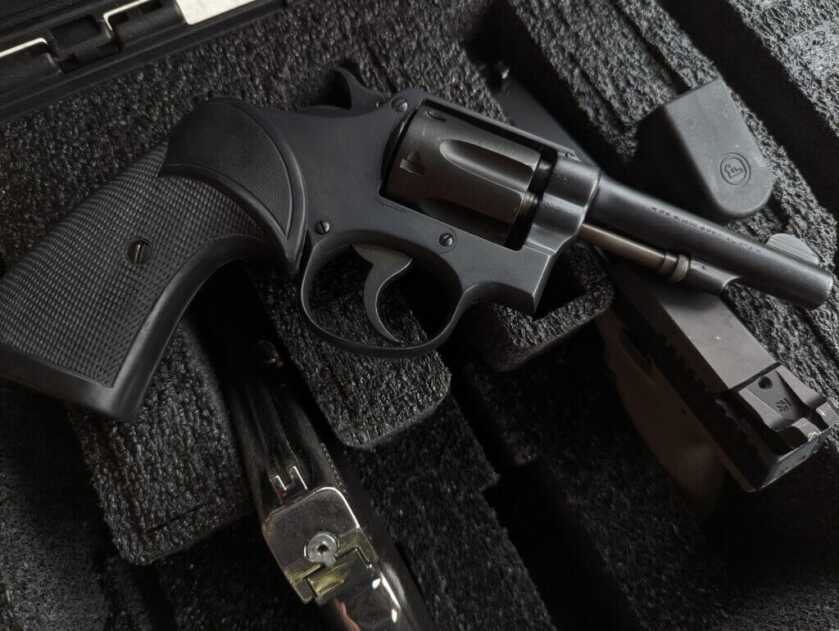
The official total is more than six million. With so many of these guns on the market, they can often be found for a bargain. I picked up the S&W M&P in this article for 180 dollars. For 180 dollars, I expect a beat-up finish, crappy grips, and similar problems. Yet, here we are with a gun that’s in great shape. The original grips have been swapped for a pair of oversized plastic grips.
I certainly got a deal, but it’s not that huge of a deal. It seems like the various S&W M&P variants are fairly affordable. They tend to get pricey when in extremely good shape or if they have some form of wartime provenance. If it’s just a normal Model 10 or M&P, there are good deals to be had.
Available on GunsAmerica Now
Breaking Down the Classic S&W M&P K Frame
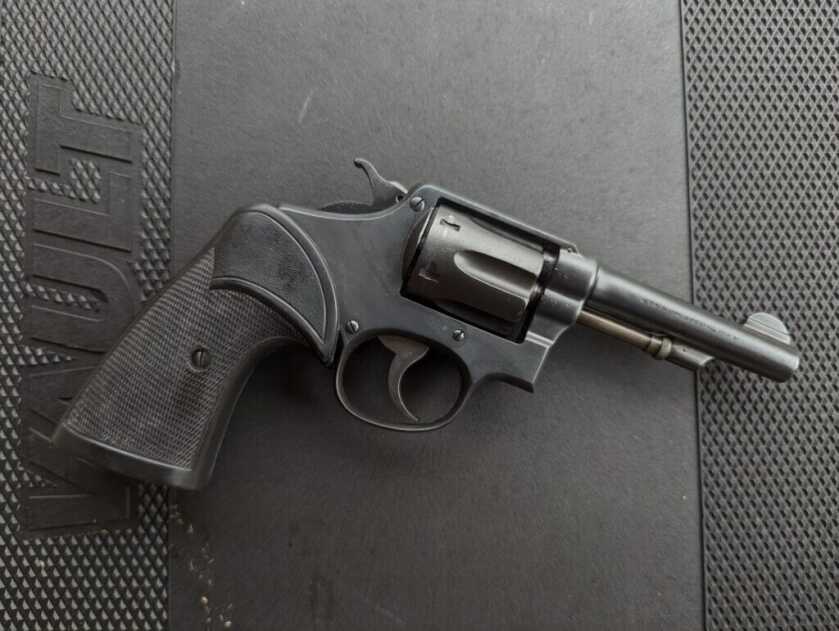
You can look at this revolver and figure out almost everything you need to know. Typically, it would have wood grip panels, which would be considerably smaller. Many apt shooters in the era of the S&W M&P would have outfitted those grips with grip adapters to make them more hand-filling.
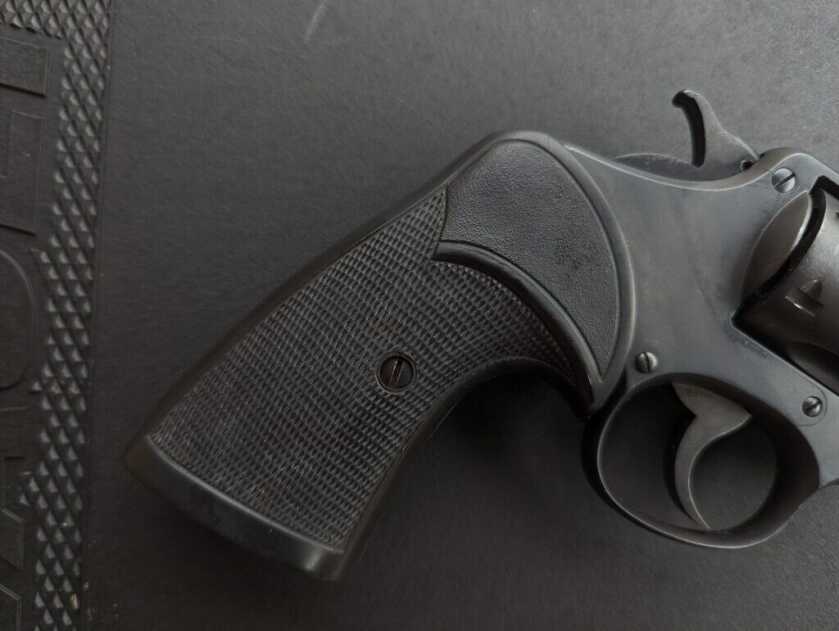
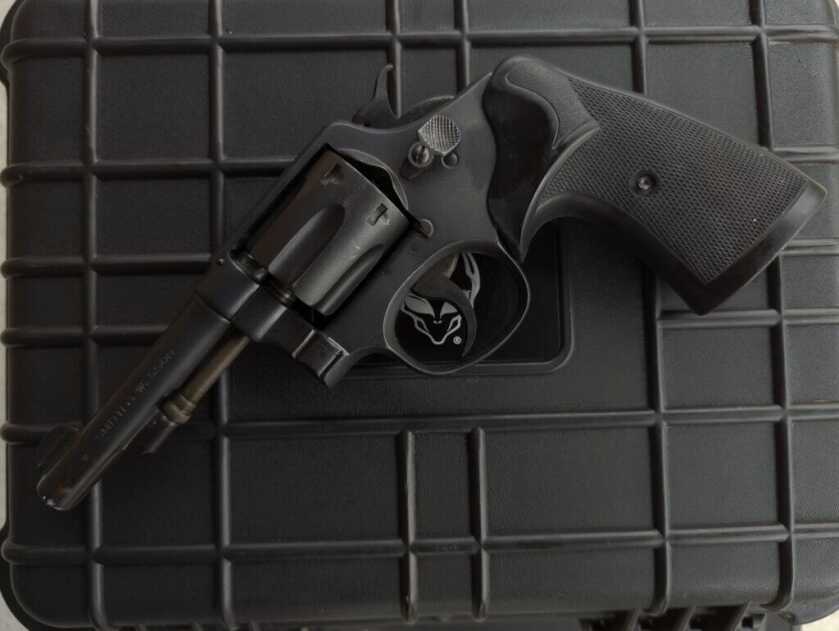
The Pachmayr rubber grips do the same. They are big, broad, and provide a great grip. These grips look odd due to their large size, but they are generally better. I’d prefer the original, but for 180 dollars, I won’t complain. The gun holds six rounds, and this model lacks the transfer bar of more modern guns.
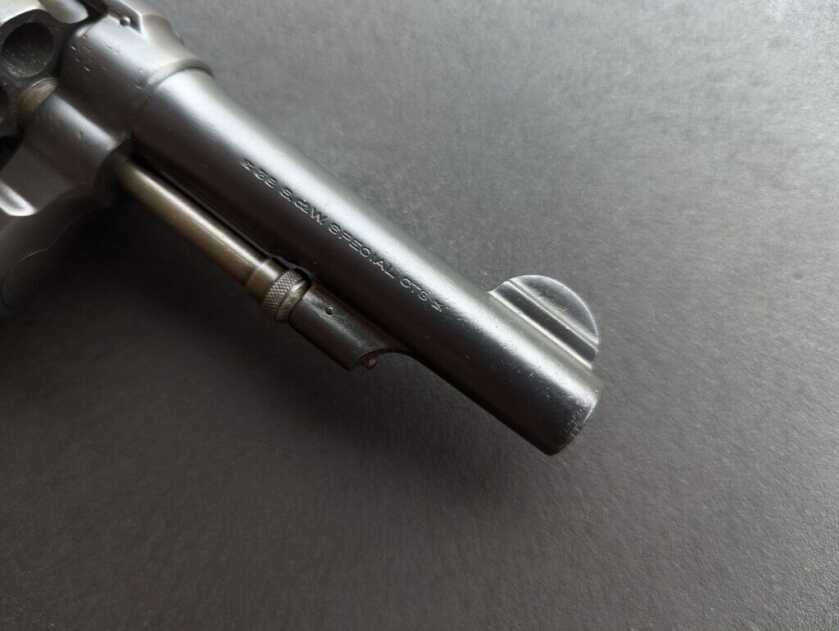
The M&P sights are a simple front half-moon with a rear trench sight. It’s as simple as it gets. It’s not fancy, but it’s functional. That describes the entire revolver quite well.
The S&W M&P – More Than a Collectible
Admittedly, you see an old gun, and you think that’s a collectible. Sure, it’s old, and they ain’t making them anymore, but if I needed a defensive firearm and had less than 200 dollars, I’d be in luck. This gun laid the groundwork for most modern defensive and duty revolvers. Not much has changed in revolver tech since the M&P in .38 Special premiered.
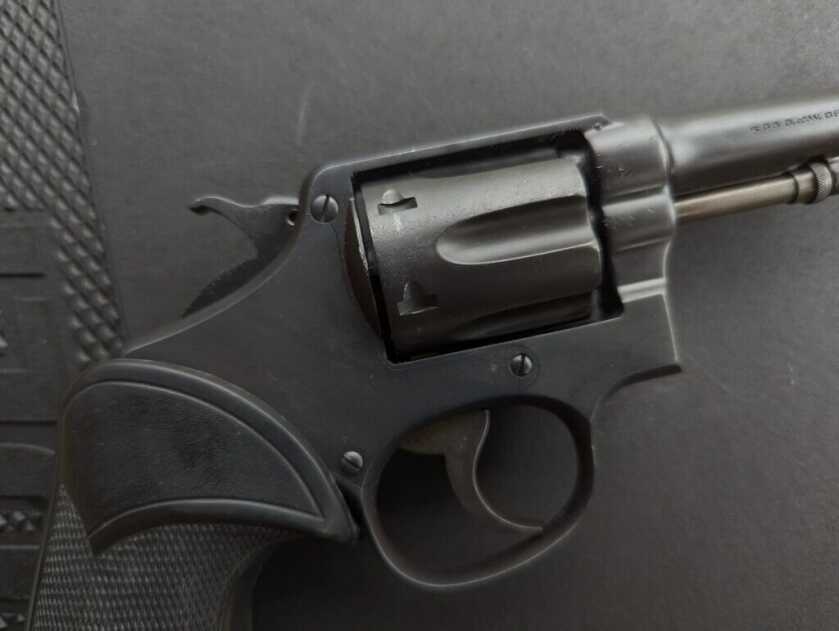
You probably shouldn’t use +P ammo in this old warhorse, but you can feed it a steady diet of standard pressure .38 Special without fail. There are plenty of capable defensive .38 Special loads in standard pressure cartridges. From the 4-inch barrel, you’ll see the velocity you need to drive those .38 caliber (technically .357) pills deep and help them expand.
Six shots of .38 Special don’t seem like much in the days of wonder nines, but it got the job done for decades. For the average citizen, it might not seem like much, but it’s unlikely you’ll fire more than six rounds in your typical defensive scenario.
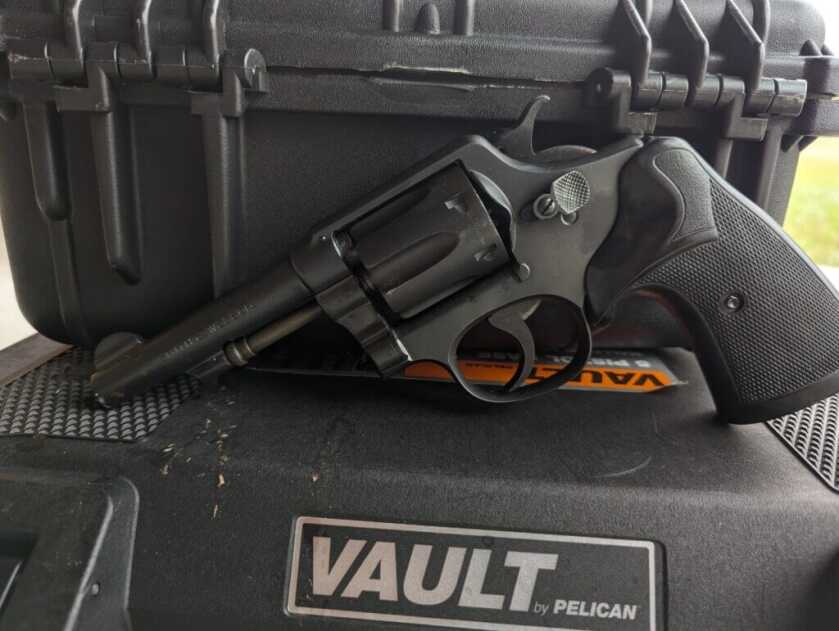
While it wouldn’t be my first choice for a defensive firearm, it would be far from my last. There are a lot of dead criminals from some of the roughest periods of American history due to guns identical to the M&P.
To the Range With the M&P
I recently came into possession of a few boxes of M-41 .38 Special. The United States military used this load in the era of the M&P series .38 Special. The cartridge is fairly standard for a .38 Special. It’s a 130-grain projectile moving at about 950 feet per second. I have a half box I’m willing to shoot for science’s sake, but the rest will remain as a collector’s item.
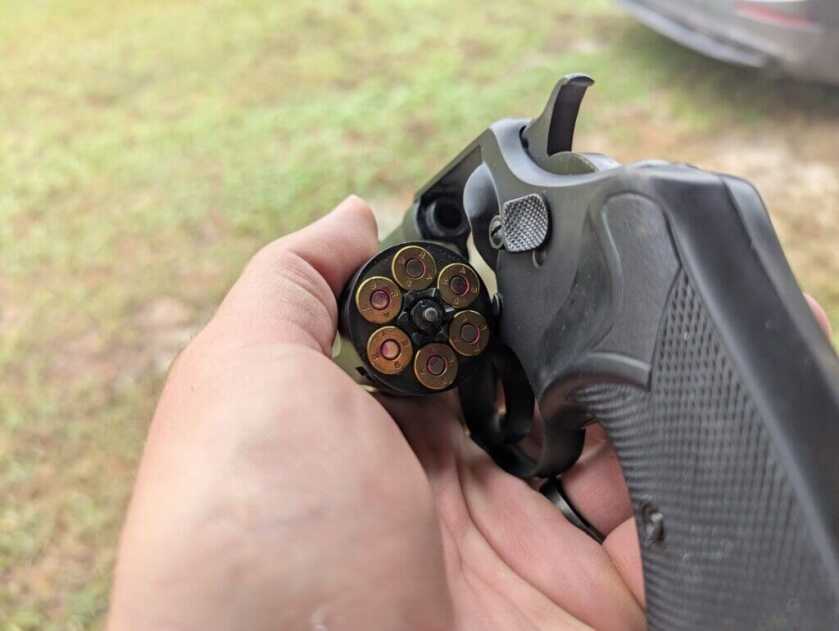
That half-box delivered a pleasant shooting experience. The big grips soak up recoil, and the fact that it’s a fairly large revolver helps. Shooting the old M-41 through the M&P was a very enjoyable experience. I suck with this type of revolver sights, so my rounds weren’t where I wanted them, but they were all grouped together.
The M&P is plenty accurate, but the user behind it wasn’t doing the best job aiming the gun. I had some normal pressure, more modern Sellier and Bellot 158-grain rounds. That stuff had slightly more recoil but was still in that realm of controllable and easy shooting.
Did S&W make better triggers in the age of the M&P, or has time smoothed out the internals that make any trigger grit through its press? I’m not the expert to answer that question, but this M&P has a remarkably smooth trigger. It feels like the kind of trigger you pay extra to obtain. It glides rearward, and while it has the double-action weight you expect, the pull is smooth and clean.
Going Fast
As a revolver amateur, I’ve begun learning how to work the double-action trigger quickly. The M&P turned out to be a great gun to learn these kinds of things. The smooth trigger and big grips turned into easy double taps. My shots weren’t where I wanted them all the time, but they were always close together.
READ MORE ABOUT REVOLVERS: Choosing Between Semi-Automatic and Revolvers
If I backed up to 25 yards and cocked the hammer to single action, I could hit a 10-inch gong regularly. It’s quite amusing to go from barely being able to shoot a revolver to hitting a gong with every trigger press. A good shot would do that with a double-action trigger, but I’m not a good revolver shot. Yet.
The gun always fired when I asked. It performed quite well for a gun that’s likely older than my dad. I would hesitate to defend my home and family with a gun if need be.
The Military and Police – A Legend
This gun seems boring. A medium frame .38 Special six-shot isn’t exciting. What’s important to realize is that this is the gun that sets that standard. This configuration is boring because it’s so successful and just right. The S&W M&P, the Model 10, the Victory Model, the K-frame, and all the other names for this gun are all excellent buys and a must-have for serious firearms collectors.
*** Buy and Sell on GunsAmerica! ***

Travis Pike is a dedicated firearms writer, a Second Amendment Advocate, and a subject matter enthusiast for all things firearms. He is an amateur competitor with dreams of one day not coming in 4th place at a local defensive match. If he’s not putting text to word processor, he’s likely spending time with family, enjoying Florida’s Nature Coast, or drinking hipster beer. As the resident Florida man he has a preference for obscure guns and calibers.
Experience
- Hunter – Long time deer and hog hunter in the swamps of Florida
- Instructor – Volunteers to teach basic firearm safety classes to kids, adults, and cats
- Wannabe Competitor – Has recently dipped his toes into competitive shooting and has happily discovered an expensive hobby.
- Marine – Served five years with the infantry before transferring to the First Civ Div.
No where in the article do you actually say the model. Is it a pre-58 or a numbered model? Would I shoot this “old gun”? We don’t even know if it’s old.
I have a bunch of 38 k-frames of various age, enjoy them all.
I had a brother in law who com-ed a guy with a rn 158. the guy lived and killed his mother a short time later. brother in law did 6years in modc prisons for it. if id provided the ammo(125jhp 1000fps. his mom might still be with us. he wouldn’t tho.
id have no problem going into harms way with a m10/64! especially if I can handload my ammo. these are excellent weapons. as for today’s smith and wesson company? they aren’t worth a rats ass and I won’t buy a smith made after 1990
The later models of the M&P had a much thicker barrel and are incredibly accurate ! My fathers duty gun was a bull barrel M&P issued in 1963, and it still can shoot nickle size groups at 50 feet !
I served with the US Air Force Security Police from 1967 to 1988. Our standard issue sidearm during that time was the S&W Model 15 Combat Masterpiece. Basically, a Model 10 with adjustable sights. After firing literally thousands of rounds through this revolver in 20 years of semi-annual qualifications and competition shooting, I still think it’s one of the best shooting handguns one can own. Look in my home gun safe and you’ll find three S&W K frame revolvers.
I would add that if one is a reloader, the .38 Special is one of the easiest to work with.
Yes, and you can get some pretty nasty loads that way ! Do some lead bullets with gas checks and you can dial the loads up a bit !
I have S&W 5 guns which are +P.
Get some original grips – Ebay is a good source, as GunBroker can be. Then find a Tyler-T-Grip for K or J frame,. You won’t be sorry.
Put a good set of hardwood Hogue grips on it, they fit the hand much better ! They made a set that had S&W medallions in them..
I bought a 6″ Python in 1985. Hated the factory grips so I bought a set of Hogues, made of mesquite, on clearance as they were dropping that wood (too hard to work). understand they are now quite the collector’s item (like the Python itself). Still beautiful and harder than woodpecker lips.
But…for a classic 5-screw Smith, personal pref is factory diamond Magna’s if they can be found….
Not boring . . . classic. Simplicity has a greatly underappreciated elegance all its own.
And a lot of Techno-Tactical Timmys with their red-dotted, laser-sighted, high-capacity, overloaded garbage-wagons seem to forget that a whole lot of bad guys, both domestically and globally, met their ends at the hands of hard men in hard times who were armed with nothing more than a simple iron-sighted, .38 or .45 that went bang every single time it needed to.
And if it didnt go bang, you could beat them down with it since it was all steel !
In my opinion the grips should be swapped out. There should be some used ones online that will not have matching serial numbers but are an upgrade from that rubber 1980 style. Then there are companies like Altamont that have awesome new wood grips.
Hogue makes some very nice hardwood grips that feel great on those guns !
Carried a model 64 for 28 years as a duty gun. I never felt outgunned.
Because you were taught that every round counted, and they probably drilled actual marksmanship into you ! They dont really do that now, and they get into spray and pray gun fights ! I feel just as comfortable with any of my five or six shot revolvers as i am with any of my wonder nines or .45s !
And i have your guns bigger brother, the model 65 in .357, great guns !
Vietnam, 1966, I was a medical crewmember on an H3 helicopter. Issue side arm was the Smith Model 15 Combat Masterpiece. A good, well made revolver with adjustable sights. Issue ammunition was 158 grain FMJ round nose ammo (18 rounds). I had no idea how pathetic the ammo was until I chronographed some of it in the 80s. Average velocity turned out to be a pathetic 770 fps. I’m glad I never had to rely on it to get me out of a jam.
Round nose FMJ bullets tend to part flesh rather than crush it, and certainly aren’t ideal “man stoppers,” but they are traditionally what the world’s militaries issue due to the 1899 Hague Conventions. At 770 fps, that 158g bullet would almost certainly have penetrated T-and-T, likely curving through your opponent as the bullet destabilized. The damage it inflicted would be consistent, probably indistinguishable, whether it was moving 770, 1070, or 1270, although the faster bullets would be less likely to destabilize within the target. (And 158 @ 1270 is full .357 Magnum performance, with attendant blast, flash, and recoil.) Surgeons and coroners alike testify that they generally can’t distinguish the wound track of one caliber from another, when non-expanding, RN bullets are used.
A 158g soft lead hollowpoint at 800-850 fps would give superior performance, as cops experienced in the 1970s-80s and beyond, but your 770 fps FMJ would’ve done all that a .38 caliber non-expanding RN handgun bullet could do. The flat-faced 148g “target” wadcutter is generally considered a more effective wounding agent.
They could have issued a 158 grain Semi wad cutter lead bullet, they would do the job better than the FMJ rounds !
Indeed, and a full wadcutter even better. The Brits adopted a .455 Webley wadcutter round about 1898-1900, but quickly replaced it due to concerns about its acceptability under Hague Convention rules. Not sure whether US Ordnance types considered it feasible or legal, or even desirable. Certainly, it was broadly understood that flat-pointed bullets “hit harder” than round-nosed bullets, so I presume the U.S. military consciously chose not to use such bullets.
Most ironic, of course, that we adopted the 5.56mm M193 ammo, whose 55g bullet @ 3250 fps would destabilize upon penetration, begin to turn sideways, then shatter at the cannelure to create the infamous “tumbling bullet” wounds that often proved so devastating. Their lethality was caused, in fact, by the dual wound channels and associated spray of lead and jacket fragments causing the normal temporary expansion cavity to be ripped open violently, and permanently. Not sure how that ever made it past Hague Convention standards!!
As a medical helicopter crew member in Vietnam, I was issued a Smith Model 15 with 4″ barrel. Issue ammunition in 1966 was the 158 gr FMJ round nose ammo. This ammunition was pathetic for self defense. Better than throwing rocks at the enemy but not by much. Years later I got ahold of some of that ammo to chronograph and discovered the velocities of 770 fps was no better than the standard target 148 grain lead wad cutter ammunition. I’m glad I never had to rely on it to get me out of a jam.