
Estimated reading time: 12 minutes
The Smith & Wesson M&P 2.0 is not just another striker-fired 9mm trying to chase the usual names. After range time, carry time, and real instructor use, this pistol proved flat-shooting, reliable, optics-ready, and good enough to make a longtime Glock carrier reach for something else.

The service-sized handgun is a mainstay of defensive shooting, especially compact-sized firearms. Some guns have dominated this market, but in the last decade, we have seen companies bring ever-improving 9mm duty-sized pistols, and these guns are now rivaling the dominant names in the marketplace. This article explores one of those standouts, the Smith and Wesson M&P 2.0 series.
Table of contents
- M&P Origins: How Smith & Wesson Built a Modern Duty Pistol Line
- Why the New M&P 2.0 Hits Hard in the Modern Duty Pistol Market
- Shooting the M&P 2.0: Flat Recoil, Fast Hits, and a Trigger That Finally Delivers
- Carrying the M&P 2.0 Compact: A Real-World CCW Test With Light and Holster
- Smith & Wesson M&P 2.0 Review Specs: Compact and Full Size Compared
- Pros and Cons: Where the M&P 2.0 Wins and Where It Still Depends on You
- Final Verdict: Why This M&P 2.0 Won Over a Lifelong Glock Carrier
- Useful Links for the Gear in This M&P 2.0 Setup
- Related Reads from GunsAmerica Digest
M&P Origins: How Smith & Wesson Built a Modern Duty Pistol Line
In 2005, Smith and Wesson introduced their newest pistol, a polymer-framed striker-fired semi-auto pistol called the M&P, short for Military and Police. It was a replacement for their earlier all-metal, hammer-fired models that had been a mainstay for police and civilians for decades and were discontinued the following year.
The early versions had a hinged trigger that left a bit to be desired. It also had a lack of texture on the grip that could be slick when wet. A 2.0 version was introduced in 2017, which increased the grip texture and updated the design with various improvements to things like the slide lock/release. The grip texture was aggressive. I can attest to that as my early 2.0 would remove hair when I carried it appendix. That gun’s mediocre trigger helped me decide to let it go.
The most important improvement that came later was S&W’s new trigger. Long gone was the hinged version, which was widely hated, and the new version took the gun to a whole different level. It was much crisper than the previous hinged trigger and allowed for much better accuracy.

Then, miracles of miracles, S&W got these added to the California Roster, so people like me could get them. I invested in two, a full size with a 4.25-inch barrel, and a compact version with a 4.0 barrel. The compact went to carry, and the full-size became my teaching gun.
🛒 Check Current Price for Smith & Wesson M&P 2.0 on GunsAmericaWhy the New M&P 2.0 Hits Hard in the Modern Duty Pistol Market
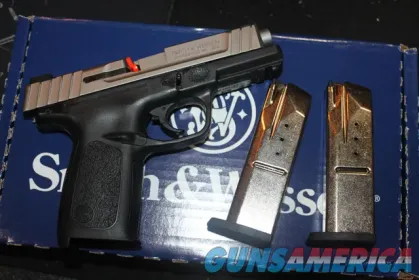
The M&P comes in cardboard and plastic cases, depending on the model. My compact came in the more traditional S&W cardboard box, but my full-size came with the plastic case. My compact was their first California version and came with an obnoxiously huge loaded-chamber-indicator that negated any optic mounting solution. I was able to buy an optic-ready slide directly from Smith, and I was off to the races. The full-size came with a much more reasonable loaded chamber indicator and the S&W CORE optic cut. As of this writing, they seem to have discontinued the older slide version with the massive chamber flag. In free states, the compact has a 15-round magazine, and the full-size has a 17-round magazine.

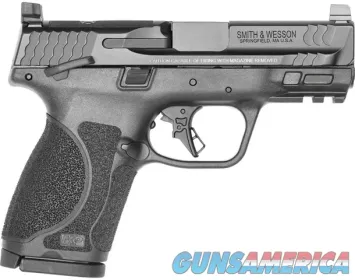
The slide comes with their tough Armornite finish that looks sharp. Not too shiny, but not like it’s parkerized either. The new slides all come with optic-ready sights that are steel, unlike other brands that use plastic as placeholders with the expectation that you will replace them. The serrations are more than adequate from both the front and back, and go along the full height of the slide. The barrel looks to have a slight crown, and the guns come standard with metal guide rods. The compact has a 4.0-inch barrel, and the full size has a 4.25-inch barrel with a slightly longer grip frame.

S&W uses its CORE mounting system on these pistols that provides plastic plates to adapt most optics to the slide. The optic does screw directly into the slide, with the plastic adapter almost working like a washer that gives support to the mounting. I wonder if this provides some level of shock absorption during recoil, but I cannot verify or prove this. I have one optic mounted directly using Smith’s system, and one mounted with a C&H Precision Weapons Systems plate. I have not seen a major difference between the two.

The frame is made of polymer, Zytel is what they refer to it as, with an aggressive stippling on the grip. This stippling is not as aggressive as I remember the earlier versions being. I’m able to carry it comfortably in the appendix position, this time not with the unpleasant cheese grater feeling. With this level of stippling, I don’t see a need for an aftermarket stipple job. There is a 3-slot Picatinny accessory rail on the end of the gun. The slide catch/release is ambidextrous, and the magazine catch can be switched to whichever side you prefer. My gun came with four backstrap /palm swell inserts to adapt the gun to you, of which I chose the small one. The gun came with two 10-round magazines. However, the best part of this frame is the trigger, but more on that later.

My version has an ambidextrous manual thumb safety as required by California, but these can be had with or without safeties based on your preference and depending on what’s legal where you live. Rest assured, the safety can be easily removed and plugs placed in the frame gaps if needed. This was how the gun was designed to be adapted by the end user.
Shooting the M&P 2.0: Flat Recoil, Fast Hits, and a Trigger That Finally Delivers

The gun points more naturally for those who are used to a more traditional grip angle. I was so used to my Glock’s 22-degree angle that I caught myself starting out low in my initial presentation. I also had to train myself to deactivate and then ride that safety while drawing and firing. I used to carry a 1911, so the safety part wasn’t as hard to adapt to, and I became used to using it like a kind of gas pedal with my thumb. It’s also out of the way enough that you can train to just leave it off.
Recoil was very pleasant on both pistols. Once chambered, the barrel-to-slide lockup was very solid, without any give when I put pressure on the barrel hood. During firing, I was very happy with my accuracy, making off-hand hits to a 4” circle as far back as 20 yards with an optic for my older eyes. While I have heard reports of accuracy issues with these guns, I didn’t have any issues with flyers or such.
The new trigger is the star of this pistol. The old curved hinged version has been replaced with the flat-faced trigger with a dingus-style trigger safety on the trigger shoe. Think like the Glock trigger, but the trigger safety is a tad wider and sits flush with the face of the trigger. My trigger broke at around 5 pounds, and had a very crisp break after some take-up. The reset was positive and audible, feeling much shorter than other pistols I’ve shot. I was able to quickly find my wall, then squeeze through it to make accurate shots.

As I continued to practice with the guns, I became more and more confident with point shooting hits at speed. During a demo at a class I was teaching, I was able to send 10 rounds down range in just over 2 seconds.
I have well over 1200 rounds through the compact, and a few hundred on the full size. No malfunctions or issues. In fact, the guns still look new due to the finish.
For the past 18 months, I have been using an S&W M&P 2.0 as an instructor at our local police academy. I can honestly say it outshoots my students’ guns from you know who. Trigger pull, ergonomics, and feel are all superior. It is also one of the only guns that one of our biggest agencies will allow you to carry instead of the big G.
Carrying the M&P 2.0 Compact: A Real-World CCW Test With Light and Holster
I carried the 2.0 Compact in a Tenicor Velo Lux holster for the gun with a Nightstick TCM 550 XL compact light. I am not usually a fan of carrying a gun with a light in the appendix position. It’s just a tad wide for me. However, this holster has changed my thinking on this, and it’s clear why Tenicor is a top-tier holster maker. I have also been really impressed with the quality of these Nightstick lights, and their customer service has been stellar, and far better than other, more expensive brands.

With the gun in the Tenicor, it hides far easier than I expected, even with some tactical padding I’ve picked up over the years. The two metal clips keep the gun secure where I want it and position the grip for quick access. It has replaced my Glock 19 as my bigger gun for carry, and I feel fully confident in its performance should something bad come my way.
The longer barrel helps with the keel principle by keeping more weight below the belt line. Weight is negligible with the holster setup.
Smith & Wesson M&P 2.0 Review Specs: Compact and Full Size Compared
| Model | M&P 2.0 Compact Optics Ready CA Compliant | M&P 2.0 Optics Ready Full Size CA Compliant |
|---|---|---|
| Caliber | 9MM | 9MM |
| Barrel Length | 4.0 in | 4.25 in |
| Overall Length | 7.25 in | 7.5 in |
| Weight | 24 oz | 26.9 oz |
| Capacity | 10 rounds | 10 rounds |
| MSRP | $679 | $699 |
Pros and Cons: Where the M&P 2.0 Wins and Where It Still Depends on You
- Pros: Excellent flat-faced trigger, very manageable recoil, strong ergonomics, optics-ready slide, steel sights, reliable performance, solid finish, strong carry and duty versatility.
- Cons: California versions can come with compromises like a manual safety or loaded chamber indicator, grip texture may still be aggressive for some users, and the transition from Glock grip angle takes practice.
Final Verdict: Why This M&P 2.0 Won Over a Lifelong Glock Carrier
I’ll end this article with a brief reality check. I was a Glock guy. For almost three decades, I carried one in various versions out in harm’s way. Over those years, I have come to respect their simplicity, durability, and reliability. However, times change, and when I reach for a gun to carry out into the world, I don’t reach for Gaston’s gun anymore. My M&P’s go with me when I teach, and would be my pick to carry when something bigger is necessary. It would also now be my pick for a duty weapon were I still in Law Enforcement. As California enters a post-Glock world, the M&P line should be at the top of the list for a duty or compact-sized pistol.

Useful Links for the Gear in This M&P 2.0 Setup
Related Reads from GunsAmerica Digest
- The New Smith & Wesson M&P M2.0: Making a Great Pistol Even Better
- Testing the M&P9 M2.0 Metal
- Still Champion: The New Glock 19 Gen5 MOS
Available on GunsAmerica Now
Brian Jensen has been a shooter for over 45 years, and served in law enforcement for over 30 years in Southern California. During that time he served for over 27 years on the Department Range Staff. Brian has written for Guns America and Harris Publications, and currently trains law enforcement trainees in a local police academy as well as civilians for CCW courses.
Away from writing Brian does photography and exploring the southern California backcountry.
Experience:
-45+ years as a shooter
-Prior Law Enforcement for over 30 years
-27+ years instructing firearms for peace officers
-Civilian CCW Instructor