
Estimated reading time: 12 minutes
Sightmark’s Shade 3.5-28×30 thermal scope zeroed fast, grouped tight, and delivered the kind of real-world night-hunting performance that makes a $999.97 price tag look downright dangerous to the competition.

Table of contents
- The $1K Thermal Scope That Zeroed Fast and Shot Tight
- Why the Sightmark Shade Matters in the Under-$1K Thermal Fight
- Two Shade Models, One Budget-Minded Thermal Mission
- Living With the Sightmark Shade 3.5-28×30 in the Field
- Sightmark Shade 3.5-28×30 Thermal Scope Specs
- Mini QD Battery Pack: The Add-On That Makes More Sense Than You’d Think
- The Test Rig Behind This Sightmark Shade Thermal Review
- 100-Yard Reality Check With the Sightmark Shade Thermal
- Night Hunt Performance: What the Shade Sees After Dark
- Sightmark Shade Pros and Cons After Real Range Time
- Final Verdict on the Sightmark Shade 3.5-28×30
- Related Reads from GunsAmerica Digest
The $1K Thermal Scope That Zeroed Fast and Shot Tight
At 50 yards in the daylight, I set the palette on the new Sightmark Shade 3.5-28×30 Thermal Scope on White Hot, and it worked fine. But the black, many hash-marked reticle wasn’t making it for my eyes.
I pressed down once on the center control button and brought up the Menu, then moved down to the Reticle settings. I selected green for my reticle color and then the T-Dot reticle option.
Perfect. The HotHands 3×5-inch hand warmer showed up very clear and sharp-edged, the T-Dot reticle precise.
My first two rounds hit low. Back into the Menu and I accessed Reticle Zero. I moved the red zeroing reticle to the initial impact location, saved that setting, and fired three times. That got me onto the handwarmer, but low and right. I made one more zeroing adjustment.

My next three rounds center-punched the warmer with a .70-inch group.
A quick and easy zeroing process, a solid group, and very clear images. Had Sightmark actually produced a solid little thermal unit for just $1,000?
Why the Sightmark Shade Matters in the Under-$1K Thermal Fight
Those early results were no fluke. The Shade offers many of the same features of larger, much more expensive units, and the little guy actually functions pretty darned well. Certainly well enough to bag night-time coyotes and hogs a couple of hundred yards away.

When I began using thermal technology over a decade ago, a good and usable thermal rifle scope started at $3,500; you could spend twice that on an even better option.
Thermals steadily got more popular, more companies got into the market, and the technology kept improving. So much so, I’ve reviewed $2,500 thermal scopes that are the equal of thermals costing twice that much just five years ago.
But the better and less expensive trend isn’t limited to higher-end units. Thermals selling at or even under $1,000 are better than ever, too. Most of these employ 256×192 thermal sensors, while their more expensive cousins are built with 384, 640, and, more recently, 1280 sensors.
Of course, these less expensive units don’t have the detection or identification range of their pricier cousins and include fewer features. Their NETD ratings are not as good.
At these prices, don’t expect laser range finders or on-board ballistic calculators, either.
And yet, just how much thermal is required for successful night hunts? Hunts where we typically get much closer to animals versus during the day?

Nearly all of the coyotes and hogs I’ve taken at night with thermal, for example, were at 125 yards or less. Frequently, much less.
You don’t need a $6,000 thermal to drop hogs at 75 yards, and a thermal like the new Sightmark Shade 3.5-28×30 is a top example of a unit that can get a hunter into the game without taking a huge swipe at the bank account.
Two Shade Models, One Budget-Minded Thermal Mission
Actually, the new Shade line includes two separate models: the 2-16×15 unit and the 3.5-28×30 thermal I used. Both look very similar to Sightmark’s Wraith Thermal, which debuted a few years ago.
Both models feature a 256×192 thermal sensor and FLCOS (Ferroelectric Liquid Crystal on Silicon) LCD display at 1280×720. Their NETD rating is less than 50 mK, they sport an aluminum body and Picatinny mount, and feature built-in photo and video recording, the latter with sound. A mini SD card is required for capturing media.

The two Shades feature power provided by two CR123 batteries. Both also employ a central control button atop the units.
Differences? While both units feature 1-8 digital zoom, the 2-16 unit magnifies up to 16x, the 3.5-28 up to 28x. The objective on my test unit was 30mm, while the other unit had a 15mm objective.

Sightmark’s retail price on the 3.5-28 is $999.97, while the 2-16 comes in at $799.97. The online prices I found from various sellers were exactly the same.
Living With the Sightmark Shade 3.5-28×30 in the Field
The rubberized controls feature a central button that, with a quick press, brings up the thermal MENU or, if held down, will turn the unit ON/OFF.

The central button is surrounded by UP, DOWN, RIGHT, and LEFT arrowed pads that let you move around in the MENU.
On my Shade 3.5-28, those directional pads allow the user to zero the unit, select from five color palettes, and choose among 10 different reticles, nine reticle colors, and five weapon profiles.
My test Shade measured 5.5 inches long, which is .60 inches longer than the 2-16 unit. With batteries and lens caps, my Shade weighed approximately 22 ounces. It also carried an IP65 environmental rating, meaning it was dustproof and water resistant but not submersible.
Sightmark Shade 3.5-28×30 Thermal Scope Specs
| Manufacturer | Sightmark |
|---|---|
| Model | Shade 3.5-28×30 Thermal Scope |
| Thermal Resolution | 256×192 |
| Objective Lens | 30mm |
| Display | 1280×720 FLCOS |
| Magnification | 3.5x |
| Digital Zoom | 1-8x |
| NETD | < 50 mK @ 50 Hz |
| Detection Range | 1,727 yds |
| Mount Type | Picatinny Rail |
| Housing Material | Aluminum |
| Color | Black |
| Power | 2x CR123A Batteries |
| Battery Life | 3.5-4.4 Hours |
| Internal Memory | Mini SD up to 256GB |
| Weight (w/batteries/caps/eyecup) | 21.91 Oz. |
| Length | 5.5” |
| INC | INC: Flip-Up Covers, Rubber Eyecup, 2x CR123A Batteries, USB Cable |
| Price | $999.97 |
Mini QD Battery Pack: The Add-On That Makes More Sense Than You’d Think
Along with the thermal, Sightmark sent me their Mini QD External Battery pack, priced at $119.97. Picatinny-mounted, the battery pack provides continuous charging with a universal USB Type A cable going into the unit and a USB-C type connection connecting to the Shade.

The unit featured a rechargeable lithium-polymer battery and a patent-pending toolless quick-detach mount. At just 1.27 inches high and 4.0 inches long and weighing 5.4 ounces, the Mini QD snapped right into place on the rifle rail ahead of my Shade, secured and out of the way.
Very handy!

The Test Rig Behind This Sightmark Shade Thermal Review
My rifle was a Geissele Automatics Super Duty MOD 1 AR-platform chambered in 5.56 NATO, and it is among the very best AR-15’s I’ve ever run.
I threaded an Operator 5.56 suppressor onto the Super Duty’s barrel. Manufactured by newcomer Engaged Industries of Elsberry, Missouri, the Operator 5.56 featured the company’s patent-pending VLB25 baffles.

For ammo, I went to Federal Premium and its American Eagle Varmint and Predator load, featuring a 50-grain jacketed hollow point bullet.
100-Yard Reality Check With the Sightmark Shade Thermal
With my 50-yard zero set, I moved onto a 100-yard shooting lane at my outdoor range.
My target here was a Delta McKenzie life-sized coyote target with handwarmers taped over the head and heart-lung area. I also attached warmers to the bottom right corner to check my zero.
I set the digital zoom to 7x. As expected, my first three rounds hit three inches high, though generally centered. I re-entered the Reticle Zero, made the needed elevation adjustment, and fired three more rounds that struck the warmer’s center with a 1.8-inch group.
Firing at the heart/lung handwarmer measuring 3×5-inches, my best five-shot group hit at 1.5 inches. Last, I fired my last three rounds at the smaller handwarmer, three inches long by two inches high, taped over the yote’s head. Those rounds pegged a nice .80-inch group.
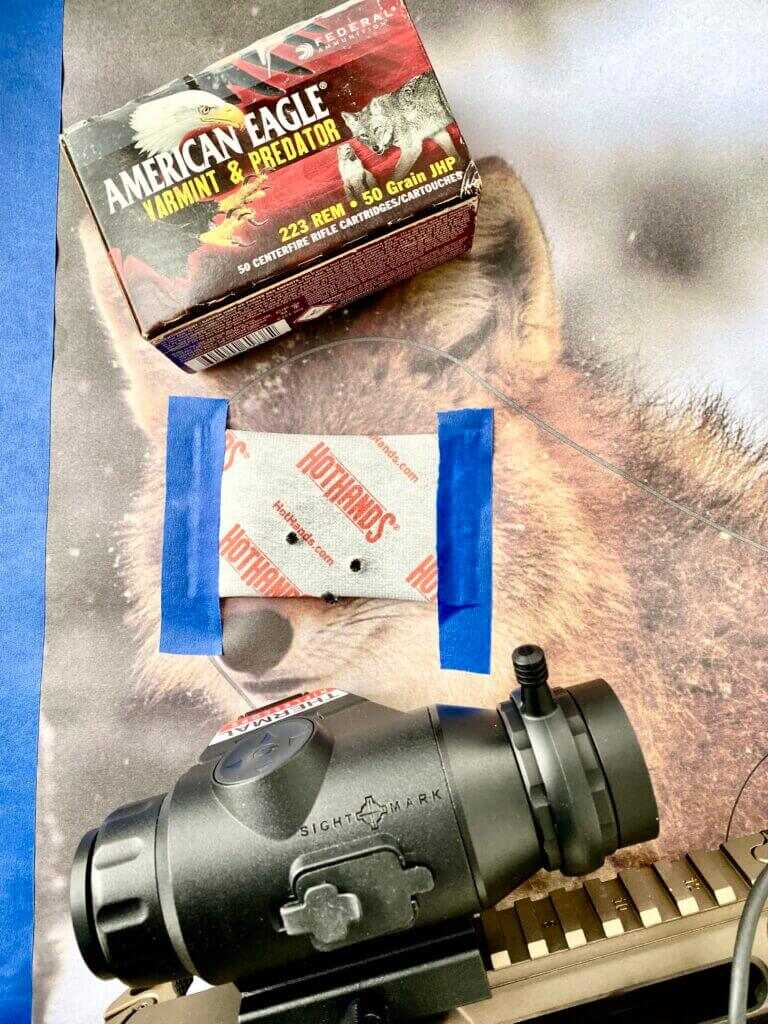
At this distance, the heat packs were still very clear, the edges apparent though not as sharp as they were at 50 yards. The cardboard backing showed up clearly, too, as did various slightly warmer objects like the wooden poles holding up the targets.
The air temperature during my shooting was 30 degrees Fahrenheit with 85-percent humidity and a fairly steady ten-mile-per-hour wind pushing in from left to right.
Night Hunt Performance: What the Shade Sees After Dark
I test out accuracy and general function during the day because shooting at night generally results in an interview by the police. But thermals are night gear. I detached the Shade from the Super Duty, and that night visited areas where animals frequent, and I generally know the distances.
The Shade had the best detection and identification range compared to any of the five $1K and under thermals I’ve used. I spotted whitetail does at approximately 140 yards and clearly saw the outlines of their ears and the knee crook of the rear legs. The warmer centers of the animals glowed more intensely than the head and rear ends.

As expected, I had no problem viewing the row of apartments 800 yards away. What impressed me was the way the warmer windows were so nicely outlined at that distance. Similar 256 sensor thermal units I’ve used presented the windows as blobs.

The Shade took pretty good photos, especially at lower magnifications. Video captures were decent.
Sightmark Shade Pros and Cons After Real Range Time
- Pros: Straightforward Menu choices, attached Picatinny Mount, Compact Size, Best in class (for this reviewer) short to medium range detection and identification.
- Cons: Control button pads need some raised texturing as they can be hard to ID with fingertips. The CR123 batteries drain too fast, faster than the manufacturer’s thermal run time ratings for sure (which, admittedly, could be the manufacturer fudging the ratings). But a new pair of Energizer lithiums lasted only two hours, essentially half of the battery life rating. And I used the battery pack for much of my initial shooting. If you buy the Shade, seriously consider the battery pack purchase, too. (Many thermal makers now provide rechargeable lithium batteries, and they are far superior to CR123’s.) The huge magnification range looks great on the specs, but in the field has limited uses. The base 3.5x and the 7x worked great, 10.5x decent, but above this range, things got blurry and distorted. You actually have to go into the Menu and select which recording function you want, photo or video. If you want to switch over? You have to go back into the menu.

Final Verdict on the Sightmark Shade 3.5-28×30
For $1,000, this Shade model will allow the night hunter to successfully take on coyotes and hogs easily out to 200 yards and maybe further. Compact and lightweight, the Shade doesn’t feel like a brick strapped onto your rifle receiver as some very heavy thermals do.
With easy-to-master menus, the Shade is a great entry-level thermal for newbies. However, given the unit’s overall effectiveness, it actually might be the only thermal night hunter ever needs.

Related Reads from GunsAmerica Digest
- Heat Seeking Optic: Sightmark Wraith Mini Thermal
- Infitac IOL25 Thermal Review: Tiny Body, Big Wins
- InfiRay Outdoor RICO RH50 V2 Thermal Riflescope Review
Available on GunsAmerica Now

Brian McCombie (Writer)
A full-time writer, Brian’s work focuses on hunting and firearms, day and thermal optics, and other shooting gear. He’s been fortunate enough to hunt much of the USA and Canada. His favorite hunt is chasing Texas hogs at night using a suppressed rifle outfitted with a thermal scope.
Dream hunt: Alaskan brown bear.
He’s taken handgun self-defense courses and long-range rifle classes for hunters. Brian continues to dive deeply into the new technologies so much a part of today’s hunting and shooting experiences.
His top firearms include AR-15’s and AR-10’s, double-stack 1911’s, and lever actions.