
Estimated reading time: 13 minutes
The Tiger’s reputation was loud, but the Sherman’s reliability, speed, and rate of fire won real fights. Here’s how the myth met reality on WW2 battlefields.
World War 2 Scale: The Cost, the Machines, the Stakes
World War 2 was the most expansive conflict in the history of the planet. Seventy million soldiers served. Some seventeen million of those died. One fourth of the men who wore the uniform between 1939 and 1940 perished. WW2 left a scar on humanity that may never fully heal.
WW2 drove technology in ways not seen before or since. The science of radio, radar, armored vehicles, submarines, aviation, and computers got a boost from that existential fight for survival that might never have occurred otherwise. We are ourselves beneficiaries of all that today.
Evolution in Action: How WW2 Tank Design Turned Chaos Into Innovation

As each combatant nation mobilized its economy behind the war effort, military evolution followed some unexpected paths. Speaking in sweeping generalities, the Germans opted for quality over quantity, the Japanese essentially fought with the designs they originally brought to the table, and the British and the Russians just tried desperately not to die. Meanwhile, the United States churned out top-quality war materiel at an historically unprecedented rate.
We started the war with seven aircraft carriers. Production of capital ships essentially ceased by D-Day. By war’s end, we had fielded 111 flattops of various sizes. At the height of production, we were launching a new F6F Hellcat fighter every hour, around the clock. Once we got fully tooled up, we were also producing some 65,000 M1 carbines every day. Our enemies never really stood a chance. A quote once spuriously attributed to Josef Stalin opined, “Quantity has a quality all its own.”
Tank Tech: Why America Built Shermans By the Tens of Thousands
In few places did this axiom play out more starkly than in the field of armored vehicles. The Germans essentially hand-built their tanks, upgrading to entirely new models as soon as the technology advanced. By contrast, the United States tooled up to produce the M4 Sherman medium tank and then built them like there was no tomorrow.
During the course of the war, Germany fielded a total of 49,777 tanks of all types. That’s 1893 Panzer I’s, 3404 Panzer II’s, 6627 Panzer 38(t )’s, 15747 Panzer III’s, 13522 Panzer IV’s, 6557 Panzer V’s, 1368 Tiger I’s, and 569 Tiger II’s. Meanwhile, the Russians built 57,300 T-34s. We produced some 50,000 Shermans alongside countless lighter and heavier models. The British also built 27,528 tanks and self-propelled guns. The Germans were lyrically outnumbered.
Reputation Is a Weapon: Tiger Fear vs Sherman Reality
Along the way, the big German cats, specifically the Panther and Tiger, developed an outsized reputation on the battlefield. Part of this was real, and part of it was just clever marketing. Regardless, the tank-killing power of the high-velocity, long-barreled 75mm and 88mm guns used on the Mk V and Mk VI tanks was rightly feared.
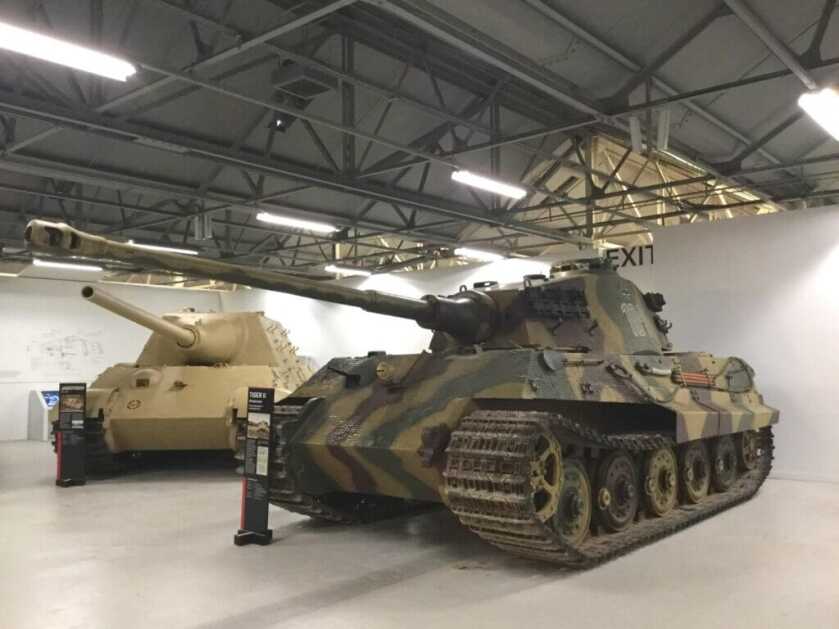
This reputation pervaded the thinking of the era. It was widely presumed that the Sherman was hopelessly inferior to its German counterparts. This mindset persists to this day. In the simply amazing David Ayer movie Fury, the epic lopsided engagement between four Shermans and a single Tiger anchors the plot. However, reality was not quite so straightforward.
Details: Misidentification, Mk IV Look-Alikes, and Tank Destroyers
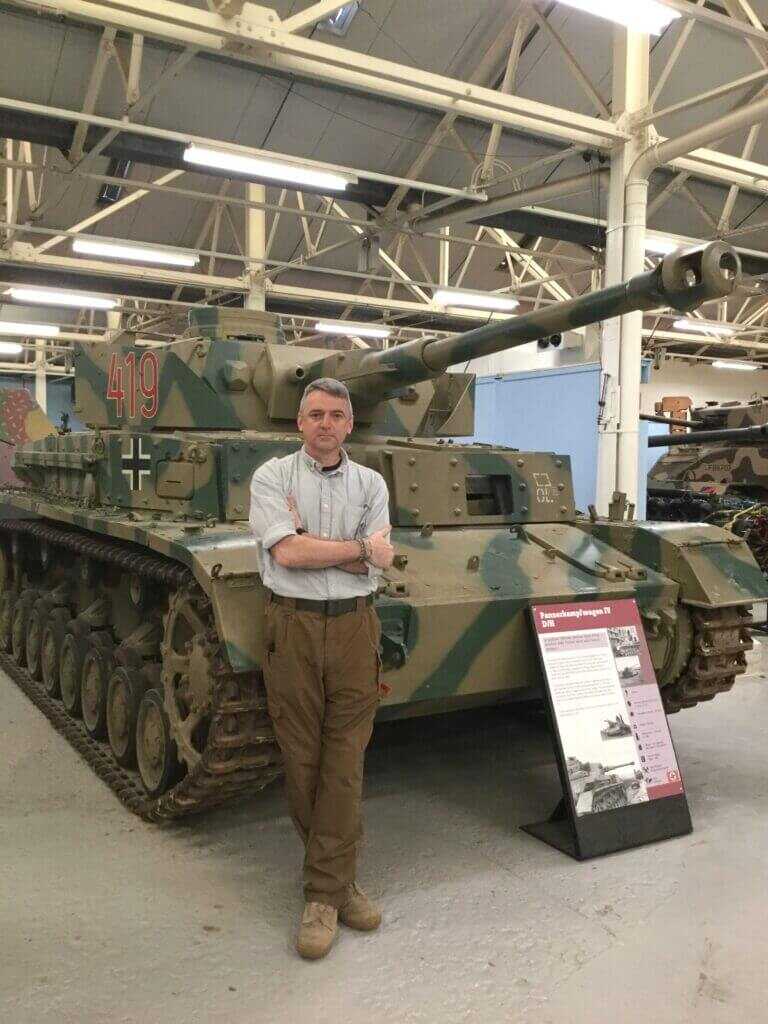
Allied troops of the period reported most any German tank they encountered as a Tiger. This is understandable. The Mk IV was the second most-produced German tank of the war. The later Mk IV variants equipped with a long-barreled 75mm gun looked very similar to the Tiger I, if markedly smaller. Factor in smoke, distance, and the chaos of combat, and misidentification is entirely understandable.
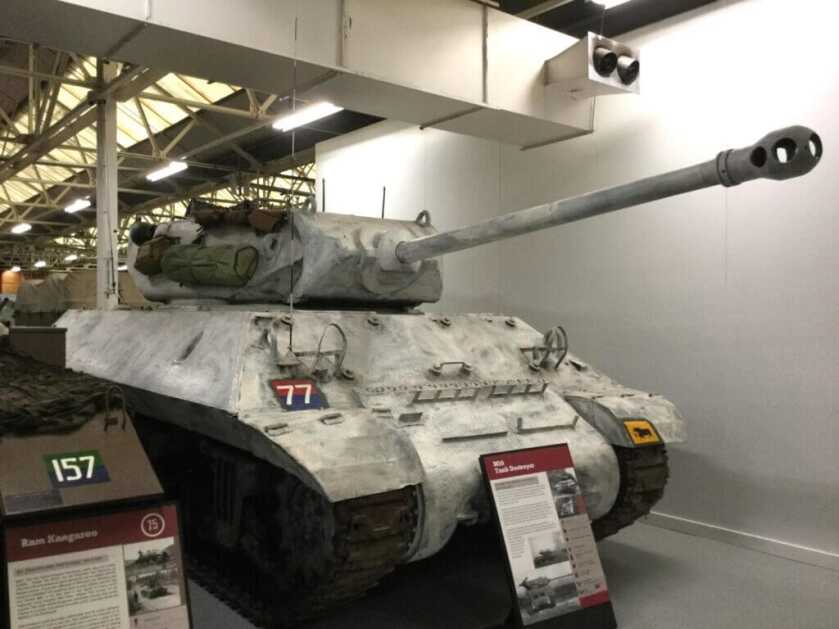
Tank-on-tank combat on the Western Front was actually somewhat unusual. The American M18 Hellcat tank destroyer was a lightly armored, open-topped vehicle sporting a 76mm high-velocity gun. The M18 was extremely fast (the top speed was listed as 55 mph) and was designed as a dedicated, highly mobile antitank weapon. By contrast, American Shermans were doctrinally deployed as infantry support vehicles.
Sherman Specifics: 75mm HE, 76mm Punch, and the Firefly’s Big Stick
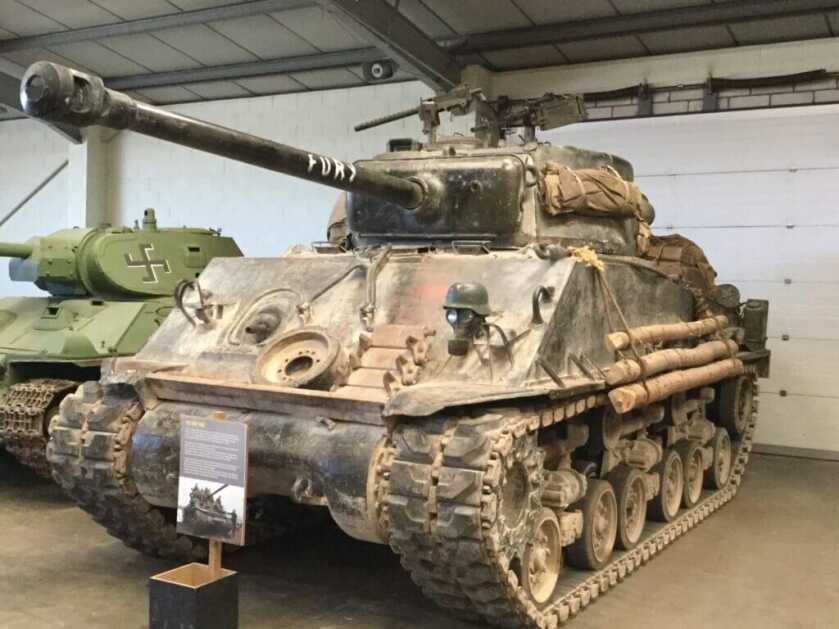
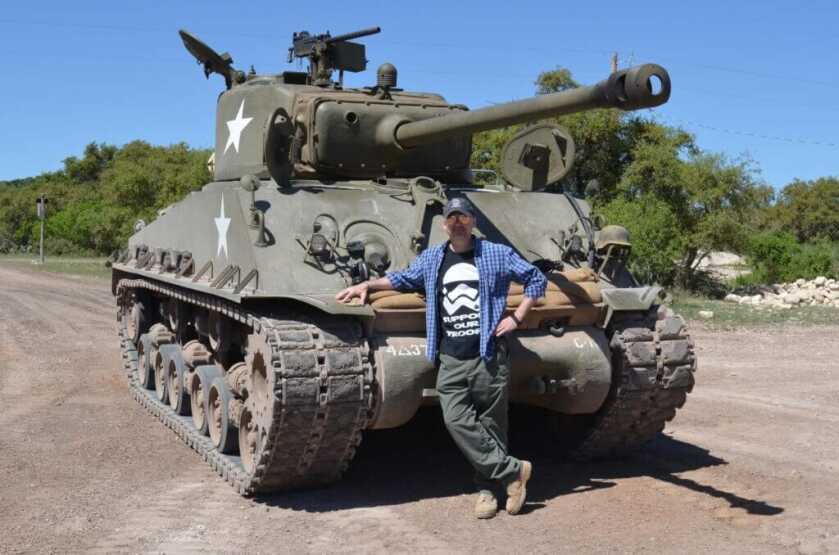
The Allies fielded Shermans in three broad variants. There were scads of sub-types, but these were the major models as defined by their main gun armament. The basic M4 sported a relatively low-velocity, short-barreled 75mm gun that fired an exceptionally effective high-explosive round. The M4A2E8 depicted in Fury wielded a higher-velocity 76mm gun that was more effective against armored targets, though somewhat less so against infantry and fixed fortifications. These larger guns could be found both with and without muzzle brakes.
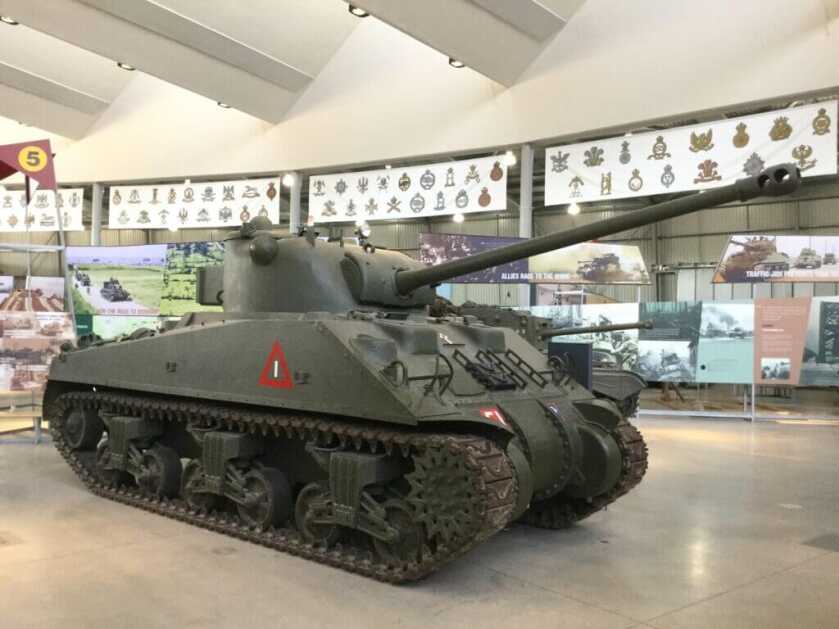
The Firefly was a standard Sherman chassis upgunned with a British 17-pounder anti-tank cannon. This quick-firing 76.2mm gun featured an extended barrel that produced a correspondingly higher muzzle velocity. The Firefly’s main gun was proof against most anything the Germans fielded. However, the bulky nature of the weapon made operations in uneven terrain or congested spaces difficult. British Fireflies were typically farmed out piecemeal in support of more conventional armored units.
What is often lost in the timeless argument pitting German against American armor are the salient benefits of the Sherman’s superlative drivetrain and fire control systems. Not only was the Sherman markedly more reliable than the Panthers and Tigers it faced, but the M4 also included a gyro-stabilized gun that made it much more accurate when firing on the move. Those stubby 75mm cannons also offered an amazing rate of fire.
War Story: Sherwood Rangers vs SS Tigers in Normandy

The Sherwood Rangers Yeomanry (SRY) was a British armored unit that fought in North Africa and then all the way across Europe from D-Day until the armistice. A part of the British Territorial Army, they were formed regionally much like our own Army National Guard. The SRY’s bloody slog across Europe was catalogued in the superb book Brothers in Arms. Brothers in Arms offers gritty, up-close descriptions of armored combat throughout WW2. A compelling read, it is available on Amazon.
The Sherwood Rangers Yeomanry fought their way across Europe using American Sherman and Stuart tanks sprinkled with a few Fireflies. One particular engagement took place toward the end of June 1944 in the congested countryside of Normandy. The Allies were desperate to expand their invasion beachhead, while the Germans pushed every available unit into action, trying to stop them. This desperate battle ultimately pitted the Shermans of the Sherwood Rangers Yeomanry against the Tigers supporting the 12th Waffen SS Division Hitlerjugend. This was the same unit that included the famed German tank ace Michael Wittman.
The Fight in Normandy: Point-Blank, Fast, and Decisive
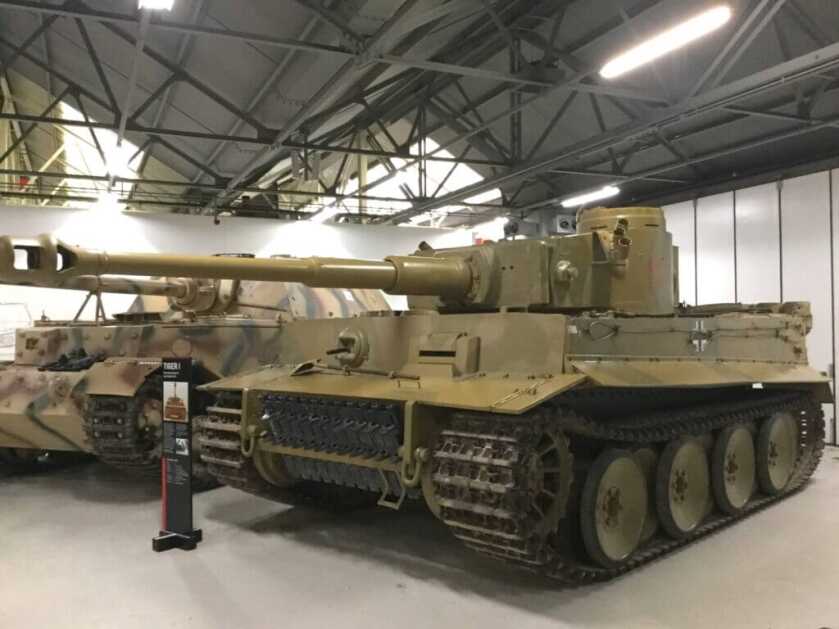
Combat at this time and place was all chaos and confusion, with friendly and enemy units intermixed amidst the fog of war. This engagement began when a British tank commander named David Render spotted the head of a fellow tanker moving at speed above a nearby hedgerow. Assuming it to belong to one of his mates, his first inkling that something was amiss was when he recognized the distinctive black cap of the German panzer corps. This particular German tanker was commanding a Panzerkampfwagen Mk VI Tiger I, 56 tons worth of mechanized pain now charging forward at a terrifyingly close range.
A nearby short-barreled Sherman commanded by John Semken was first to get an angle. At a slant range of 120 yards, Semken ordered his gunner, Henry Simons, to fire the 75mm armor-piercing round they kept up the spout for emergencies. This hardened solid shot moved at around 2,000 feet per second and produced a prominent trace visible even in bright daylight. That first shot connected, but smoke from the muzzle blast and the tracer element occluded the space between the two vehicles. Amazingly, Semken’s crew then cycled off another nine rounds in the next thirty seconds. Simons tweaked the lay of his gun throughout to keep his shot on target as best he could, given the diminished visibility. Meanwhile, the rest of the British tanks also got tooled up. However, by then, the hapless Tiger was done.
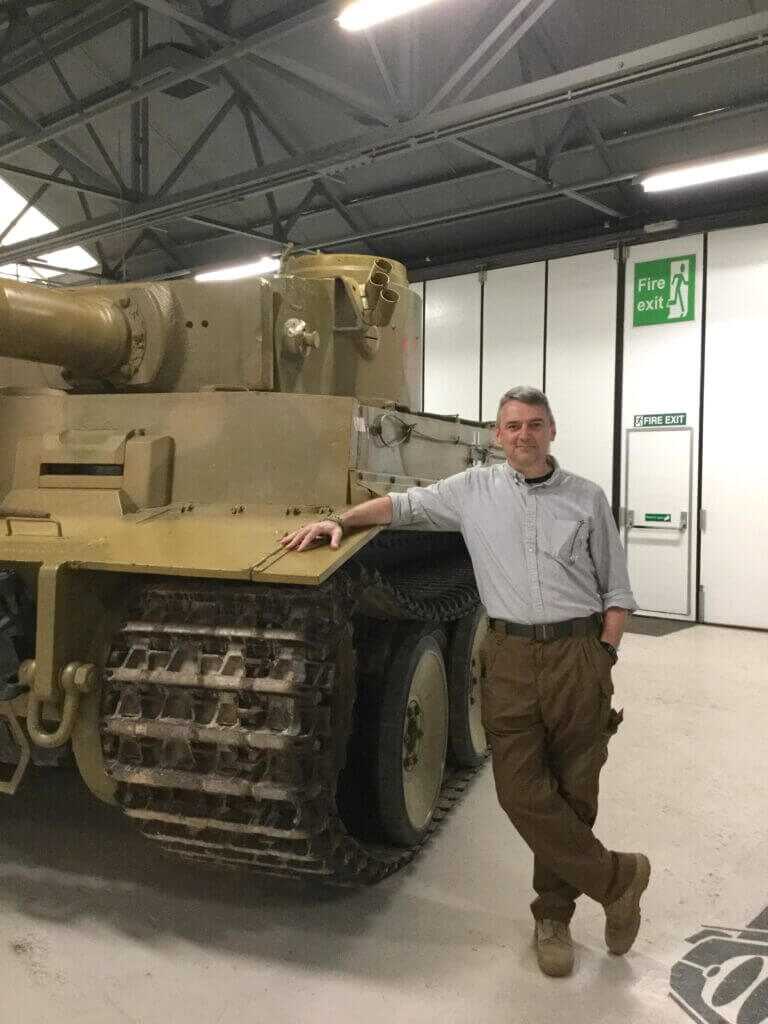
This big cat was from 2. Kompanie, SS-Panzerabteilung 101–Wittman’s outfit. The Tiger I sports some prodigious 100mm frontal armor. However, it was hot this day, so the driver had his hatch locked open. Simons’ first round struck the Tiger’s thick gun mantlet and showered the German driver with white hot steel splinters from above. The next nine rounds in such rapid succession did not brew up the German beast, but they convinced the crew to call it a day. The SRY captured the Tiger and its crew more or less intact.
One-on-one, the Tiger and Panther were objectively more formidable tanks than the Allied Shermans they faced. However, they were notorious for breaking down, particularly later in the war. They were also badly outnumbered and chronically short of fuel. Additionally, the capacity to fire an astronomical number of rounds on the move and in a short period of time obviously worked in the Sherman’s favor. While the Sherman’s high profile was much maligned, it was actually shorter than the Tiger and Panther and only two inches taller than the Mk IV that made up the backbone of the German panzer corps. In short, the Sherman was a fine tank that held its own against all comers when played to its many manifest strengths.
Ruminations: Driving a Real Sherman and Debunking the Legend
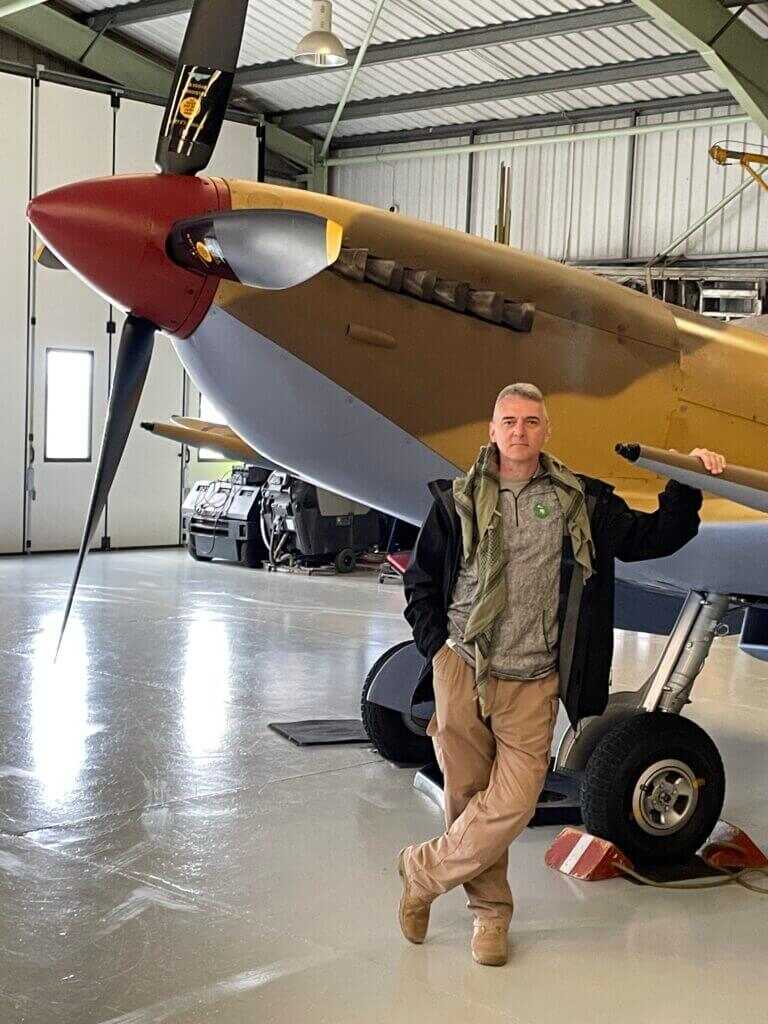
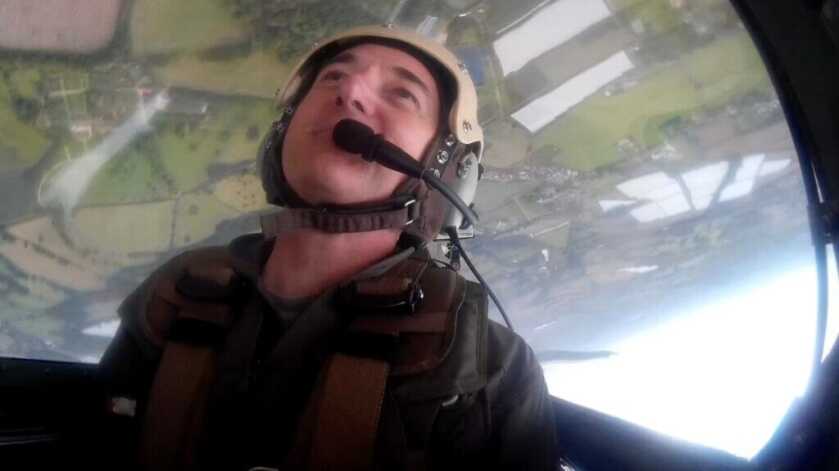
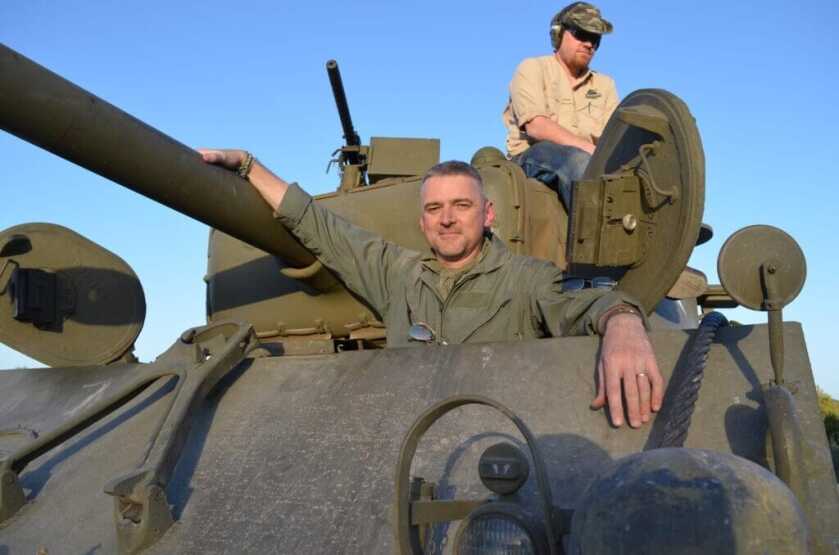
I’ve been described by friends as the luckiest man alive. That’s not necessarily hyperbole. I have had the privilege of flying a restored British Spitfire and have also driven a magnificent WW2-vintage Sherman tank. I even got to fire the main gun. Getting up close and personal with that 67,000-pound beast was a once-in-a-lifetime privilege. Your reading this stuff is what makes all that possible. Legit and from my heart, thanks.
We Americans have always made exceptional war machines. Even 75 years after it was produced, the running gear on that Sherman was remarkably smooth, and the drive train remained unnaturally reliable. In the hands of citizen soldiers drawn from free nations around the world, our mass-produced Shermans were instrumental in helping win World War 2. Even when pitted one-on-one against the vaunted German Tiger I, when deftly wielded, the Sherman could still be a formidable adversary.
Sherman vs Tiger Quick Facts
| Tank | M4 Sherman, Tiger I, Panzer IV |
|---|---|
| Main Guns | 75mm short, 76mm high velocity, 17-pounder |
| Weight | Sherman 67,000 pounds, Tiger I 56 tons |
| Armor Note | Tiger I frontal armor 100mm |
| Output | About 50,000 Shermans; Germany fielded 49,777 tanks total |
| Doctrine | Sherman for infantry support; M18/M10 for antitank |
Pros & Cons: Fearsome Cats vs Workhorse Shermans
- Pros: Sherman reliability and rate of fire; stabilized gun for accurate fire on the move; Firefly 17-pounder punch; massive Allied production.
- Cons: Early 75mm suboptimal vs heavy German armor; Tiger and Panther carried powerful long guns; urban or tight terrain challenged long barrels like Firefly’s.
Related Reads from GunsAmerica Digest
- The Real Sherman Behind Fury
- M18 Hellcat: America’s Fast Tank Destroyer
- Sherman Firefly and the 17-Pounder

Will is still trying to figure out what he really wants to be when he grows up. However, shooting guns and claiming it was work seemed like a pretty sweet hustle. As a result, Will serendipitously transformed an avocation into a vocation.
Raised in the Mississippi Delta, Will flew UH1H, OH58A/C, CH47D and AH1S helicopters operationally as an Army Aviator. He is SCUBA-qualified and has parachuted out of perfectly good airplanes at 3 o’clock in the morning. Will has summited Mount McKinley, Alaska, six times…always at the controls of an Army helicopter, which is the only way sensible folk climb mountains.
Will has delivered sixty babies and occasionally wrung human blood out of his socks. He is married to his high school sweetheart and has three awesome adult children. Turn-ons include vintage German machineguns, flying his sexy-cool RV6A airplane, Count Chocula cereal and the movie “Aliens.”
www.word-monkey.com
Experience:
-Professional Writer-thousands of publishing credits for dozens of titles
-Mechanical Engineer/Practicing Physician
-Instrument-rated Commercial Pilot
-Sunday School Teacher
Not a Tiger tank, but a German WWII Panther story:
My father was in WW II, 7th Armored Division, Technical Sargent. In looking at his war pictures, he took one of a German Panther Mark V, which he writes:
“When I first saw one of these in action, I thought it was dragging a telephone pole. Found out soon enough”.
Always enjoy your insight Dr.
Having been in the Armored Calvary in the 1980’s this is all I know: track laying vehicles are maintenance intensive. Like 24 hours a day when in the field. It’s a grueling backbreaking life. Then there’s the mud. You became an expert on mud. Mud- mud -mud. Did I mention MUD?
A friend’s Dad was a tank commander, probably company commander since he was a Captain. He had four Shermans blown out from under him and in three cases he was the only survivor. Baling out of one he was immediately engaged in hand to hand combat with a German who nearly cut his hand off. The Captain eventually killed the German with a knife. He always said if we had another world war he was dragging us both down to enlist in anything but armor because he saw so many tankers killed in what he thought was inferior equipment.
My Dad was an Army Reserve armor guy 1945-1957. A Master Sergeant tank commander. He was in the M26 Pershings which were superior to the German tanks. Introduced late in the war, only a literal handful of Pershing’s were deployed in the push into Germany in 1945.
I watched a documentary years ago in which a WWII British tank commander was interviewed. He related that their M4 Shermans had the unenviable design flaw of having ammunition stored above the tracks, which made the tank very vulnerable to catching fire when hit (this being remedied by moving ammunition storage to the hull floor in a later design). He added that this occurrence was commonplace and led his compatriots to refer to the Sherman as a “Tommy cooker”, a dark play on the portable field stove of the same name.
He related an encounter with a Tiger I, in which he attempted to avoid the larger foe by placing his Sherman behind a large brick building. To his surprise, his Sherman was disabled when the German tank gunner simply fired through six to eight brick walls between the vehicles.
At the end of the interview, he claimed that in the event a disabled Sherman was deemed salvageable the tank was thoroughly cleaned and repainted, but they couldn’t mask the smell of the burned flesh from the previous crew.
Thank you for your articles. The rewards garnered from your writing are well-deserved.
My Dad was a tank platoon commander, 3rd Armored Div. Saw action from Normandy to Battle of The Bulge. His little Sherman Mk4 took out 2 German tanks, one a Panther & the other a Tiger. He had after action photo of he & his crew by Tiger with cupola blown off. Yes, the Sherman was a worthy opponent to the German hardware.
J.E.Hopkins, Ohio
My Dad was a tank platoon commander, 3rd Armored Div. Saw action from Normandy to Battle of The Bulge. His little Sherman Mk4 took out 2 German tanks, one a Panther & the other a Tiger. He had after action photo of he & his crew by Tiger with cupola blown off. Yes, the Sherman was a worthy opponent to the German hardware.
J.E.Hopkins, Ohio
Nice. My Dad was a combat medic and served with various units, including the 3rd Armored.
I wonder if he was the medic who cared for
my Dad when was blown from his tank on 12/22/44, in Belgium.
I have correspondence home from my Dad showing that he was in Holland on 12/22/44, and was in Germany by 1/1/45. Nice thought, though.