
Estimated reading time: 9 minutes
There are a few movies that stand out to your average gun guy. Heat is a classic, so is Collateral, and we get the John Wick series too. One of the more underrated gun guy flicks is Leon: The Professional.
The Professional is an awesome movie. Jean Reno plays an assassin employed by a skeezy, low-level mobster. We don’t see much backstory on the man, but when it comes time to sell his wares, he’s an expert. Dare I say a professional? Leon’s chosen firearms are a pair of Beretta 92FS pistols fitted with a custom compensator.

Table of contents
Hero Guns
There is a concept in movies, TV, comics, video games, and more called Hero Guns. Hero Guns are always eye-catching and interesting. For visual media, they allow the hero to stand out. A hero gun could be John Wick’s P30L with its custom comp, Judge Dredd’s Lawgiver, Robocop’s Beretta, and, of course, the Terminator’s lever-action Winchester shotgun.
For Leon, his hero gun was that custom Beretta. The Beretta 92 series absolutely dominated action movies in the late 80s and early 90s. It made appearances in Die Hard, Lethal Weapon, Kuffs, and more than I care to list.

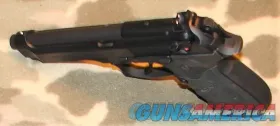
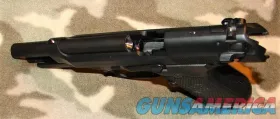
To make Leon’s Berettas stand out in a crowded field of Beretta-fueled action flicks, the armorers added custom compensators. This created a pair of firearms that entered a realm of legendary status. As a fan of 90s action flicks and Beretta pistols, the moment I found a similar firearm, I slapped my cash down and took it home happily.
All About The Compensator
Leon had a pair of 92FS pistols, and mine is a simple 92F. It’s a small difference, but in a world where guys obsessively clone firearms down to the finest detail, it has to be mentioned. The compensator is not an original either.
Leon’s pistols wore Al-Gi-MEC compensators, which were Italian-made and extremely rare. Italy has a history of IPSC shooting and sport shooting in general, so it’s no surprise that they would produce a compensator for the Italian-produced Beretta pistol. Sadly, they didn’t produce a ton, and they certainly didn’t make an import effort either.
Interestingly, they didn’t require a threaded barrel. Instead, they installed via a specialized guide rod, and the compensator was attached to the guide rod. This design seems inefficient, but threaded barrels simply weren’t as common in the 1990s.

Al-Gi-MEC compensators are impossible to find, but that doesn’t mean the cause was lost. An Italian company called SGS produced nearly identical compensators. Then SGS went bankrupt.
A company called HEC manufactured compensators, which they referred to as the HEC/SGS compensator; however, these were short-lived. Finally, the last bastion of this style of compensator came from a fella named Ric70506 on the Beretta forums, who began making small productions of this compensator.
It’s unclear if he’s still making them, and he doesn’t have a website, and the last email address I found for him bounced my email back. If you browse through various forums, you might have the opportunity to find Ric and his comps.
Breaking Down The Comp
These compensators have to be fitted to the gun. With previous models, you either needed a gunsmith or to be handy with the tools. With Ric’s compensators, you sent him a series of measurements, and he could fit the comp to your gun.
The compensator consists of three blast ports. We have two large ports and one smaller one. The compensators use a stainless steel blast chamber surrounded by aluminum, so the compensator is fairly lightweight.

Unlike more modern designs, there are no side ports present, so it’s purely a compensator and has no braking effects.
The compensator balances well on the Beretta 92. It’s easy to see why Leon liked them. The rear-heavy design of the Beretta 92 helps a lot, and the open top slide cuts a lot of weight up front. When aiming, you won’t feel the gun dip or want to drive down.
Until you pull the trigger.
Shooting Like Leon
The Beretta 92 series is are soft shooter. The thick grip disperses recoil well into the hand, the heavy metal design absorbs recoil, and the lightweight slide doesn’t create excessive movement in your hand as it reciprocates. The massive compensator this gun wears takes a gun that’s 9 out of 10 for control and amps it up to eleven.
This style of compensator wasn’t trying to be micro-sized. Many individuals are installing compensators on their carry guns, which is causing the compensators to shrink in size, thereby reducing some of their effectiveness. Two massive ports and one slightly smaller port are redirecting a lot of gas upward.

This drives the gun downward and keeps you on target. In fact, it’s so utterly effective, I had to pause for a microsecond and realize the recoil impulse and muzzle rise were over. Muscle memory of shooting shot after shot after shot with a comped gun told me the recoil impulse should be a nanosecond longer.
I understand why Leon was so efficient shooting his Berettas with one hand and even dual-wielding. They’re barely moving! I joke, but seriously, this massive compensator makes a substantial difference in how the Beretta 92 handles.

I don’t have a holster to hold this beast, so I fired a Bill Drill, but from the low ready. It took me 1.7 seconds, and to be fair, I’ve only scored sub-2 seconds from the draw once. The compensator makes it easy to almost thoughtlessly pull the trigger without the gun rising off target.
I would love to see the Bill Drill time this thing can generate in the hands of a skilled shooter.
Going Pro
Compensators can famously affect the reliability of 9mm handguns. Shooting 115-grain ammo can often cause some guns to malfunction and fail. That’s not the case with my version of the Leon gun. I fired Monarch steel-cased 115-grain ammo through it, and it never failed to feed, extract, or eject.
I’m no expert, but I think this gun and comp combo’s reliability comes from the fact that it’s not attached to the barrel. It doesn’t add weight to a recoil-operated system and therefore doesn’t compromise its reliability. Not using a threaded barrel seems inefficient, but it clearly has its upsides.

The lack of recoil also improves my accuracy; this particular 92F is blessed in the accuracy department. At 15 yards, I was able to put five rounds into a two-inch circle. Sometimes a shot or two would break the line, but it counts in all the scoring conventions I’m aware of.
The comped Beretta is an absolute beast, and it’s a ton of fun. The armorer of the film, Christophe Maratier, is a particularly well-established European armorer. He’s worked on the John Wick films, the Taken films, and even cult favorite Ronin.

He had a good command of firearms and firearm efficiency. The comped Beretta 92s would have been a high-tech option in 1994. The pistol was in its glory days and offered excellent capacity, an established reputation, and the compensator put it over the top.
READ MORE HERE: Hands-On: The Canik Mete MC9 Prime
Where They Got It Wrong
One thing the movie gets hilariously wrong is when Leon pairs his compensator with a suppressor. The suppressor starts at the end of the compensator, which renders it hilariously ineffective. The exploding gas coming out of the compensator would make the suppressor useless.

Also, what is the suppressor attaching to? The barrel isn’t threaded, and the inside of the compensator isn’t threaded. So I guess thoughts and prayers hold it on the gun.
While the suppressor is absurd, the gun is not. Comped guns aren’t typically used for fighting; they tend to be oriented to competition shooters. The Beretta doesn’t lose a lick of reliability when wearing a compensator, and you get substantial muzzle rise reduction.

Leon’s Beretta is a competent fighting pistol, and in 1994, it would have been what the kids call high speed. I love it when movies have a hero gun that not only stands out, but can be an efficient weapon that’s not just over the top to be over the top.
If you get a chance to get your hands on a Beretta wearing a SGS, HEC, Ric, or even Al-Gi-MEC, I say jump on it; you won’t regret it.
*** Buy and Sell on GunsAmerica! ***
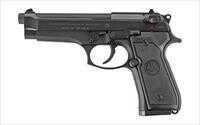
Available on GunsAmerica Now

Travis Pike is a dedicated firearms writer, a Second Amendment Advocate, and a subject matter enthusiast for all things firearms. He is an amateur competitor with dreams of one day not coming in 4th place at a local defensive match. If he’s not putting text to word processor, he’s likely spending time with family, enjoying Florida’s Nature Coast, or drinking hipster beer. As the resident Florida man he has a preference for obscure guns and calibers.
Experience
- Hunter – Long time deer and hog hunter in the swamps of Florida
- Instructor – Volunteers to teach basic firearm safety classes to kids, adults, and cats
- Wannabe Competitor – Has recently dipped his toes into competitive shooting and has happily discovered an expensive hobby.
- Marine – Served five years with the infantry before transferring to the First Civ Div.
Question: As an assassin, most of Leon’s shooting would consist of one shot per job. Very little rapid fire and thus little need for muzzle control for follow up shots. Does a brake contribute anything besides extra weight and bulk?
Great movie…with the moral ambiguity storyline…who could forget Gary Oldman screaming EVERYONE !! …Reno teaching Portman how to be a hitman just unforgettable ..
Travis,
Excellent article, you did your research. Many years ago I was able to purchase an SGS reproduction from Rick off the Beretta forum. I was lucky enough to be able to get the raw aluminum version that he bead blasted to give it a matte silvery finish that matched my OG Italian made straight dust cover 92F Inox perfectly.
I believe that the gap in between the two support arms at the bottom rear of the comp that attaches to the dust cover were too wide and thus has caused some wear against the dust cover but that’s ok because it stays hidden. The guide rod is a two piece captured with a screw. This does make it a pain to field strip and clean the pistol but that’s ok. I can say that the comp is very effective at reducing recoil and greatly increases the accuracy of the 92F, but the reason I purchased is for the aesthetics and it doesn’t disappoint, the gun looks amazing.
Excellent movie, that’s a fact and one many people seem to have never heard of. Glad you brought it up!
One of my favorite movies of all times! Also one of the sweetest (non-romantic) love stories of all time! Course I might be biased because of all the guns.
Just FYI, the movie was released with at least 3 titles, depending on where/when it was released.
“The Professional”
And
“Leon’s story”
And more recently,
“León: The Professional”
1. Yes it does have a braking effect. The ports don’t have to be in the sides for that. Physics 201.
2. John Wick was the silliest nonsense ever to be not animated.
The Professional is a great movie; one of the first DVDs I ever bought and a stellar representation of the 1990s action flics. Probably the best movie, character, and acting of Jean Reno’s storied career. While the pubescent Natalie Portman’s singing of Like a Virgin is creepy, Gary Oldman puts the evil into his corrupt DEA agent character to perfection. Watch it!
I always hoped that Natalie would be tapped to make a sequel as an adult. Formula movie where her kid(s) are kidnapped and she’s forced out of “retirement” to do a “job”. Or, some scenario to protect her husband from nasties. In either one, she takes out the bad guys in the end. Something along those lines.
Lyle