

Estimated reading time: 1 minute
After hearing that Leica was releasing the new Geovid Pro 10×42 AB+, I began scouring the internet for information. I wanted to know what improvements had been made to the menu, display, rangefinder, app, and so on. My search proved to be in vain, and I was left wondering whether this new rangefinding binocular was a significant enough improvement over the Leica Geovid Pro to justify a purchase.

Table of contents
I had previously tested the Leica Geovid Pro 10×32 AB+ against the SIG Kilo10K-ABS Gen 2. As a long-range shooter, I felt the Leica 10×32 Pro wouldn’t provide the level of accuracy I needed, even though its glass was better than SIG’s. I was very excited when I saw Leica had released a new version of their range-finding binoculars with Applied Ballistics onboard. From what I could tell, they had a more powerful rangefinder. I was hopeful that they had also improved the menu, app, and overall user experience.
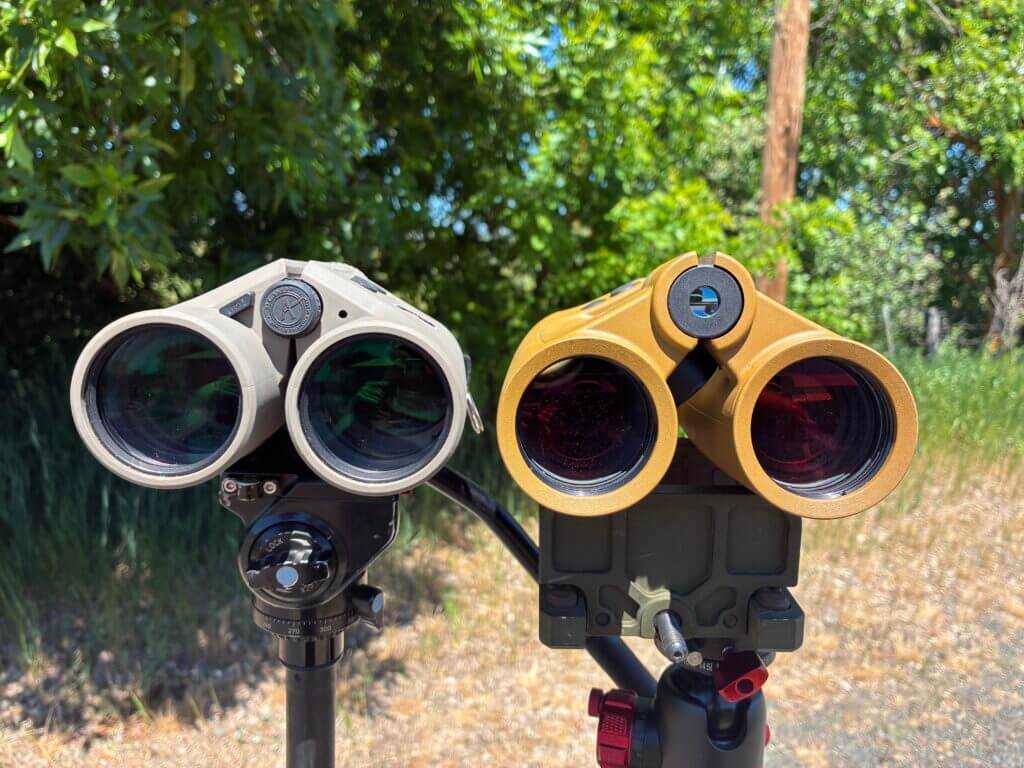
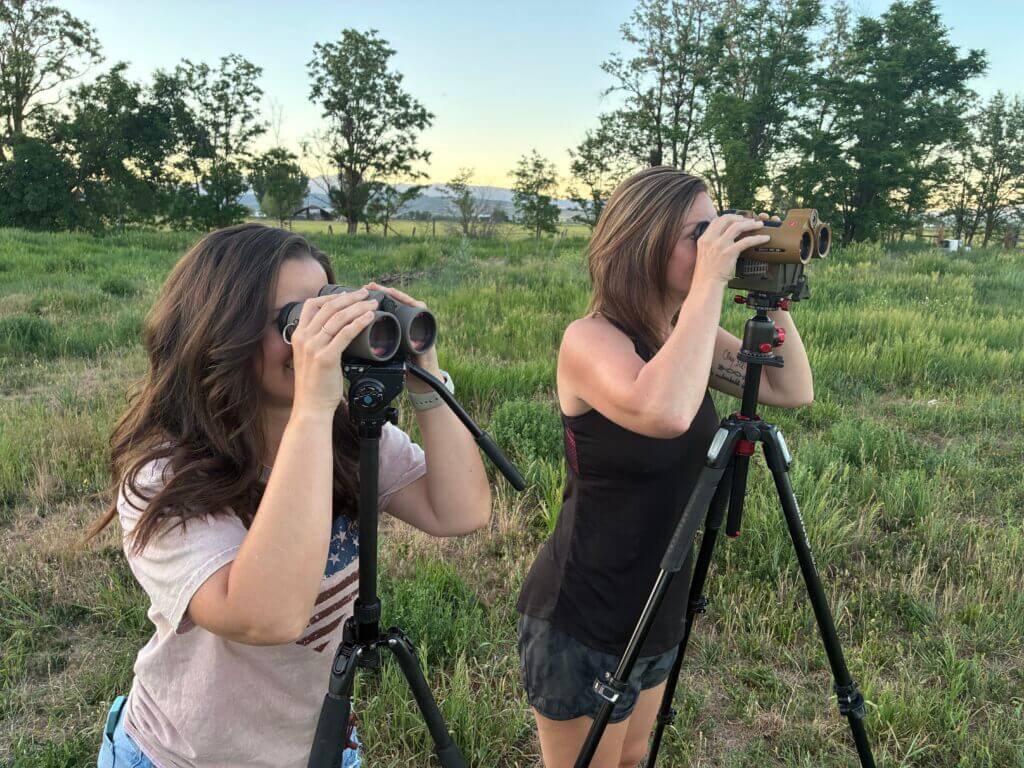
When I finally found a pair of AB+ binoculars for sale, I bought them for the purpose of testing them against the SIG Kilo10K, even though I had only recently purchased the SIGs. I am not sponsored or endorsed by either of these companies and paid for both pairs with my own money (I’m still married, for now). The following is not a regurgitation of the specs—those are readily available. This is my personal experience and opinion on how these two 10×42 range-finding binoculars stack up from a hunter’s and shooter’s perspective.
Rangefinder – SIG KILO10K Wins
The SIGs win this category hands down, as they should with a claimed 10,000-yard range. But it’s not just about distance. The beam is also tighter, making it more likely to hit the target you’re trying to range. It’s also faster and works better in fog.
This was one of my biggest complaints about the Leica 10×32 Pro. For example, brush or trees beside or behind a target made getting an exact range nearly impossible due to beam accuracy. When I thought I’d ranged a target correctly, the beam was actually hitting something 30 yards behind it. This may not matter at short distances, but at 900 yards, that’s a miss.
After extensive side-by-side testing, I found the SIGs more accurate at hitting the desired target due to their beam size.
Range and Power
Leica did improve the range and power of the rangefinder in the new Geovid Pro 10×42 AB+, but it’s still a ways behind the SIG. At 1,000 yards, the beam on the Leica AB+ is 65W x 29T inches. The SIG’s beam is 54W x 2T inches—a significant difference.
I also found it easier to hit targets using the SIS’s range button. The Leica’s button made it harder to keep the binos steady while ranging, comparable to using a rifle with a 4-lb trigger versus a 2-lb trigger.
That said, the AB+ is a big improvement over the 10×32 Pro. With that model, I struggled to get consistent readings past 1,200 yards on animals or landscape. The AB+ consistently ranged out to 1,800 yards, with a max range of 3,160 yards. The SIGs consistently reach 3,000 yards, with a max of 5,634 yards. I didn’t have a way to lock either bino into a tripod, and I’m sure more range could be achieved with one.

Glass – Geovid Pro AB+ Wins
The Leicas win this category easily. While the glass on the SIGs is good, it can’t match the remarkable image clarity from the Leicas. This is noticeable in all lighting conditions and becomes especially clear at long ranges.
After spending a lot of time behind the SIGs, I convinced myself the glass was top-tier, and it is decent. But when I switched back to the Leicas, I was reminded of what true alpha glass does to the viewing experience. The image is simply sharper and better. At distances over three miles, I could spot elk with the Leicas that I had missed with the SIGs. I would then return to the SIGs and, now knowing where the elk were, see them—but my brain didn’t immediately register that I was looking at elk.
This happened repeatedly.
I’ve been using Swarovski glass for over 20 years, and I believe the Leica AB+ is among the best available. It is truly a joy to look through—and at its price point, it should be.
Menu – SIG KILO10K Wins
The SIGs win this category by a country mile, and this is my biggest complaint about the Leicas.
Navigating the Geovid Pro AB+ menu is frustrating. It’s essentially the same system used in the Geovid HD-B 2200, which I owned for five years. It was released around 2016. Everything is controlled via two buttons, with single clicks, double clicks, and long presses required to navigate. It sounds simple, but I often ended up in the wrong menu with the AB+, even with being familiar with the menu from the HD-B 2200s.
Leica did add a wind feature that can be controlled directly from the binos (not just the app). With enough practice, I could use it without cursing—but it’s still nowhere near as intuitive as the SIG’s wind feature.
Leica Menu Frustrating and Confusing
Using the Leica menu is like driving a car in a foreign country where you can’t read the road signs. You’re unsure of how you’re going to get to your destination and often end up cycling through features you don’t need multiple times.
The Leica user manual is also lackluster. After reading it several times, I gave up and turned to YouTube, which helped me become semi-proficient. Also, there’s an obnoxious blinking Bluetooth icon on the Leicas that I haven’t figured out how to turn off. It blinks regardless of whether the phone is connected, in airplane mode, or off. If there is a way to turn this icon off, I could not find it.
When you range a target with the AB+, it first gives you the elevation hold (e.g., 4.5 moa), then that disappears, and it shows the wind hold (e.g., .25moa), then that disappears too. There are three display durations: 1, 3, and 5 seconds. I started with 1, which was too quick to remember the numbers. I settled on 3 seconds, which is better, but I also don’t like waiting—animals that receive hunting pressure don’t hold still for long.
SIG Menu Home Run
With the SIGs, the menu is a home run. When you range a target, all the relevant information appears on the display at once: holdover, wind, bullet velocity, foot-pounds of energy, and which gun profile is selected. It remains visible long enough to refer back to without having to range again. I never even needed the SIG user manual—it’s that intuitive.
Another standout feature of the SIGs is the ability to lock environmental settings. The Leicas have the option to manually set this feature in their app, but I was unable to get it to transfer to the binos. With the SIGs, I can scroll through the menu in the binocular and set the temperature manually. This would be very beneficial during winter months to set the temperature to avoid inaccurate readings caused by transitioning between a 70°F truck and a 10°F environment. The same goes for carrying binos under warm clothing and next to your body. This manual override feature can be the difference between a hit and a miss. While that may not sound like a big deal, I have yet to get a shot at a wolf, and when I do, I most certainly do not want to miss due to my binos reading the wrong temperature.
Ergonomics and Design – Geovid Pro AB+ Wins
I give a slight edge to the Geovid Pro AB+ here. I prefer the SIGs’ smaller profile and lighter weight, but I don’t like how close the objective lens is to the edge of the barrel. My concern is getting the lens scratched if something’s at the bottom of my bino pack. It’s a minor complaint, but SIG could easily address it.
I also like Leica’s placement of the laser in the center hinge, rather than the barrel. I believe this contributes to its superior clarity.
Neither bino lost focus nor had eyecup issues in the field. Once adjusted, both held their settings. The Leicas needed less fine-tuning to achieve a clear picture, likely due to the superior glass. I found myself wanting to adjust the SIGs more in low-light conditions than the Leicas. The focusing systems on both were good, with the AB+ being slightly smoother.
I also feel like the fit and finish is slightly better in the Leicas. Both feel extremely durable. While I didn’t abuse them, I believe they could withstand significant wear.

App – SIG KILO10K Wins
The SIGs win again here, but it’s not a dramatic difference. Once you’re familiar with it, the Leica app is functional. However, the SIG BDX app shines with its syncing capabilities. When syncing profiles to the SIG binos, you get confirmation that changes have been received, which gives me a warm, fuzzy feeling inside. With Leica, I often found myself double-checking that everything had synced properly and that changes that had been made in the app got to the binos. The SIG app also has a larger bullet library, which makes plugging in your data faster.
Both apps include a ballistic truing system that is easy to use.
Both binoculars include a tracking system. I only used the SIGs, which integrate with OnX (already on my phone). Leica uses Basemap. I assume it works fine too—kudos to both companies for including this feature, which would be very helpful in finding down game across a drainage where you would lose line of sight with the animal.
The Geovid Pro AB+ also includes a “shot probability analysis,” which estimates your likelihood of hitting a ranged target. I didn’t use it, as I have a strong understanding of my capabilities on whether or not I and my weapon system can make a hit. However, I can see this being valuable for others who do not have as much experience in long-range shooting and want to only take ethical shots.
Both binoculars use Applied Ballistics, which is the best shooting app on the market, in my opinion. I used these binos side by side for weeks, ranging the same targets with both of them, over and over. The calculations were close enough to each other that you couldn’t dial for the difference using 1/4 moa corrections.
Price – SIG KILO10K Wins
As of this writing, the Leica Geovid Pro AB+ retails for $3,849.00, and the SIGs for $2,699.00. While I’m willing to pay extra for alpha glass, I don’t believe the AB+ is $1,150 better than the 10K’s in terms of optics alone. Conversely, the 10K’s are easily worth $1,150 more than the AB+ in terms of electronics. Financially, the SIGs are the better bargain.

READ MORE HERE: REVIEW: NOCPIX QUEST H50R Thermal Rangefinding Binoculars
Conclusion
I never thought that I would ever use anything but alpha glass for hunting after using it for the last 20 years. However, with the incredible advancements in long-range shooting, the need for ultra-precise electronics has increased. After testing both range-finding binoculars side by side (I literally wore two bino packs while hunting this spring), my conclusion is clear: the SIG Kilo10K is the better tool, especially for hunters wanting to take advantage of long-range shots.
I confirmed this on rock chucks out to 1,100 yards. I hunt year-round, for a variety of animals—elk, deer, bears, antelope, turkeys, wolves, coyotes, foxes, badgers, rock chucks, squirrels, and starlings. My rifles and loads range from .22 long rifle to 7PRC. The SIGs handle this versatility without issue.
If I were only hunting mule deer (my favorite quarry) or Coues deer, I’d opt for the Leicas. These animals are hard to spot, and alpha glass makes a real difference. They are the very reason that I started buying alpha glass twenty years ago. While the AB+ may not give me the confidence to make every conceivable shot on a deer, they would for about 75 percent of the shots I have encountered so far. And you won’t kill 100 percent of what you can’t see.
Opinion of 6 More People
During this test, I had six others (some experienced shooters, others more casual hunters) use both binoculars. All currently own optics with alpha glass. Without knowing my opinion, they all said the Leica had slightly better glass, but they unanimously chose the SIGs for themselves, citing reasons ranging from the display, menu, and rangefinder to price and overall size of the optics. Two plan to buy the SIGs after using them. (Both are very experienced shooters and are currently using Leica Geovid 3200.com and the other Swarovski EL Range.)
I hope that one of these companies will finally release a rangefinding binocular that combines cutting-edge electronics with true alpha glass. SIG is closer to achieving that than Leica. I don’t know why they haven’t yet put alpha glass in the Kilo10K—if they did, they would make all other rangefinding binoculars obsolete.
As it stands, in my opinion, alpha glass is the only thing keeping Leica competitive in this market.
Here’s a link to the Leica
Here’s a link to the SIG
*** Buy and Sell on GunsAmerica! ***

Jorden Doggett brings real-world experience and precision to the GunsAmerica team as a law enforcement sniper, certified firearms instructor, and dedicated long-range shooter. His background in tactical training and real-time decision-making in the field gives him a unique and credible perspective on gear, ballistics, and marksmanship.
Off-duty, Jorden is a passionate hunter who spends as much time as possible in the mountains chasing elk, deer, bears, coyotes, and wolves. Whether he’s behind a scope, in the field with his rifle, or training the next generation of shooters, he brings discipline, insight, and grit to everything he does.
Experience:
– Law Enforcement Sniper – Active-duty LEO sniper with extensive tactical training and operational experience.
– Certified Firearms Instructor – State-certified LEO firearms instructor with a focus on rifle and precision shooting.
–Certified TacMed Instructor- State certified TacMed instructor with a focus on combat medicine.
–Long-Range Marksman – Deeply experienced long-range shooter with a strong background in precision rifle work.
– Big Game & Predator Hunter – Hunts elk, deer, coyotes, bears, and wolves across rugged terrain.
– Ballistics & Gear Expert – Trusted voice on tactical equipment, rifles, optics, and performance under pressure.
– Mission-Driven – Committed to excellence, safety, and advancing firearms knowledge in both professional and civilian circles.