
Estimated reading time: 13 minutes
Henry’s walnut-stocked 9mm PCC already stood out in a market packed with lookalike carbines. The M-LOK version adds just enough modern utility to make this brushed-bronze oddball feel even more at home on the range, around the homestead, and anywhere a traditionalist wants a carbine that still knows what century it lives in.
Thanks to legal work surrounding brace pistols and a renewed interest in the subgun category in competition, those looking for a pistol caliber carbine are spoiled for options. The market is flooded, but there are precious few truly unique designs. You have a choice of AR-9s, wonky Keltecs, or some variant of a street-legal foreign subgun. When Henry Repeating Arms debuted their 9mm Homesteader carbine in 2023, it was a change in kind. It was hard to imagine a company famous for its lever actions diving into the semi-auto market, but not only did they, but they also did it in such a way that one would expect Henry to do it. The walnut-and-steel Homesteader offers some variety and great utility. In 2025, the Henry Homesteader M-LOK carbine was quietly launched. It offers both subtle and major differences that improve upon the original and make it even more viable for the homestead.

Table of contents
- Henry Homesteader M-LOK Features That Actually Matter
- First Impressions of Henry’s Brushed Bronze 9mm PCC
- Range Test: The Henry Homesteader M-LOK on the Firing Line
- Henry Homesteader M-LOK Specifications
- Is the Henry Homesteader M-LOK the Traditional PCC to Beat?
- Henry Homesteader M-LOK Pros and Cons After 300 Rounds
- Related Reads from GunsAmerica Digest
Henry Homesteader M-LOK Features That Actually Matter
The Henry Homesteader M-LOK is a semi-automatic 16-inch barreled blowback carbine chambered in 9mm Luger. It features American walnut stocks and is checkered along the sides of the semi-pistol grip and fore-end. In the box, the rifle ships with a detachable polymer five-round and ten-round magazine, both of which sit proud of the magazine well. In addition, the Homesteader M-LOK comes with the option for an interchangeable magazine well to fit readily available Glock magazines.

The rifle is tapped for a Weaver 63B optics rail but wears an adjustable barrel-mounted peep sight and a front post. It is also available with a threaded barrel with a 1/2×28″ pitch. The original model came with a blued barrel and a dark anodized aluminum receiver. The overall aesthetic and functionality are akin to rifles like the old Marlin Camp Carbine or a dressed-up version of Ruger’s PC Carbine. I tended to think of the Homesteader as the old Winchester Model 1907 carbines with a bit less punch.
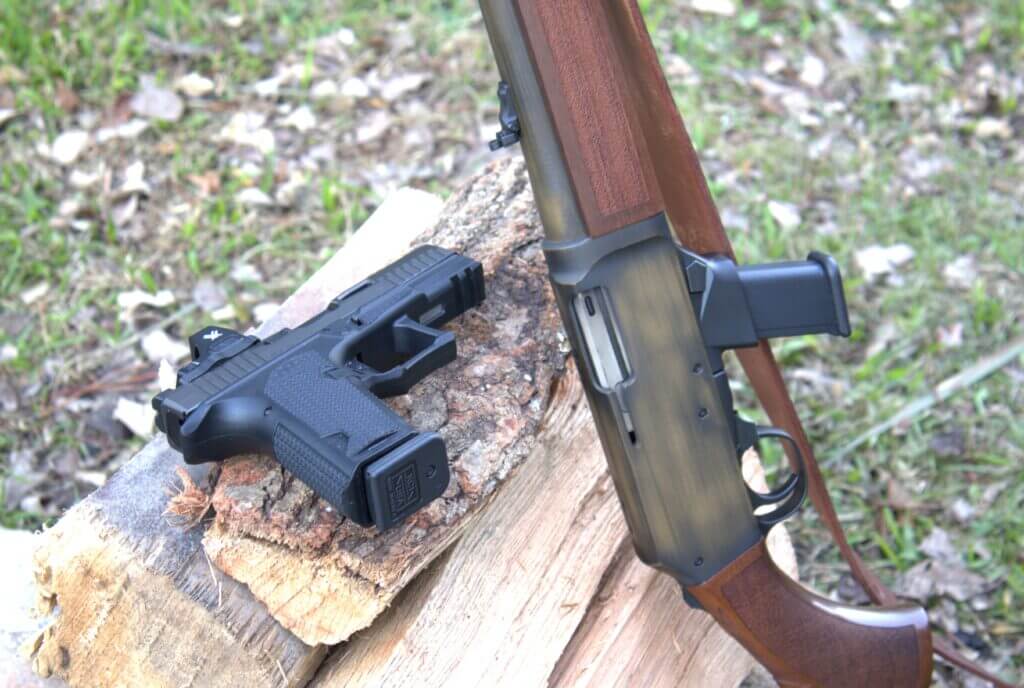
The Homesteader M-LOK tweaks the aesthetic with a brushed bronze cerakote over the barrel and receiver. Mechanically, the Homesteader M-LOK is identical to the original model. It uses a blowback action compensated by a weighted fore-end. The action has a hooked charging handle, much like a .22 rifle, that can be mounted on either side of the action for use by left-handed and right-handed shooters. The safety is the tang-mounted variety, similar to that of a Mossberg shotgun. The rifle has an anodized aluminum receiver and a blued steel trigger group that contains a bladed bolt stop that holds the action open for any administrative gun handling that needs to happen. The final control is the magazine release lever, which is located at the front of the magazine well.
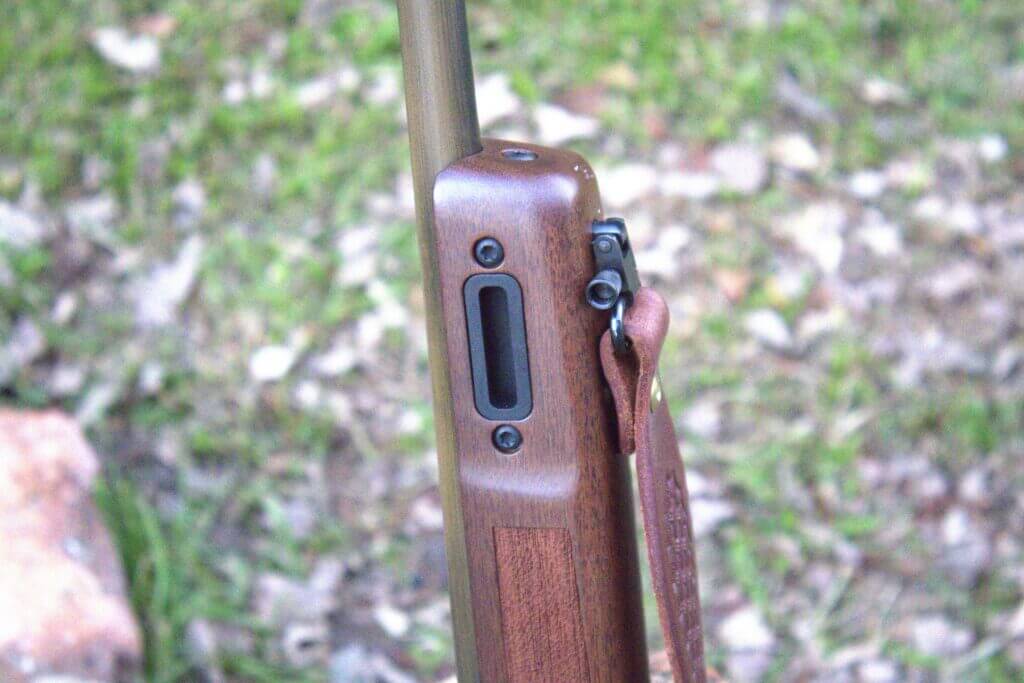
Aside from its color scheme, the Homesteader M-LOK is differentiated by an M-LOK slot on both sides of the fore-end and a corresponding shorter section of checkering as seen on the original model. The checkering on the semi-pistol grip is contained to the sides of the grip, leaving the top smooth, where the original is checkered just behind the safety.
The Homesteader M-LOK is set up for adult shooters, with a length of pull of fourteen inches and a beefy rubber buttpad to boot. Out of the box, the rifle comes with a fixed blade front sight and a barrel-mounted adjustable peep rear sight. In an interesting twist, the peep sight on the M-LOK rifle is further forward than the original. It is also tapped for a Weaver 63B optics mount or one of Skinner Sights’ Picatinny rail mounts.
Swapping in the Glock Magwell
I ultimately did most of my shooting with the factory magazine well and the included Henry magazines. This setup looks neat, but the rifle also came with an interchangeable Glock magazine as well. So yes, it can take Glock mags.
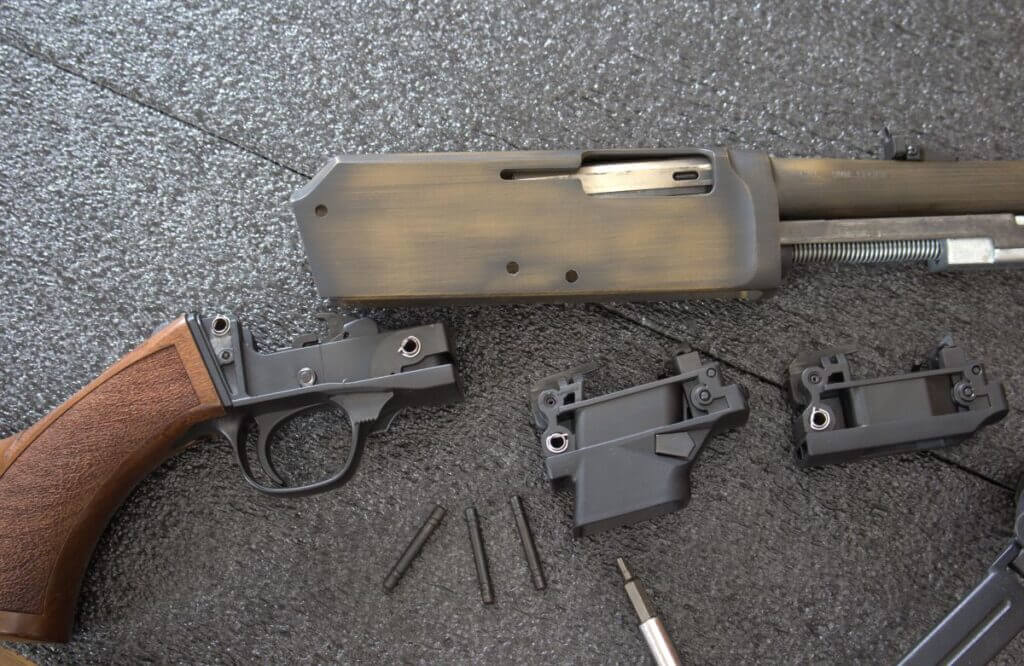
All you have to do to install the Glock mag well is punch out the three action pins and pull the buttstock down and off the frame. The existing magazine release, which is a polymer unit, comes right out, and the Glock magazine goes in. Reassemble, and you are ready to use any Glock double-stack 9mm magazine.
First Impressions of Henry’s Brushed Bronze 9mm PCC
My total experience with the Homesteader before going toe to toe with the M-LOK model comes down to handling one at my local shop a month before mine arrived. I liked the lines of that original model, but it was beefy for a 9mm PCC. 6 1/2 pounds of well-balanced mass is sleek for a centerfire rifle, but for a lower-powered 9mm carbine, it felt dense. When I finally got my hands on the M-LOK model, I liked the addition of the rail slots for low light solutions, but I had to wonder why a brushed bronze cerakote was put over the receiver and barrel? The idiosyncrasies became clearer as I got to shooting.
Range Test: The Henry Homesteader M-LOK on the Firing Line
First Shots With the Henry Homesteader M-LOK
My experience with 9mm pistol caliber carbines is about as close to zero as you can get without actually being zero. In theory, a longer sighting plane and a stock give the user more control and accuracy than a pistol, while that longer 16-inch barrel should afford more velocity and power with the 9mm ammunition. Instead of going for my usual benchrest accuracy test, I decided to do some offhand shooting and fire some rounds across my chronograph between the Henry M-LOK and a 4-inch-barreled Rainier Dusk19. The Dusk19 was kind enough to share its KCI Glock magazines for the effort.
I started off shooting the Homesteader with the stock Henry magazines. These single-stack polymer magazines are sleek and easy to load. They release from the magazine well similarly to a .22 rifle, by pinching the magazine release toward the magazine and pulling the magazine out. Loading is just as easy as pushing the magazine home, grabbing the charging handle, and briskly pulling back the bolt and letting it fly home. With the bolt forward, it can be difficult to fully seat the magazine, and it requires a good rap to seat. Alternatively, you can lock the bolt to the rear with the ambidextrous bolt stop and effortlessly insert the magazine. The bolt stop does not act like a bolt release, so the charging handle has to be racked to load.
I took my first shots at 25 yards on paper from an offhand position to get on top of the sights and the trigger. My first five shots of PPU 115-grain FMJ went quickly, and I noticed my group was about six inches lower than my aiming point. For my next group, I held the front sight in the upper 1/3 of the rear peep instead of in the lower half and got to my aiming point.
With that settled, I set up my Caldwell chronograph and shot several loads between the Henry and my Dusk 19 Glock clone. The same PPU 115-grain training round produced an average five-shot velocity of 1,158 fps out of the pistol. The 16 1/2 inch tube on the Homesteader gave an average of 1,401 feet per second. I tested my other ammunitions including the Hornady Critical Duty 124 grain +P FTX, which produced 1,160 feet per second out of the pistol and 1,315 feet per second out of the rifle. In short, depending on the ammunition you pick, the Homesteader offers a ballistic advantage that opens the door to using 9mm for tasks it is not normally associated with handguns and braced pistols, whether it is knocking down distant plates or taking a poke at medium game.
Accuracy at 50 Yards With Iron Sights
After getting a handle on the sights, I decided to bench the Homesteader and shoot for groups at 50 yards. The ammunition used included:
- PPU 115 grain FMJ
- Igman 124 grain FMJ
- Hornady Critical Duty 124 grain +P FTX
- Federal Punch 124 grain JHP
- Winchester 115-grain JHP

This is performance that is fairly typical for a .22 rimfire rifle with iron sights at the same distance, although the 9mm Luger has more potential overall. Those groups should be readily improved with a red dot optic or even an LPVO, but on its own, in its stock format, the Homesteader is a shooter.
How the Henry Homesteader M-LOK Handles
The Henry Homesteader handles better than it looks on paper. It is a blowback-operated 9mm that relies on a heavy bolt and spring pressure to cycle properly. But instead of being back-heavy, the Homesteader strikes a good balance at the magazine, as the bolt is effectively delayed by a reciprocating weight under the Midwest Industries handguard. Although it weighs more than a 9mm carbine ought to, it carries well on a leather sling, particularly with the discreet Henry magazines in tow. The Glock magazine well is superior in that it takes Glock magazines and has a reversible push-button release, but it and standard 15-round mags tend to stick out of the rifle enough to poke when the rifle is riding across your back.
The safety is easy to reach, whether you are left or right-handed. So too is the infinitely reversible charging handle. The bolt stop was somewhat confusing to me at first. It reminded me greatly of Marlin rimfire rifles, which have a stop that can be pushed up to lock the bolt in the rear position, but pushed or pulled for the bolt to be released. The stop in the Homesteader M-LOK is just a stop, and it takes a pull of the charging handle to release the bolt.

Although the Homesteader can benefit greatly from an optic, the iron sights are easy to pick up in all but the lowest light and do not cover up reasonably small targets. I expected a coarser sight picture since the peep is mounted on the barrel rather than the receiver for a longer, finer sight picture.
The trigger behaves more like a well-worn shotgun rather than a pistol-caliber carbine. Instead of a mush, followed by a distinct wall, the Homesteader’s trigger has a bit of take-up and a deliberate hill that leads to an unexpected, quick break. On my Lyman trigger scale, it breaks in at 4 1/2 lbs. It is not a match trigger, but it is utterly easy to predict from shot to shot when the shot will break. With this combination of sights and trigger, I was able to hit those 9mm pills out past 100 yards on eight-inch steel plates with regularity, provided I held just over them to make those hits.
Why the Brushed Bronze Finish Makes More Sense Than It Should
Sparsely cerakoting a blued gun like a Henry might seem sacrilegious, but as I ran the Homesteader through the wringer, particularly in bright as well as dusk and dawn, the answer came to me, as I shot it alongside a pair of polished blued and stainless-steel rifles, namely a Marlin 336 and a Marlin 1895 SBL, respectively. The cerakote actively breaks up the outline of the Homesteader, and it discourages sunlight from glinting off the barrel and receiver, which can spook game and skew your own aim. Although brushed bronze cerakote wouldn’t be my first choice for a traditional rifle, it makes sense on reflection.
Reliability After 300 Rounds
9mm blowback carbines, provided they are not fed with the weakest possible ammunition, are simple long guns that tend to feed what you put in them. The Homesteader M-LOK is no exception. It got through my usual 300-round battery of testing without a failure to fire or cycle of any kind. What is more remarkable is that it got through testing while having no lubrication at all. Ordinarily, I do a complete disassembly and lubrication before testing begins. In the case of the Homesteader, it made its way on the range without the usual treatment. Only afterwards did I realize that there was not even factory packing grease to get by on.
Henry Homesteader M-LOK Specifications
| Model | Henry Homesteader M-LOK |
|---|---|
| Caliber | 9mm Luger |
| Barrel Length | 16 inch |
| Weight | 6 1/2 pounds |
| Length of Pull | fourteen inches |
| Magazine Options | five-round and ten-round magazine |
| Thread Pitch | 1/2×28″ |
Is the Henry Homesteader M-LOK the Traditional PCC to Beat?
If any number of AR and AK-9s or folding PCCs do not quite do it for you, the traditionalist can be satisfied with the Henry Homesteader M-LOK. Though it tips the scales, the Homesteader readily compensates with a mix of traditional styling and modern add-ons. From a shooting perspective, recoil is mild, and any number of sighting systems are available to complement the excellent iron sight setup. The added power from a genuine carbine-length barrel also makes for a platform that can do more than simply defend the homestead.
Henry Homesteader M-LOK Pros and Cons After 300 Rounds
- Pros: Rugged blowback action, long barrel, higher velocity, reversible charging handle, crisp iron sights, M-Lok weapon light ready.
- Cons: longer than needed length of pull of 14 inches, no independent bolt release, brushed bronze finish may not be to taste.
Related Reads from GunsAmerica Digest
- More Henry Homesteader coverage on GunsAmerica Digest
- Ruger PC Carbine reviews and related coverage
- More pistol caliber carbine reviews on GunsAmerica Digest

Jim Maybrick has been a consistent voice in the firearms world for over a decade, writing hundreds of articles and producing dozens of videos that span nearly every corner of the shooting sports. With a background in military and economic history, Jim has a talent for weaving compelling stories around historic firearms designs and the rise and fall of legacy manufacturers.
But Jim’s interests go far beyond the past—he’s just as comfortable diving into muzzleloading traditions as he is testing the latest rimfire loads or mastering cutting-edge modern systems. His thoughtful, data-driven approach brings clarity and depth to every review.
When he’s not at the range or deep in a spreadsheet, you’ll find him enjoying time with family, chasing game, or refining the lost art of starting a perfect campfire.
Experience:
– Veteran Writer & Content Creator – Over twelve years of experience in firearms journalism with hundreds of published pieces.– Military & Economic Historian – Academic background that fuels in-depth analysis of historic firearms and industry trends.– Versatile Shooter – Covers a wide range of topics from muzzleloaders and rimfire ballistics to today’s most advanced platforms.– Storyteller at Heart – Known for insightful writing that blends technical detail with engaging historical context.– Outdoorsman & Family Man – Reconnects with nature through hunting, fishing, and old-school firecraft.– Analytical Mindset – Brings precision, structure, and storytelling to every article—whether it’s a gear review or a deep historical dive.
Nice gun. It looks a lot my grandpa’s old 1907 Winchester he used to pack around the mountains.
In your article, you state the M-Lok forearm for the Henry Homesteader is from MidWest Industries. I went to their website and they do not show it (but do show a skeleton type stock for it). Is MidWest Industries going to have the M-Lok forearm available (hopefully with a blued end cap, so it would match non M-Lok Homesteader rifles)?
My only complaint with my Homesteader is that the stock is too high for the peep sight. With the red dot mounted, it’s pretty good, though. IMHO I would rather pay $150 less for a Homesteader with a polymer stock. Stay safe. j
There is a lot of information in this article….sadly not one hint of a PRICE.
Over $1100 for that jamomatic crowbar. Nothing superior about it in any way. Read other reviews by regular folks, they can’t get rid of them fast enough