
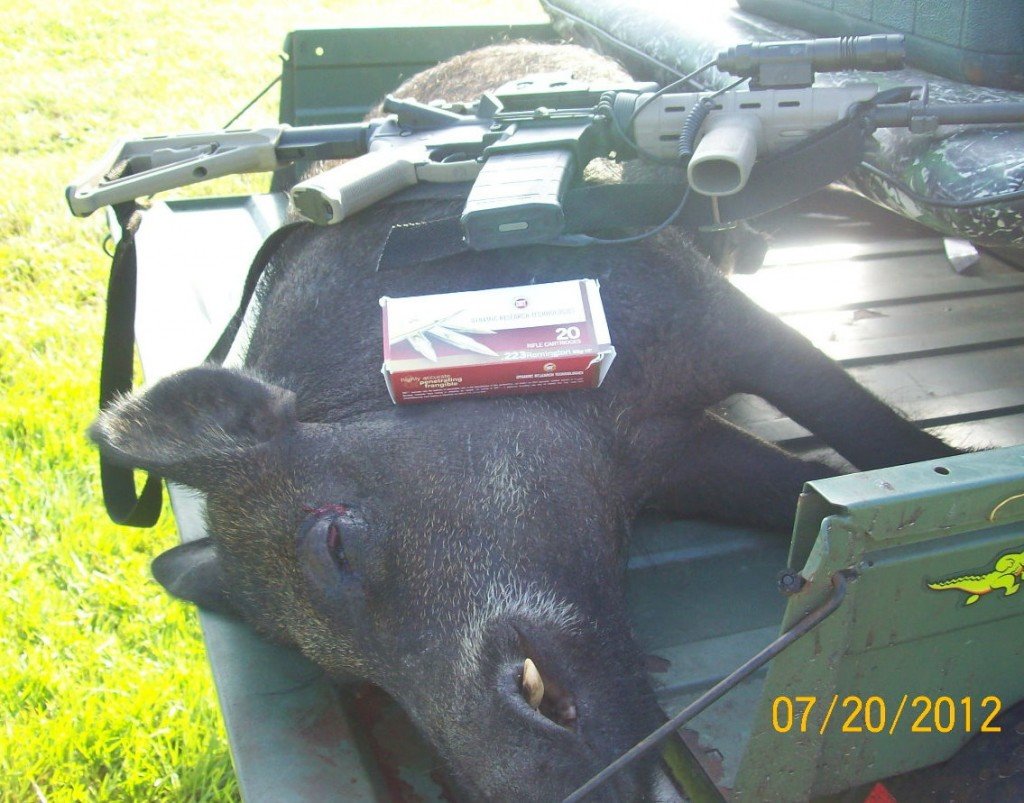
You may never have even heard of the biggest innovation in terminal ballistics since the hollow point. It has been around for more than five years, and the bullets are made from compressed powder, wrapped in a standard copper jacket. Loaded ammunition is available in most common rifle calibers, as well as the usual handgun suspects and even some exotic hunting calibers. The bullets alone are also available in bulk for the handloader. The company is called DRT, or Dynamic Research Technologies. If you hit a living being with a DRT bullet, it will become our definition of DRT, “(D)ead (R)ight (T)here.”
Firearms
Show First
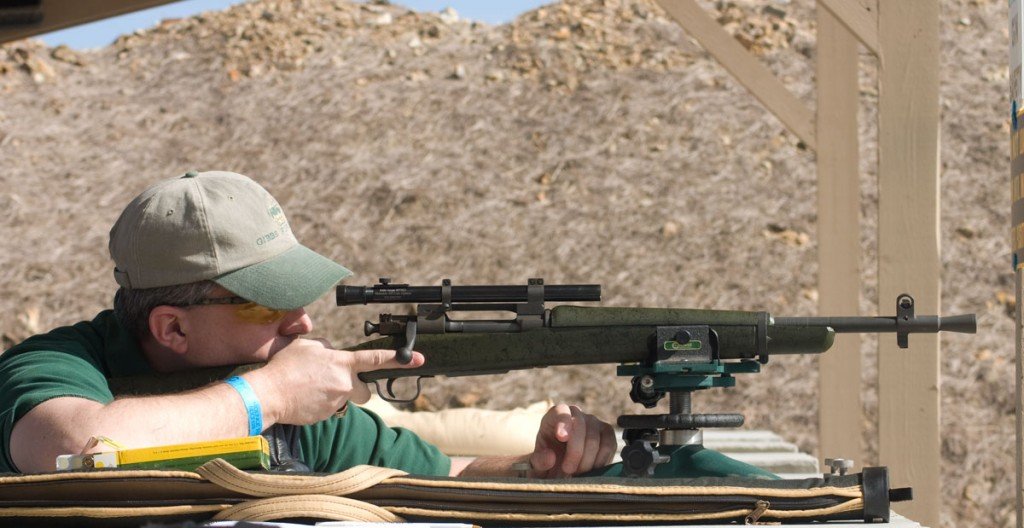
Gibbs “Pig Buster”—A Hard-Hitting Hog Hunting Rifle With A Little History
Published: March 26, 2012 { 35 comments }The folks at Gibbs Rifle Co. have a history of taking surplus military rifles of arguably minimal collector interest and turning them into sport specialty rifles that have a serious “fun gun” factor and “tough as nails” demeanor. Perhaps the best known of them are the Summit and Quest chambered in .45-70 and .308, respectively. Those were built on surplus Enfield actions and were not attempts to reproduce any sort of historical military gun at all. Instead, they were practical, utilitarian rifles that made good use of surplus military and some new parts. “Commercial sporterizing,” probably best describes it, and as Gibbs puts it, they “…take the best features of historic military arms and translate them to meet modern sporting needs.”
The Mighty .17 Rimfires – A Tiny Little Cartridge With Great Big Fun
Published: November 16, 2010 { 24 comments }I am a .17 lover, in spite of my reputation for liking really big guns. Being a .17 shooter is sort of like other things your friends and family would like to keep in the closet. But trust me; it is okay to like the wee rifles because there are few things that go bang that are as much fun.
To buy and like a .17 of any size you have to overcome the opinions of “experts” and writer types who will tell you all of the “bad” things about them. If you begin with the foundation that it is likely few of these naysayers have ever fired a .17, it immediately makes you feel better about the smallest of the commercial rounds. That they foul badly, are inaccurate, blow like feathers in the wind and have no killing power is simply untrue. My sweet seventeens have mostly been centerfires, and their emphasis has been on speed. Many of them are honest 4000 fps propositions and the fastest bullet I have ever chronographed was a .17, fired over the Oehler at 4600 fps. I have shot numerous sub-half-inch groups, thumped lots of various small critters, a few coyotes and some deer. With my long term affection for .17s it will not surprise you that I couldn’t wait to get my hands on the Hornady Rimfire when it was released over a decade ago.

Craig Boddington DON’T BLOW THE SHOT OF A LIFETIME
Published: October 31, 2010 { 1 comment }Life isn’t always fair. It’s possible to spend an entire lifetime of hard hunting and never get a chance at a truly fantastic, world-class trophy. It’s also possible to take a Boone and Crockett whitetail on the very first outing. The strange nature of hunting is that, while both effort and technique certainly count, ultimately there is a major element of random chance that places a great animal and a hunter in proximity at the same time.
THE .30-06 – Still America’s Best!
Published: October 10, 2010 { 80 comments }The cartridge first known as “Ball Cartridge, Caliber .30, Model of 1906” is without question the most famous American rifle cartridge, not only in our own country but throughout the world. In 1903 we replaced the Krag-Jorgensen in .30-40 Krag with the long-serving and much-loved 1903 Springfield and a new .30-caliber cartridge. The Springfield was a Mauser clone, its rimless cartridge similar to Mauser’s designs, but longer with more case capacity. The initial 1903 cartridge was loaded with the same 220-grain roundnose bullet as the Krag, but in 1906 the bullet was changed to a faster and more aerodynamic 150-grain spitzer. At the same time the case neck was shortened by .07-inch, thus the Model of 1906—the .30-06—went forward to make history. The .30-06 served the United States in both World Wars, the Korean conflict, the early years of Vietnam, and a dozen banana wars in between. It was chambered to the Springfield, the Pattern 14 Enfield, the Marine Corps’ Johnson semiauto, the Garand, the Browning Automatic Rifle (BAR), and several versions of the Browning machinegun. Clear into my time, the 1970s, the .30-06 was still seeing use both with snipers and in the Browning light machinegun.