
The MR762A1 from H&K is a 7.62×51 (.308 Winchester) descendent of the HK416/417 series, a semi-automatic rifle for civilian users. This system uses a solid “pusher” rod instead of the gas tube on a standard AR, and this makes the system very clean, because gas never gets into the receiver. It takes HK417 mags, and as you can see from the video, there are a number of features built into this rifle that make it more sure and stable than a standard “legacy rifle” AR-platform configuration.
GunsAmerica Product Reviews – Rifles
Show First
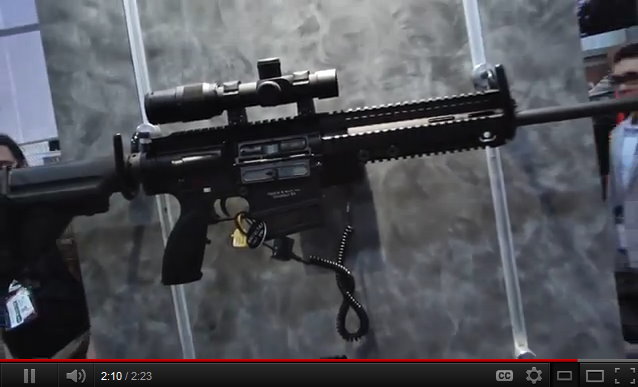
Heckler & Koch HK MR762A1 Civilian Battle Rifle -VIDEO POST
Published: January 23, 2012 { 61 comments }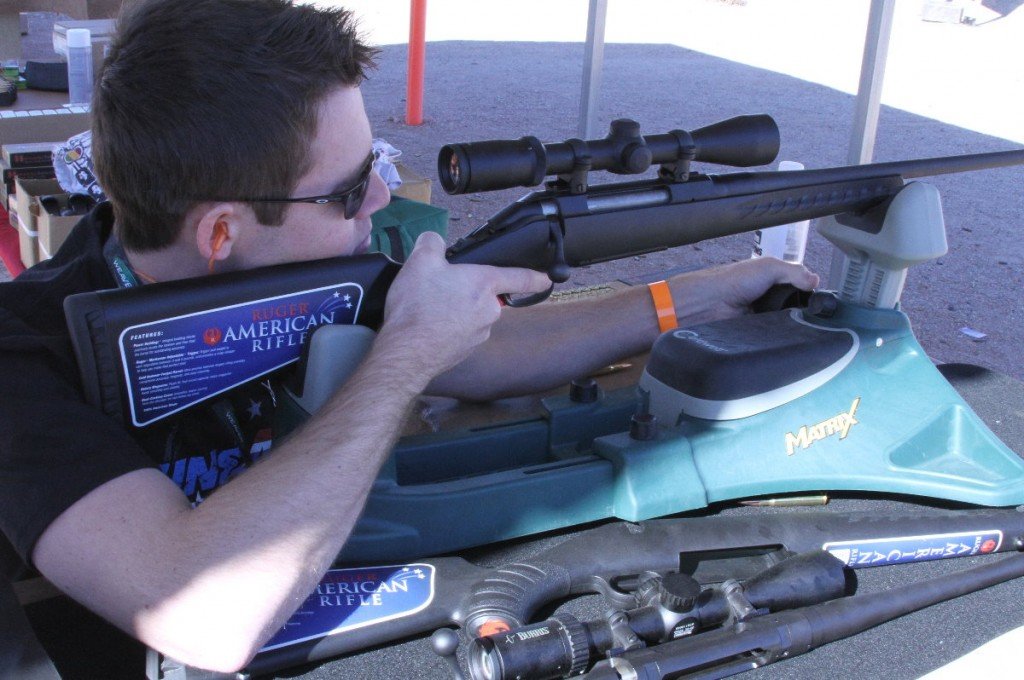
The Ruger American Rifle – An American Legend is Born
Published: January 19, 2012 { 50 comments }The Ruger firearms tradition is about to experience nothing short of a slam dunk. What else would you call a six and a half pound 22″ barrel Ruger deer rifle that has a modern design polymer stock, trigger safety, four round rotary magazine, aggressive recoil pad, shoots into about an inch at 100 yards consistently, and has an MRSP of $449? Ruger calls it the American Rifle, and I call that a slam dunk.
Over and over we are hearing from manufacturers in the American firearms industry that they are bringing to market a “completely new gun.” I think it is actually because of the internet. Because where it used to be that a product succeeded or failed, and the reason for the success or failure was largely a mystery. The ubiquitous voice of the internet now can and does let you know almost immediately what consumers like about your product and what they don’t like, and this gives you the power to change your product to better meet their needs.
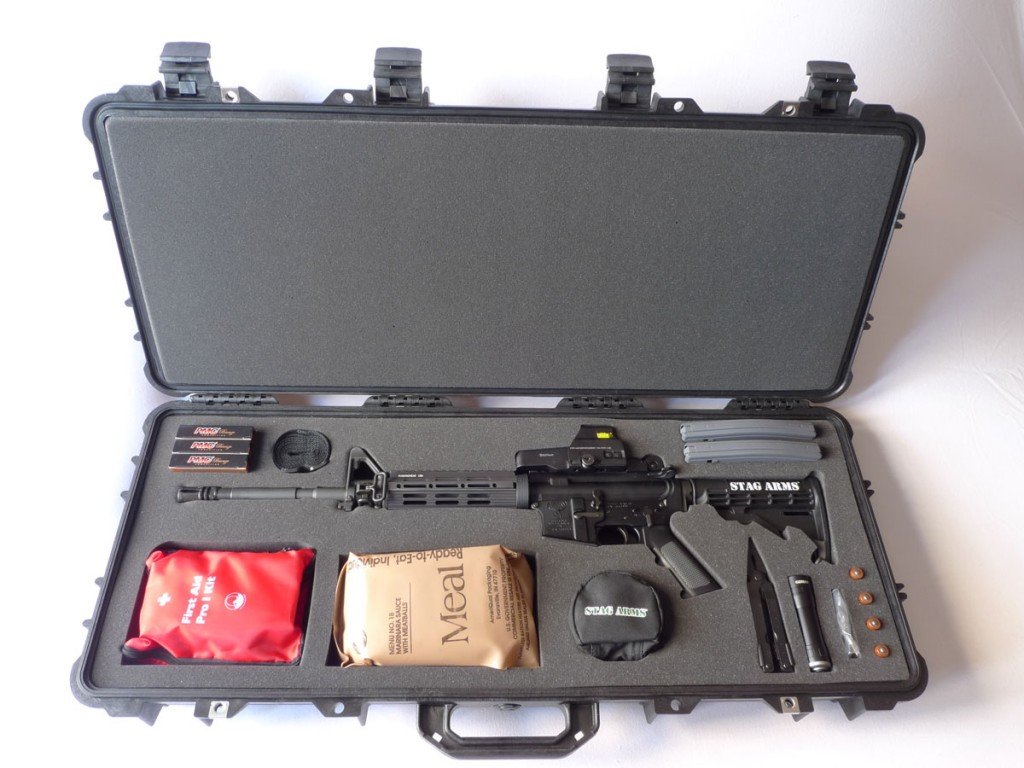
Ready to Roll ESK From STAG
Published: January 19, 2012 { 75 comments }Stag Arms had two new products at SHOT that are going to take a lot of the guesswork out of self-defense and 3-Gun competition for shooters who want “turn-key” solutions. The 2012 Executive Survivor’s Kit (ESK) is a special project done in partnership with Stag distributor LAN World and specifically marketed toward affluent people who have themselves, their family, and assets to protect during a “survival” situation. The kit is not set up for surviving a zombie apocalypse or an end of the world scenario, but instead for the more plausible scenario of being displaced for a few days by some disaster. I’ll be the first to admit that the whole “Katrina” thing has been done to death, but there never fails to be some new natural or domestic threat to make you realize that you need a gun. With social movements such as “occupiers” who think they’re somehow entitled to “their fair share” of what YOU own, I don’t blame people for being concerned about their safety.
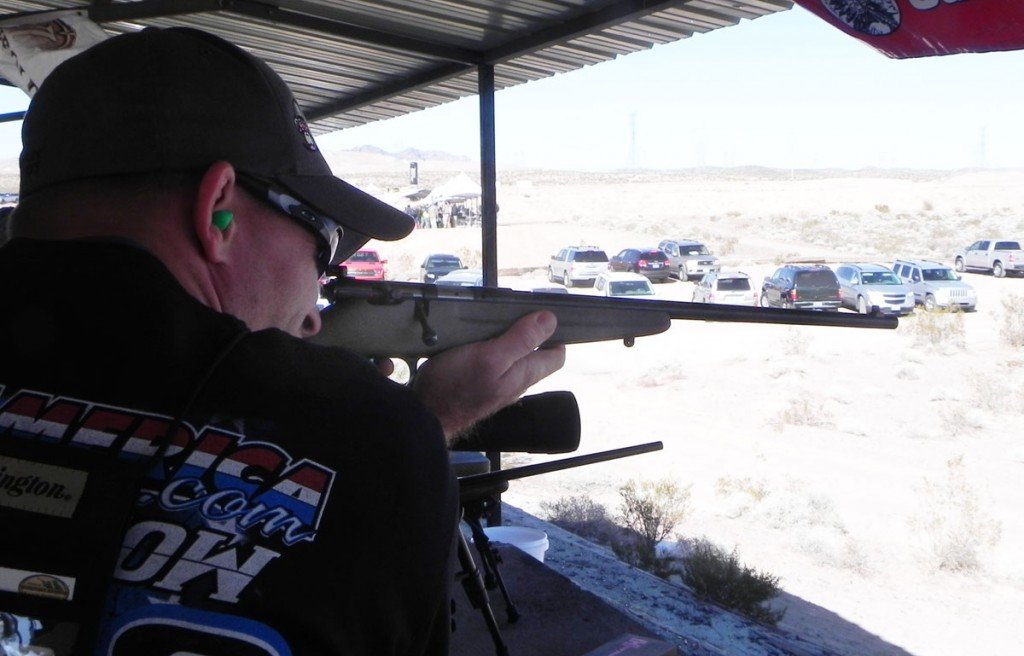
The Savage Rascal .22LR Boys Rifle
Published: January 17, 2012 { 49 comments }A brand spanking new .22 Rimfire is a rite of passage for many American kids and getting the right .22 is perhaps the most important decision a parent can make. Of all the variables a parent has to consider, safety is probably at the top of their list. Parents need to think about safe places to shoot, eye and ear protection, how to safely store the gun and more. One thing they shouldn’t have to consider is having a gun that is safe, and safe to shoot—those ought to just be givens.
When we get our kids their first gun, it’s natural to want to get them something like what we had as kids, and a popular feature of “boys” guns “back in the day” was a cocking knob. It seems simple and safe enough to open a bolt, chamber a round, and pull back the cocking piece to shoot. I’ve even heard many parents insist on that type of action because they can easily see if the gun is cocked or not. They see the cocking knob as a safety feature. Well, I’m not so sure about that anymore after seeing the new Savage Rascal at Media Day. Its action is specifically made without a cocking knob—for safety reasons!
A New Era for Thompson Center – The Dimension Modular Rifle
Published: January 17, 2012 { 59 comments }I can’t say that the Thompson Center Dimension rifle is the biggest story at SHOT Show 2012, but it is definitely the most interesting. Being from New Hampshire myself, I was an early Thompson Center customer (I had a White Mountain Carbine) and have been a fan since. In fact one of the early articles on the GunsAmerica Blog was about out of the box MOA guns, and both the TC Venture and Icon made MOA easily, and they are both great values in a deer rifle.
By far the most famous product of Thompson Center is the line of pistols known as the Contender, then later the Encore and G2 Contender. If you are new to shooting sports, the Contender pistol series is a modular system that utilizes one universal frame and interchangeable barrels and forends for varying calibers. You buy one Contender, and several, or even dozens, of barrels, from .17 Hornet to .416 Rigby in the later versions. Several calibers were invented specifically for the Thompson Contender series, including the .30TC and numerous wildcats. A whole cottage industry of making Contender barrels sprung up over the years, based on the overwhelming success of the Thompson Contender. For the hobby shooter, there has never been a finer instrument to nerd out on with your reloading press and bench rest.
Fast forward to now, since TC was bought by Smith & Wesson, and a lot of us TC fans out there have been wondering what would become of our old friend, especially since the plant in Exeter, New Hampshire was closed last year. Smith & Wesson is a public company, so what the gun nerds think doesn’t always count when you boil everything down to nuts and bolts shareholder profits.
So it is with gratitude to the folks at Smith & Wesson that I say, Thompson Center is charging forward with a completely new, and revolutionary rifle system called the Dimension. It has been two years in the works and the Dimension made its debut today at Media Day at the Range, SHOT Show 2012. Take a look through the pictures here, and I will try to explain how it works to the best of my ability.
Mossberg 30-30 Levergun – Model 464 – Gun Review
Published: November 27, 2011 { 74 comments }
When most people think of the classic deer rifle, they think of the lever action 30-30. Very few avid gunners don’t have one, yet this is a gun that is not the most powerful, not the most accurate, not the most quick shooting, and not the most reliable. For all the new gun owners, shooters and hunters that have come into the gun world over the last few years, you just have to re-ask the question, “why on earth would I ever want a lever action 30-30?” Is it just sentimental value in an old time cartridge that keeps the 30-30 going, or is there something there?
Guns are different from most things except maybe cars and guitars in that they have an “aura” about them. You won’t often see a rich businessman driving a Honda CRX “tuner” to the office, and you certainly shouldn’t play Ozzy songs on a Fender Telecaster, not that you can’t. Likewise, a lot of people feel weird stomping around the woods with an AR-15. It isn’t that the AR isn’t capable of taking a deer, a hog, or a coyote. It just doesn’t feel right.
The same thing goes for a high-powered bolt gun. In the thick woods of New England, Pennsylvania and other popular hunting grounds, you can feel like you are overdoing it with a high powered rifle. Most shots are under 100 yards and you don’t need all that power for a deer. For many hunters, a lever action 30-30 is “just right,” and it makes you feel like rough and tumble cowboy, which is always cool for a gun guy.
That is why there are literally millions of 30-30s are out there hunting this season, and one that has become very popular is the Mossberg 464. It is made in America by Americans, and we found it to be as accurate as most bolt guns for the first five shots in a cold gun. The point of balance on the 464 is right in the middle of the receiver, exactly where you want it to be for walking around the woods for hours, and right in the middle of a mounted normal length rifle scope, so it retains the balance. If you look at the 464, it looks like a Winchester Model 94, the most classic of all leverguns. But some of the features inside are much more like the Marlin 336, which is the other US made 30-30 still available today. The 464 is smoother than the 94, yet feels more like one than it does the Marlin.
Hornady revolutionized the 30-30 in 2007 with the introduction of their LeverEvolution ammunition. Prior to this, all traditional leverguns with tubular magazines had to use flat pointed bullets. Otherwise the tip of the bullet in the magazine would impact the primer of the round in front of it, setting it off inside the magazine and blowing a hole out of the side of your gun. LeverEvolution utilizes an aerodynamic spitzer type bullet with a polymer tip, so that they don’t set off the primer. They really actually work, and since the more than 4 years that have passed since their introduction, the LeverEvolution ammo has taken over the market for 30-30 deer rifles.
The Ruger Gunsite Scout Rifle – Gun Review
Published: November 27, 2011 { 108 comments }
As the 2012 SHOT Show approaches, one of the guns that didn’t get as much attention as it should have from this past year’s show was the Ruger Gunsite Scout Rifle. If you haven’t seen this gun, it is based on a theoretical design from a shooting legend, Colonel Jeff Cooper, who started the Gunsite Academy. The premise of the gun is a “one gun solution, ” with a spec that it has to be a .30 caliber with an effective kill power on a man sized target out to the effective range of the shooter, and that is has to be short , light, and handy. This isn’t the first “Scout Rifle” design to hit the market, and Col. Cooper was involved with a Steyr project back in the day that is still sold today. But for the money, Ruger definitely has a very strong offering, and has nailed the Scout concept at an affordable price, MSRP $995.
Chambered in .308 Winchester, the 16.5″ barreled Ruger Gunsite Scout Rifle comes in at 7 lbs. empty and is 38″ long. This is basically to the spec of Col. Cooper, and this is with a wood, not plastic stock. The length of pull is adjustable with stock inserts from 12.75 inches to 14.25 inches, so it fits all sizes of shooters and can be adapted to body armor. Gunsite has a method of training shooters where length of pull is crucial, and this rifle is made to help you “settle into it.” I think that is the reasoning behind the wood composite stock as opposed to plastic. Laminated wood looks a little funny, but it is just as durable and weatherproof as plastic, and it is only about a half a pound heavier. The fine checkering on the beefy feeling forend and handgrip make you feel good with the gun, like it was made for you, and the weight distribution of the wood also just “feels right,” which is what the designers at Ruger and Gunsite were going for.
When you see the profile of this new Ruger Scout collaboration, a couple things immediately stick out. One is the ten round removable box magazine. To my knowledge there are no other bolt rifles in this price range that even have a box magazine. You are stuck with 3 or 4 rounds in the mag. The Scout also has a forward optics rail, for a special type of scope called, coincidentally, a Scout Scope. The Scout Rifle concept is 50 years old and the methodology of the Scout has been applied to experimental rifles for two generations now, using everything from standard Remington, Winchester and Ruger actions, to surplus Mosin-Nagants and Mausers. The forward mounted Scout Scope has what is called a “long eye relief.” That means you can see a full field with the scope 8 or 9 inches away from your eye. These scopes are also used on pistols to some degree by handgun hunters and long range target shooters.
The forward mounted scope allows you to take advantage of the optic, while retaining your peripheral vision for optimum situational awareness. It takes some getting used to, but most major optic companies make a Scout Scope model, and once you get used to it, the advantage is clear. In an unknown situation with nobody but you covering your back you don’t want your eye locked into a normal scope. Col. Cooper had this forward mount in his spec, long before long eye relief scopes were popular, and he was definitely on to something. The respect that his name commands in the gun world is well deserved. Most of us don’t have the ability to go out to Gunsite to train, but the expertise there has given us what amounts to the right tool for the job.
3 Gun Competition STAG 3G AR-15
Published: November 11, 2011 { 128 comments }
Zombies may not be taking over America yet, but in the world of shooting sports, 3-Gun competitions for sure already are. You can’t talk about shooting these days without hearing about the popularity of 3-Gun. STAG Arms, a sponsor of the TV show 3-Gun Nation, hopes to capture the rifle part of the 3 Gun market with a new rifle created specifically for competition in 3-Gun events. It is called the STAG Arms 3G, MSRP $1,495. All of the competitors in the finals of 3-Gun Nation this year, being held in Las Vegas next week, will be shooting the STAG Arms 3G, and I am pretty sure all of the competitors are going to ask to keep them or buy them after the event. It is a really nice gun.
The 3G is an 18″ barreled AR-15 with about all the bells and whistles you could want for 3-Gun and a lot more. It comes standard with a 15″ Sampson free floating handguard, a Magpull ACS stock and MOE handgrip, and a Geissele Super 3-Gun trigger created specifically for 3-Gun competition. The gas system is the full rifle length version, not the shorter M4 version. This makes for a lot less felt recoil and very smooth controllability shot to shot. STAG also makes one of the few reliable .22 conversion kits for the AR, and it works flawlessly in this new 3G.
I guess the question is, how many people would buy a dedicated gun for 3-Gun? The STAG 3G would answer that question,” it doesn’t matter. ” The 3G is a formidable battle rifle with almost perfect balance. The twist on the gun is 1 in 8,” which is capable of stabilizing a wide range of bullet types, and the 18″ barrel turns a corner as fast as a 16″ M4, but with a better gas system and more velocity. You also couldn’t ask for a better stock and hand filling grip than the Magpull product. STAG really didn’t skimp on this rifle and they made some important add-on choices that you may not have gotten as right forced to make the choices yourself.
I personally find quad rails annoying, even with too-fat rail covers. This smart Samson handguard comes with 3 short rail sections to mount whatever you like on the gun. It makes for a comfortable, hand sized forward grip and the flexibility to add whatever you like. You can see from the pictures I like the stumpy UTG/Leapers forward vertical grip, and I was able to mount this in less than five minutes. What I like about it most is that you don’t need a special AR wrench to take the handguard off. It utilizes a collar and two Allen screws, and slides off with little or no effort. For ease of use the Samson wins hands down.
The Kel-Tec Sub-2000
Published: September 8, 2011 { 99 comments }Marching to the beat of your own drummer can be a challenge in the gun world. But over and over again, Kel-Tec CNC, the company we all know for their tiny extremely affordable and reliable pocket pistols, keeps showing up with a new beat, and the guns are some of the most interesting in the entire shooting world.
The Sub 2000 is a folding pistol-caliber polymer carbine, and that is about where standard descriptions run out of gas. At first glance you may try to compare it to a gun you already know, but quickly you realize that it is unlike any other gun you know.
You find yourself saying, “It’s kind of like a … um, no, it’s kind of like nothing.”
The Sub-2000 cocks in the rear, and all of the moving parts of the gun are located in the rear. If you look in the pictures, that whole front barrel assembly swings up from a release in the trigger guard and the entire gun effectively folds in half. It is pretty much a totally unique firearm.
At an MSRP of $409 and a street price well under $400, the Sub-2000 is loaded with features that you wouldn’t expect in such an inexpensive gun. It takes Glock 17 mags in the standard model, but Kel-Tec is also shipping them in Glock 19, Smith & Wesson 59 type, Beretta 92 & 96, and Sig 226 configurations, and the gun is available in both 9mm and .40S&W. The plastic rear sight automatically flips up when you deploy the front of the rifle, and the front sight is a completely adjustable fiber optic. The barrel is 16″, and the weight is only slightly more than a pistol at 4lbs. It fold down to 16″ long.
Read More…
The PA Pellet Flintlock from Traditions Performance Firearms
Published: July 28, 2011 { 19 comments }
Many of us long for the days when technology didn’t rule our lives, yet we love the convenience of it. It’s the same thing with special muzzleloader seasons for whitetail. The antiquity of the technology is romantic, but better ballistics, better sights, and easier and more consistent components can make a hunt more likely to put a rack on the wall and fill a freezer with meat. The precious time we manage to actually get out into the woods in our busy lives is valuable, and going into the woods with a better gun during muzzleloader season has become the norm instead of the exception.
Read More…