
For those who want all the advantages of a red dot on their pistol, Springfield Armory is answering the call early on by offering a new version of their time-proven and hugely popular XDM pistol. It is called the OSP for “Optical-Sight Pistol.”
Red Dots
Show First
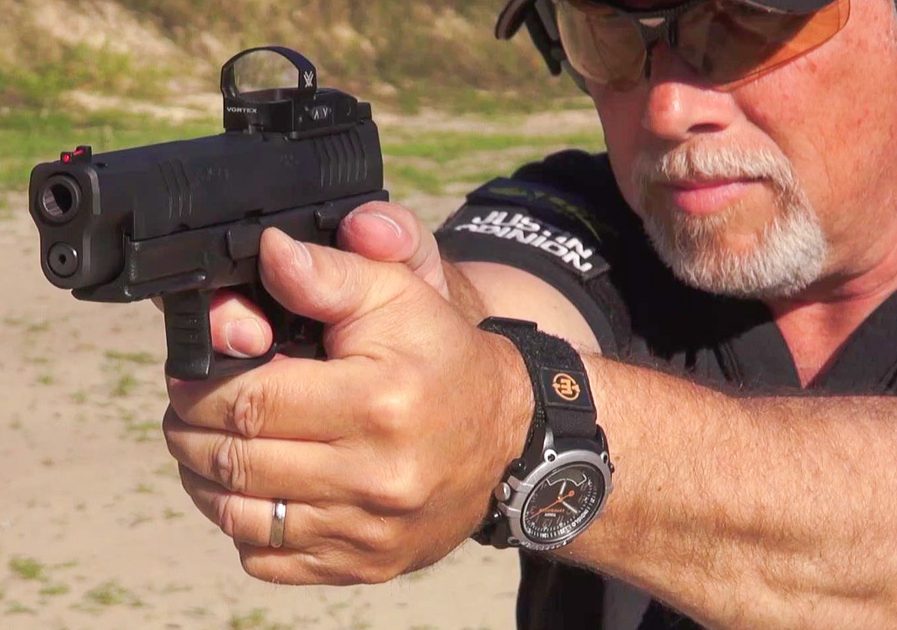
First Look! Springfield Armory XDM Optical Sight 9mm Pistol (OSP). Full Review.
Published: August 9, 2016 { 16 comments }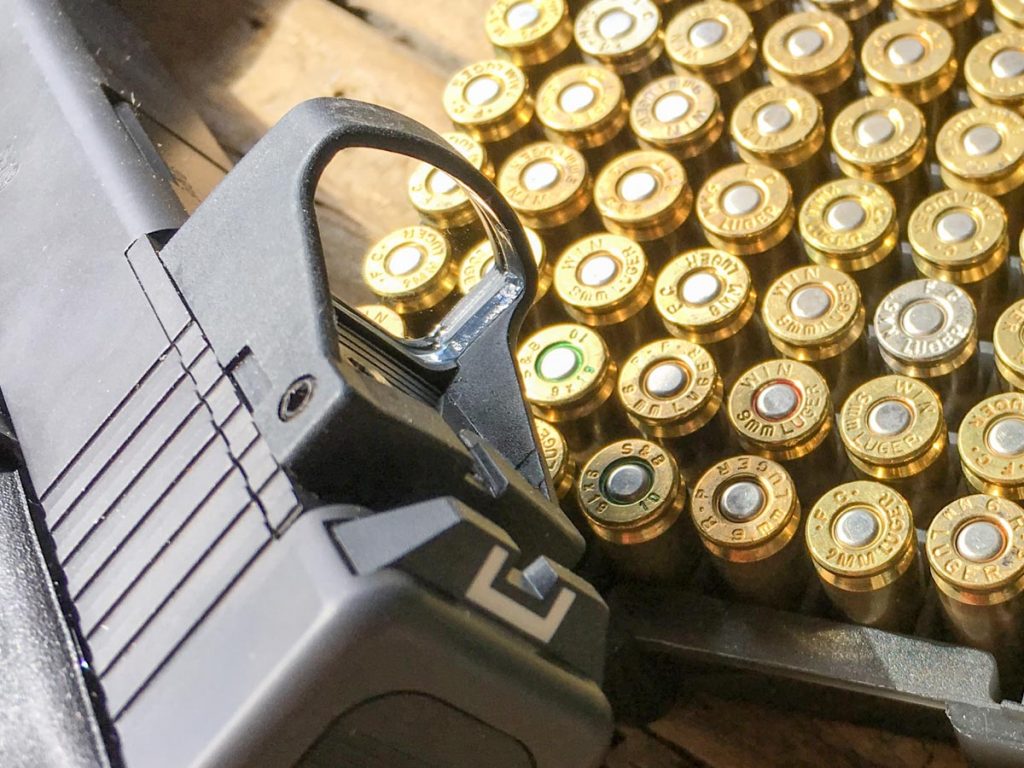
First Look: Shield Mini Sight Polymer Red Dot Optic
Published: July 20, 2016 { 13 comments }The new Shield Mini Sights are made of polymer. That alone is news enough–but the lens is polymer, too. Those used to steel and aluminum and glass will find this new combination
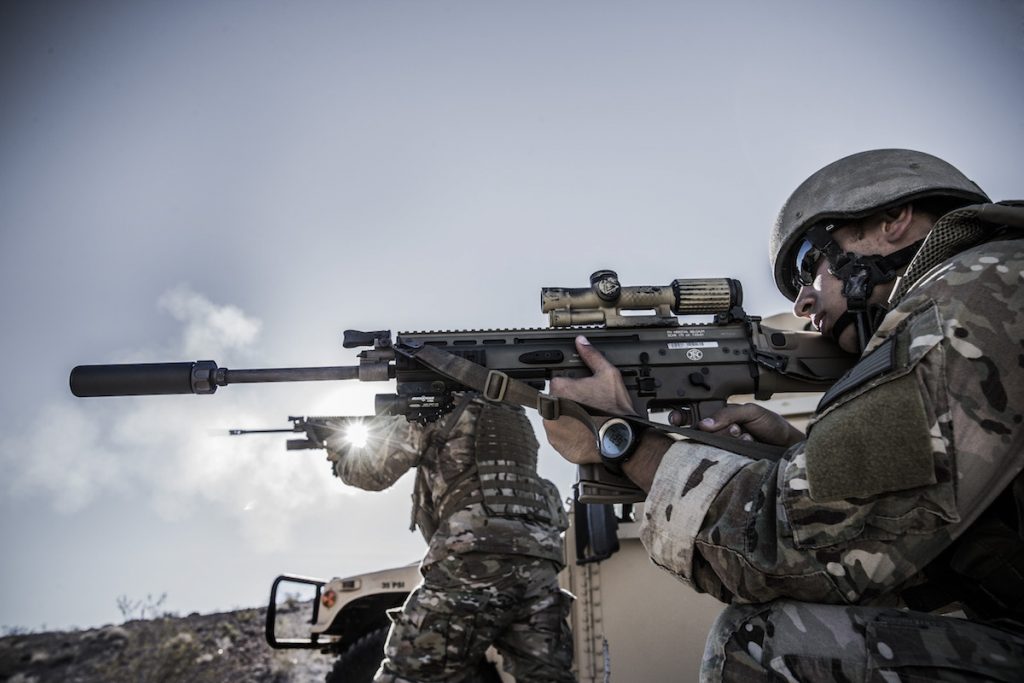
Red Dots vs. Magnified Scopes: Which Tactical Optic Is Right For You?
Published: June 28, 2016 { 28 comments }I hate to kill a sacred cow for all you tactical ninjas out there, but in most cases a magnified optic is better than a red dot.
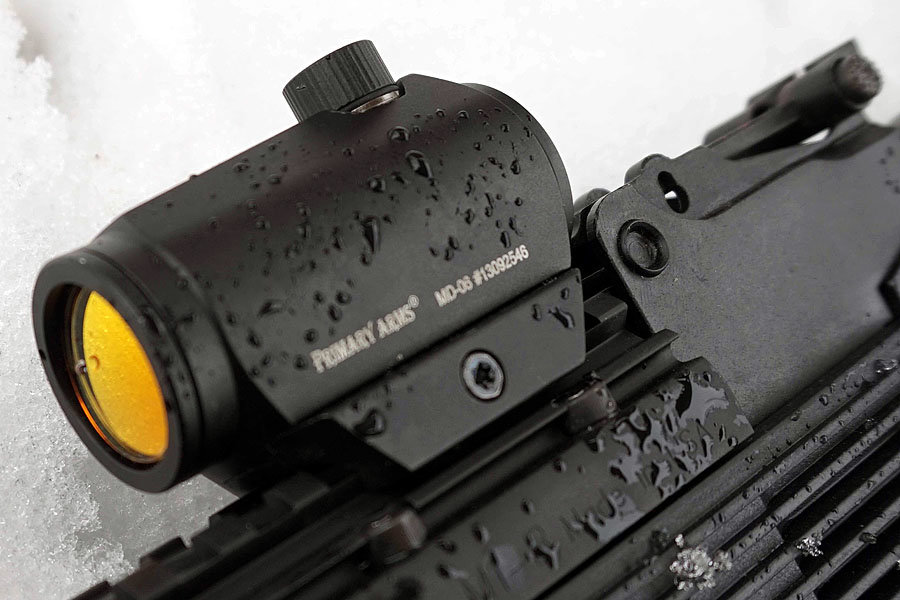
The Primary Arms Micro Dot–Easy on the Wallet
Published: March 4, 2015 { 6 comments }The Micro Dot from Primary Arms is rugged, waterproof, and unbelievably inexpensive. If you’re in the market for a solid optic, and aren’t willing to invest in some of the more expensive options on the market–the Micro is a great option. We’ve been kicking this one around for two years now with no issues.
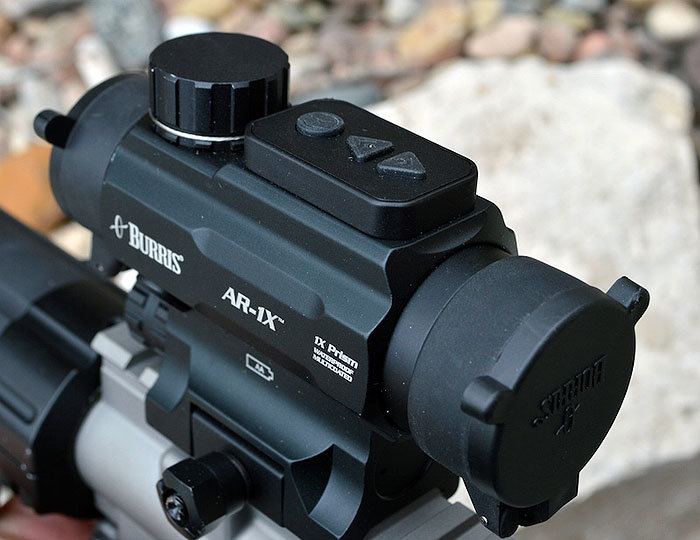
Burris AR-1X–The Best Red Dot Under $500?
Published: February 22, 2015 { 13 comments }From a distance, the Burris AR-1X is just another red dot sight wrapped up in a different look, however that would be the incorrect assumption. This Burris AR-1X has features which make me feel that this may be one of the better red dots on the market. And it isn’t going to break the bank.
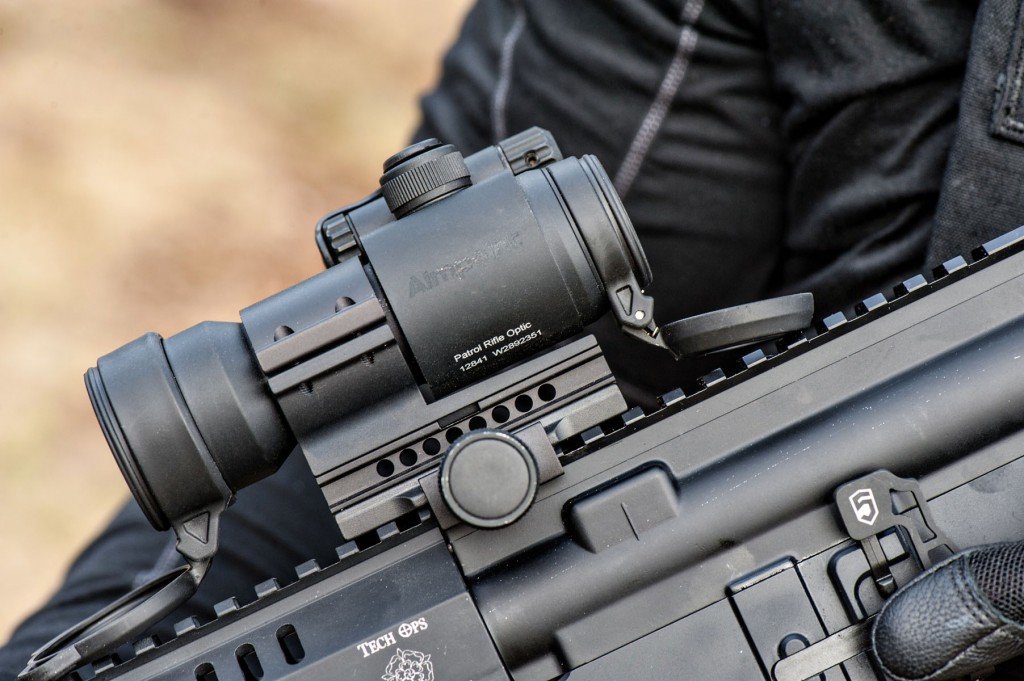
Aimpoint PRO—Advanced Technology and Durability
Published: February 26, 2014 { 2 comments }Introduced at SHOT Show 2011, the Aimpoint Patrol Rifle Optic (PRO) entered the competitive red dot market with a host of features designed specifically for the Law Enforcement Officer (LEO). Aimpoint, which has been in the red dot business since 1974, took its years of experience as well as input from LEO professionals to create an optic that is optimized for the LEO mission field and the LEO wallet. The features of the PRO are vast, and while Aimpoint has other red dot optics in its product inventory that may appear comparable, none could match the MSRP of $440.
The catch, at the time, was it was specifically made for LEO and could only be bought from an authorized Aimpoint Dealer. Of course with that kind of price point for a top-notch optic, everyone wanted to get his hands on one (or four). The general public was initially frustrated by the lack of availability, but Aimpoint wanted to make sure the LEO community was the first to get the PRO. Some civilians (like me) were able to get the PRO from other sources a few months down the road, but pickings were slim and disappeared very quickly. Eventually, like everything, the mystique of the optic and its “unobtainable” status faded away. Aimpoint now offers the PRO as part of its commercial line, available to the American shooting public. Even as we enter 2014, the Aimpoint Patrol Optic is still one of the most affordable, well-rounded and robust red dots on the market. I have used red dot optics that are lighter and smaller, but for my money it is hard to beat the PRO for what you get.
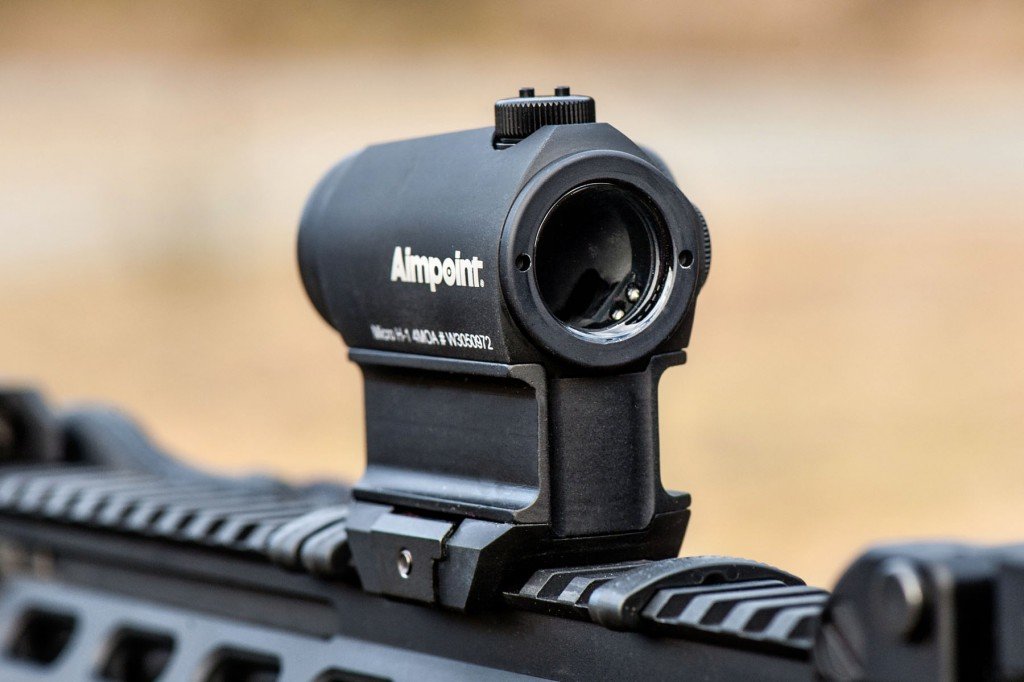
Aimpoint Micro H-1 Review
Published: February 20, 2014 { 3 comments }In 2007, Aimpoint set the bar high for the micro red dot sight (MRD), which was then new to the market. Until then, military grade red dot sights were fairly large, consisting of a wide 30mm tube with a battery compartment slung off the side. While very effective in combat and in the civilian hunting and shooting sports, they added bulk and weight to the firearm. This proved cumbersome, especially for competition shooters mounting red dots to their pistols. When Aimpoint launched its Micro Red Dot series, it took all the reliability, durability and long battery life of its proven larger red dots and crammed it into a small, light-weight package.
Originally Aimpoint had three micro models, the T-1, H-1 and R-1. All three shared the same physical dimensions, weight and operating controls, but they were intended for different applications. The T-1 was designed primarily for a military and law enforcement application, while the H-1 and R-1 were intended for the American hunter and competition shooter respectively. As the R-1 has been discontinued and the primary difference from the H-1 is the color (silver instead of black), this article will only address the T-1 and the H-1. The different specifications between the T-1 and the H-1 are their availability of night vision settings, operating temperature ranges, water resistance and color. The military and Law Enforcement T-1 has four night vision settings and is rated for operation in -50 to 160 degrees Fahrenheit. It is also submersible to 80 feet. These extra features come at a premium, and the T-1 commands a higher price point than the H-1. The H-1 looks like the more expensive T-1, but it lacks the night vision settings, has an operating temperature range of -20 to 140 degrees Fahrenheit and is only submersible to 15 feet. The H-1 also has more distinct manufacture and product markings than the T-1.
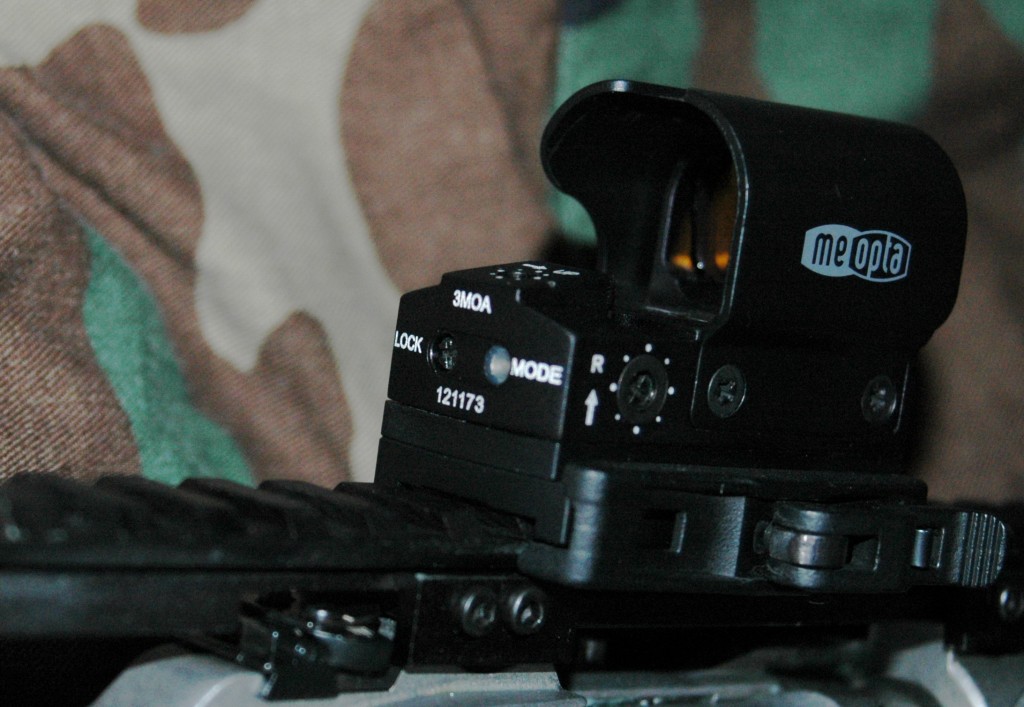
Testing the Meopta M-RAD Sight
Published: February 6, 2014 { 6 comments }Meopta’s sight called the M-RAD, or Meopta Rapid Acquisition Dot, reflex sight looks similar to many high-end reflex optics, but what stands out is that it is quite a bit smaller. At first glance, I thought it was a pistol sight but then realized it is a combat rifle setup. The M-RAD weighs 3.07 ounces (or 105 grams), compared to an EoTech XPS that weighs 8 ounces, but it is solidly made of aluminum. The unit is strong, and the reticle itself is surrounded by an aluminum frame for protection from being banged around. Weight is important because after hours or days of carrying a rifle around, you will find that trimming off every ounce you can is a huge benefit. It comes equipped with a picatinny mount that quickly attached with a lever/cam-style mount that was very effective and kept it on tight. It released easily, and seemed to keep zero well. The M-RAD is easy to operate with one simple button, and the system is waterproof and compatible with night vision technology. The extremely useful support package supplied with the sight holds everything, including tools, spare batteries and cleaning supplies for the optic. There are additional spacers to raise the sight higher for a proper sight picture, tools to adjust the sight and even a specially designed screwdriver for opening the battery compartment. Overall, this is a smaller unit that is both rugged and lightweight, and it performs well.
The EOTech EXPS-3 Battle Sight & G23.FTS 3x Magnifier
Published: June 26, 2011 { 11 comments }Close quarters battle has always been the proving ground for the EOTech line of holographic weapons sights. You will find EOTech sights mounted on just about every type of small arms tactical weapon made, and they are equally at home on the SWAT team as they are in the battlefields of Iraq and Afghanistan. The EOTech 553 is in U.S. military service under the designation SU-231/PEQ and M553 in the commercial market. I got a chance to look at two new products from EOTech, the updated top of the line version of their battle sight called the EXPS-3, and a new scope that sits in front of the EOTech sight for more precise shots and flips out of the way when you don’t need it. Read More…
The Aimpoint Hunter Series Red-Dot Big Game Sights
Published: March 23, 2011 { 8 comments }With all the talk we have around here about long range accuracy and long distance shots, very little of it applies to actual big game hunting. Punching paper has almost no relationship to hunting in the field. Paper targets just sit there. You don’t have to work hard to find them. They don’t move. It is almost like they were made to sit there and let you shoot at them. Oh yea, they were. Most shots on deer, hogs and even most African game is taken well inside of 100 yards, and often less than 50 yards.
None of those things are true with actual game, whether it is a Whitetail deer in the Pennsylvania woods, or a hog in the Everglades, or a Kudu on the plains of Africa. Wild game is almost always moving somewhat, and they are usually pretty darned hard to find, especially the big ones. When it is time for your shot, the shot you worked really hard to get and probably prayed for by your bedside the night before, you don’t want to look down your rifle and discover that you have the wrong optic for the job. Even at 4 power magnification a moving deer 75 yards away can be a difficult target to find in your scope when split seconds count. Yet optics are preferable in many ways to iron sights, because you don’t have to align them.