

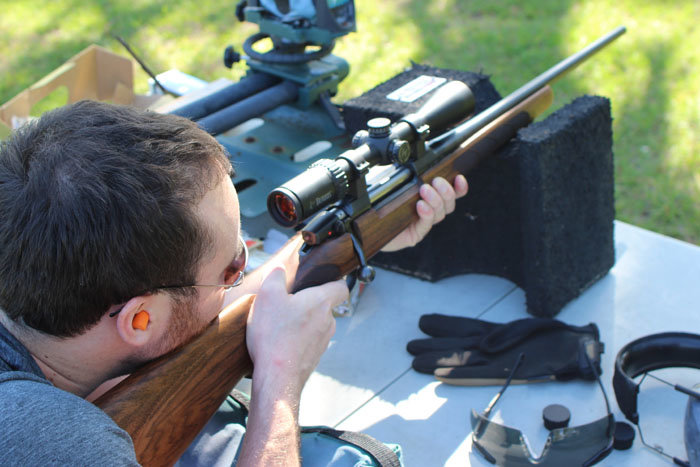
CZ is not the first name in American hunting rifles, but I think they need more love. This 557 in .30-06 is rock solid, dependable, and as accurate as any rifle you’ll find on the shelf at any mom-and-pop gun store in America. It is time these rifles get the respect they so obviously deserve.
Guns
Show First
300 AAC Blackout Fundementals – Ammunition and Reloading
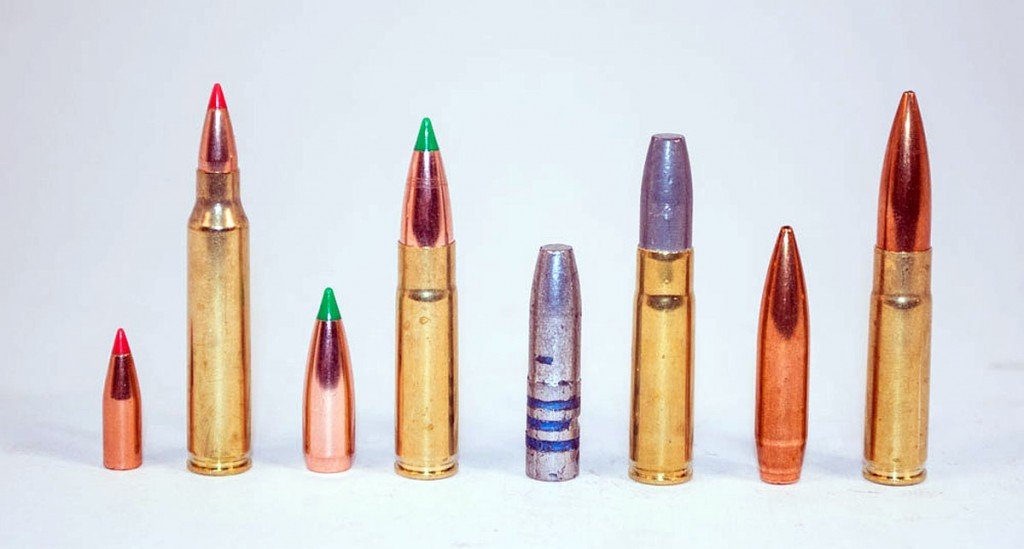
Published: July 10, 2014 { 32 comments }Love it or hate it, the 300 AAC Blackout is an interesting and incredibly diverse cartridge. Imagine trying to design a ballistic compensation scope for a cartridge that can use 110 grain projectiles traveling at 2,400 feet per second AND 245 grain projectiles traveling at 950 feet per second. Reloading is just as challenging.

Savage Axis II XP, Big Bang for a Few Bucks
Published: June 7, 2014 { 42 comments }Let’s say you’ve just gotten a call from a friend who wants to go hunting with you, tomorrow, and he doesn’t have a rifle. He really wants to go. And you know you’ll be able to put him on a deer, or a hog, or something, but you don’t have an extra rifle set up and ready to go. There’s a big-box retailer right around the corner. What would you suggest?
There’s a lot to presume about the hypothetical above. Let’s pretend the friend knows his ass from his elbow and is aware of basic firearms safety and function. We can assume he can get a license and that you will be hunting, not poaching. What you need is a rifle that’s turnkey. You need a gun, one in a common caliber, and an optic (preferably one that’s already attached and sighted in).
You need a Savage Axis II, the complete package.

Inside Ruger’s New Mayodan North Carolina Plant
Published: June 4, 2014 { 36 comments }[one_half padding=”0 0 0 0px”] [/one_half] [one_half_last padding=”0 0 0 0px”] [/one_half_last] Ruger knows the rimfire market. There’s a lot to say about Ruger’s latest addition to the rimfire line. They run off of the 10/22 magazine and are tack drivers. The rifles are lightweight, indestructible and inexpensive. That last part is hard to wrap your head [...]
AK-47 Hog Blaster – The Ultimate Counter Insurgency Weapon
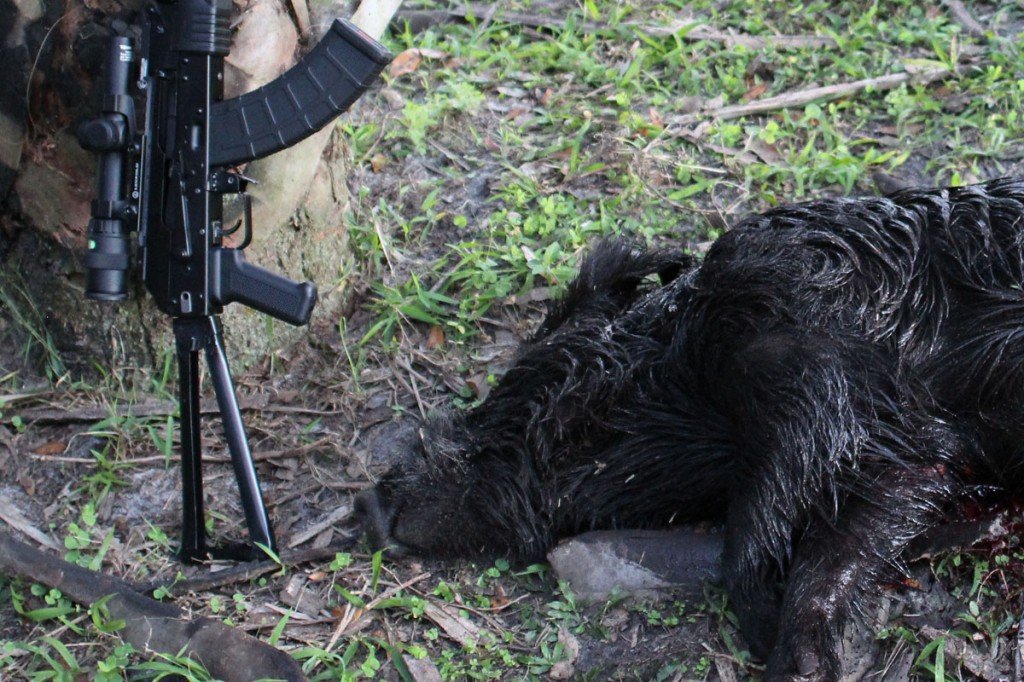
Published: March 19, 2014 { 36 comments }“What is the best gun for hunting hogs?” I asked this question to everyone I knew for more than a month before my hunt. I Googled it at least 20 times. Everyone seems to have a different opinion. Some prefer the compact design and rapid-fire potential of the AR-15. Others leaned toward the power and range of the .30-06 and .308s. Those who’ve hunted with a good 6.8 spc were passionate about the caliber’s performance. No one mentioned 7.62×39, much less the venerable AK platform’s design. As one who prefers the Kalashnikov over the Stoner, I knew what I was going to take. And now, after the hunt, I’d put my Arsenal AK up against the biggest tooth hogs south Florida has to offer.
The Arsenal AK line in 7.62×39, with the right soft point ammo, can be an effective rifle for hunting. The Arsenal AK line in 7.62×39, with the right soft point ammo, can be an effective rifle for hunting.
When I was presented with the opportunity to hunt hogs with Dwayne “Hog Man” Powell and Kissimmee River Hunt and Fish, a guide service out of Okeechobee, Florida, I decided I’d set up some real-world reviews, too. We were going to hunt, and I knew Dwayne was going to put us on hogs. Dwayne is the Jim Cramer of hunting guides. If you can catch it or hunt it in Florida, Dwayne Powell will show you how. For those of us looking to test guns, Hog Man gives a veritable guarantee.
I had a variety of guns at my disposal. I could have taken any number of AR-15s into the bush. I had a .30-06, a couple of 6.8s. There were five of us hunting, so we each went out with something slightly different.
Busting the Magnum Myth! – Choosing YOUR Ideal Hunting Cartridge
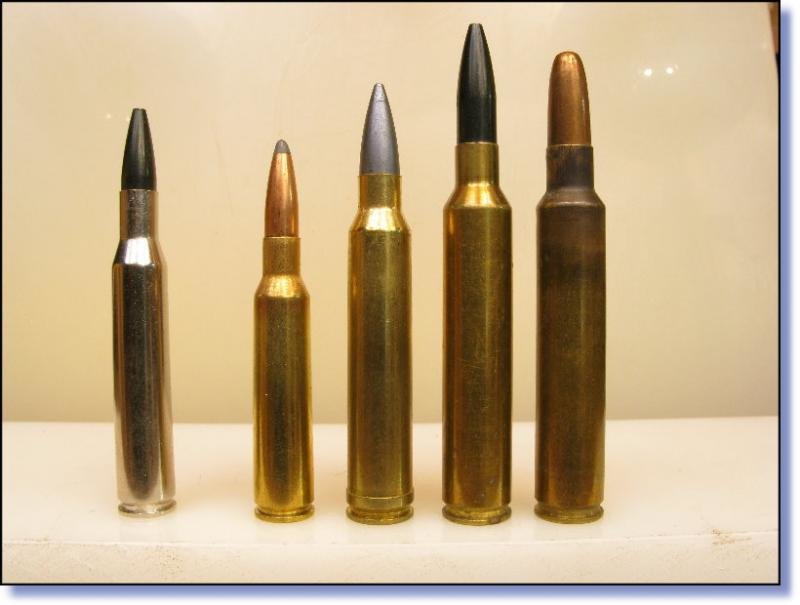
Published: October 21, 2012 { 108 comments }Kinetic energy does not matter. Accuracy almost does not matter. The headstamp on the case certainly does not matter. Having more shells in the magazine does not matter. How well you can hit with your rifle is almost all that matters!
What if I were to tell you that there is a rifle out there that will let you take more deer and elk; and bears and sheep and caribou and coyotes; and kudu? Yes, there is a rifle out there that will make you more successful in virtually any hunting situation you can imagine. Now your mind immediately goes to the biggest, fastest, largest, longest and most expensive kind of machine modern technology can create. But alas, this is going to be much simpler and down to Earth than you might imagine.
I am about to offer you the keys to the kingdom of hunting-rifle success; keys gleaned from several decades of hunting and the observation of more than 1000 head of big game being taken. This is not about me, but about the dozens of men, women and young shooters I have guided or known around the world. Folks just like you who I have watched succeed and fail, often very simply because of the rifle, or more accurately the cartridge they have chosen. Kinetic energy does not matter. Accuracy almost does not matter. The headstamp on the case certainly does not matter. Having more shells in the magazine does not matter. How well you can hit with your rifle is almost all that matters!
What if I were to tell you that there is a rifle out there that will let you take more deer and elk; and bears and sheep and caribou and coyotes; and kudu? Yes, there is a rifle out there that will make you more successful in virtually any hunting situation you can imagine. Now your mind immediately goes to the biggest, fastest, largest, longest and most expensive kind of machine modern technology can create. But alas, this is going to be much simpler and down to Earth than you might imagine.
I am about to offer you the keys to the kingdom of hunting-rifle success; keys gleaned from several decades of hunting and the observation of more than 1000 head of big game being taken. This is not about me, but about the dozens of men, women and young shooters I have guided or known around the world. Folks just like you who I have watched succeed and fail, often very simply because of the rifle, or more accurately the cartridge they have chosen.

Duck Hunting in September
Published: September 30, 2012 { 2 comments }Duck hunting is very different depending on where you hunt. In the Northeast, a good day of duck hunting might mean a few shots at a few pairs of Mallards. But down here in Florida, we have several kinds of ducks and the state has created a four day mini-season in September for hunting a small duck called a Teal, which if I researched it correctly, is technically the Blue Winged Teal. The season also includes wood ducks, but we won’t cover them here. Teal travel in flocks, not pairs, and it is not unusual, on a good duck pond, to see dozens in a morning. We went out for the first morning of this year’s mini-season, hosted by our guide Dwayne Powell at Kissimee River Hunt & Fish, and we were able to experience birds flying over our heads in the hundreds. The limit is 6 birds, and several of our party limited out in a short time. Even our 11 year old shooter shot several birds, and we are all eager for the next phase of the season November 17-25. If you haven’t duck hunted, especially in Florida, you are missing a good time and a lot of shooting.
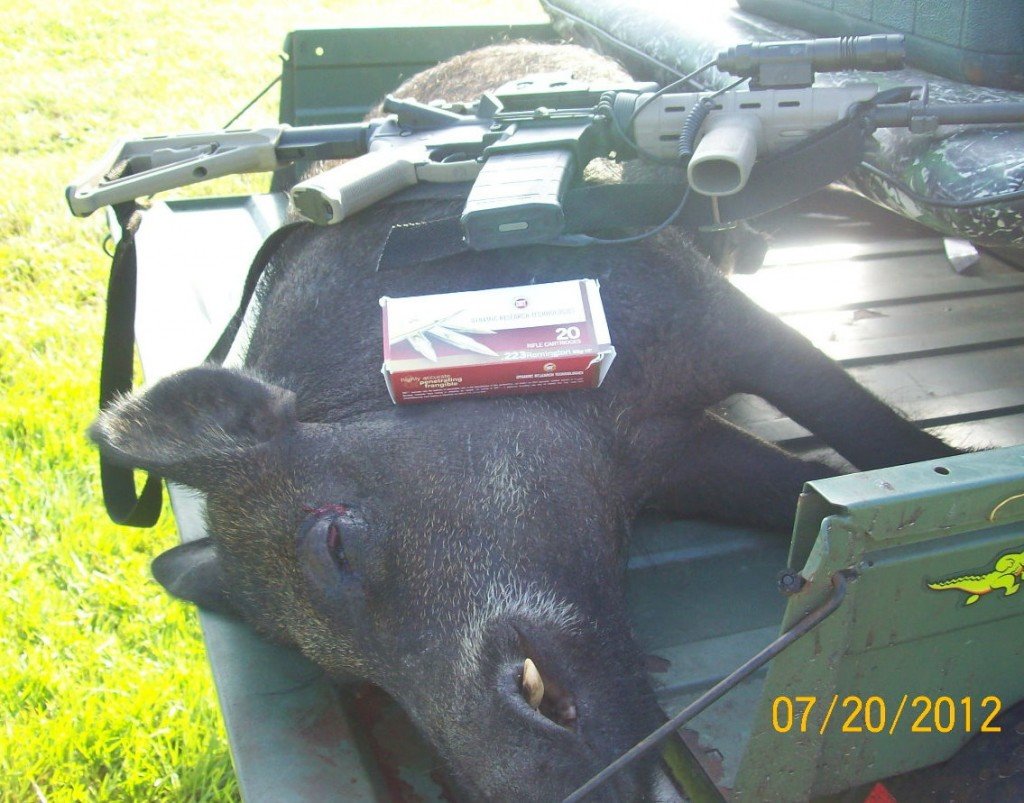
DRT Frangible .223 Ammo vs. Charging Wild Boar
Published: July 24, 2012 { 90 comments }You may never have even heard of the biggest innovation in terminal ballistics since the hollow point. It has been around for more than five years, and the bullets are made from compressed powder, wrapped in a standard copper jacket. Loaded ammunition is available in most common rifle calibers, as well as the usual handgun suspects and even some exotic hunting calibers. The bullets alone are also available in bulk for the handloader. The company is called DRT, or Dynamic Research Technologies. If you hit a living being with a DRT bullet, it will become our definition of DRT, “(D)ead (R)ight (T)here.”

Gibbs “Pig Buster”—A Hard-Hitting Hog Hunting Rifle With A Little History
Published: March 26, 2012 { 35 comments }The folks at Gibbs Rifle Co. have a history of taking surplus military rifles of arguably minimal collector interest and turning them into sport specialty rifles that have a serious “fun gun” factor and “tough as nails” demeanor. Perhaps the best known of them are the Summit and Quest chambered in .45-70 and .308, respectively. Those were built on surplus Enfield actions and were not attempts to reproduce any sort of historical military gun at all. Instead, they were practical, utilitarian rifles that made good use of surplus military and some new parts. “Commercial sporterizing,” probably best describes it, and as Gibbs puts it, they “…take the best features of historic military arms and translate them to meet modern sporting needs.”
The Mighty .17 Rimfires – A Tiny Little Cartridge With Great Big Fun
Published: November 16, 2010 { 24 comments }I am a .17 lover, in spite of my reputation for liking really big guns. Being a .17 shooter is sort of like other things your friends and family would like to keep in the closet. But trust me; it is okay to like the wee rifles because there are few things that go bang that are as much fun.
To buy and like a .17 of any size you have to overcome the opinions of “experts” and writer types who will tell you all of the “bad” things about them. If you begin with the foundation that it is likely few of these naysayers have ever fired a .17, it immediately makes you feel better about the smallest of the commercial rounds. That they foul badly, are inaccurate, blow like feathers in the wind and have no killing power is simply untrue. My sweet seventeens have mostly been centerfires, and their emphasis has been on speed. Many of them are honest 4000 fps propositions and the fastest bullet I have ever chronographed was a .17, fired over the Oehler at 4600 fps. I have shot numerous sub-half-inch groups, thumped lots of various small critters, a few coyotes and some deer. With my long term affection for .17s it will not surprise you that I couldn’t wait to get my hands on the Hornady Rimfire when it was released over a decade ago.