Rollin White Arms Co.

Rollin White Pocket Revolver Accuracy

Rollin White pocket revolvers were built around the .22 rimfire cartridge and intended for close-range work. Their fixed front sights and simple frame notch rear sights offer straightforward alignment, while the single-action mechanisms provide a predictable break for shooters familiar with antique systems. At typical pocket-gun distances, a sound example can still deliver practical accuracy that reflects period expectations. For collectors who take these revolvers to the range after a proper inspection, the Rollin White Arms Co. pocket model often proves more capable than its tiny size suggests.

Concealed Carry and Pocket Defense Heritage

These revolvers were conceived as compact, easily carried arms for civilians and military personnel who needed a backup sidearm. Small overall dimensions, short barrels around three inches in length, and slim rosewood or walnut grips made them suitable for coat pockets and small holsters of the era. Sold through Smith & Wesson channels and other outlets, the Rollin White Arms Co. pocket revolver helped meet heavy demand for concealable cartridge handguns during the Civil War period. Today that same profile gives the guns strong appeal for collectors interested in early concealed carry history and secondary arms issued alongside larger service revolvers.

Antique Quality and Collectible Value

Rollin White Arms Co. revolvers were produced with brass frames, spur triggers, and steel barrels and cylinders that were often finished with nickel plating and blued surfaces. Many examples still show crisp barrel markings, intact plating, and original wood grips, evidence of careful manufacture and the resilience of 19th-century materials. Condition has a major influence on value, and well-preserved pieces with sharp rollmarks, solid lockup, and original parts are prized. For collectors focused on early metallic cartridge revolvers, a clean Rollin White pocket revolver offers both historical interest and long-term collectible potential.

Product Focus

Pocket Revolvers

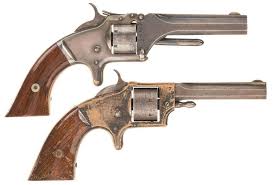
The primary product associated with Rollin White Arms Co. is the small .22 rimfire single-action pocket revolver. These solid-frame handguns typically feature an octagon barrel of about three to three and a half inches, a spur trigger, and a square butt frame with smooth wood grips. The key mechanical feature is the bored-through cylinder, which allowed metallic cartridges to be loaded from the rear and helped usher in a new era of revolver design. Barrel markings often reference both Rollin White Arms Co. and Smith & Wesson, making correct stampings a major point of interest for collectors. For those who own or are considering a Rollin White revolver, careful examination of markings, serial numbers, and mechanical condition is essential for authentication and safe use.
Pocket Revolvers

Collecting Rollin White Revolvers

Collecting Rollin White Arms Co. revolvers often centers on originality, condition, and historical context. Examples with matching parts, intact finishes, and legible markings such as “Rollin White Arms Co. Lowell, Mass” or “Made for Smith & Wesson” command strong attention. Serial numbers, grip style, and small design details can help narrow production periods and distinguish factory work from later alterations. Many collectors also track the relationship between Rollin White’s patent, Smith & Wesson production, and these contract pocket revolvers as an important part of their appeal. For buyers active in the antique handgun market, a documented Rollin White pocket revolver fills a key slot in any early cartridge revolver collection.
Collecting Rollin White Revolvers

Parts, Care, and Restoration

Maintaining a Rollin White pocket revolver calls for the same respect given to any mid-19th-century firearm. Springs, screws, and small internal parts may show wear or past repairs, and original finishes can be fragile. Many owners choose gentle cleaning and careful lubrication rather than aggressive refinishing, since patina and original plating contribute greatly to collector value. When replacement parts are needed, specialist suppliers and experienced antique gunsmiths are the best sources for safe, sympathetic work. Before any live firing, a qualified gunsmith should inspect the revolver for structural integrity and cylinder timing. Sensible care and light use help preserve both function and historical character.
Parts, Care, and Restoration

Frequently asked questions

What makes Rollin White Arms Co. revolvers notable?

Rollin White Arms Co. pocket revolvers are notable for their bored-through cylinders, compact .22 rimfire design, and close ties to early Smith & Wesson metallic cartridge revolvers.

Did Rollin White Arms Co. work with Smith & Wesson?

Yes. Many Rollin White pocket revolvers were produced in Lowell, Massachusetts and marked “Made for Smith & Wesson,” reflecting a contract relationship and shared cartridge technology.

What caliber are Rollin White pocket revolvers?

Most Rollin White Arms Co. pocket revolvers are chambered for .22 rimfire cartridges consistent with the period, often .22 Short.

Are Rollin White revolvers safe to shoot?

Many examples can still be fired with appropriate .22 rimfire ammunition after inspection by a qualified gunsmith, but their age and collector value lead some owners to treat them primarily as display pieces.

How can I identify a genuine Rollin White Arms Co. revolver?

Look for correct barrel and frame markings, spur trigger brass frames, small octagon barrels, and other details documented in reference guides for 19th-century pocket revolvers. Serial numbers and rollmarks play a key role in verification.

Where can I buy Rollin White Arms Co. revolvers?

Rollin White Arms Co. pocket revolvers appear through antique firearms dealers, auction houses, and collector listings on platforms such as GunsAmerica.

About

Rollin White Arms Co. represents the firearm manufacturing efforts of Rollin White, the inventor tied to one of the most influential early cartridge revolver patents in the United States. The company’s pocket revolvers illustrate the rapid shift from percussion systems to self-contained metallic cartridges in the mid-1800s. For collectors and students of firearm history, the Rollin White name connects key themes: patent law, industrial innovation, and the growth of the American handgun market.

History

Popular Models

Latest Firearm News & Reviews

Stay informed with the latest news, expert reviews, and in-depth articles on firearms, shooting sports, and gun-related topics. Whether you’re a seasoned shooter or new to the world of firearms, our collection of articles will keep you updated on industry trends, product launches, and valuable tips for responsible gun ownership.